
If you are using vibrating screens to process materials with high moisture content, high viscosity, or complex compositions, the trommel screen is a solution you simply cannot overlook. Leveraging a mechanism that combines rotary tumbling with gravity-assisted self-cleaning, the Baichy GTS series trommel screen delivers processing capacities ranging from 0.5 to 350 t/h with aperture sizes between 2mm and 80mm. Unlike vibrating screens, it is virtually immune to blinding (screen clogging) when handling sticky, wet materials with >15% moisture content, and its fully enclosed structure ensures zero dust emissions. It is not merely an alternative to vibrating screens, but the definitive solution for scenarios where vibrating screens fail.
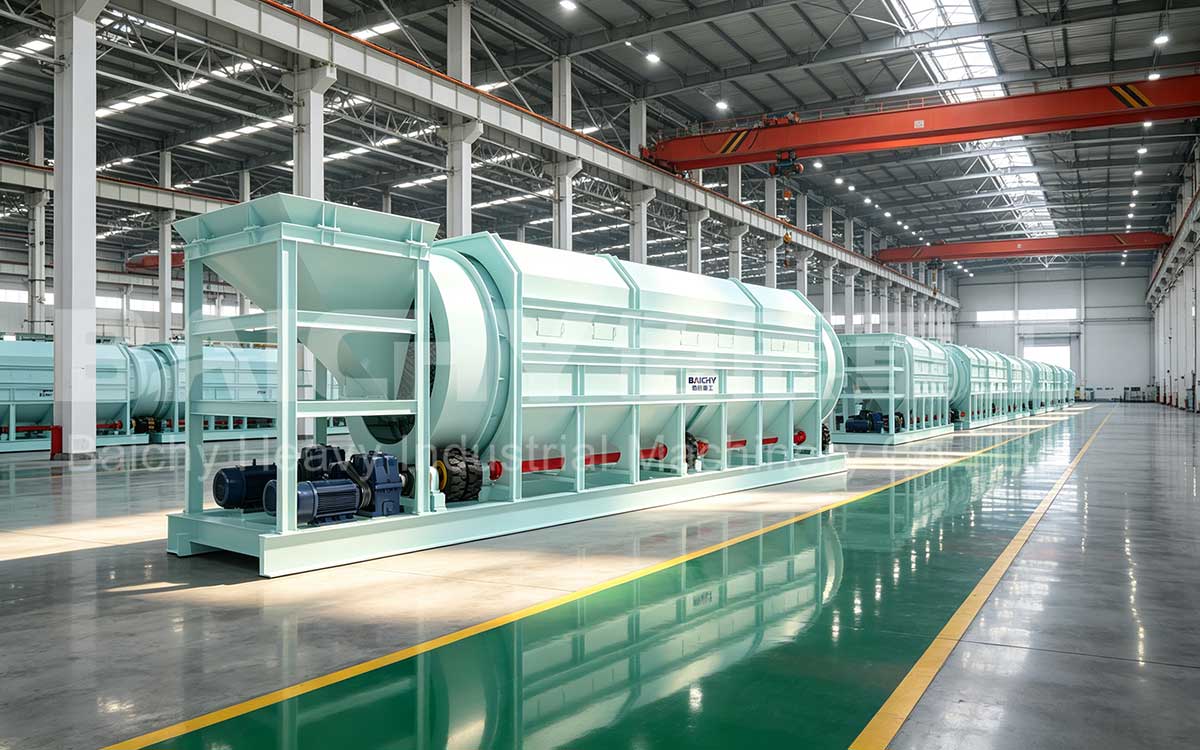
GTS Trommel Screen
1. Why can trommel screens handle materials that defeat vibrating screens?
Vibrating screens rely on high-frequency excitation forces to make material "jump" across the screen surface. When dealing with high-moisture materials (such as river sand, humus, or mineral sludge) or high-fiber content (such as compost or municipal waste), the material tends to clump and paste over the mesh, causing the vibrating screen to fail instantly.
Trommel screens solve this problem using a completely different physical mechanism:
• Tumbling instead of jumping: Material inside the rotating drum is lifted, undergoes free-fall, and scatters in a cascading motion. With every tumble, material particles are rearranged, ensuring fresh surfaces constantly contact the mesh—preventing the formation of a "caked layer."
• Self-cleaning effect: During rotation, material lodged in the apertures falls out naturally due to gravity. When combined with optional rotary brushes or elastic cleaning balls, the screen remains clog-free even during continuous 24-hour operation.
• High moisture tolerance: For river sand, mineral sludge, and compost with moisture levels between 10% and 25%, the trommel screen’s throughput remains virtually unaffected—overcoming a well-known weakness of linear and circular vibrating screens.
2. Translating benefits: What do the trommel screen's technical specifications mean for your profits?
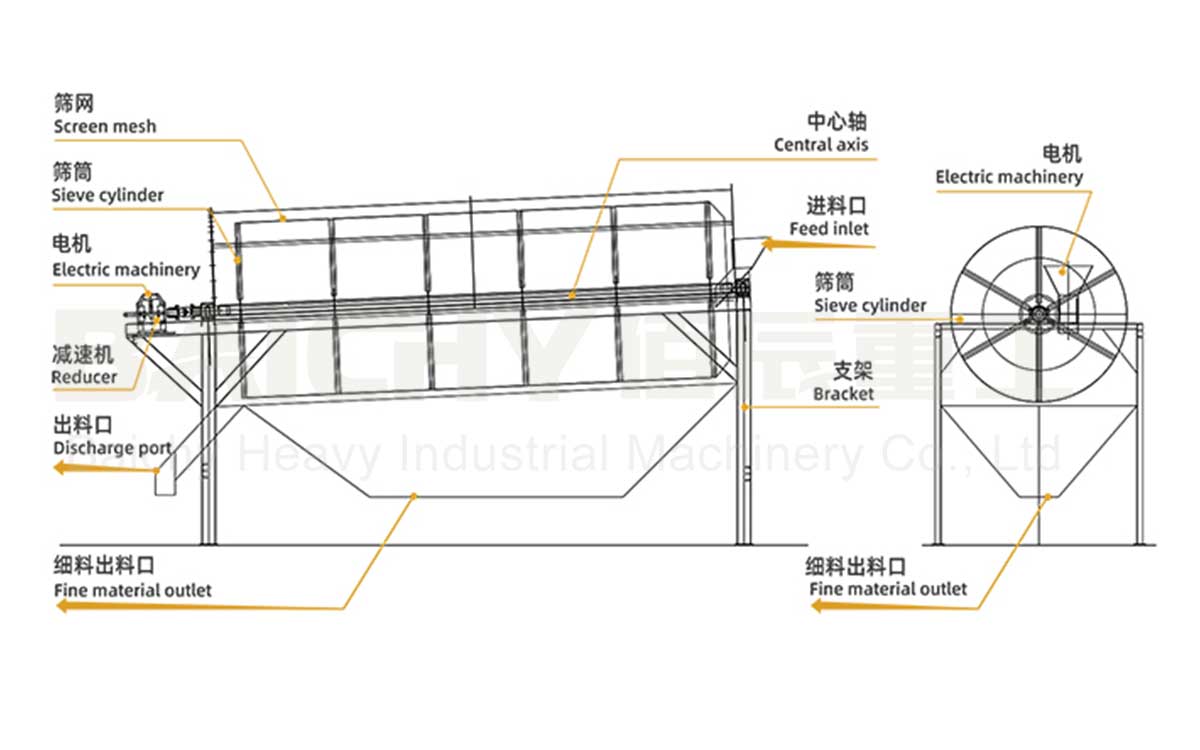
Structural diagram of the trommel screen
| Core Technology / Feature | Benefits (What this means for mine owners/producers) |
| Rotary tumbling screening (non-vibrating) | Clog-free operation: Sticky or wet materials do not blind the screen mesh, eliminating downtime for cleaning and associated maintenance costs. |
| Fully enclosed dust cover (standard) | Environmental compliance & zero fines: No dust leakage ensures compliance with local environmental regulations; operators are no longer exposed to silica dust. |
| Interchangeable screen plates (2–80mm) | Versatility: A single machine can screen sand, ore, compost, or waste simply by swapping screen plates, maximizing asset utilization. |
| Integrated through-shaft structure | Low noise & vibration-free: No special foundation reinforcement required; operating noise ≤75dB, making it suitable for operations near residential areas. |
| Modular drum design | Quick replacement: The screen drum can be replaced as a single unit; downtime is under 2 hours per instance, ensuring >95% annual production line availability. |
| Large maximum feed size (≤300mm) | Eliminates pre-screening: Most raw ore or construction waste can be fed directly without upstream pre-screening equipment, saving on CAPEX. |
3. Performance Specifications: Baichy GTS Series Trommel Screen
| Model | Drum Diameter (mm) | Drum Length (mm) | Mesh Size Range (mm) | Max. Feed Size (mm) | Processing Capacity (t/h) | Power (kW) | Application Scenario |
| GTS0618 | 600 | 1800 | 2–80 | <300 | 0.5–2 | 1.1 | Laboratory / Small-scale gold sand screening |
| GTS0824 | 800 | 2400 | 2-80 | <300 | 2-20 | 2.2 | Compost screening / Small-scale sand mining |
| GTS1030 | 1000 | 3000 | 2-80 | <300 | 20-100 | 4 | River sand grading / Construction waste aggregate separation |
| GTS1236 | 1200 | 3600 | 2-80 | <300 | 30-120 | 7.5 | Medium-sized sand plant / Coal mine classification |
| GTS1545 ⭐ | 1500 | 4500 | 2-80 | <300 | 60-280 | 11 | Flagship model: Standard for sand & gravel aggregates / Gold mine overburden stripping |
| GTS1860 | 1800 | 6000 | 2-80 | <300 | 80-350 | 22 | Large-scale mining / C&D waste processing line |
Processing capacity is based on sand and gravel material with a bulk density of 1.6 t/m³. Actual output varies depending on material density, moisture content, and clay content.
4. Six Core Application Scenarios
| Industry | Typical Materials | Recommended Models | Screening Objective |
| Sand & Aggregate | River sand, manufactured sand, pebbles | GTS1030 / GTS1545 | Size grading: 0–5mm / 5–20mm / 20–40mm |
| Metal Mining | Gold mine overburden, oxidized copper ore | GTS1545 / GTS1860 | Pre-screening before washing; removing waste rock to improve feed grade |
| Coal/Coking | Raw coal, coke | GTS1236 / GTS1545 | Sorting by size into clean coal, middlings, and gangue |
| Construction Waste Recycling | C&D debris, crushed brick/concrete | GTS1545 / GTS1860 | Separating rebar fragments from aggregates; increasing recycled aggregate purity |
| Compost/Organic Fertilizer | Mature compost, sludge compost | GTS0824 / GTS1030 | Screening out large, undecomposed chunks; producing uniform commercial fertilizer |
| Municipal Solid Waste (MSW) Sorting | Mixed MSW | GTS1860 | Sorting by size after bag breaking; separating organics from recyclables |
5. Avoiding Pitfalls: 4 Key Questions to Clarify Before Buying a Trommel Screen
✅ Best Practices:
1. Determine material moisture content before selecting equipment: For materials with >15% moisture, a trommel screen is the preferred choice; for dry materials with <5% moisture, vibrating screens still hold an advantage. If the feed material's moisture content fluctuates significantly, a trommel screen is the safest option.
2. Smaller screen apertures are not always better: The design aperture must be 1.1–1.2 times the upper limit of the target particle size. For example, to separate fines smaller than 5mm, the aperture should be around 6mm; otherwise, the throughput rate will drop sharply.
3. Tilt angle determines capacity and precision: Trommel screens typically operate at an inclination angle of 3°–7°. Steeper inclination angle → faster material flow → higher capacity but reduced screening precision. Baichy sets the default factory angle to 5°, which is adjustable on-site.
4. Consider multi-layer screening drums: If a production line requires separating 3–4 different specifications simultaneously, a multi-layer (2–3 layer) trommel screen can accomplish this in a single step, eliminating the need to connect multiple units in series.
❌ Beware of low-priced, inferior products:
1. Insufficient screen plate thickness: Some low-cost products use thin steel plates (2–3mm) for the drum; under typical sand and gravel operating conditions, these wear through in just three months. Baichy GTS series screens utilize Q345B wear-resistant steel plates reinforced with localized hard-facing (weld overlay), offering a design service life of ≥12 months.
2. Lack of dust covers: Open-style trommel screens generate clouds of dust—a recipe for trouble given today's strict environmental regulations. The entire Baichy GTS series comes standard with sealed dust covers.
3. Cutting corners on the drive system: The gearbox is the heart of a trommel screen. Baichy uses cycloidal pin-wheel reducers with variable frequency drives (VFD) to ensure smooth startup and overload protection, effectively eliminating the common gear-stripping issues found in low-end domestic gearboxes.
CTA:
WhatsApp Online
📞 WhatsApp: +86-15093222637
Get your free trommel screen configuration proposal within 24 hours.
FAQ:
Q1: Trommel screen vs. vibrating screen—which one should I choose for my operation?
A: The criterion is simple: look at the material's moisture content. For dry sand or crushed stone with <5% moisture, vibrating screens offer high speed, a compact footprint, and lower costs. If moisture exceeds 10%, or if the material contains clay or fibers or tends to clump/stick together, the trommel screen is the only option that avoids frequent screen blinding (clogging). If you are unsure about fluctuations in the feed material's moisture content, the trommel screen is the safer choice.
Q2: What is the actual capacity of the GTS1545?
Why does the spec sheet list such a wide range (60–280 t/h)? A: Throughput capacity depends on three variables: material density (sand at 1.6 t/m³ vs. ore at 2.8 t/m³), moisture content (dry material flows faster than wet material), and screen aperture size (throughput is much higher with 10mm apertures than with 3mm ones). Empirical data shows that when screening river sand with 8% moisture content using a 10mm aperture, the GTS1545 model delivers a stable output of 120–160 t/h.
Q3: What are the wear parts for the trommel screen? Are operating costs high?
A: The primary wear parts are the screen plates/mesh (lifespan of 8–18 months, depending on material abrasiveness) and support rollers (lifespan of 12–24 months). Compared to the exciters, springs, and screens found in vibrating screens, trommel screens have fewer wear parts and lower unit costs. Taking the GTS1545 as an example, the annual budget for wear part replacement is approximately 1,500–3,000—far lower than that of a vibrating screen with equivalent capacity.
Q4: What happens if the trommel screen apertures get clogged?
A: The trommel screen is designed with inherent self-cleaning capabilities; as material tumbles, gravity causes it to fall away naturally. For extremely sticky materials, Baichy offers two optional solutions:
① Rotating steel wire brush—installed on the outside of the screen drum, it continuously sweeps the apertures as the drum rotates;
② Elastic cleaning balls—these bounce and impact the interior of the screen drum, dislodging material stuck in the apertures. Both options enable continuous, unattended operation.
Q5: How many material sizes can a single trommel screen separate simultaneously?
A: A single-layer trommel screen separates material into two fractions (oversize and undersize). Baichy can customize the unit with a 2–3 layer drum structure to separate 3–4 different particle size specifications in a single pass. For example, with a 3-layer configuration—0–5mm fine sand, 5–20mm medium aggregate, 20–40mm coarse aggregate, and >40mm oversized material—a single production line handles the entire classification process.
Q6: Will the fully enclosed structure affect heat dissipation or maintenance?
A: No, it won't. The dust cover is equipped with multiple quick-opening access doors, so routine inspections and screen panel replacements can be performed without removing the entire cover. The top of the cover features a breather vent with a filter element to balance internal air pressure while capturing dust. The motor and gearbox are located outside the cover, ensuring heat dissipation is unaffected.
> "Pre-screening with a jaw crusher" → Jaw Crusher
> "Complete configuration of a sand and gravel aggregate production line" → Sand and Aggregate Solutions
> "Pre-screening of gold ore prior to washing" → Gold Ore Processing
> "Construction waste recycling" → Construction and Demolition Waste Recycling