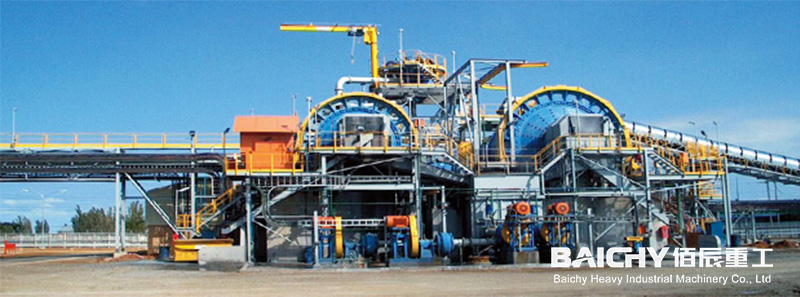
Ball Mill Mineral Processing Production Line
At the core of mining extraction and mineral processing operations, mining mills bear the critical responsibility of bridging the gap between crushing and separation. They constitute the decisive link in unlocking mineral value and achieving the efficient utilization of resources. Far from being a singular piece of equipment, the mining mill represents a Perse family of grinding devices—each category possessing a unique design philosophy and specialized area of expertise.
Faced with such a wide array of options, precisely matching the specific characteristics of the ore with production objectives becomes a critical decision that mineral processing plant managers must carefully deliberate. This article systematically outlines the lineage of mainstream mining mills, analyzes their distinct characteristics and applicable scenarios, and provides a clear, logical framework for equipment selection—empowering you to identify and secure the core engine that will maximize your mine's economic returns.
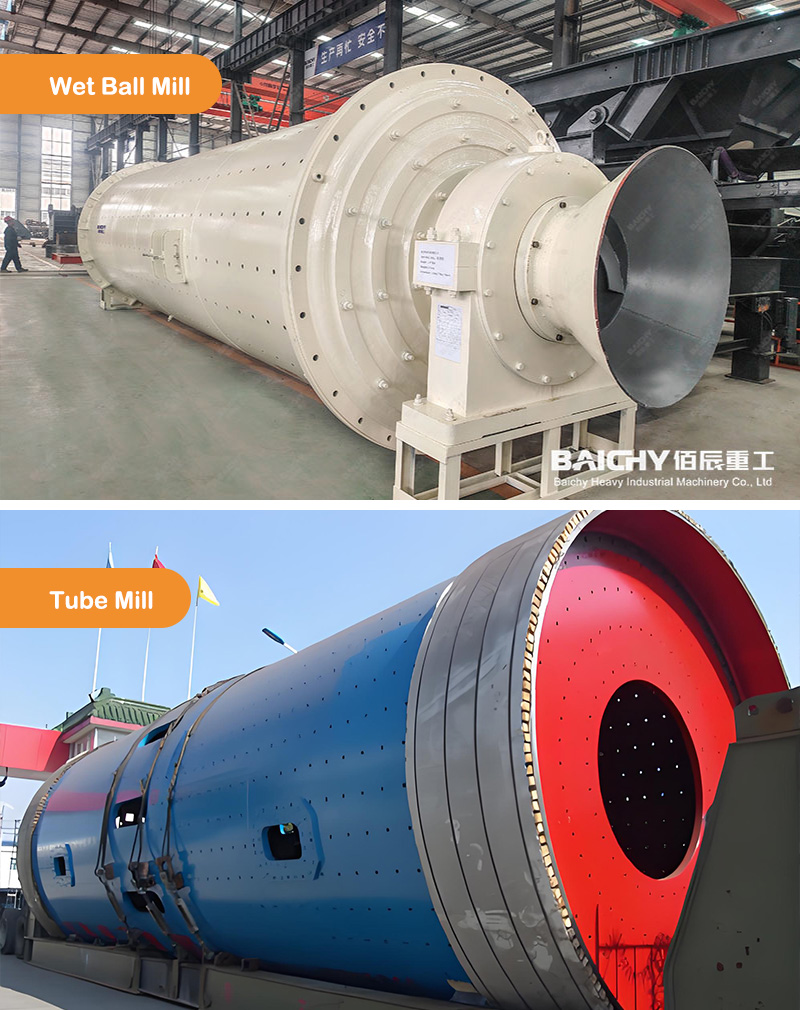
Wet Ball Mill and Tube Mill
Mining Mills: An Overview—From Coarse Crushing to Fine Grinding
A mining mill is a piece of heavy-duty industrial equipment designed for the fine and ultra-fine grinding of ore. It utilizes grinding media—such as steel balls, steel rods, or the ore itself—and harnesses the impact and abrasion forces generated by the rotation of a cylindrical drum to achieve this objective. Its primary goal is to further pulverize ore received from the crushing stage (typically with a particle size of 25 mm or less) down to 0.074 mm (200 mesh) or even finer, thereby ensuring the complete liberation of valuable minerals from the gangue (waste rock).
Based on the type of grinding media employed and the method of ore discharge, mainstream mining mills are primarily categorized into the following types:
| Type | Grinding Media | Feed Particle Size | Discharge Particle Size | Key Features and Applications |
| Ball Mill | Steel Balls | ≤ 25 mm | 0.074 – 0.4 mm | The most widely used type; suitable for ores of varying hardness; capable of both dry and wet grinding; delivers excellent fine-grinding results. |
| Rod Mill | Steel Rods | ≤ 50 mm | 0.833 – 3 mm | Produces a uniform particle size distribution with minimal over-grinding (generation of excessive fines); frequently used for the pre-grinding of rare metal ores—such as tungsten and tin—prior to gravity separation or magnetic separation processes. |
| Autogenous / Semi-Autogenous Mills | Ore itself + a small quantity of large steel balls | ≤300 mm | 0.074–0.4 mm | Utilizes the ore itself as the grinding medium; simplifies the process and reduces steel consumption; suitable for large-scale open-pit mines. |
| Vertical Mills | Grinding rollers and grinding table | ≤50 mm | 0.074–0.2 mm | Low energy consumption; small footprint; integrates grinding, drying, and classification functions; commonly used in non-metallic mineral processing. |
Broad Application Scenarios: Beyond Metallic Ores
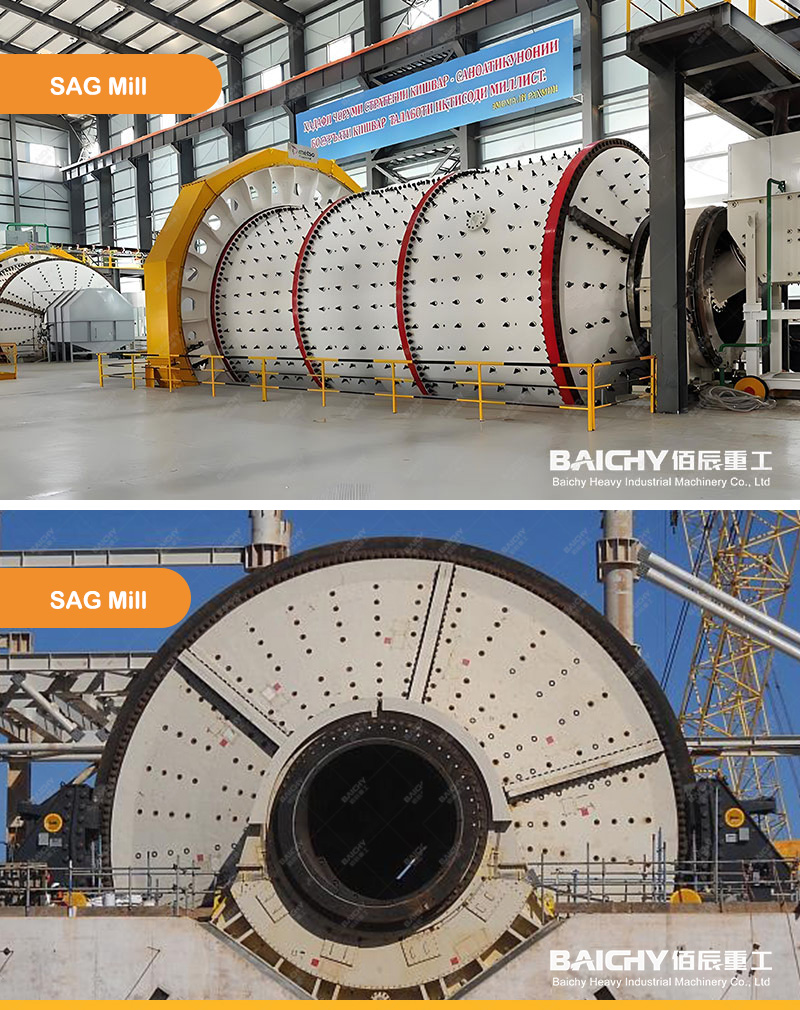
SAG Mill
The application of modern mining mills has expanded across a wide spectrum of mineral processing scenarios:
• Ferrous and Non-ferrous Mineral Beneficiation: This represents the most classic application of mining mills. In beneficiation plants for iron, copper, gold, lead-zinc, and other ores, mills serve as indispensable preparatory equipment prior to flotation or magnetic separation operations. Their grinding performance directly determines the degree of mineral liberation, thereby influencing recovery rates.
• Deep Processing of Non-metallic Minerals: For non-metallic minerals such as limestone, quartz, kaolin, and barite, mining mills are required to grind the materials into powders of varying fineness for use in industries such as papermaking, coatings, plastics, and ceramics. In these applications, there are heightened requirements regarding product whiteness, purity, and particle size distribution.
• Cement and Building Materials Production: In cement production lines, large-scale ball mills or vertical mills serve as the core machinery for grinding raw meal and clinker. Their operational stability directly impacts the overall production output and energy consumption of the entire line.
• Metallurgy, Chemicals, and Solid Waste Treatment: Mining mills play a pivotal role across various sectors—from grinding slag in the metallurgical industry and pulverizing phosphate rock in the chemical industry, to processing industrial solid waste in the field of environmental protection.
Why Choose Our Mining Mills? An Analysis of Core Advantages
The mining mills we design are not merely pieces of equipment; they represent a comprehensive system solution dedicated to creating value for our clients. Our key advantages include:
1. High-Efficiency and Energy-Saving Design: By employing advanced simulation technologies to optimize shell rotation speed, liner profiles, and grinding media ratios, we ensure that energy is channeled maximally into the grinding process rather than being wasted on unnecessary wear. This results in energy savings of 15% to 30% compared to traditional equipment.
2. Exceptional Reliability: Key components—such as the girth gear and main shaft bearings—are crafted from high-quality materials and undergo precision machining. The mill shell is fabricated from high-strength steel plates and validated through Finite Element Analysis (FEA) to ensure stability during prolonged, heavy-load operations, thereby significantly reducing downtime caused by mechanical failures.
3. Intelligent Control and O&M: The system can integrate online monitoring modules for parameters such as mill load, lubricant temperature, and vibration. This enables data visualization and intelligent control capabilities, allowing for the optimization of grinding pulp density and feed rates to ensure stable production while providing robust support for predictive maintenance strategies.
4. Flexible Customization Services: We offer tailored design and configuration solutions—ranging from inPidual machines to complete grinding circuits—based on specific client requirements, including ore characteristics (hardness, particle size, moisture content), production capacity targets, and site-specific conditions.
Success Story
A large-scale iron ore beneficiation plant was previously utilizing an aging ball mill, which suffered from low hourly throughput and high energy consumption. We replaced their existing unit with a new Φ4.5 × 6.5-meter energy-efficient ball mill, equipped with innovative corrugated liners and high-efficiency double-layer diaphragm plates. Following this upgrade, while maintaining the same power consumption level, the hourly throughput increased by 22%. Furthermore, the passing rate for the target particle size (-200 mesh) improved from 88% to 92%. These improvements resulted in annual electricity savings exceeding one million RMB, significantly shortening the client's return-on-investment period.
Our Featured Grinding Equipment Recommendations
Based on the advantages outlined above, we highly recommend the following high-performance mining mills:
1. MQG/Y Series Energy-Efficient Grate/Overflow Ball Mills: Our flagship product line, featuring a comprehensive range of specifications (from small laboratory-scale mills to large-scale units exceeding Φ6 meters). These mills utilize mature technology and are ideally suited for the fine grinding of most metallic ores, offering exceptional cost-effectiveness.
2. MZS Series Autogenous/Semi-Autogenous Mills (AG/SAG Mills): Designed specifically for large-scale open-pit mines, these mills are capable of processing coarse run-of-mine (ROM) ore. They streamline the beneficiation process while reducing both capital investment and operational costs, making them the preferred choice for modern beneficiation plants with annual processing capacities in the tens of millions of tons.
3. LUM Series Ultrafine Vertical Mills: Specifically designed for the deep processing of non-metallic minerals and the ultrafine grinding of industrial solid waste, these mills integrate grinding, drying, and classifying functions into a single unit. The system's power consumption is 30%–50% lower than that of traditional ball mill systems, and the fineness of the final product can be adjusted with great flexibility.
Frequently Asked Questions (FAQ)
Q1: How do I select the appropriate mill type and specifications for my mine?
A1: This requires a comprehensive assessment of multiple factors, primarily including: the grindability and hardness of the ore, the required particle sizes for both the feed and the final product, the designed production capacity, the investment budget, and the subsequent mineral processing methods. We recommend that you provide detailed ore samples and processing requirements; our team of engineers will then conduct professional grinding tests and design a customized solution for you.
Q2: How can I control the consumption of grinding media—such as steel balls—during mill operation?
A2: Media consumption constitutes one of the major operating costs. Control methods include:
① Selecting high-hardness, wear-resistant alloy steel balls or rods;
② Replenishing the grinding media periodically and scientifically based on mill operating data (such as current load and noise levels) to maintain an optimal size distribution; and
③ Utilizing liners with superior wear resistance to minimize abnormal wear between the grinding media and the liners.
Q3: Do your mills support automation and remote monitoring capabilities?
A3: Yes. All of our modern mining mills can be seamlessly integrated into automated control systems. We offer online monitoring modules that track key parameters—such as feed rate, grinding pulp density, bearing temperature, vibration levels, and lubrication pressure—and utilize SCADA systems or cloud-based platforms to enable remote monitoring, data analysis, and fault prediction, thereby facilitating the development of intelligent mineral processing plants.