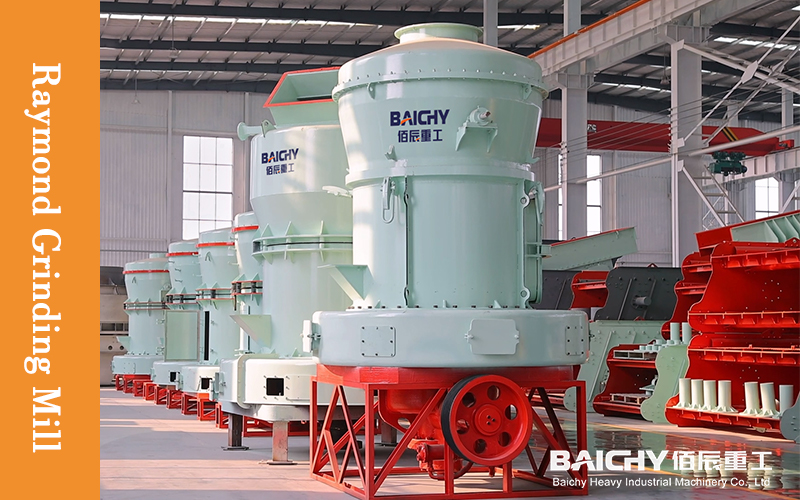
Raymond Mill
The Raymond Roller Mill—often referred to in Chinese as the "Leimeng Mill" or "Suspended Roller Grinding Mill"—is a classic piece of equipment used in the mineral processing, building materials, and chemical industries for producing fine powders ranging from 80 to 600 mesh. Its core appeal lies in the ingenious combination of mechanical grinding and airflow classification, creating a highly efficient closed-circuit circulation system.
I. Core Structure: Vertical Layout and the "Four Key Components"
To understand its working principle, one must first identify its key components (using a typical "R-type" Raymond Mill as an example):
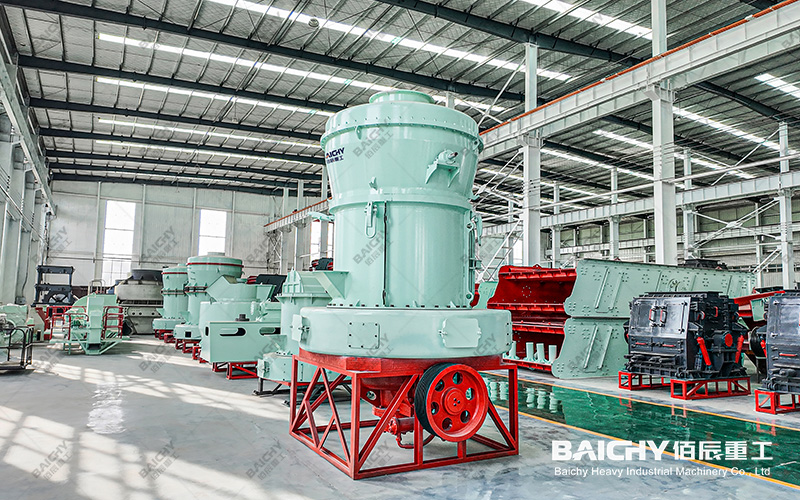
1. Main Unit (Grinding Core): Features a vertical structure containing grinding rollers (typically 2 to 6), a grinding ring (liner), a plum-blossom frame (crossbeam), and scraper blades. The grinding rollers are pressed tightly against the grinding ring via a pressure mechanism; this is where the actual pulverization takes place.
2. Classifier (The "Grading Brain"): Located above the main unit, it consists of an impeller driven by a variable-speed motor. It determines the fineness of the finished product, effectively acting as the entire system's "Quality Inspector."
3. Blower (Airflow Power Source): Provides the motive force for the system's circulation, blowing the pulverized material upward and conveying it to the classification stage.
4. Cyclone Separator (Product Collector): Utilizes centrifugal force to separate the qualified fine powder from the airflow.
5. Auxiliary Systems: Feeders, bucket elevators, dust collectors, etc.
II. Working Process: A Four-Step Closed-Loop Grinding Cycle
The operation of the Raymond Roller Mill follows a typical closed-loop process comprising four stages: "Grinding – Air Classification – Collection – Circulation."
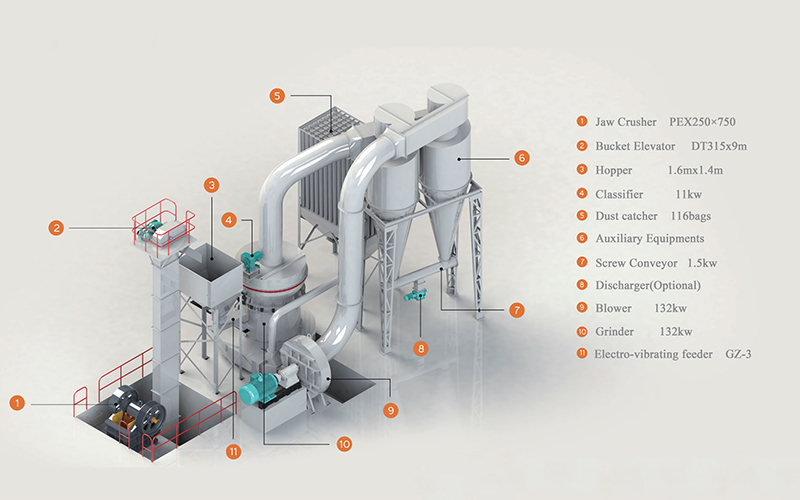
Raymond Mill Process Flow Diagram
Step 1: Feeding and Scooping
After being crushed and elevated, the lump-form raw material is fed uniformly into the grinding chamber of the main unit via a feeder. Rotating scraper blades scoop up the material and toss it into the grinding zone situated between the grinding rollers and the grinding ring.
Step 2: Centrifugal Grinding (The Core Pulverization)
This constitutes the most fundamental physical action within the Raymond Roller Mill. The grinding rollers are suspended from the plum-blossom frame and, driven by the transmission mechanism, perform the following movements:
- Orbital Motion: The grinding rollers revolve around the central axis of the mill.
- Rotational Motion: Driven by friction, the grinding rollers rotate around their own respective axes. - Centrifugal Compaction: Driven by centrifugal force, the grinding rollers swing outward, pressing firmly against the grinding ring. The raw material is crushed and sheared into powder within the narrow gap between the rollers and the ring.
Step 3: Air Classification (Dynamic Screening)
The ground powder is lifted by an upward airflow generated by a blower and enters the classifier (grading impeller) located above:
- Qualified Fine Powder: Powder with a fineness finer than the preset value is carried by the airflow's drag force; it passes smoothly through the gaps in the classifier impeller and enters the downstream piping.
- Unqualified Coarse Powder: Coarse particles—whose gravitational force exceeds the airflow's drag force—are blocked and deflected back by the classifier blades, falling back into the grinding chamber for secondary grinding (recirculation).
Step 4: Product Collection and Airflow Circulation
• Collection: The airflow carrying the qualified fine powder enters a cyclone separator; under the influence of centrifugal force, the powder is thrown against the inner wall and settles downward to be discharged via the powder collector.
- Circulation: The "clean" airflow, having been separated from the powder, is drawn back into the blower through a return air duct, establishing a closed-loop circulation system. The system typically operates under negative pressure; any excess gas (containing trace amounts of dust) is purified through a bag filter before being vented, thereby ensuring environmental compliance.
III. Key Mechanisms and Advantages
1. Negative-Pressure Closed-Loop Circulation: This is the key to the Raymond mill's low dust emission and high efficiency. The airflow circulates within a closed loop—"Blower → Grinding Chamber → Classifier → Cyclone Separator → Blower"—resulting in high energy utilization efficiency and a clean workshop environment.
2. Online Fineness Adjustment: The fineness of the finished product can be precisely controlled by adjusting the rotational speed of the classifier impeller. The higher the rotational speed, the finer the classification particle size (i.e., the finer the product).
3. Laminated Crushing Effect: The method of crushing the material layer between the grinding rollers and the grinding ring consumes less energy compared to impact-based crushing and results in more uniform wear on the grinding rollers. IV. Applicable Materials and Limitations
• Applicable: Non-flammable and non-explosive materials with a Mohs hardness of ≤9.3 and a moisture content of <6%, such as limestone, calcite, barite, kaolin, gypsum, etc.
• Limitations: For materials that are highly viscous, have excessive moisture content, or are ultra-hard (e.g., silicon carbide), processing may lead to material clogging or accelerated wear of components.
Summary
The working principle of the Raymond Roller Mill can be summarized as: "Vertical Centrifugal Rolling + Dynamic Airflow Classification + Negative-Pressure Closed-Circuit Circulation." It achieves continuous, high-efficiency grinding through its mechanical structure, while utilizing an airflow system to provide real-time control over particle size. This combination makes it a timeless and versatile piece of equipment for the processing of medium-to-fine powders.
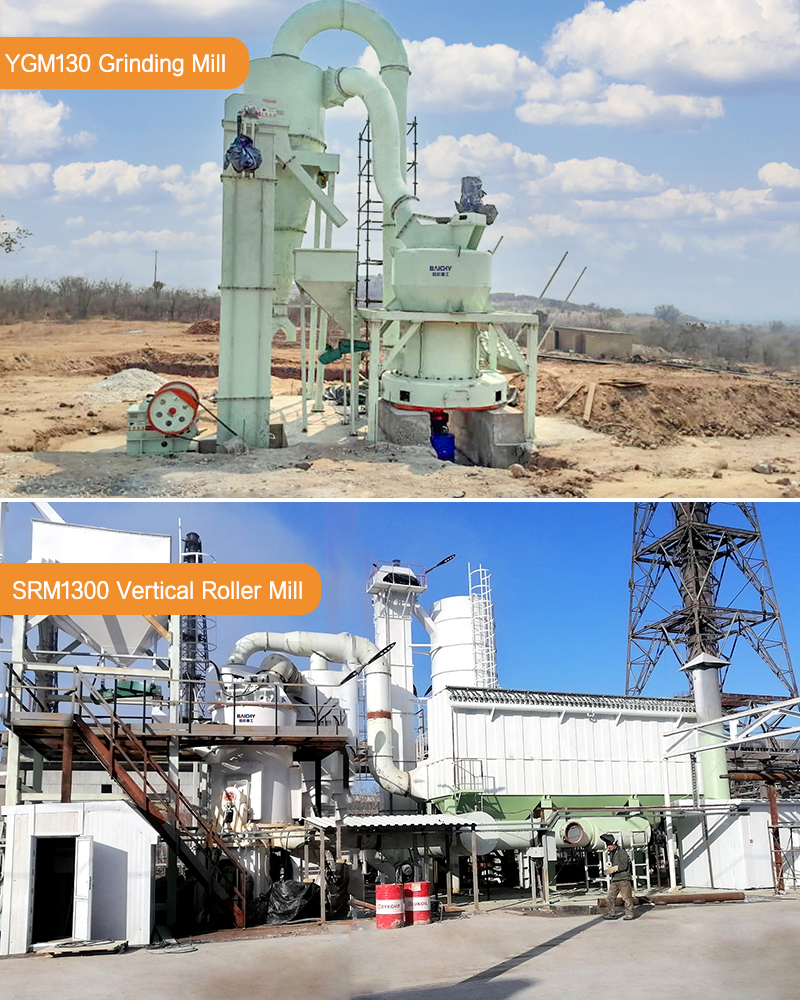
Grinding Equipment — Customer Site
Frequently Asked Questions (FAQ)
1. Can the fineness of the Raymond Mill's output be adjusted? How is it adjusted?
Yes, it can be adjusted, and the process is quite convenient. The output fineness is primarily controlled by adjusting the rotational speed of the classifier (analyzer) impeller located above the grinding chamber. The faster the impeller rotates, the greater the centrifugal force generated; consequently, only finer particles are able to pass through, resulting in a finer finished product. Conversely, reducing the rotational speed results in a coarser finished product. This adjustment can be performed without stopping the machine, offering a high degree of operational flexibility.
2. Why is there very little dust emission when the Raymond Mill is in operation? Is it truly "dust-free"?
This is attributed to its negative-pressure closed-circuit circulation system. The entire airflow ductwork operates under a slight negative pressure—driven by the system fan—which prevents dust from escaping into the surrounding environment. The airflow carrying the pulverized material circulates within a sealed pipeline; the powder is ultimately collected by a cyclone separator and a complementary pulse dust collector (such as a bag filter). The purified air is rarely discharged externally, resulting in a very clean workshop environment. While it is not *absolutely* "dust-free," the dust removal efficiency typically exceeds 99.9%.
3. Which materials are *not* suitable for processing with a Raymond Mill?
The primary materials that are unsuitable include:
• High-moisture and viscous materials: Such as wet clay. These materials tend to adhere to the grinding rollers, grinding rings, and air ducts, leading to material clogging and a reduction in production output. • Materials of Extreme Hardness: Materials with a Mohs hardness exceeding 9 (such as silicon carbide or corundum) cause abnormally rapid wear on grinding rollers and rings, resulting in prohibitively high operating costs.
• Flammable and Explosive Materials: The grinding process may generate sparks or high temperatures, thereby posing significant safety hazards.
• Highly Corrosive Materials: These require specialized anti-corrosion designs; standard-material Raymond mills are not suitable for such applications.