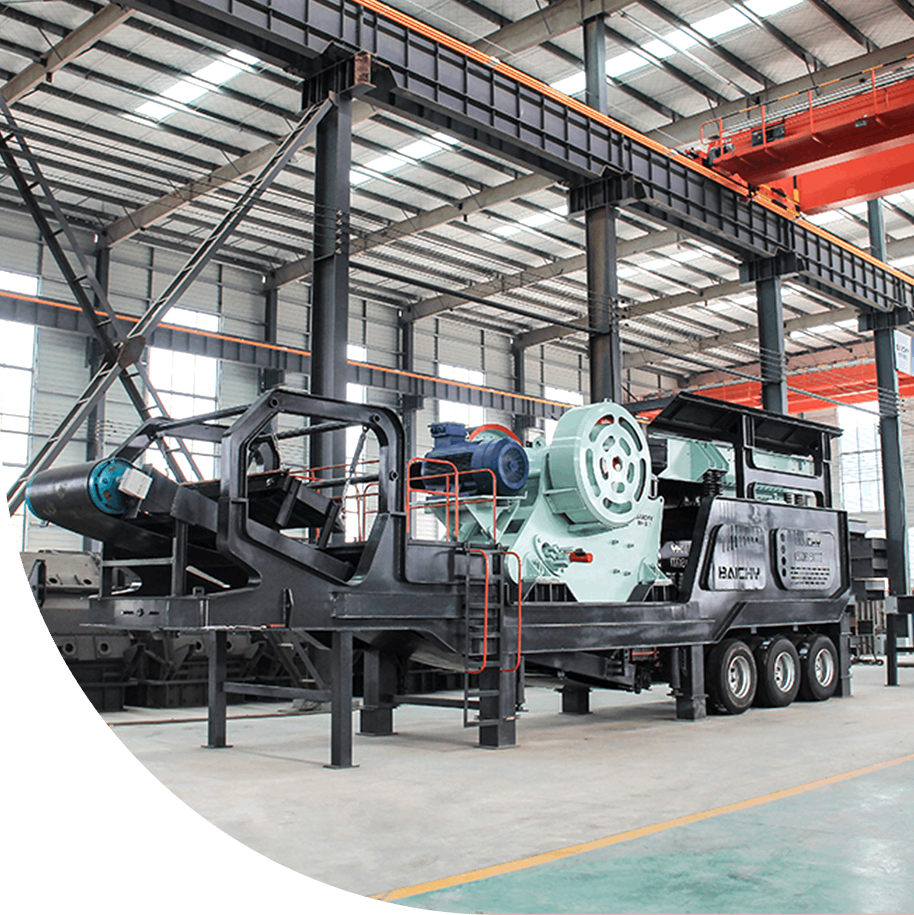

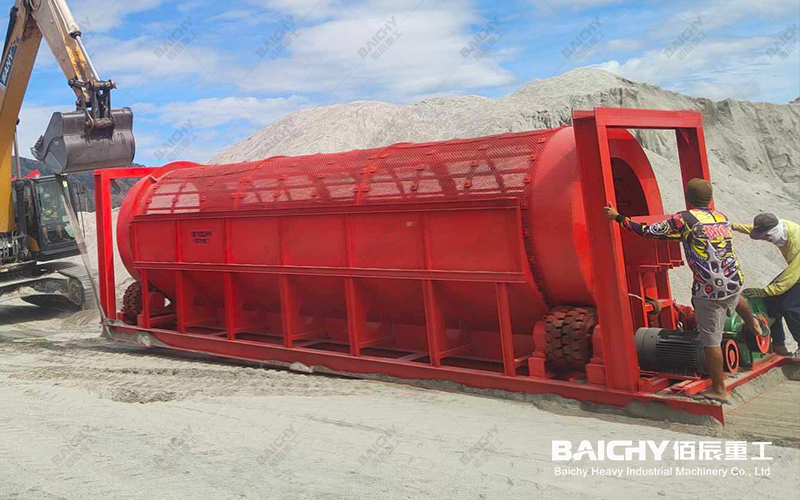
Rotary drum screen customer site
In mines, sand and gravel plants, and solid waste treatment sites, traditional vibrating screens often suffer from clogging and low screening efficiency when dealing with materials that are highly viscous, have high moisture content, or complex compositions. Baichy Heavy Industry's Trommel Screen, with its unique mechanical structure and physical sorting characteristics, has become the preferred equipment for thousands of quarries and recycling centers worldwide.
I. Baichy Heavy Industry Trommel Screen: Core Technical Parameter Table
The following data is based on Baichy Heavy Industry's standard model configuration and supports customized modifications for special working conditions (such as mobile or diesel-powered).
| Equipment Model | Cylinder Diameter/Length (mm) | Motor Power (kW) | Processing Capacity (t/h) | Maximum Feed Size (mm) | Screen Aperture Range (mm) |
| GTS-1020 | Φ1000 × 2000 | 4.0 - 5.5 | 10 - 30 | ≤ 150 | 2 - 50 |
| GTS-1230 | Φ1200 × 3000 | 7.5 - 11 | 30 - 80 | ≤ 200 | 2 - 80 |
| GTS-1545 | Φ1500 × 4500 | 11 - 15 | 80 - 150 | ≤ 250 | 5 - 100 |
| GTS-2060 | Φ2000 × 6000 | 18.5 - 30 | 150 - 350 | ≤ 300 | 5 - 150 |
II. Core Application Scenarios of Rotary Drum Screens: From Mining and Processing to Municipal Solid Waste
The advantage of rotary drum screens lies in their "inclusiveness" of materials, making them widely applicable in the following high-intensity working environments:
• Sand and gravel aggregate production: Used for pre-sorting river pebbles and mountain rocks, effectively removing mud and impurities from the material surface to ensure the cleanliness of the finished sand and gravel.
• Alluvial gold ore beneficiation: As the "vanguard" of gold ore washing lines, drum screens break up mud clumps through powerful rotation, working in conjunction with washing machines to improve gold ore recovery rates.
• Construction waste recycling: Separating concrete blocks, bricks, plastics, and soil; an indispensable sorting step in mobile crushing plants.
• Coal and coke sorting: Removing gangue from large coal pieces or grading coke according to particle size to reduce dust emissions.
• Domestic/industrial waste treatment: Used for coarse sorting of compost, humus, and recycled materials; extremely strong anti-entanglement ability.
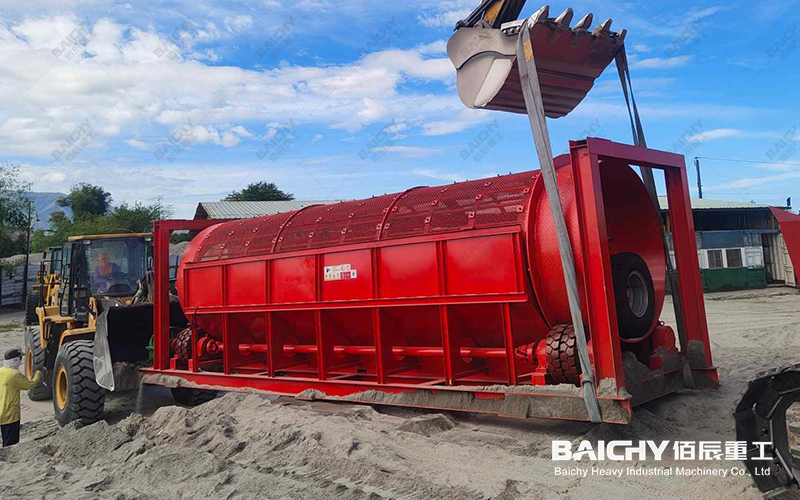
Rotary drum screen customer site
III. Technology Selection Analysis: Rotary Trommel Screen vs. Traditional Vibrating Screen
| Evaluation Dimensions | Rotary Trommel Screen | Vibrating Screen | Baichy Heavy Industry Recommendations |
| Material Moisture Content | Extremely High Adaptability (Does not clog with water-containing or sticky materials) | Average (Wet and sticky materials easily clog the screen) | Trommel screen is the first choice for sand and ore washing |
| Material Particle Shape | Flexible tumbling, friendly to lightweight materials (plastics/paper) | High-frequency impact, good for crushing and grading hard rock | | Trommel screen is the first choice for solid waste treatment |
| Sealing and Environmental Protection | Easy to fully seal, extremely low dust | Open structure, relatively large dust generation | Trommel screen is recommended for indoor operation |
| Installation Difficulty | Compact structure, balanced foundation load | Large vibration amplitude, requires high-strength concrete foundation | Trommel screen is recommended for mobile operation |
| Screening Accuracy | Medium (Suitable for coarse and pre-screwing) | High (Suitable for multi-stage fine grading) | Vibrating screen is the first choice for aggregate grading |
IV. Application Principle of Rotary Trommel Screen: Precise Rhythm of Centrifugal Force and Gravity
The working logic of the rotary trommel screen is clear and efficient. The equipment is mounted at an angle on the frame, and the motor drives the drum axis to rotate via a reducer:
• Material tumbling: Material entering the drum is carried to a certain height as the drum rotates, and then rolls down under gravity, creating continuous tumbling.
• Layered sorting: Smaller particle sizes pass through the screen mesh and fall, while larger particle sizes slide along the drum's inclination to the rear for discharge.
• Dynamic self-cleaning: Through the mutual impact of the materials themselves and an optional cleaning device, viscous materials effectively prevent clogging of the screen openings.
V. Typical Application Materials and Configuration
Recommendation Matrix "Hardcore" solutions provided for pain points in different industries.
| Target Materials | Industry Pain Points | Baichy Solution | Key Configuration Recommendations |
| River Pebbles/Mountain Rocks | High mud content, polluting downstream crushers | Pre-selection washing: Removes surface mud while sorting | Spraying system + perforated steel screen |
| Alluvial Gold Ore | Mud clumps encapsulate gold powder, low recovery rate | Powerful dispersing: Crushes mud clumps through rotational shear force | Built-in baffle plate + extended cylinder |
| Household Waste/Compost | Fiber materials entangle, difficult to sort | Anti-entanglement sorting: Low-speed rotation avoids long fiber encapsulation | Shaftless structure design + automatic cleaning brush |
| Coal/Coke | High dust levels, easily broken particles | Low-loss grading: Small drop, maintains material integrity | Fully sealed casing + variable frequency speed control drive |
VI. Why Choose Baichy?
• High capacity coverage: Supports customized capacity from 0.5 to 350 tph, meeting the needs of all scenarios from small-scale trials to large quarries.
• High-Quality Materials: The screen mesh is made of high-manganese steel woven or perforated steel plate, increasing wear resistance by 30% and significantly reducing downtime replacement costs.
• Non-Clogging Design: For wet and sticky materials, Baichy has optimized the speed ratio and screen hole arrangement, maintaining high-efficiency output even during rainy seasons.
• Modular Customization: Optional diesel engine drive, mobile chassis, or spray washing system are available, suitable for remote areas or power shortage conditions.
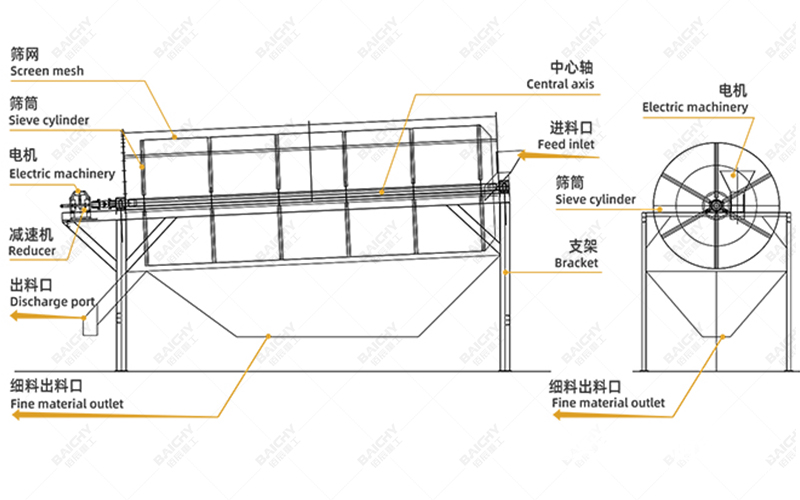
Structural diagram of a rotary drum screen
Frequently Asked Questions
Q: What is the difference between a rotary drum screen and a vibrating screen?
A: Vibrating screens rely on high-frequency vibration for separation, suitable for dry, highly mobile particles; rotary drum screens rely on rotation and material friction, offering better anti-clogging performance and washing effect when processing complex materials with high moisture content, strong viscosity, or containing mud clumps.
Q: How do I replace the screen mesh of a rotary drum screen?
A: Baichy Heavy Industry uses a segmented, detachable screen mesh design. No complete disassembly of the drum is required; worn sections can be quickly replaced simply through the side inspection door, reducing single-person operation time to less than 2 hours.
Q: What is the maximum feed particle size for Baichy Heavy Industry's trommel screen?
A: The standard model supports feed sizes up to 300mm. For extra-large boulders, we offer reinforced heavy-duty trommels to handle extreme mining impact loads.