
Introduction to the Raw Mill in a Cement Plant
Every tonne of cement starts long before it reaches the kiln. Before clinker can be burned, the limestone, clay, iron ore and silica sand that make up the mix must be reduced to a fine, homogeneous powder called raw meal. This job belongs to one machine: the raw mill. Understanding how a raw mill works is essential for anyone who operates, maintains or invests in a cement plant, because the raw mill sets the chemical consistency, the particle size and the energy cost of everything that follows.
In this guide, we explain the raw mill working principle step by step, break down the key components, compare the two dominant raw mill technologies — ball mill and vertical roller mill — and give you a practical raw mill parameter table you can benchmark against your own line.
What Is a Raw Mill in a Cement Plant?
A raw mill is the grinding unit that converts pre-crushed raw materials into fine powder with a controlled particle size distribution and a uniform chemical composition. The output, called raw meal, is fed into the preheater and rotary kiln to produce clinker. The raw mill typically operates with hot kiln exhaust gas that dries the material while it is being ground, which is why a raw mill usually combines grinding and drying in a single machine.
Three jobs are combined inside every raw mill:
- Grinding – reducing material from a feed size of up to 50 mm to a fineness where 8–12% residue remains on a 0.08 mm sieve.
- Drying – evaporating the 3–8% moisture in the feed using hot gas (180–350 °C).
- Classification – returning oversize particles to the grinding zone while sending fine particles to the separator.
How a Raw Mill Works — The Working Principle Explained
The raw mill working principle follows a continuous, closed-circuit loop. Material enters, gets ground and dried, gets classified, and oversize particles are returned. Here is the sequence:
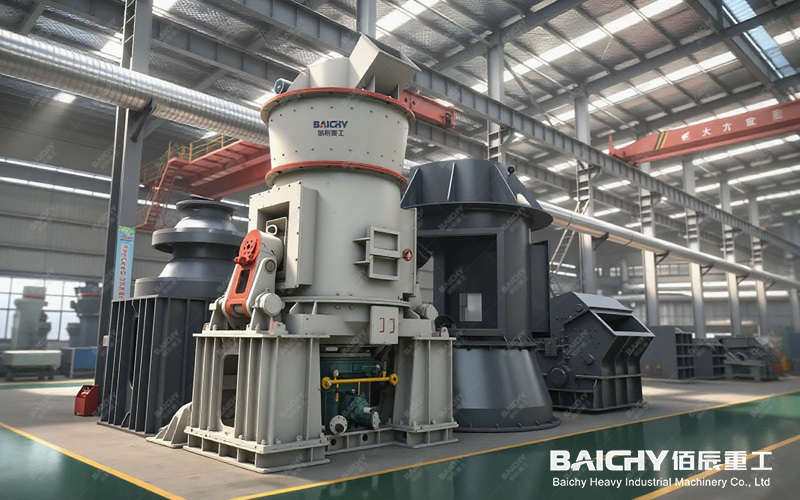
vertical roller mill
Step 1 – Proportioning and Feeding
Raw materials are stored in separate silos and blended in a controlled ratio — typically 75–85% limestone, 10–15% clay, and small amounts of iron ore and silica. A weigh feeder meters the correct mix into the raw mill inlet.
Step 2 – Grinding Zone
Inside the raw mill, the material is crushed between grinding media. In a ball mill raw mill, steel balls crush the feed as the drum rotates. In a vertical roller mill, the material is crushed between a rotating table and stationary rollers under hydraulic pressure.
Step 3 – Hot Gas Drying
Kiln exhaust gas is drawn into the raw mill at high velocity. The gas dries the moisture in the feed and simultaneously lifts the fine particles upward toward the separator — this is called air sweeping.
Step 4 – Classification and Return
In the dynamic separator at the top of the raw mill, coarse particles fall back to the grinding table, while fine powder passes to a cyclone or bag filter and is collected as finished raw meal.
Step 5 – Homogenization and Storage
The collected raw meal enters a blending silo where compressed air mixes it further, smoothing out any short-term variations before the meal is sent to the preheater.
Key Components of a Raw Mill
| Component | Function | Common Failure / Care Point |
|---|---|---|
| Feeding system (weigh feeder + rotary feeder) | Meters the correct material ratio into the raw mill | Clogging; seal wear |
| Grinding table / drum | Carries the material bed under the rollers or media | Surface wear; pitting |
| Grinding rollers or steel balls | Crushes the feed against the table | Roller tyre wear; ball breakage |
| Hydraulic system | Presses rollers onto the material bed (VRM) | Oil pressure drop; accumulator fault |
| Hot gas inlet duct | Supplies drying gas into the raw mill | Erosion; blockages |
| Dynamic separator | Classifies fine and coarse particles | Damper wear; uneven distribution |
| Cyclone / bag filter | Collects finished raw meal | Bag blinding; pressure drop |
| Air-swept discharge | Transports fines to the separator | Gas short-circuiting |
| Drive and gearbox | Rotates the table or drum | Bearing temperature rise; vibration |
Ball Mill vs Vertical Roller Mill as a Raw Mill
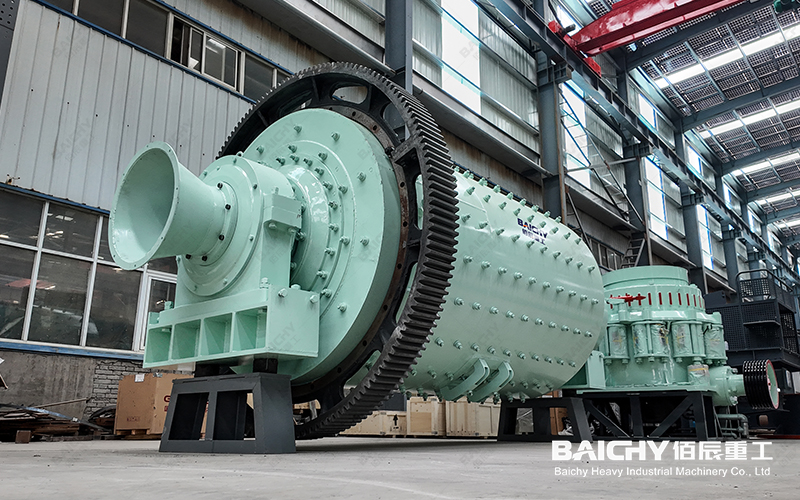
Dry Ball Mill
There are two main technologies used as a raw mill in a cement plant: the ball mill and the vertical roller mill (VRM). Each has a different raw mill working principle.
| Comparison Point | Ball Mill Raw Mill | Vertical Roller Mill (VRM) |
|---|---|---|
| Grinding action | Tumbling steel balls | Rollers pressed on a rotating table |
| Specific power | 17–25 kWh/t | 12–18 kWh/t |
| Drying capacity | Limited (needs pre-dryer) | High (can handle 15–20% moisture) |
| Footprint | Larger, horizontal layout | Compact, vertical layout |
| Fineness control | Via ball charge and classifier | Via roller pressure and table speed |
| Noise level | High | Lower |
| Maintenance | Media replenishment frequent | Fewer wear parts, longer campaigns |
| Ideal feed size | Up to 50 mm | Up to 80–100 mm |
Raw Mill Parameter Table (Reference Values for a 250–300 t/h Line)
The table below gives practical operating parameters for a modern vertical raw mill in a 5000 t/d cement plant. These are reference values and should be tuned to your specific feed and target chemistry.
| Parameter | Typical Value / Range |
|---|---|
| Rated capacity | 250–300 t/h |
| Feed moisture | 3–8% |
| Product fineness (0.08 mm sieve residue) | 8–12% |
| Product fineness (0.2 mm sieve residue) | 1.5–2.5% |
| Grinding table speed | 25–32 rpm |
| Roller hydraulic pressure | 8–12 MPa |
| Inlet gas temperature | 180–350 °C |
| Outlet gas temperature | 80–110 °C |
| Inlet gas volume | 450,000–600,000 m³/h |
| Specific power consumption | 12–18 kWh/t |
| Pressure drop across mill | 5,500–7,500 Pa |
| Separator rotor speed | 60–90 rpm |
Factors That Affect Raw Mill Performance
Operating a raw mill efficiently is about balancing four variables at once. Getting them wrong shows up directly in output rate, power and fineness.
Feed Moisture and Grindability
Wet feed increases the drying load and can collapse the material bed, causing vibration trips. Limestone grindability (Bond work index) changes the power a raw mill needs per tonne.
Fineness Target
The closer you grind, the more energy a raw mill consumes. Over-grinding raises power and lowers kiln burnability control; under-grinding leaves coarse quartz that never reacts in the kiln.
Gas Flow and Mill Outlet Temperature
Too little gas leaves moisture in the meal; too much gas lifts coarse particles and floods the separator. Most operators control the raw mill around an outlet temperature of 90–100 °C.
Roller Pressure and Table Dam Ring
Higher hydraulic pressure improves grinding but increases wear and power. Dam ring height controls the material bed thickness and is one of the first levers to adjust on a VRM-type raw mill.
The Role of the Raw Mill in the Cement Production Line
The raw mill does not work alone. It sits between the crusher and the kiln in a chain that decides final clinker quality:
Crusher → Raw material storage → Raw mill → Blending silo → Preheater → Rotary kiln → Clinker cooler → Cement mill
Because the raw mill controls both chemistry and fineness, any deviation in its output is carried directly into clinker and cement. A well-tuned raw mill improves kiln stability, reduces fuel consumption and lowers overall plant operating cost.
Raw Mill Common Problems and Solutions
- Excessive vibration (VRM): thin material bed or low gas volume — increase feed rate or adjust dam ring height.
- High fineness residue: worn grinding rollers, low hydraulic pressure — recondition tyres and reset pressure.
- Low mill outlet temperature: insufficient hot gas — open the hot gas damper.
- Separator flooding: gas velocity too high — trim separator speed and gas volume.
- Bag filter pressure rise: blinding from condensation — raise gas temperature above dew point.
FAQ
1. What is the purpose of a raw mill in a cement plant?
The raw mill grinds and dries pre-crushed limestone, clay and corrective materials into a fine, homogeneous raw meal with controlled fineness and chemistry, so that the kiln produces consistent clinker. Without the raw mill, the kiln cannot burn a stable feed.
2. How does a raw mill differ from a cement mill?
A raw mill processes raw, unburned materials and usually needs integrated hot-gas drying, targeting 8–12% residue on a 0.08 mm sieve. A cement mill grinds clinker plus gypsum after burning, runs hotter and finer, and has no drying duty. The raw mill working principle is otherwise similar.
3. Which is better: a ball mill or a vertical roller mill as a raw mill?
For new plants and high-moisture feeds, a vertical roller mill is usually preferred because it consumes less power (12–18 kWh/t vs 17–25 kWh/t), dries more effectively and has a smaller footprint. A ball mill raw mill is still competitive for very hard, low-moisture feeds and where existing media-handling infrastructure exists.
4. What is the normal fineness of raw meal leaving a raw mill?
Typical targets are 8–12% residue on a 0.08 mm sieve and 1.5–2.5% residue on a 0.2 mm sieve. The exact figure depends on raw material grindability, kiln type and the target clinker chemistry. Fineness should be tuned against kiln burnability, not maximised blindly.
5. How can I reduce the energy consumption of my raw mill?
Focus on the four levers: optimise feed moisture and grindability, hold fineness at the minimum acceptable level, maintain adequate but not excessive gas flow, and keep rollers and separator tuned. Regular monitoring of specific power (kWh/t) and pressure drop lets you catch drift before it becomes a cost.
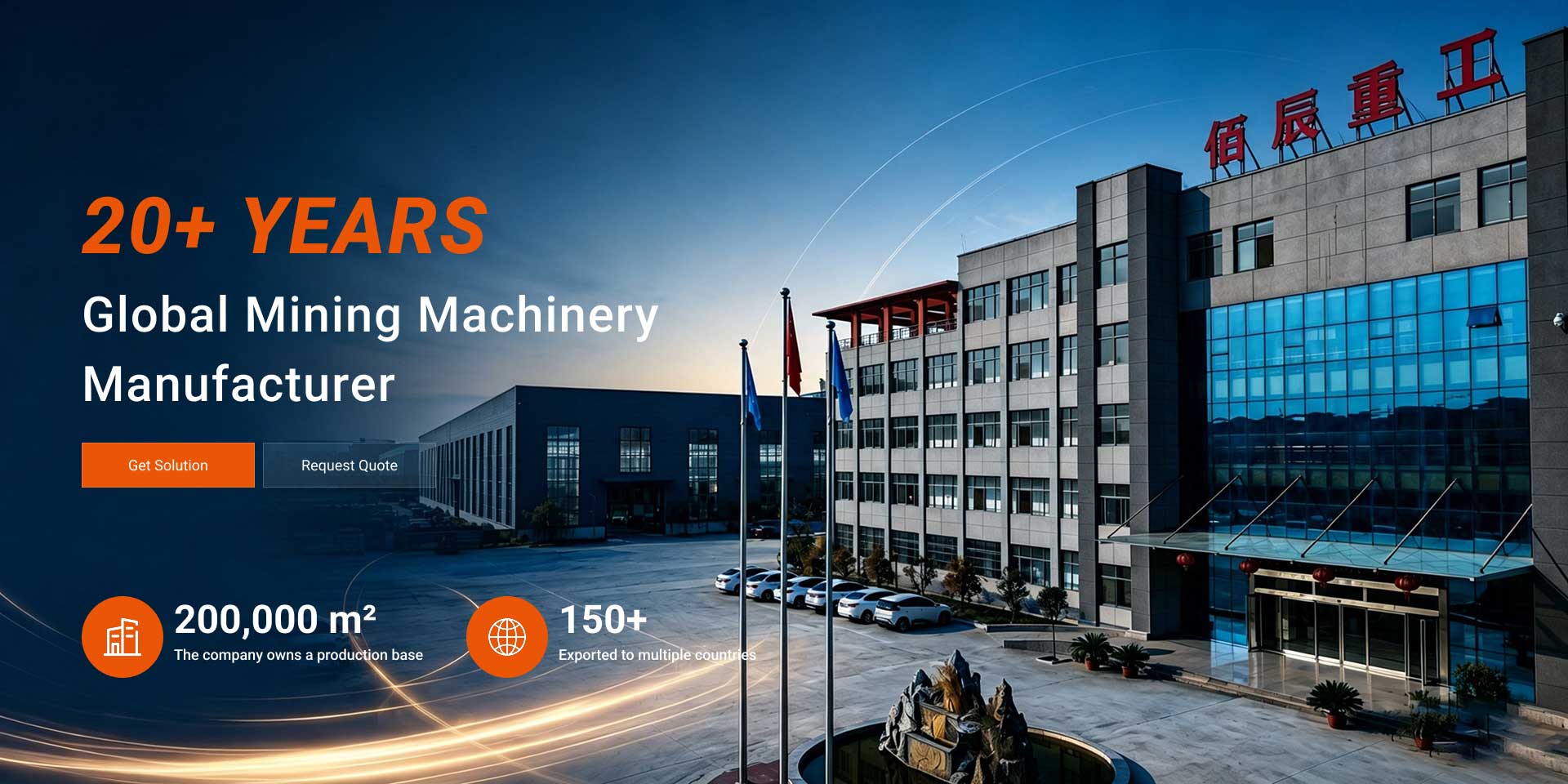
Baichy Heavy Industry
Baichy Heavy Industry is a high-tech mining equipment company integrating R&D, manufacturing, sales, and after-sales service. Focusing on crushing, grinding, and mineral processing equipment, we provide professional solutions to our customers. We are ISO9001:2015 、certified, and our products include mobile crushing palnts, crawler crushing plant, construction waste crushing plants, jaw crushers, sand making machines, cone crushers, fine crushers, grinding mills, ball mills, etc., all with reliable performance to meet diverse project needs.
Baichy Heavy Industry – Your Trusted Partner
To ensure optimal performance of your equipment, Baichy Heavy Industry offers:
- Professional on-site installation guidance
- Comprehensive operator training
- 24/7 technical support & maintenance services
Our complete after-sales service system guarantees long-term, stable operation of your machinery with minimal downtime.
Protect Your Rights – Only Use Official Channels
To avoid scams and ensure authentic support, contact us exclusively through:
• Official Website: www.baichychina.com
• WhatsApp: +8615093222637
• Email: [email protected]
Your satisfaction is our priority – expect prompt, professional service every time.
(Note: Beware of unauthorized third parties claiming to represent Baichy. Always verify through official contacts.)