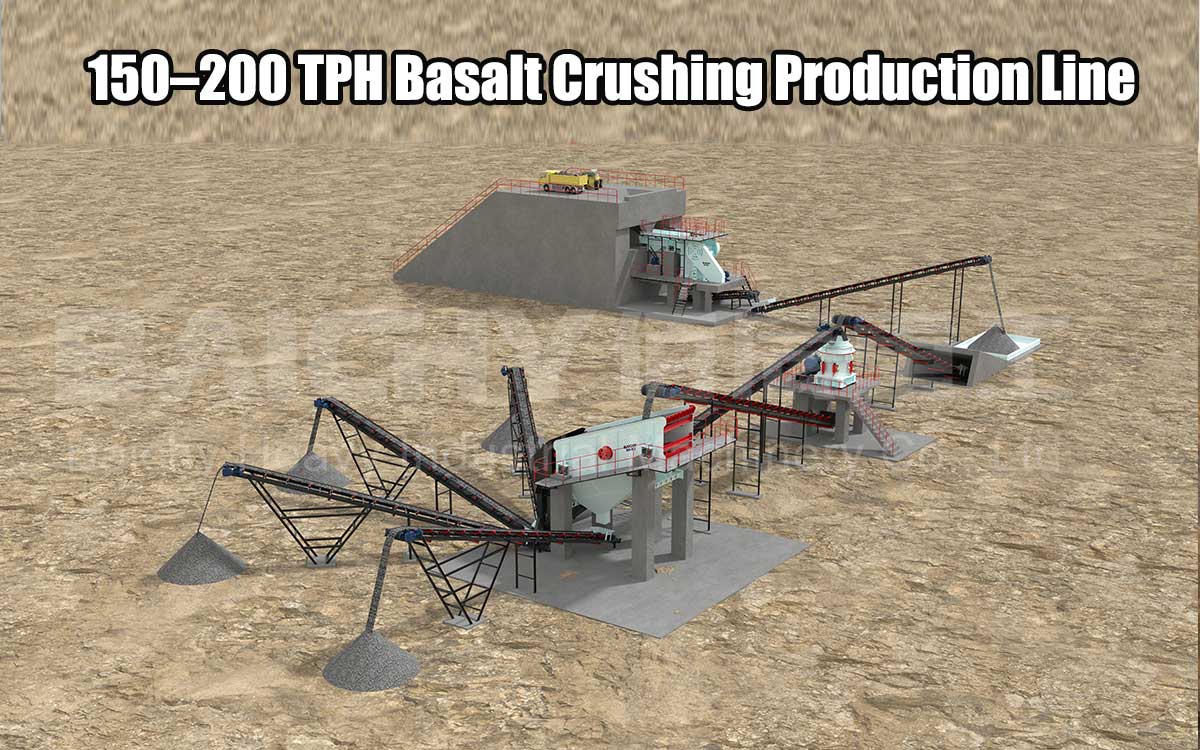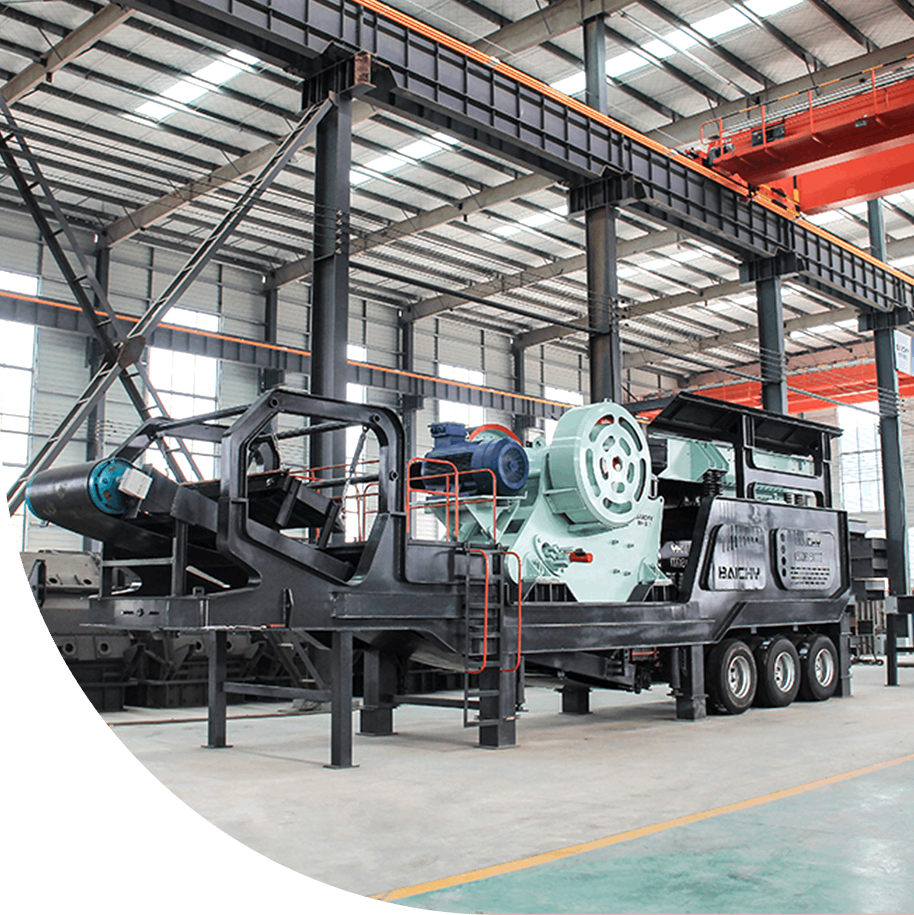

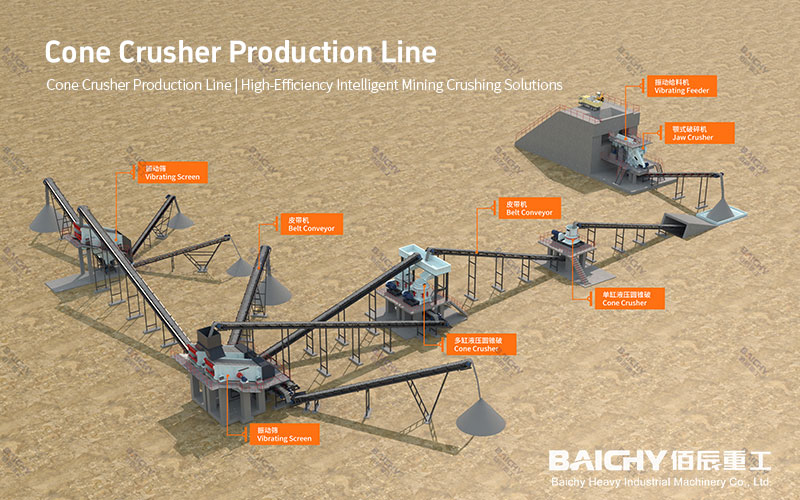
Cone Crusher Production Line — Three-Stage Crushing Production Line
Many project managers at quarries and mining sites often confuse the functional roles of primary, secondary, and tertiary crushing when planning production lines. These three stages of crushing are not merely repetitive steps; rather, each has a distinct Pision of labor, corresponding to specific feed sizes, processing objectives, and crushing equipment. Improper configuration can lead to a host of problems, including production bottlenecks, skyrocketing energy consumption, and finished product particle shapes that fail to meet quality standards. This article aims to clearly contrast the core differences between these three crushing stages, helping you quickly clarify the logic behind crushing line configurations to achieve an efficient and cost-effective production layout.
Overview: What is the Three-Stage Crushing Process?
In modern crushing processes for sand, gravel aggregates, and metal ores, "multi-stage crushing" is the standard practice for enhancing efficiency and controlling product particle size. Typically, we systematically Pide the entire crushing process—from raw mine ore to qualified finished products—into three stages based on their sequential order and specific objectives: Primary Crushing (Coarse Crushing), Secondary Crushing (Medium Crushing), and Tertiary Crushing (Fine Crushing).
Each crushing stage prepares the material for the next, progressively reducing particle size to ultimately produce a range of product specifications that meet market demands. Understanding the distinctions between primary, secondary, and tertiary crushing is the cornerstone for designing a production line that delivers high output, low energy consumption, and superior quality.
Detailed Comparison of Core Functions Across the Three Crushing Stages
Primary Crushing (Coarse Crushing): The Production Line's "First Gate"
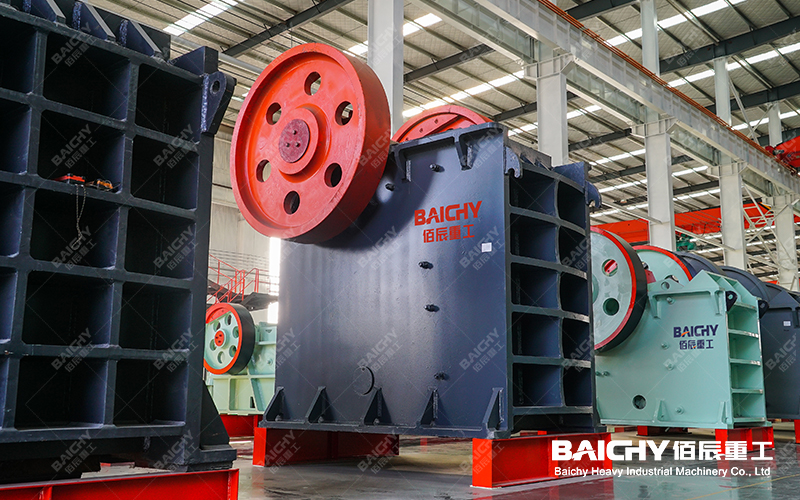
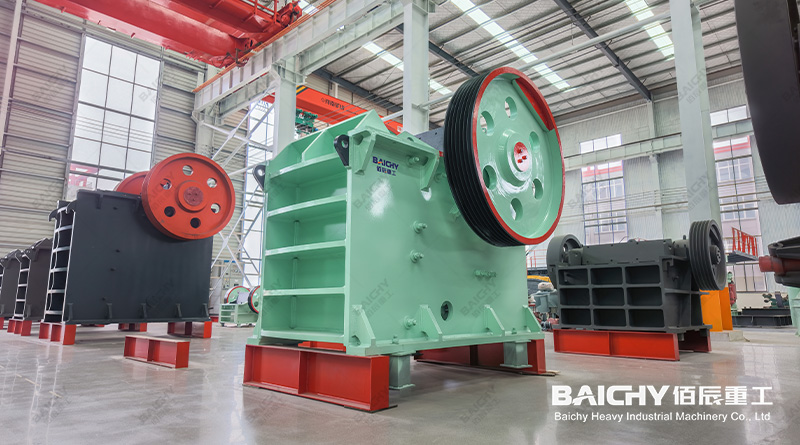
Primary Jaw Crusher
• Core Task: To process large blocks of raw ore (run-of-mine material) transported from the mining face, performing the initial reduction in size.
• Feed Size: Typically very large, ranging up to several hundred millimeters or even exceeding 1 meter.
• Discharge Size: Generally falls below 250–300 mm.
• Common Equipment: Jaw Crushers and Gyratory Crushers. These machines are renowned for their powerful crushing force and robust stability, providing a steady and uniform feed for the subsequent crushing stages.
• Positioning: The core front-end component of the production line; its processing capacity directly determines the maximum throughput of the entire system.
Secondary Crushing (Medium Crushing): The "Intermediate Processor" Bridging the Stages
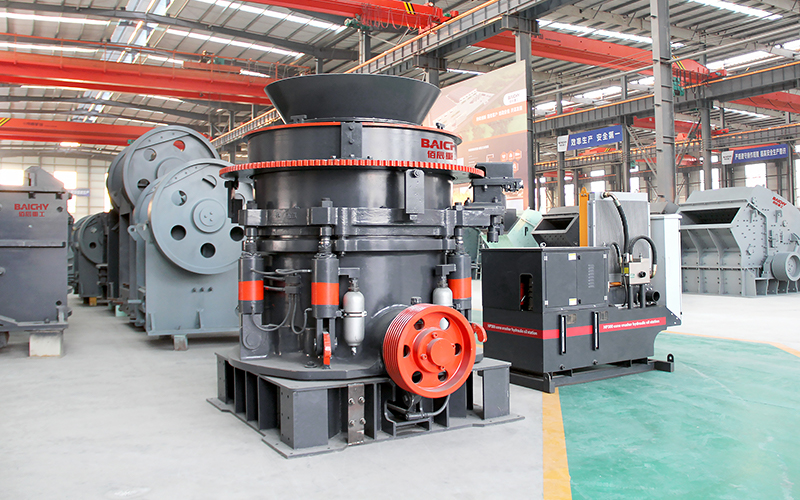
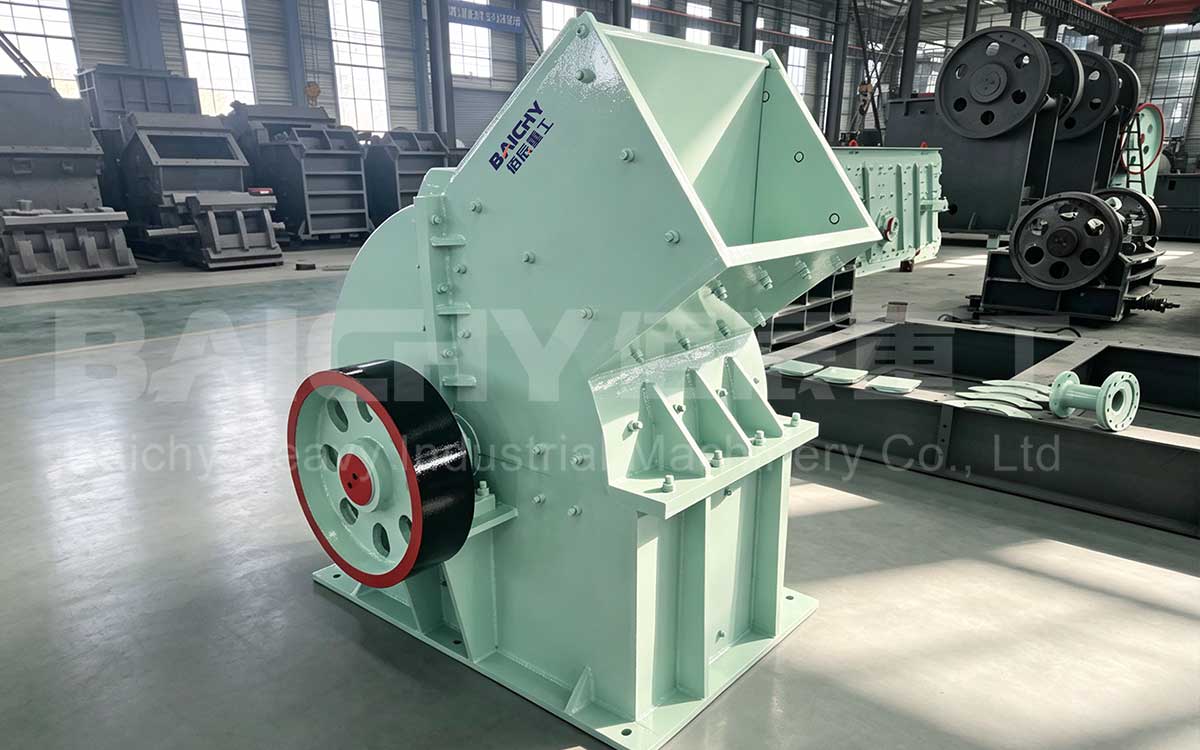
Hydraulic Cone Crusher
• Core Task: To receive the output from the primary crushing stage and perform further size reduction, preparing the material—at an appropriate particle size—for either tertiary crushing or direct screening.
• Feed Size: Typically less than 300 mm.
• Discharge Size: Controllable within a range of approximately 30–100 mm.
• Common Equipment: Cone crushers and impact crushers. Cone crushers are better suited for hard, highly abrasive materials; impact crushers, while capable of producing superior particle shape, experience relatively faster wear on their wear parts.
• Positioning: A critical link connecting the primary (coarse) crushing stage with the tertiary (fine) crushing stage; its efficiency directly influences the workload of the fine crushing section and the gradation of the final product.
Tertiary Crushing (Fine Crushing): The "Final Shaper" of Finished Product Quality
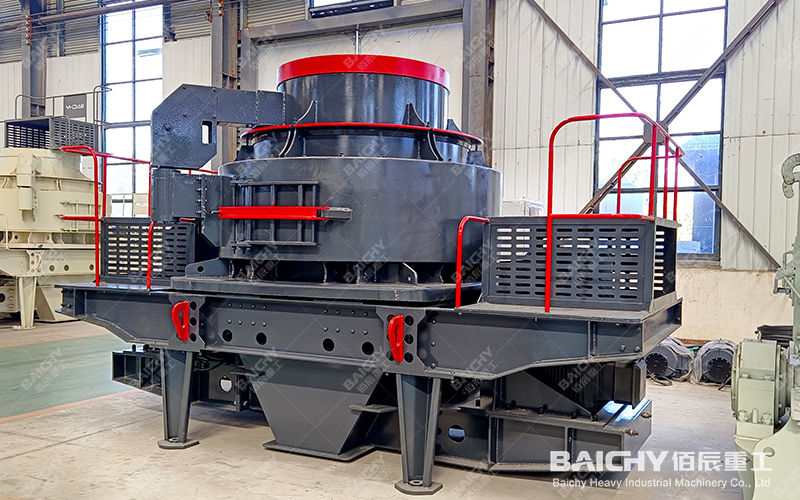
Sand Making Machine
• Core Task: To perform fine-grained crushing on materials, producing final, qualified sand and aggregate products (e.g., in specifications such as 0–5 mm, 5–10 mm, 10–20 mm, etc.).
• Feed Size: Typically less than 50 mm.
• Discharge Size: Precisely controlled to be under 31.5 mm, with the capability to produce manufactured sand in large volumes.
• Common Equipment: Sand making machines (Vertical Shaft Impact—VSI—crushers), fine cone crushers, and High-Pressure Grinding Rolls (HPGR). Among these, the sand making machine combines both crushing and shaping functions, making it the preferred choice for producing high-quality manufactured sand.
• Positioning: The core section that determines the final product's quality, gradation, and fineness modulus; it serves as the key link for enhancing the added value of the product.
To make the comparison more intuitive, we have summarized the core differences in the table below:
| Feature | Primary Crushing (Coarse Crushing) | Secondary Crushing (Medium Crushing) | Tertiary Crushing (Fine Crushing) |
| Core Function | Preliminary breakdown of large raw ore blocks | Further crushing of medium-sized materials | Fine crushing and particle shaping |
| Typical Feed Size | 0–1000 mm | 0–300 mm | 0–50 mm |
| Target Output Size | ≤ 250–300 mm | 30–100 mm | ≤ 31.5 mm (Capable of producing manufactured sand) |
| Key Equipment | Jaw Crusher, Gyratory Crusher | Cone Crusher, Impact Crusher | Sand Making Machine, Fine Cone Crusher |
| Value Proposition | Ensures stable feed supply; determines maximum production capacity | Acts as a critical link; optimizes intermediate particle sizes | Shapes the final product; enhances product value |
Core Advantages and Typical Case Studies of Tertiary Crushing
Tertiary crushing—particularly the process stage utilizing modern sand-making machines—offers the following irreplaceable advantages:
1. Superior Particle Shape: By employing "stone-on-stone" or "stone-on-iron" crushing principles, the equipment effectively shapes the particles. This results in manufactured sand with a rounded shape and continuous gradation, significantly enhancing concrete performance.
2. Controllable Fineness Modulus: By adjusting rotor speed, feed volume, and material cascade patterns, the fineness modulus of the finished sand can be flexibly controlled to meet various engineering standards.
3. Multi-functional Capability: A single piece of high-efficiency tertiary crushing equipment (such as a sand-making machine) can simultaneously perform multiple tasks—including fine crushing, shaping, and sand production—thereby simplifying the overall process flow.
Typical Case Study: A Large-Scale Construction Aggregate Project in East China
• Pain Point: The tertiary crushing stage in the original production line suffered from low efficiency; the finished sand exhibited a high content of needle-like and flaky particles, resulting in weak market competitiveness.
• Solution: We replaced the client's aging fine-crushing equipment with our company's HVI series high-performance sand-making machines. This established an advanced "three-stage, closed-circuit" process flow comprising a Jaw Crusher, a Single-Cylinder Cone Crusher, a Multi-Cylinder Cone Crusher, and an HVI Sand Making Machine.
• Results: Manufactured sand yield increased by 35%; the finished sand features a rounded grain shape and a fineness modulus consistently within the 2.6–2.9 range, fully meeting the national Class I sand standards. The product commands a significant market premium, and the investment payback period has been substantially shortened.
Recommended Equipment
Based on the specific crushing stages and material characteristics involved, we recommend the following core equipment:
• Primary Crushing Recommendation: PE Series Deep-Cavity Jaw Crusher
◦ Features a heavy-duty frame and an extra-large feed opening; specifically designed for high-intensity coarse crushing, it serves as the reliable "iron fist" of the production line's primary crushing stage.
• Secondary Crushing Recommendation: HPT Multi-Cylinder Hydraulic Cone Crusher
◦ Utilizes a laminated crushing principle to deliver high output with low energy consumption. It is particularly well-suited for crushing medium-hard to hard abrasive ores, standing as an energy-efficient benchmark in the secondary crushing stage.
• Tertiary Crushing Recommendation: VSI6X Series Vertical Shaft Impact Crusher (Sand Maker)
◦ Equipped with a four-port "waterfall-flow" feeding system, it achieves high efficiency in both crushing and sand formation. The deep-cavity impeller design boosts throughput by approximately 30%, making it the ultimate tool for producing high-quality aggregates and premium-grade manufactured sand.
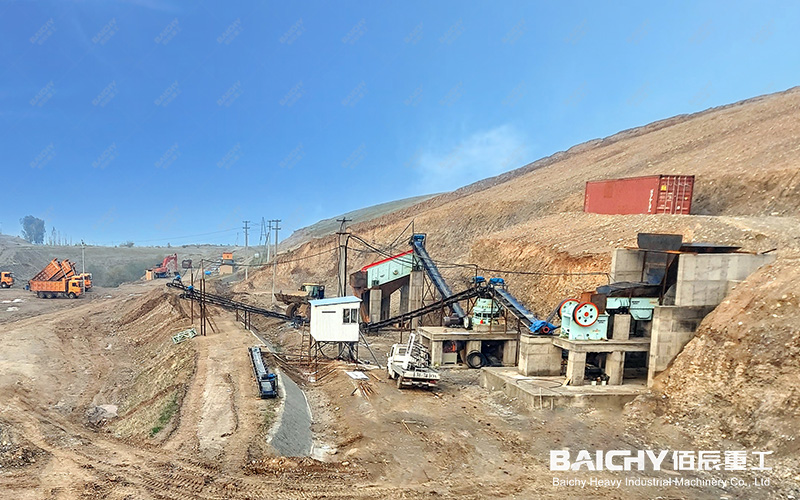
Primary vs. Secondary vs. Tertiary Crushing
Frequently Asked Questions (FAQ)
Q1: Is a tertiary crushing stage mandatory for my production line?
A: Not necessarily; this depends on your final product requirements. If you only need to produce crushed stone aggregates (e.g., 12/13 mm or 24 mm gravel), a secondary crushing stage combined with screening may suffice. However, if you need to produce high-quality manufactured sand or have strict requirements regarding the grain shape of the stone materials, then an efficient tertiary crushing (sand-making) stage is essential.
Q2: Both secondary and tertiary crushing stages can utilize cone crushers; how do I choose between them?
A: When used for secondary crushing, the focus for a cone crusher lies in processing capacity and wear resistance; the cavity design typically follows a standard configuration. When used for tertiary crushing (fine crushing), the focus shifts to controlling product particle size and grain shape; the cavity profile is shorter and steeper, with a more acute crushing wall angle. When configuring a crushing production line, it is essential to perform professional selection calculations based on material characteristics, target output, and the desired product mix.
Q3: Does tertiary crushing consume the most energy? How can this be reduced?
A: Since it involves the repeated impact crushing of fine-grained materials, the specific energy consumption (per unit of product) for tertiary crushing is indeed relatively high. The key to reducing energy consumption lies in the following: 1) Supplying the tertiary crushing stage with a feed that is consistent and of appropriate particle size (by optimizing the preceding primary and secondary crushing and screening stages); 2) Selecting modern sand-making equipment that is both highly efficient and energy-saving; and 3) Adopting the "more crushing, less grinding" philosophy to optimize the overall process.
Summary
Clearly understanding the distinctions between primary, secondary, and tertiary crushing—and subsequently configuring the production line and selecting equipment on a scientific basis—constitutes the essential first step in establishing a modern aggregate or ore processing line that is high-yield, high-quality, and energy-efficient. Each stage of crushing plays an indispensable role, collectively forming a precision manufacturing system that transforms massive raw rocks into premium-grade aggregates.