
Mobile Jaw, Cone & Combined Crusher in Mexico
Quick Answer: Which Crusher Do You Need in Mexico?
If you are planning a quarry or mining project in Mexico, three machines cover more than 80% of real-world crushing duties:
Mobile jaw crusher — the primary stage. It takes blasted rock straight from the face (up to 600–900 mm) and reduces it to roughly 100–200 mm. Choose it when the deposit is spread out, the concession is temporary, or you need to move between sites in states such as Nuevo León, Coahuila and Sonora.
Cone crusher — the secondary and tertiary stage. It delivers the cubical, in-spec aggregate that Mexican concrete and asphalt plants demand (20 mm, 13 mm, ½", ¾"). Choose it for hard, abrasive rock such as basalt, granite, andesite and copper ore.
Combined crusher — a single chassis that integrates primary crushing with secondary crushing (and often screening). Choose it for medium-hard limestone and gypsum at 80–300 t/h, where footprint, transport cost and fast commissioning matter more than ultimate tonnage.
Baichy Heavy Industry manufactures and exports all three, with configurations tuned for Mexican rock, Mexican grid power (460 V / 60 Hz), and Mexican logistics routes (Manzanillo, Veracruz, Lázaro Cárdenas).
Mobile Jaw, Cone & Combined Crusher in Mexico
Mexico's Crushing Market: Why Demand for Mobile Plants Keeps Rising
Nearshoring and infrastructure are rewriting aggregate demand
Mexico's construction and mining sectors are pulling in opposite directions — and both favor crushing equipment. On one side, nearshoring has pushed industrial park, warehouse and housing construction across the Bajío corridor (Querétaro, Guanajuato, Aguascalientes) and along the northern border (Tijuana, Ciudad Juárez, Monterrey). Every square meter of slab needs graded aggregate. On the other side, public infrastructure programs in the southeast and continued copper, gold and silver production in Sonora, Zacatecas and Chihuahua keep demand for reliable secondary and tertiary crushing high.
The practical consequence for quarry operators: the winning plants are no longer the biggest ones — they are the ones that can be relocated and re-commissioned fastest. This is exactly why the mobile jaw crusher has moved from "optional" to "default" for new Mexican concessions, and why a tracked or tyre-mounted cone crusher is now commonly paired with it in a two-stage circuit.
Rock types across Mexico: what you are actually crushing
| Region | Dominant rock | Hardness (Mohs / UCS) | Recommended primary | Recommended secondary |
|---|---|---|---|---|
| Yucatán Peninsula | Limestone, sascab | Soft–medium (40–120 MPa) | Mobile jaw crusher or combined crusher | Impact / combined crusher |
| Bajío & Centro | Andesite, basalt, rhyolite | Hard (120–220 MPa) | Mobile jaw crusher | Cone crusher |
| Nuevo León / Coahuila | Limestone, dolomite | Medium (80–150 MPa) | Mobile jaw crusher | Cone crusher or combined crusher |
| Sonora / Chihuahua | Copper ore, granite, quartz | Very hard (150–250 MPa) | Heavy-duty mobile jaw crusher | Cone crusher (multi-cylinder hydraulic) |
| Guerrero / Michoacán | Metamorphic, volcanic | Hard–very hard | Mobile jaw crusher | Cone crusher |
Matching the machine to the rock is the single biggest lever on your cost per ton. Putting a soft-rock combined crusher on Sonora granite will destroy liners; putting a heavy cone crusher on Yucatán limestone is capital you will never recover.
The Three Machines in Depth
Mobile jaw crusher: primary crushing without civil works
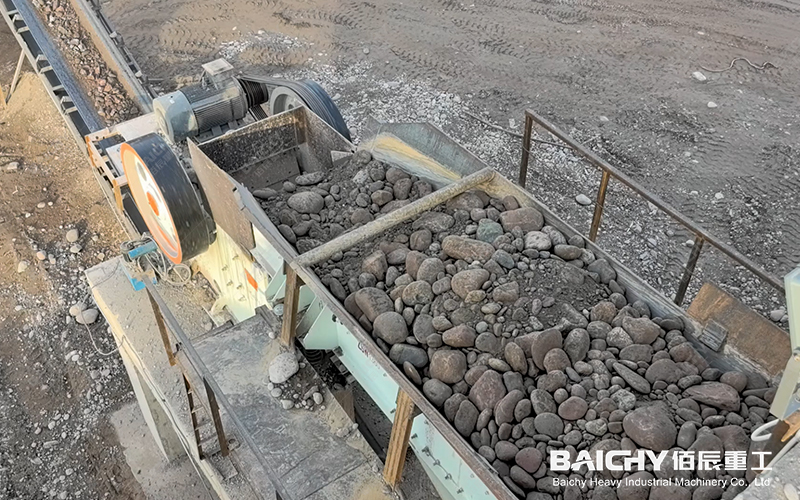
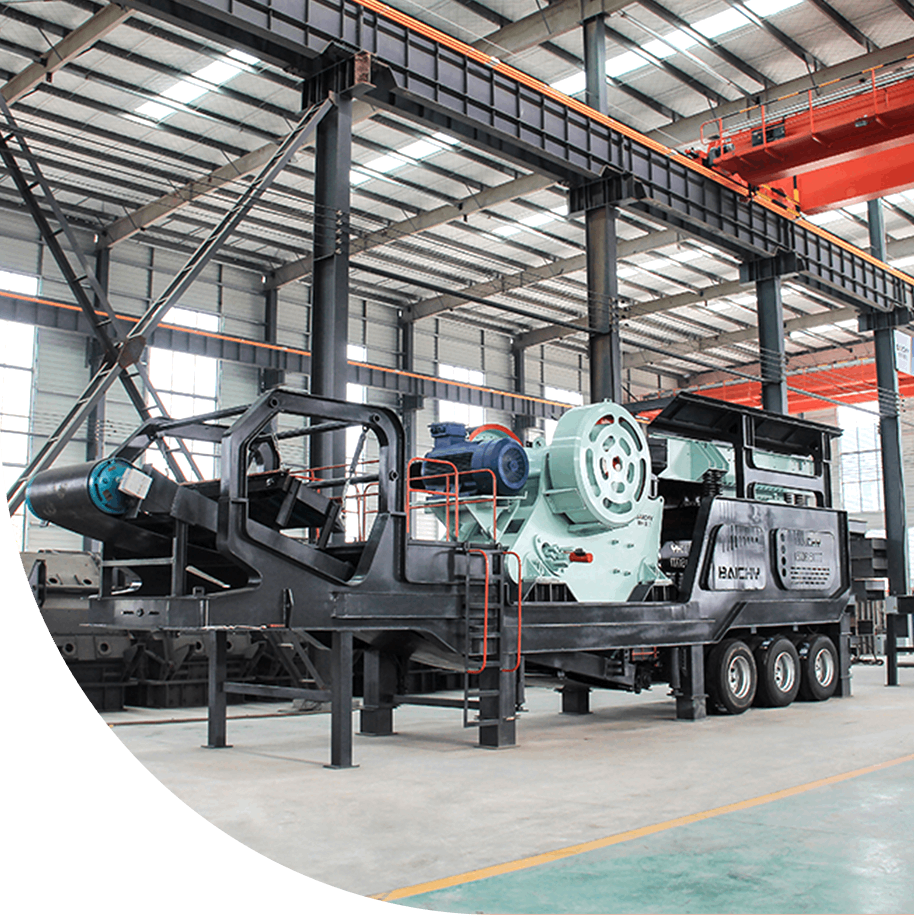
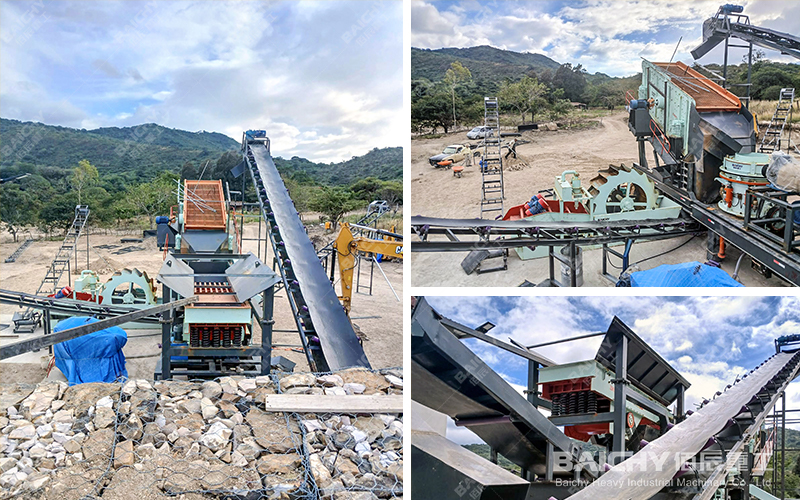
A mobile jaw crusher from Baichy integrates a vibrating feeder, a heavy-duty jaw crusher, a discharge conveyor and (optionally) a pre-screen into one transportable frame. Because the plant arrives pre-wired and pre-assembled, a Mexican operator can typically be producing saleable material within 24–72 hours of the machine landing on site — versus 4–8 weeks of foundations for a stationary plant.
Why it matters locally:
No concrete foundations — critical when a concession is granted for 12–24 months, or when the rock face migrates.
Diesel-electric or full-electric drive — remote sites in Durango or Baja California often lack grid power at the pit.
Transport-legal dimensions — our tyre-mounted units fold to standard trailer widths for Mexican federal highways.
Best for: blasted basalt and andesite, river gravel, demolition concrete recycling, and as the front end of any 100–500 t/h plant.
Cone crusher: the shape-maker for Mexican aggregate specs
The cone crusher is where product shape and gradation are decided. Baichy supplies both spring cone crushers (simpler, lower capex, excellent for medium-hard rock) and multi-cylinder hydraulic cone crushers (higher reduction ratio, hydraulic clearing and adjustment, better for very hard abrasive ore).
Key advantages in Mexican service:
Cubical output — essential for the 20 mm and 13 mm fractions used in ready-mix concrete and asphalt along federal highways.
Laminated crushing principle — lower flakiness index, less recirculation, lower kWh per ton.
Hydraulic cavity clearing — when tramp iron or an uncrushable boulder enters the chamber, the operator clears it in minutes instead of hours.
Wear-part commonality — manganese mantles and concaves are stocked in standard cavity profiles (fine / medium / coarse) to simplify reordering.
Best for: secondary crushing after a mobile jaw crusher, tertiary pebble crushing in copper circuits, and any plant selling into specification-driven aggregate markets.
Mobile Jaw, Cone & Combined Crusher in Mexico
Combined crusher: two stages, one chassis, one motor base
The combined crusher (sometimes called a two-in-one or composite crusher) mounts a primary crushing unit and a secondary crushing unit on a single frame, usually with an integrated vibrating screen and return conveyor. Material enters at up to 500–700 mm and leaves as finished 0–20 mm or 0–30 mm product from one machine.
Where it wins in Mexico:
• Limestone and gypsum operations in Yucatán, Campeche, Nuevo León and Puebla — soft to medium rock where one machine can legitimately do the work of two.
• Small and mid-sized quarries (80–250 t/h) that cannot justify a full three-stage plant.
• Contract crushers who need to quote a competitive price per ton and move weekly.
• Sites with limited land or difficult access — one machine, one pad, one power connection.
The trade-off is honest: a combined crusher will not match a dedicated jaw + cone circuit on hard abrasive rock above roughly 150 MPa. It is a value-engineered solution, not a universal one.
Technical Parameters at a Glance
The table below lists representative Baichy models. All units can be supplied as stationary, tyre-mounted mobile or crawler-mounted versions, and can be engineered for 460 V / 60 Hz operation.
| Model | Machine type | Max feed size (mm) | Discharge range (mm) | Capacity (t/h) | Installed power (kW) | Approx. weight (t) | Typical application in Mexico |
|---|---|---|---|---|---|---|---|
| Baichy MJ-6090 | Mobile jaw crusher | 500 | 60–160 | 70–180 | 130 | 34 | Primary crushing, limestone & andesite quarries |
| Baichy MJ-75106 | Mobile jaw crusher | 630 | 80–200 | 120–280 | 175 | 46 | Large primary plant, copper & basalt operations |
| Baichy MJ-1210 (tracked) | Mobile jaw crusher (crawler) | 700 | 100–250 | 180–400 | 220 | 52 | Steep pits, frequent relocation, no-ramp sites |
| Baichy CS-160 | Cone crusher (spring) | 250 | 10–40 | 90–220 | 160 | 21 | Secondary crushing of river gravel & andesite |
| Baichy HST-250 | Cone crusher (multi-cylinder hydraulic) | 300 | 8–38 | 120–430 | 250 | 27 | Tertiary crushing, hard ore, exact aggregate shape |
| Baichy BC-1214 | Combined crusher | 500 | 0–30 (finished) | 80–160 | 155 | 26 | Limestone & gypsum, one-step aggregate production |
| Baichy BC-1416 | Combined crusher | 600 | 0–40 (finished) | 140–300 | 220 | 34 | Mid-size quarries, contract crushing, fast relocation |
Capacities are indicative and based on bulk density of 1.6 t/m³ with continuous, choke-fed operation. Actual throughput depends on feed gradation, moisture, clay content and closed-side setting. Baichy engineers will size your circuit against your specific rock sample.
How to Configure a Complete Mexican Crushing Circuit
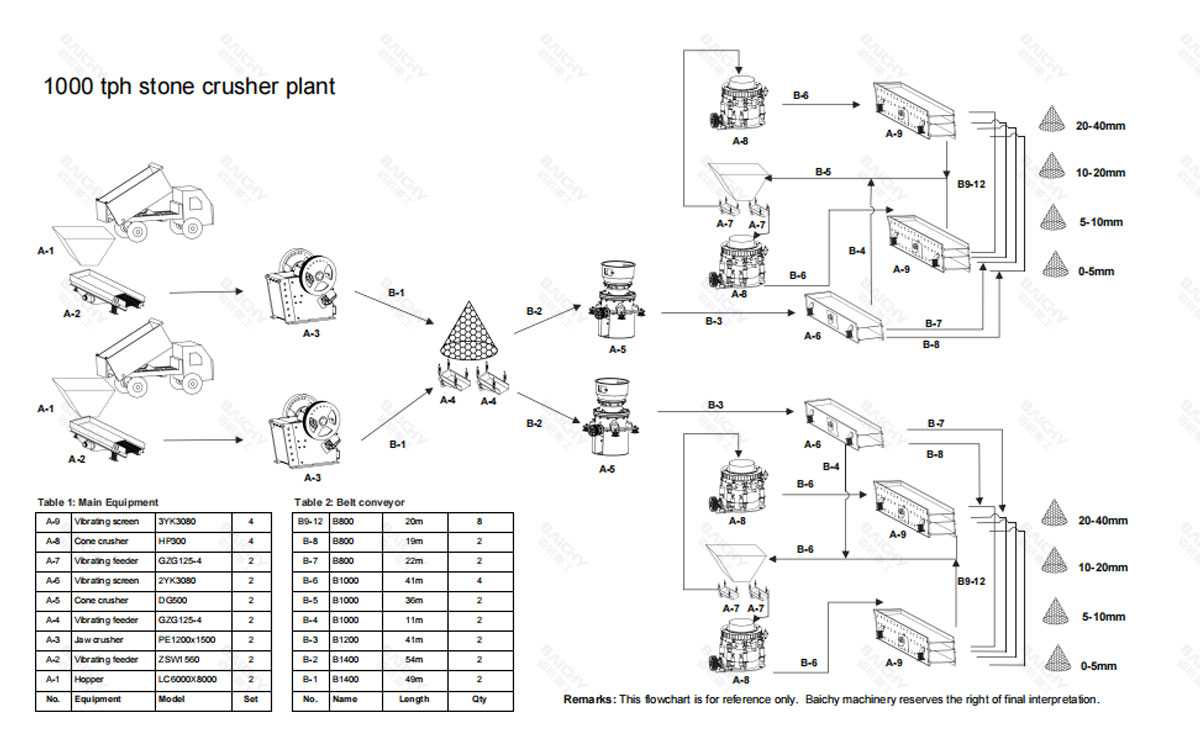
100–150 t/h: the contract-crusher setup
Mobile jaw crusher (MJ-6090) + combined crusher (BC-1214) + 2-deck vibrating screen. Two machines, two pads, roughly one week to commission. Ideal for limestone and for contractors serving several small jobs across a state.
200–300 t/h: the standard quarry setup
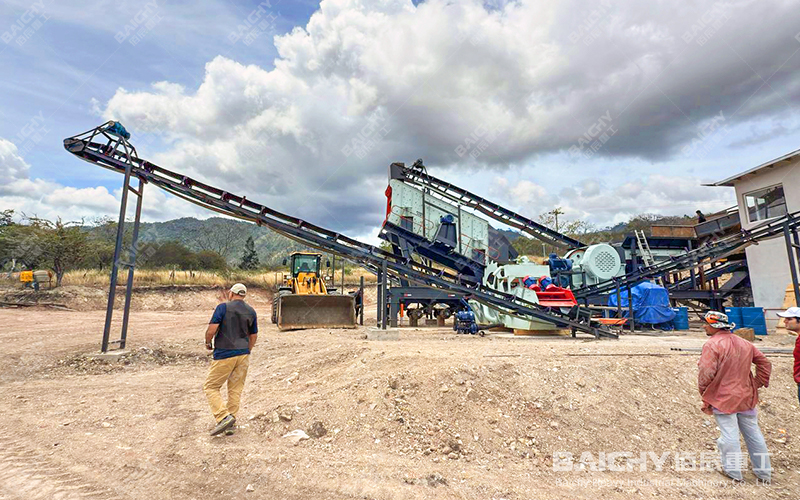
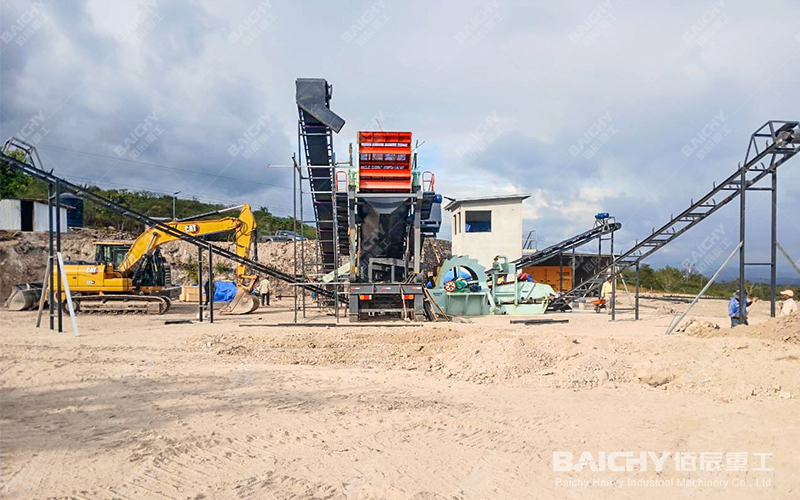
Mobile jaw crusher (MJ-75106) + cone crusher (HST-250) + 3-deck screen with return conveyor. This is the configuration we ship most often to the Bajío and the north. It produces three or four saleable fractions simultaneously and handles hard volcanic rock without complaint.
400 t/h and above: the mining setup
Heavy-duty mobile jaw crusher (MJ-1210) + primary scalping + two cone crushers in parallel + multi-deck screening. Used for copper and iron ore, and for large aggregate operations supplying metropolitan demand.
Region-specific engineering notes
High altitude (Zacatecas, Puebla, Estado de México): above 2,000 m, engines derate. We oversize diesel drives and specify altitude-rated electrical cabinets.
High humidity and clay (Veracruz, Tabasco, Chiapas): we add grizzly feeders, increased screen slope, and optional washing to prevent screen blinding.
Coastal salt exposure (Mazatlán, Manzanillo, Tampico): C5-M marine coating, stainless fasteners and sealed electrical enclosures are available on request.
Grid stability: soft starters and VFDs on all major motors protect against voltage dips common in rural Mexican supply.
Operating Cost, Wear Parts and Service Support
Where your money actually goes
Across a typical three-year Mexican quarry operation, the cost split is roughly: energy 35–40%, wear parts 25–30%, labour 12–15%, maintenance and lubricants 8–10%, and relocation/logistics 5–8%. Two conclusions follow:
Liner selection is a financial decision, not a technical detail. Coarse cavity profiles last longer but produce a coarser product; fine profiles produce spec material faster but wear sooner. Baichy supplies all profiles for each cone crusher model so you can tune this seasonally.
Energy efficiency compounds. A laminated-crushing cone crusher typically consumes 15–25% less kWh per ton than an impact-based secondary stage on hard rock — the difference pays for the machine over a few years of two-shift operation.
Spare parts and after-sales in Mexico
Baichy maintains a stocked wear-parts program for jaw dies, cone mantles and concaves, screen meshes, belt idlers and hydraulic spares. Shipments to Manzanillo, Veracruz, Lázaro Cárdenas and Altamira are routine, and we support installation supervision, operator training and commissioning either remotely or on site. Remote diagnostics are available on all PLC-equipped plants.
Why Mexican Buyers Choose Baichy Heavy Industry
Manufacturer-direct pricing — factory supply for crushing, grinding and beneficiation equipment, with no trading margin.
Complete scope — jaw, cone, impact, combined crusher, vibrating screens, feeders, conveyors, ball mills, classifiers, flotation and gravity separation.
Engineered for local conditions — 460 V / 60 Hz electrics, Spanish-language HMI, altitude and coastal packages.
Testing before you buy — send us rock samples; we run crushing and grindability tests and size the circuit against real data.
Documented export experience — full export packing, CO, and coordination with your customs broker.
Indicative FOB price ranges (for budget planning only; final pricing depends on configuration): mobile jaw crusher USD 90,000–260,000; cone crusher USD 55,000–280,000; combined crusher USD 45,000–120,000. Contact Baichy for a firm, project-specific quotation.
Frequently Asked Questions
1. Should I buy a mobile jaw crusher or a stationary jaw plant in Mexico?
Choose a mobile jaw crusher if your concession is temporary, your pit face moves more than once a year, or you cannot justify 4–8 weeks of civil works. Choose stationary if you have a 10+ year reserve, fixed infrastructure and a permanent power connection. Most Mexican operations under 300 t/h now start mobile.
2. What size cone crusher do I need after a mobile jaw crusher?
Match the cone crusher's feed opening to your jaw discharge, not to your final tonnage. As a rule, the cone should receive material no larger than roughly 80% of its feed opening. For a 150 t/h andesite plant we would typically pair an MJ-6090 mobile jaw crusher with an HST-250 multi-cylinder cone crusher.
3. Is a combined crusher suitable for hard rock?
A combined crusher is designed for medium-hard and medium-abrasive rock — limestone, dolomite, gypsum, marl and weathered material below roughly 150 MPa compressive strength. For basalt, granite and most copper ores, use a mobile jaw crusher followed by a cone crusher.
4. How long does delivery to Mexico take, and which port?
Manufacturing lead time for a standard mobile jaw crusher or cone crusher is typically 25–40 days, plus 25–35 days sea freight to Manzanillo or Veracruz. Combined crusher units are usually faster to build. We coordinate packing lists and certificates of origin with your customs broker.
5. Can Baichy help me select the plant if I only know my target tonnage?
Yes. Send your target t/h, rock type (or a sample), feed size and required final fractions. Our engineers will return a full flow sheet, equipment list, power draw, layout drawing and quotation — sized to Mexican power standards and site conditions.
Conclusion
For Mexican quarries and mines, the decision comes down to rock, mobility and product specification. A mobile jaw crusher wins on speed of deployment and relocation flexibility; a cone crusher wins on product shape, energy efficiency and hard-ore performance; a combined crusher wins on capital cost, footprint and simplicity for soft to medium rock. Most successful Mexican plants use the first two together, and use the third where limestone volumes justify a leaner circuit.
Baichy Heavy Industry supplies all three — plus grinding and beneficiation equipment — direct from the factory, engineered for Mexican power, altitude and logistics. Tell us your rock and your tonnage, and we will size the plant.
Baichy Heavy Industry
Baichy Heavy Industry is a high-tech mining equipment company integrating R&D, manufacturing, sales, and after-sales service. Focusing on crushing, grinding, and mineral processing equipment, we provide professional solutions to our customers. We are ISO9001:2015 、certified, and our products include mobile crushing palnts, crawler crushing plant, construction waste crushing plants, jaw crushers, sand making machines, cone crushers, fine crushers, grinding mills, ball mills, etc., all with reliable performance to meet diverse project needs.
Baichy Heavy Industry – Your Trusted Partner
To ensure optimal performance of your equipment, Baichy Heavy Industry offers:
- Professional on-site installation guidance
- Comprehensive operator training
- 24/7 technical support & maintenance services
Our complete after-sales service system guarantees long-term, stable operation of your machinery with minimal downtime.
Protect Your Rights – Only Use Official Channels
To avoid scams and ensure authentic support, contact us exclusively through:
• Official Website: www.baichychina.com
• WhatsApp: +8615093222637
• Email: [email protected]
Your satisfaction is our priority – expect prompt, professional service every time.
(Note: Beware of unauthorized third parties claiming to represent Baichy. Always verify through official contacts.)