
Granite Crusher & Stone Crushing Production Line Design
Granite is one of the toughest and most abrasive rocks in the world, which makes granite crushing a different engineering problem from limestone or sandstone. A well-designed granite crusher is not simply a machine — it is a complete stone crushing production line where every stage, from the vibrating feeder to the final screen, must be matched to the rock's hardness. In this guide, Baichy Heavy Industry, a professional manufacturer of mining crushers, grinding mills and mineral processing equipment, walks you through how to design a reliable granite crushing plant, and why the jaw crusher remains the undisputed king of primary crushing.
Why Granite Crushing Demands a Different Approach
Before you pick any crusher, you must understand the material itself.
Granite's Physical Properties
- Hardness: 6–7 on the Mohs scale, with a compressive strength of 100–250 MPa. It is classified as hard-to-very-hard rock.
- Abrasiveness: High quartz content means every ton crushed also wears the manganese jaws and cone liners faster than with soft rock.
- Moisture: Quarried granite is usually dry, so blockage risk is lower than with clay-bearing ores — but fines can still build up without pre-screening.
The direct consequence: a granite crusher needs heavy-duty frames, wear-resistant manganese jaw plates, and a crushing circuit that is designed for hard rock from day one. A low-cost machine that works for limestone will fail within weeks on granite.
The Three Golden Rules of Granite Crushing Design
1. Never crush granite with an impact crusher as the primary. Impact crushers excel on soft and medium materials; on granite they wear out in weeks and deliver poor shaped product.
2. Use a jaw crusher for primary + cone crusher for secondary/tertiary. This combination is the industry benchmark for hard rock, delivering cubical aggregates and long wear life.
3. Match feed size to the jaw's gape. As a rule of thumb, the maximum feed particle size should be about 85% of the feed opening width — 600 mm blasted rock needs a gape of roughly 700 mm or wider.
Jaw Crusher Selection & Plant Design Guide
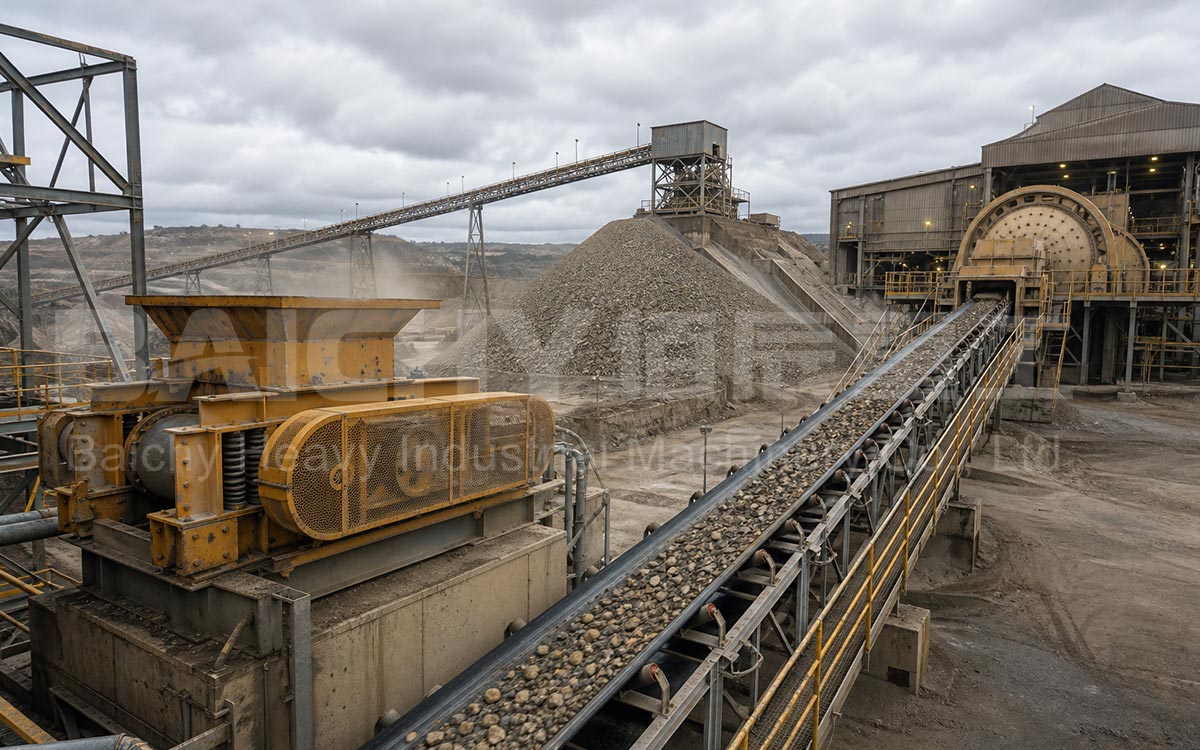
The Granite Crusher Production Line: Stage by Stage
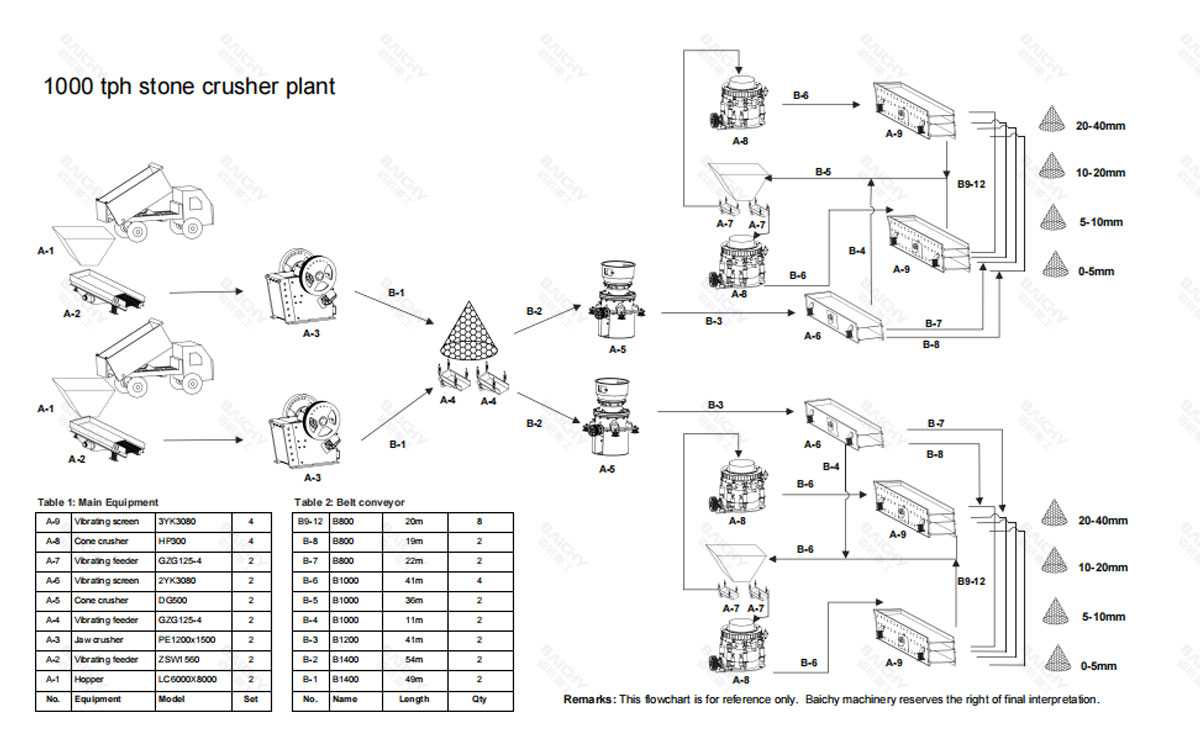
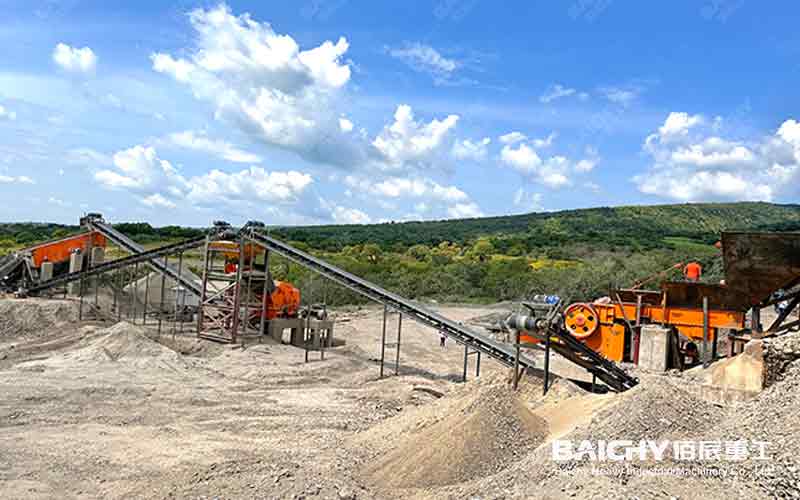
A typical granite crushing plant runs through five coordinated stages. Skipping or undersizing any of them will bottleneck the whole line.
Stage 1 — Feeding and Pre-Screening
A ZSW series vibrating grizzly feeder receives dump-truck loads of blasted granite, removes fine soil and small particles before the primary crusher, and feeds the rest at a controlled rate. Pre-screening is not optional: it prevents blockages and lifts the effective capacity of your jaw crusher by as much as 15–20%.
Stage 2 — Primary Crushing with a Jaw Crusher
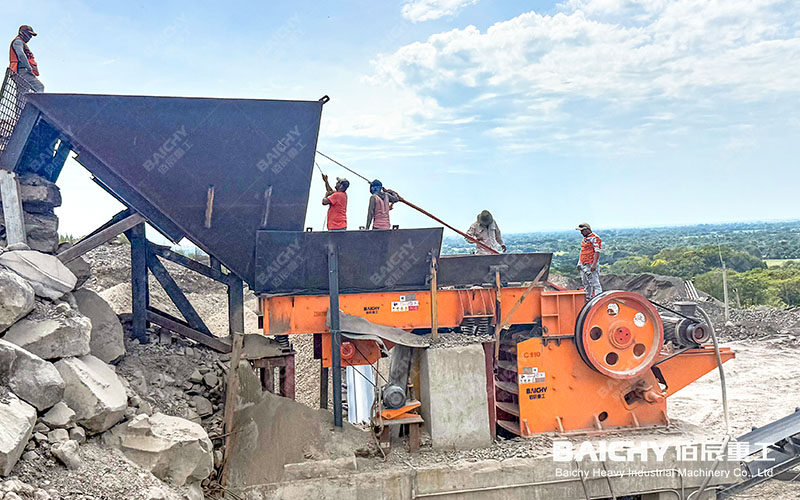
The jaw crusher is the workhorse of the line. It takes raw granite blocks (typically 500–700 mm, up to 1200 mm on the largest models) and reduces them to 150–300 mm by compression between a fixed and a movable jaw. Because granite is hard, the jaw crusher must feature:
- High-manganese steel jaw plates for wear resistance;
- A heavy-duty welded frame and reinforced bearings;
- A large feed opening to accept oversized rock without pre-breakage.
This is exactly where Baichy's PE series primary crushers are built to excel — a fact reflected in the specification table below.
Stage 3 — Secondary Crushing with a Cone Crusher
The 0–150 mm product from the jaw moves to a CS or HP series cone crusher. Cone crushers use inter-particle crushing, which is ideal for abrasive hard rock: they produce high cubicity, a 70%+ crushed-stone yield, and wear parts that last 2–3 times longer than impact crushers on granite.
Stage 4 — Tertiary Crushing and Sand Making (Optional)
For high-spec concrete and asphalt aggregates, a VSI sand-making machine shapes the final material into a near-cubic form and produces manufactured sand. This stage is what separates premium aggregates from ordinary ones.
Stage 5 — Screening and Re-Circulation
Vibrating screens classify the product into fractions such as 0–5 mm, 5–20 mm and 20–40 mm. Oversize material is returned to the cone crusher through a re-circulation conveyor. The closed loop is the difference between a 70% and a 95% yield.
Jaw Crusher Specification Table — PE Series
Choosing the right granite crusher model is a numbers game. The table below lists Baichy's PE jaw crusher lineup with official specifications. Capacity varies with feed size, closed-side setting and material hardness.
| Model | Feed Opening (mm) | Max. Feed Size (mm) | Discharge Range (mm) | Capacity (t/h) | Motor Power (kW) |
|---|---|---|---|---|---|
| PE250×400 | 250×400 | 210 | 25–60 | 5–20 | 15 |
| PE400×600 | 400×600 | 350 | 40–90 | 15–60 | 30 |
| PE500×750 | 500×750 | 425 | 50–100 | 40–130 | 45 |
| PE600×900 | 600×900 | 500 | 60–125 | 90–180 | 55 |
| PE750×1060 | 750×1060 | 630 | 60–150 | 110–380 | 110 |
| PE900×1200 | 900×1200 | 750 | 95–165 | 220–450 | 132 |
| PE1200×1500 | 1200×1500 | 1020 | 150–300 | 400–800 | 220 |
*Source: Baichy official PE jaw crusher specification. Output depends on material, feed size and discharge setting.*
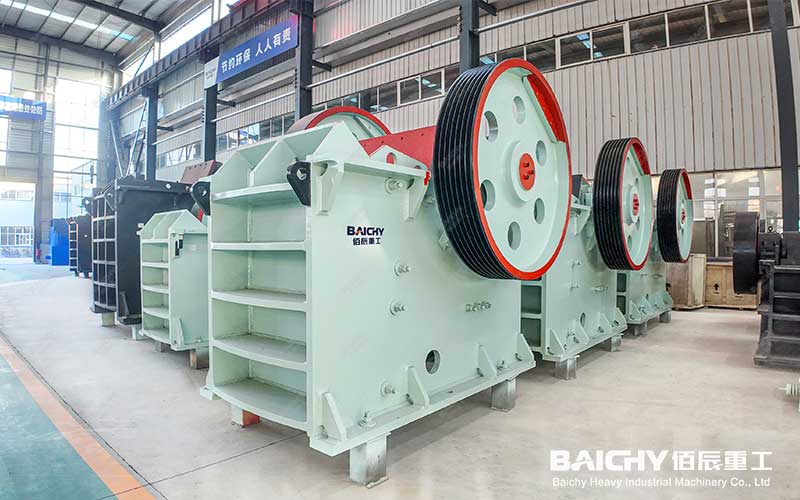
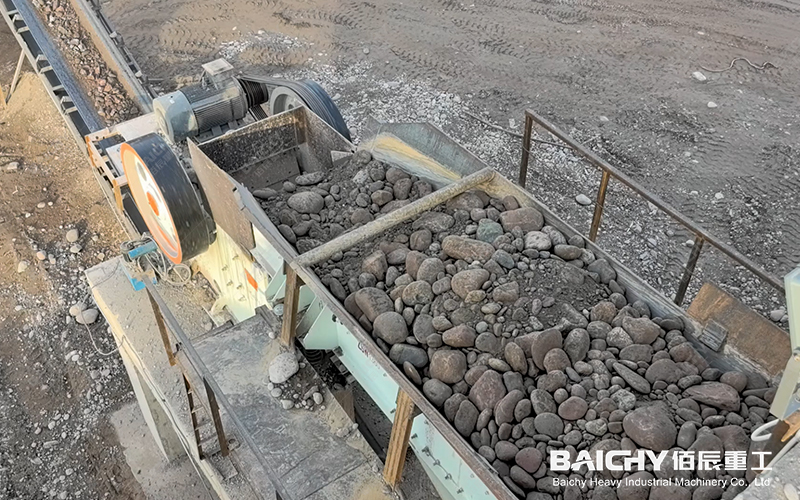
Granite crushing plant - jaw crusher
How to Read the Table for Your Project
- Feed size rules the gape. If your blasted rock peaks at 600 mm, you need a PE750×1060 (750 mm gape). Undersizing causes constant blockages and downtime.
- Capacity decides the model. A 100 t/h plant pairs naturally with a PE750×1060; a 40 t/h operation can run on a PE500×750.
- Power follows hardness. Granite demands the upper end of the motor power range because the crusher must compress very hard rock continuously.
Case Study: Designing a 100 TPH Granite Crushing Plant
Let us put the theory into practice with a 100 t/h granite crushing plant — one of the most requested configurations for quarry owners and aggregate producers.
The Equipment List
| Stage | Equipment | Role |
|---|---|---|
| Feeding | ZSW Vibrating Feeder | Pre-screen fines, feed uniformly |
| Primary | PE750×1060 Jaw Crusher | Crush 0–630 mm granite to 0–150 mm |
| Secondary | CS Series Cone Crusher | Inter-particle crushing, 70% stone yield |
| Screening | 3YK Vibrating Screen | Classify 0–5 / 5–20 / 20–40 mm |
| Conveying | Belt Conveyors | Move material between stages |
The Design Logic
1. The PE750×1060 jaw crusher handles typical blasting material (≤600 mm) comfortably through its 630 mm max feed and adjustable 60–150 mm discharge.
2. The cone crusher then takes the harder job of shaping the aggregate, protecting the jaw from fine-crushing duty.
3. A closed screening circuit re-circulates oversize, lifting usable aggregate yield above 90%.
The result is a granite crushing production line that runs 8–10 hours a day with minimal downtime and predictable operating costs.
Key Operating Costs You Must Budget For
Buying a granite crusher is one-time; running it is a lifetime. The three biggest cost drivers are:
1. Jaw Plate Wear
Granite's abrasiveness means manganese jaw plates are your single largest consumable. High-quality plates on a PE750×1060 typically last 6–12 months depending on throughput and setting. Baichy's high-manganese plates are designed to extend this interval and cut replacement frequency.
2. Cone Crusher Liners
Secondary and tertiary cone liners also wear on granite. Choosing a reputable jaw crusher manufacturer who provides genuine, correctly-hardened liners matters more than the sticker price of the machine.
3. Power Consumption
Granite crushing is energy-intensive. Oversized motors waste electricity; undersized motors trip and stall. Specifying power correctly — as the table shows — keeps your cost per ton low over the plant's life.
Fixed or Mobile Granite Crusher?
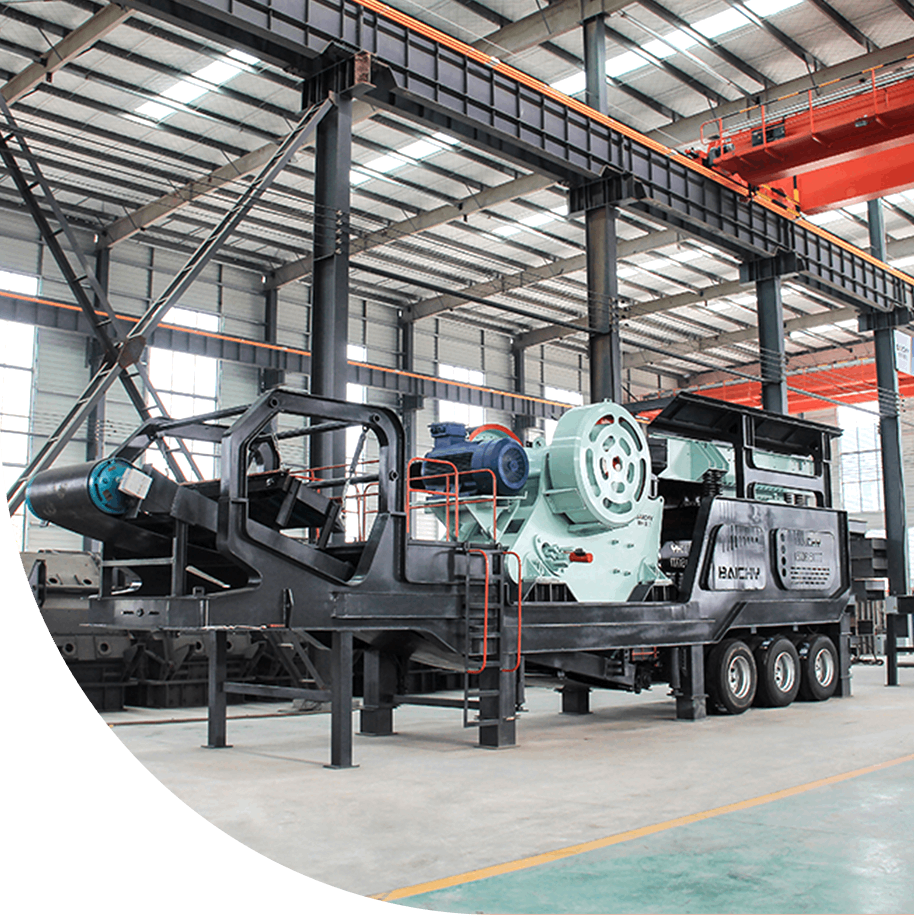
Your site conditions decide this. A fixed stone crushing production line offers the lowest cost per ton and highest capacity, ideal for long-term quarries. A mobile granite crusher (wheel-mounted or crawler) suits multiple pits, construction sites and short contracts where relocation speed beats throughput. Baichy offers both PE-based fixed lines and mobile jaw crusher platforms, so you are not forced into a compromise.
Conclusion: Building the Right Granite Crusher Starts with the Jaw
A profitable granite crushing plant is built on correct stage design, matched capacity, and a primary jaw crusher tough enough for the hardest rock. Feed size dictates the gape, capacity dictates the model, and hardness dictates the wear budget. Follow the three golden rules, use the specification table to size your machines, and partner with an experienced jaw crusher manufacturer like Baichy Heavy Industry. Tell us your material type, required capacity and project site, and our engineers will deliver a complete granite crusher solution — from design and layout to installation and commissioning.
Frequently Asked Questions (FAQ)
1. What is the best crusher for granite?
For primary crushing, a jaw crusher (PE series) is the best choice because it handles hard, abrasive rock with high compressive strength. For secondary and tertiary stages, a cone crusher outperforms an impact crusher on granite, producing cubical aggregates with longer liner life.
2. What size granite can a PE750×1060 jaw crusher accept?
The PE750×1060 has a 750×1060 mm feed opening and accepts a maximum feed size of 630 mm, which comfortably handles typical blasted granite (usually ≤600 mm). Its discharge is adjustable from 60 to 150 mm, producing primary feed for a cone crusher.
3. How much does a granite crushing plant cost?
Cost depends on capacity, stage count and whether the line is fixed or mobile. A 100 t/h granite plant typically represents a significant capital outlay split between feeder, jaw crusher, cone crusher, screens and conveyors. Contact Baichy for a tailored quotation based on your capacity and site.
4. Why should I use a cone crusher instead of an impact crusher for granite?
Granite is hard and highly abrasive. Cone crushers use inter-particle compression, yielding 2–3 times longer wear-part life and better cubical shape than impact crushers on granite. Impact crushers are better reserved for soft and medium-hard materials.
5. Can Baichy design and install a complete granite production line?
Yes. Baichy Heavy Industry provides turnkey granite crusher solutions — equipment selection, plant layout, installation, commissioning and after-sales support. Provide your material type, required capacity and project details for a custom engineering proposal.
Baichy Heavy Industry
Baichy Heavy Industry is a high-tech mining equipment company integrating R&D, manufacturing, sales, and after-sales service. Focusing on crushing, grinding, and mineral processing equipment, we provide professional solutions to our customers. We are ISO9001:2015 、certified, and our products include mobile crushing palnts, crawler crushing plant, construction waste crushing plants, jaw crushers, sand making machines, cone crushers, fine crushers, grinding mills, ball mills, etc., all with reliable performance to meet diverse project needs.
Baichy Heavy Industry – Your Trusted Partner
To ensure optimal performance of your equipment, Baichy Heavy Industry offers:
- Professional on-site installation guidance
- Comprehensive operator training
- 24/7 technical support & maintenance services
Our complete after-sales service system guarantees long-term, stable operation of your machinery with minimal downtime.
Protect Your Rights – Only Use Official Channels
To avoid scams and ensure authentic support, contact us exclusively through:
• Official Website: www.baichychina.com
• WhatsApp: +8615093222637
• Email: [email protected]
Your satisfaction is our priority – expect prompt, professional service every time.
(Note: Beware of unauthorized third parties claiming to represent Baichy. Always verify through official contacts.)