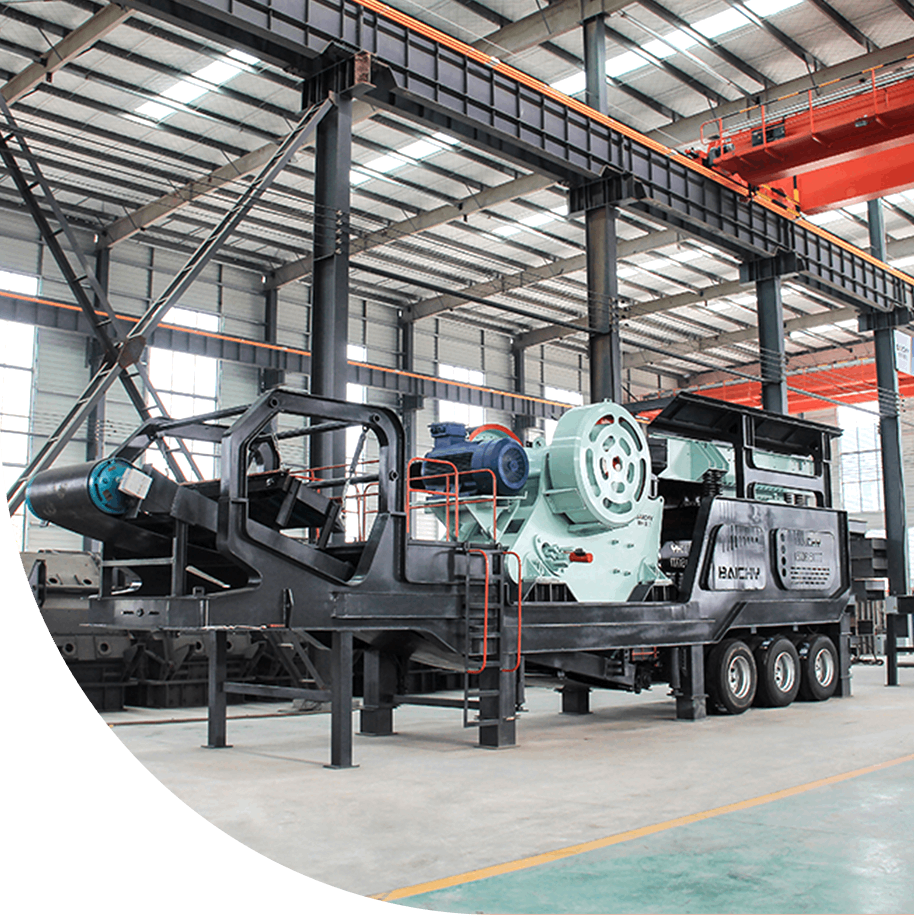

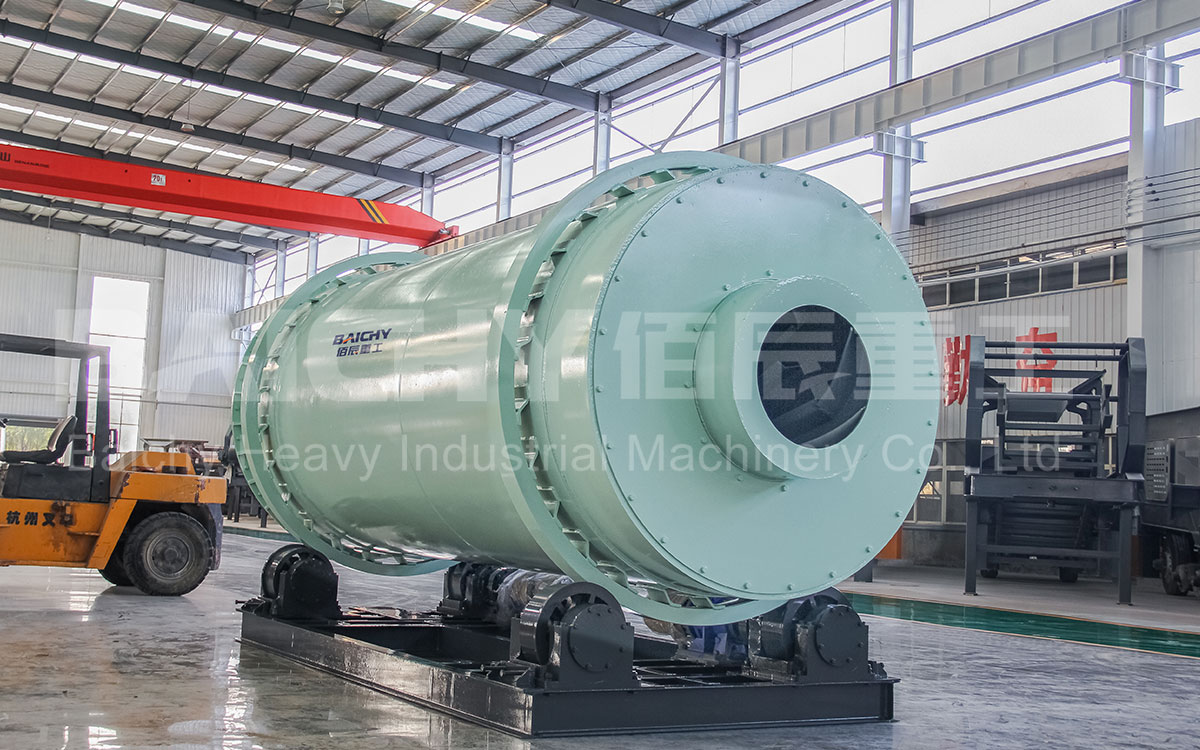
Frac Sand Dryer
Frac sand is the backbone of hydraulic fracturing. It keeps underground fractures open so oil and gas can flow to the wellbore. But before it reaches the well site, every grain must be bone dry. If a frac sand dryer leaves more than 0.5% moisture in the material, the proppant will clump, bridge, and fail the API specification — costing you a rejected load and lost production time.
At Baichy Heavy Industry, we design and build frac sand rotary dryers trusted by proppant plants around the world. This guide covers how a frac sand dryer works, how to size one, which heat source to choose, the key parameters that control product quality, and what your total lifecycle cost will really look like. Whether you are expanding an existing line or planning a greenfield proppant plant, you will find the answers you need here.
How Does a Frac Sand Dryer Work?
A frac sand dryer operates on a simple but highly effective principle: continuous convective heat transfer. Wet sand enters a slightly inclined rotating drum at one end, while hot gases flow through the drum. Inside, specially designed lifting flights pick the sand up and shower it through the hot gas stream, maximizing the contact area between every grain and the heat.
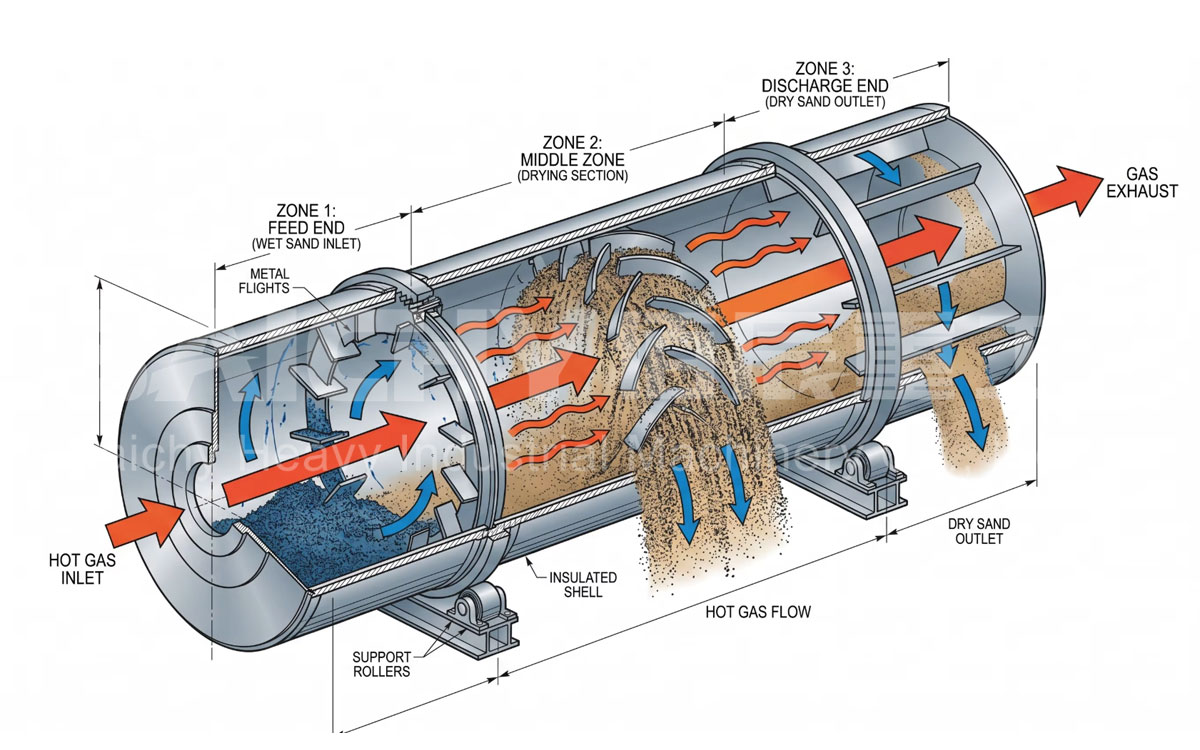
Working Principle of the Triple-Drum Dryer
The Drying Process Step by Step
1. Feeding. Wet frac sand (often 8–20% moisture after washing) is conveyed to the feed end by a belt conveyor or bucket elevator.
2. Lifting and cascading. As the drum rotates at 2–8 rpm, lifting flights raise the sand and let it fall through the hot air as a dense material curtain.
3. Heat exchange. Moisture on the surface and inside the grains evaporates rapidly. The temperature is controlled so the quartz crystal structure is never thermally damaged.
4. Discharging. Dried sand exits the lower end with a stable moisture content of ≤0.5%.
5. Dust collection. A cyclone separator and baghouse capture fine particles from the exhaust gas, meeting strict emission standards.
Co-Current or Counter-Current: Which Is Better for Frac Sand?
Sand is not heat-sensitive — quartz softens only above 1000°C. That is why proppant producers choose counter-current operation. The driest material contacts the hottest gas at the discharge end, pushing thermal efficiency to 65–80%. Over a full year, a 15% difference in thermal efficiency means burning 15% more fuel. For a large frac sand dryer, that is tens of thousands of dollars.
Frac Sand Dryer Specifications and Capacity
Sizing a frac sand dryer correctly is the single most important purchasing decision. Capacity is driven by the drum diameter and length, the initial moisture content, and the target outlet moisture. The table below shows Baichy's standard frac sand rotary dryer range, based on quartz sand with an inlet moisture of 10–20% and an outlet moisture below 0.5%.
| Model Specification | Wet Capacity (10% → 0.5%) | Wet Capacity (20% → 0.5%) | Motor Power | Footprint (incl. furnace & dust collector) |
|---|---|---|---|---|
| φ1.5 × 12 m | 8–15 t/h | 5–8 t/h | 15 kW | ~120 m² |
| φ2.0 × 16 m | 20–35 t/h | 12–20 t/h | 22 kW | ~180 m² |
| φ2.4 × 18 m | 35–55 t/h | 22–35 t/h | 37 kW | ~240 m² |
| φ2.8 × 20 m | 55–85 t/h | 35–55 t/h | 55 kW | ~300 m² |
| φ3.0 × 22 m | 70–110 t/h | 45–70 t/h | 75 kW | ~360 m² |
| φ3.6 × 25 m | 120–200 t/h | 80–130 t/h | 132 kW | ~460 m² |
Note: Capacities vary with sand type, particle size distribution, moisture content, and heat source. Baichy offers free material drying tests and returns moisture curves plus a specification recommendation within 5 working days.
For very high-moisture feeds (above 18%), a triple-pass rotary dryer is recommended. The three concentric drums extend the drying path, lift thermal efficiency above 80%, cut the footprint by up to 40%, and lower fuel cost by another 10–15%.
Key Operating Parameters That Control Frac Sand Quality
A frac sand dryer is only as good as the parameters you run it at. Getting these wrong either wastes fuel or damages the product.
- Drum rotation speed: 2–8 rpm (VFD adjustable). Higher speed creates a denser material curtain and faster heat exchange, but shortens residence time.
- Inclination angle: 2–5°. A steeper angle raises throughput but cuts residence time.
- Inlet air temperature: 400–800°C. Above ~870°C, quartz undergoes a crystal phase transition that can crack the grains. Stay within the safe window.
- Outlet air temperature: 80–150°C. Below 80°C risks condensation and baghouse blinding; above 150°C wastes heat.
- Internal air velocity: 2–5 m/s. Above 5 m/s, fine sand under 0.5 mm gets pulled into the dust system, reducing your yield.
- Residence time: 15–40 minutes. High-moisture feed requires a longer residence time to reach ≤0.5% moisture.
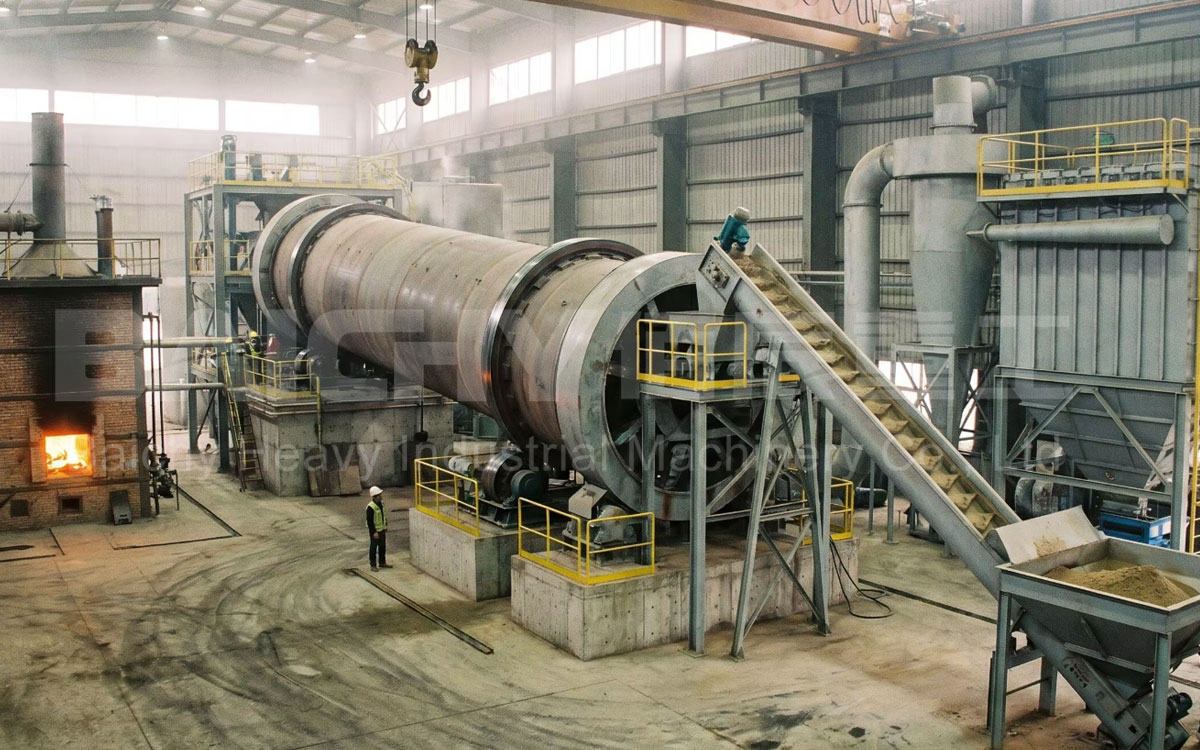
Frac Sand Dryer
Choosing the Right Heat Source for Your Frac Sand Dryer
Fuel is the largest operating cost over the life of a fra
c sand drying line. Your choice depends on local energy prices and emission rules.
| Heat Source | Fuel Cost / Ton of Sand (Ref.) | Temperature Control | Best For |
|---|---|---|---|
| Coal-fired hot air furnace | $0.5–1.2 | Low (±50 °C) | Coal-producing regions, lenient emission rules |
| Natural gas burner | $0.8–2.0 | High (±10 °C) | Areas with pipeline gas, strict emission standards |
| Biomass pellet furnace | $0.4–1.0 | Medium (±30 °C) | Agricultural regions, carbon-neutral goals |
| Heavy oil / diesel | $1.5–3.0 | Medium (±20 °C) | Remote mining sites without gas or coal |
Baichy is not tied to a single heat source. We configure the most cost-effective combustion system based on your local energy prices and environmental compliance requirements. Standard installations pair a cyclone with a pulse-jet baghouse (≥99% collection, <50 mg/Nm³ outlet), and a wet scrubber can be added for markets requiring <20 mg/Nm³.
Why a Rotary Dryer Beats the Alternatives for Frac Sand?
Four drying technologies compete for proppant producers: rotary drum, fluidized bed, belt, and vertical dryers. For frac sand, the rotary drum wins on almost every axis.
- Capacity: A single rotary dryer handles 1–300+ t/h. Fluidized beds top out near 50 t/h and require multiple parallel units.
- Thermal efficiency: Rotary drums reach 60–80%; fluidized beds 50–70%; belt dryers only 40–55%.
- Reliability: Rotary dryers tolerate particle-size variation and high moisture. Fluidized beds fail when air nozzles clog; belt dryers need mesh replacement every 2–3 years.
- Operating cost: A single rotary dryer consumes 15–20% less fuel than four parallel fluidized beds, needs one operator per shift instead of three, and has a design life of 25+ years.
When we compare the total cost of ownership, the rotary drum frac sand dryer is 25–35% cheaper per ton over a 20-year lifecycle — and that saving comes from fuel, labor, and downtime, not the equipment price itself.
How to Size a Frac Sand Dryer for Your Plant?
To get an accurate specification, send these five inputs to our engineers:
1. Sand type and source (river sand, manufactured sand, quartz sand, or sea sand)
2. Initial moisture content (from actual sampling)
3. Target outlet moisture (usually ≤0.5% for proppant)
4. Required hourly capacity (wet basis)
5. Available heat source and local energy prices
A concrete example: to dry 50 t/h of wet sand from 20% to 0.5% moisture, the evaporation rate is about 9.8 t/h. We would recommend a φ2.8 × 20 m or φ3.0 × 22 m drum with counter-current flow and an inlet gas temperature of 600–700°C. Because even fine sand (0–3 mm) dries more than 30% faster than coarse sand (3–20 mm), final sizing is always confirmed by an actual material test.
Frequently Asked Questions
Q1. What moisture content should a frac sand dryer achieve?
API-grade frac sand must reach ≤0.5% moisture before packaging. Baichy's rotary dryers hold outlet moisture stably below this level regardless of inlet moisture. The discharge temperature typically runs 90–120°C, so the sand may need natural cooling or a cooling drum before entering the finished-product silo.
Q2. How much coal or gas does a frac sand dryer consume?
For a φ2.4 × 18 m dryer processing 50 t/h of sand from 20% to 0.5% moisture, standard coal consumption is roughly 120–140 kg per tonne of water evaporated — about 24–28 kg per tonne of sand. Actual figures depend on coal quality, operating skill, and ambient temperature.
Q3. Can a frac sand dryer handle high-moisture washed sand?
Yes. For feeds above 18% moisture, we recommend a triple-pass rotary dryer. The three drying zones extend residence time, push thermal efficiency above 80%, and reduce fuel consumption by another 10–15% compared with a single-pass drum.
Q4. What emission control does a frac sand dryer need?
The standard configuration is a cyclone separator plus a pulse-jet baghouse, achieving ≥99% fine-particle collection and an outlet concentration below 50 mg/Nm³ — compliant in most regions. Markets requiring <20 mg/Nm³ (such as the EU and North America) add a wet scrubber. Coal-fired systems can be fitted with flue-gas desulfurization.
Q5. How do I get an accurate quote for a frac sand dryer?
Send our engineers your sand type, initial and target moisture, hourly capacity, and heat-source availability. We provide a specification recommendation and budgetary quote within five working days, backed by a free material drying test so the sizing is based on your real sand — not a generic estimate.
Choose Baichy as Your Frac Sand Dryer Supplier
Drying frac sand is not a side process — it is a critical quality gate that protects the integrity of your proppant and your contracts. The right frac sand dryer pays for itself through lower fuel consumption, higher uptime, and consistent API-grade output.
As a leading manufacturer of mining crushing, ore grinding, and mineral processing equipment, Baichy Heavy Industry builds frac sand drying systems engineered for reliability and low total cost of ownership. From a single rotary dryer to a complete feeding, drying, cooling, and dust-collection line, we deliver equipment configured for your material and your energy market.
Contact our team today for a free material test and a custom frac sand dryer quotation.
Baichy Heavy Industry
Baichy Heavy Industry is a high-tech mining equipment company integrating R&D, manufacturing, sales, and after-sales service. Focusing on crushing, grinding, and mineral processing equipment, we provide professional solutions to our customers. We are ISO9001:2015 、certified, and our products include mobile crushing palnts, crawler crushing plant, construction waste crushing plants, jaw crushers, sand making machines, cone crushers, fine crushers, grinding mills, ball mills, etc., all with reliable performance to meet diverse project needs.
Baichy Heavy Industry – Your Trusted Partner
To ensure optimal performance of your equipment, Baichy Heavy Industry offers:
- Professional on-site installation guidance
- Comprehensive operator training
- 24/7 technical support & maintenance services
Our complete after-sales service system guarantees long-term, stable operation of your machinery with minimal downtime.
Protect Your Rights – Only Use Official Channels
To avoid scams and ensure authentic support, contact us exclusively through:
• Official Website: www.baichychina.com
• WhatsApp: +8615093222637
• Email: [email protected]
Your satisfaction is our priority – expect prompt, professional service every time.
(Note: Beware of unauthorized third parties claiming to represent Baichy. Always verify through official contacts.)