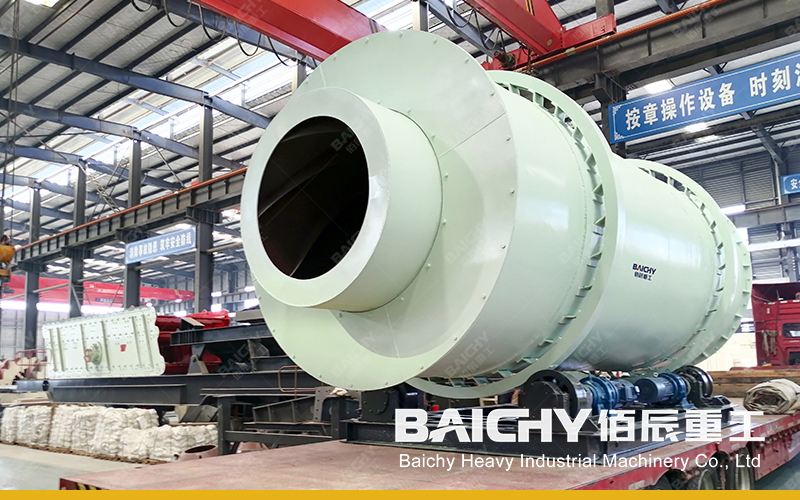
On large-scale, industrialized fertilizer production lines, one piece of equipment acts like a tireless "drying warrior," silently undertaking the crucial task of transforming high-moisture-content wet materials into uniformly dried finished products—this is the rotary dryer. This seemingly simple cylindrical device embodies immense ingenuity in ensuring fertilizer granule strength, stabilizing nutrient content, and facilitating storage and transportation. This article will take you on a deep pe into the world of rotary dryers, exploring how they have become an indispensable part of the modern fertilizer industry.
I. What is a Fertilizer Rotary Dryer?
A fertilizer rotary dryer, also known as a rotary air dryer, is a continuous drying device that uses a slowly rotating, inclined cylinder to efficiently evaporate moisture from wet materials through direct or indirect contact with hot air. It primarily processes fertilizer granules that still contain a certain amount of moisture after granulation, such as compound fertilizers, organic fertilizers, and BB fertilizers. Its core mission is to achieve rapid, uniform, and thorough drying while ensuring that the physicochemical properties of the fertilizer are not damaged.
II. Working Principle: A Perfect Dance of Heat and Machinery
The rotary dryer operates as a highly efficient and coordinated production line. Its principle can be summarized in the following steps:
1. Feeding and Lifting: High-moisture-content wet fertilizer is continuously and evenly fed into a slightly inclined rotating cylinder through the feed end. Special lifting plates (or material lifting plates) are installed on the inner wall of the cylinder. As the cylinder slowly rotates, these lifting plates continuously lift and scatter the material, forming a uniform material curtain across the cylinder's cross-section.
2. Hot Air Contact: Clean hot air generated by the combustion furnace is introduced into the cylinder at either the feed or discharge end (depending on the airflow design). When the material is scattered by the lifting plates, it is fully dispersed in the hot airflow, achieving maximum contact area between the material particles and the hot air. This "material curtain" state greatly improves heat and mass transfer efficiency.
3. Drying and Conveying: Under the influence of gravity, the material slowly moves towards the discharge end as the cylinder rotates and tilts. During this process, moisture is continuously evaporated, and the material gradually dries. After the entire "journey" is complete, the properly dried fertilizer is discharged from the outlet.
4. Dust Removal and Exhaust: Exhaust gas carrying moisture and a small amount of dust is discharged from the other end of the cylinder and enters the subsequent dust removal system (such as a cyclone dust collector, bag filter, or scrubbing tower). After purification, it meets emission standards and environmental protection requirements.
III. Why is a rotary dryer an ideal choice for fertilizer production?
Compared to box dryers, belt dryers, and other equipment, rotary dryers exhibit irreplaceable advantages in fertilizer production:
• High throughput and continuous operation: Capable of 24-hour uninterrupted operation, perfectly matching the production rhythm of upstream granulators and downstream coolers and packaging machines, greatly improving the efficiency of the entire production line.
• Uniform drying and stable quality: The unique material lifting system ensures that every fertilizer granule receives the same degree of drying, avoiding the phenomenon of external dryness and internal moisture or uneven drying, resulting in consistent finished product quality.
• High adaptability and wide application: By adjusting parameters such as cylinder rotation speed, tilt angle, hot air temperature, and wind speed, it can flexibly handle various fertilizers with different formulas and initial moisture contents, from organic fertilizers to inorganic compound fertilizers.
• Robust structure and durability: The main body of the equipment is made of high-quality steel, with wear-resistant liners in key areas, capable of withstanding corrosion and long-term wear from fertilizer raw materials, resulting in a long service life.
• High thermal efficiency and economical operation: A good insulation layer and efficient material-air contact method reduce heat loss and fuel consumption, thereby saving operating costs.
IV. Selection and Optimization: Maximizing the efficiency of the rotary dryer
To fully utilize the efficiency of the rotary dryer, the following points are crucial:
• Precise model selection: The appropriate model and specifications must be selected based on the characteristics of the material (initial moisture content, particle size, heat sensitivity), production requirements, etc.
• Airflow Selection: Co-current flow (hot air and material flow in the same direction) is suitable for heat-sensitive materials; counter-current flow (hot air and material flow in opposite directions) is suitable for materials requiring deep drying, offering higher heat utilization.
• Routine Maintenance: Regularly check the lubrication of the support rollers and thrust rollers, clean any adhering material from the lifting plates, and ensure the insulation layer is intact. These are crucial for ensuring the long-term stable operation of the equipment.
The fertilizer rotary dryer is far more than a simple "drying drum"; it is a precision device integrating mechanical engineering, thermodynamics, and fluid mechanics. With its superior reliability, high production capacity, and stable finished product quality, it has become core equipment in modern fertilizer plants and organic fertilizer plants. Investing in a well-designed and highly efficient rotary dryer provides a solid guarantee for the quality of your fertilizer products, production efficiency, and market competitiveness.