
Dry Ball Mill: Applications, Working Principle and Models
A dry ball mill grinds ore, cement clinker, coal and non-metallic minerals into powder with air as the only carrying medium, so the product leaves the cylinder dry. This page covers its applications, working principle and published model range.
What Is a Dry Ball Mill?
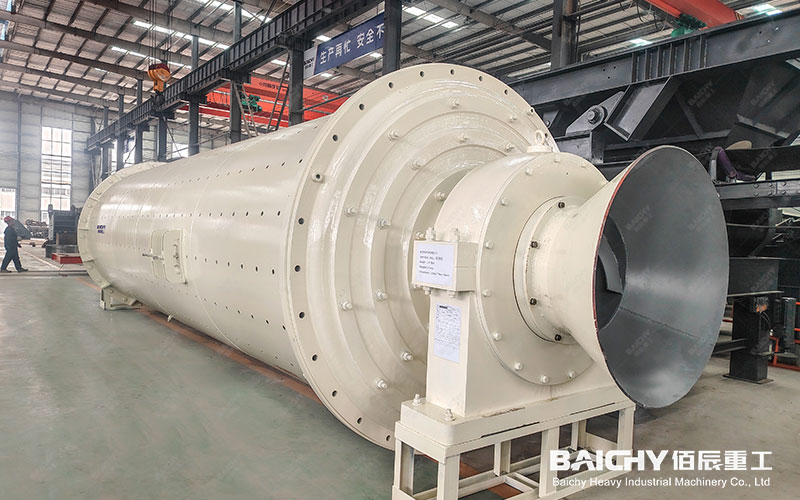
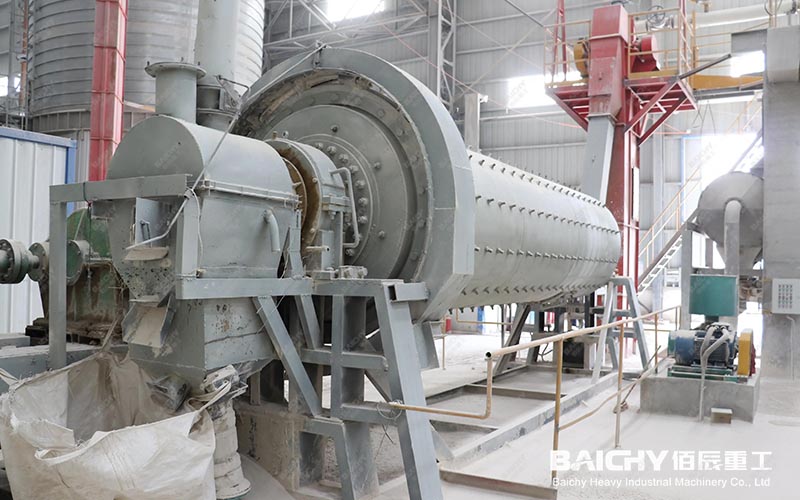
A dry ball mill is a rotating cylindrical mill that reduces material by impact, friction and attrition between the grinding media and the feed, without adding water or a chemical solution. A dry ball mill is chosen when the material is water-sensitive or the process must deliver dry powder directly.
Grinding media are steel balls or ceramic balls. Feed enters through a hollow shaft and the powder leaves at the other end.
How Does a Dry Ball Mill Grind Material Without Water?
A dry ball mill grinds by lifting the grinding media and the feed inside the rotating cylinder, letting the media fall back onto the material; breakage comes from impact, friction and grinding.
Two stages describe the progress inside a dry ball mill:
1. Initial stage — few balls touch the material and particles are coarse.
2. Stable stage — the ball charge builds up and the media grind the smaller particles.
Baichy sets cylinder speed at 0.5–40 rpm and fineness between 80 and 2500 mesh with a powder classifier; the range covers material up to Mohs 9 with ±2 μm fineness.
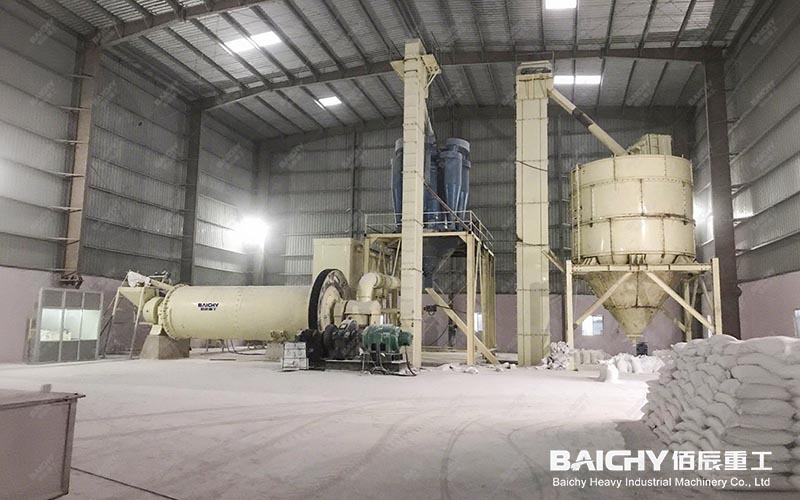
dry ball mill applications
Which Materials and Industries Use Dry Ball Mills?
Dry ball mills serve ore dressing, cement, chemicals and non-metallic mineral processing on water-sensitive material that must leave dry.
| Material group | Materials | Duty of the dry ball mill |
|---|---|---|
| Metal ores | Iron ore, gold ore, copper ore, lead-zinc ore | Pre-grinding before ore dressing |
| Rare metal ores | Tungsten ore, molybdenum ore, manganese ore | Dry grinding ahead of flotation |
| Ceramics and glass | Quartz sand, feldspar, kaolin, talc | Dry preparation of raw material |
| Fillers and building minerals | Limestone, calcite, barite | Ultra-fine powder for fillers |
| Chemical and refractory | Graphite, fluorite, bentonite, refractory material | Dry grinding of chemical raw material |
| Cement and concrete additions | Cement clinker, slag, fly ash | Grinding step in cement production |
| Gypsum, silica and fuel | Gypsum, silica powder, mica, coal powder, coke | Additives and metallurgical fuel |
Dry Ball Mill or Wet Ball Mill: How to Choose?
The carrying medium decides. A dry ball mill uses air only and discharges dry powder, while a wet ball mill grinds in water or a chemical solution and discharges a slurry for dewatering.
| Aspect | Dry ball mill | Wet ball mill |
|---|---|---|
| Carrying medium | Air only; no water added | Water or chemical solution; slurry |
| Product at the discharge | Dry powder, ready for a dry step | Slurry; needs dewatering downstream |
| Dust | Dust control system required | Less dust |
| Where it fits | Water-sensitive material such as cement | A wet separation step or very high fineness |
Dry Ball Mill Model Specifications
The published range runs from Φ1.2x4.5 at 1.6–5.8 t/h and 55 kW to Φ4.6x10+3.5 at 180–210 t/h and 3550 kW.
| Model | Capacity (t/h) | Rotate Speed (r/min) | Grinding Balls (t) | Power (kW) | Gear Box Model | Speed Ratio |
|---|---|---|---|---|---|---|
| Φ1.2×4.5 | 1.6–5.8 | 30.3 | 5 | 55 | ZD30 | 4.5 |
| Φ1.5×5.7 | 3.5–6 | 26.34 | 11 | 130 | ZD40 | 4 |
| Φ1.83×6.4 | 6.5–15 | 23.9 | 21 | 210 | ZD60 | 4.5 |
| Φ1.83×7 | 7.5–17 | 24.5 | 23 | 245 | ZD60 | 4.5 |
| Φ2.2×6.5 | 14–20 | 21.4 | 31 | 280 | ZD70 | 5 |
| Φ2.4×7 | 17–28 | 20.4 | 39 | 380 | ZD80 | 5 |
| Φ2.4×8 | 20–35 | 20.3 | 42 | 570 | ZD80 | 5 |
| Φ2.4×12 | 35–45 | 20 | 63 | 800 | MBY710 | 6.3 |
| Φ2.4×13 | 35–48 | 19.4 | 68 | 800 | MBY710 | 6.3 |
| Φ2.6×13 | 40–55 | 19.5 | 82 | 1000 | JDX800 | 6.3 |
| Φ3×9 | 50–55 | 18.34 | 78 | 1000 | JDX800 | 6.3 |
| Φ3.2×9 | 60–70 | 17.6 | 95 | 1250 | MBY900 | 7.1 |
| Φ3.5×11 | 75–85 | 16.8 | 150 | 1250 | JDX900 | 5.84 |
| Φ3.8×12 | 85–110 | 17 | 175 | 1600 | MBY800 | 5.6 |
| Φ4.6×10+3.5 | 180–210 | 15 | 278 | 3550 | JQS3500 | 15.1 |
Cells are reproduced as published on the Baichy dry ball mill page; output varies with material.
dry ball mill applications
FAQ: Dry Ball Mill Applications and Operation
1. What is a dry ball mill used for?
A dry ball mill handles ore, cement and non-metallic duties: iron, gold and copper ore; cement clinker, slag and fly ash; quartz sand, feldspar and kaolin; limestone, calcite and barite; and coal powder or coke.
2. How does a dry ball mill work?
The cylinder rotates and lifts the grinding media and the feed until the media fall back and break the particles by impact, friction and grinding. Air carries the powder out, so no water is added.
3. What is the difference between dry and wet ball milling?
A dry ball mill relies on air and discharges dry powder. A wet ball mill grinds in water or a chemical solution, forms a slurry and needs dewatering equipment downstream.
4. Which grinding media should be used, steel balls or ceramic balls?
Steel balls are dense and deliver a strong impact force, suiting hard material such as metal ore, but they can introduce iron contamination. Ceramic balls are corrosion-resistant, so they suit high-purity duties such as electronic-grade silicon powder.
5. How do you calculate the capacity of a ball mill?
Baichy publishes: capacity (t/h) = 0.2 × cylinder effective volume (m³) × filling rate (25%–45%) × material density. The worked example is a Φ2.4×6 m ball mill wet grinding iron ore at a theoretical 8–12 t/h.
6. How can the energy consumption of a dry ball mill be reduced?
Grade the ball charge: Baichy suggests large balls of Φ100 mm at 40% and small balls of Φ20 mm at 60%. Variable-frequency control matched to material hardness is published as saving 15%–20%.
Baichy Heavy Industry
Baichy Heavy Industry is a high-tech mining equipment company integrating R&D, manufacturing, sales, and after-sales service. Focusing on crushing, grinding, and mineral processing equipment, we provide professional solutions to our customers. We are ISO9001:2015 、certified, and our products include mobile crushing palnts, crawler crushing plant, construction waste crushing plants, jaw crushers, sand making machines, cone crushers, fine crushers, grinding mills, ball mills, etc., all with reliable performance to meet diverse project needs.
Baichy Heavy Industry – Your Trusted Partner
To ensure optimal performance of your equipment, Baichy Heavy Industry offers:
- Professional on-site installation guidance
- Comprehensive operator training
- 24/7 technical support & maintenance services
Our complete after-sales service system guarantees long-term, stable operation of your machinery with minimal downtime.
Protect Your Rights – Only Use Official Channels
To avoid scams and ensure authentic support, contact us exclusively through:
• Official Website: www.baichychina.com
• WhatsApp: +8615093222637
• Email: [email protected]
Your satisfaction is our priority – expect prompt, professional service every time.
(Note: Beware of unauthorized third parties claiming to represent Baichy. Always verify through official contacts.)