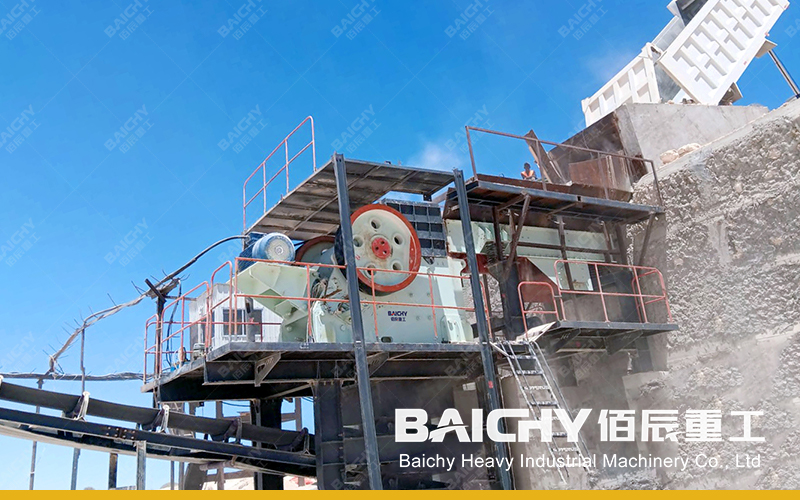
100tph aggregate crushing production line
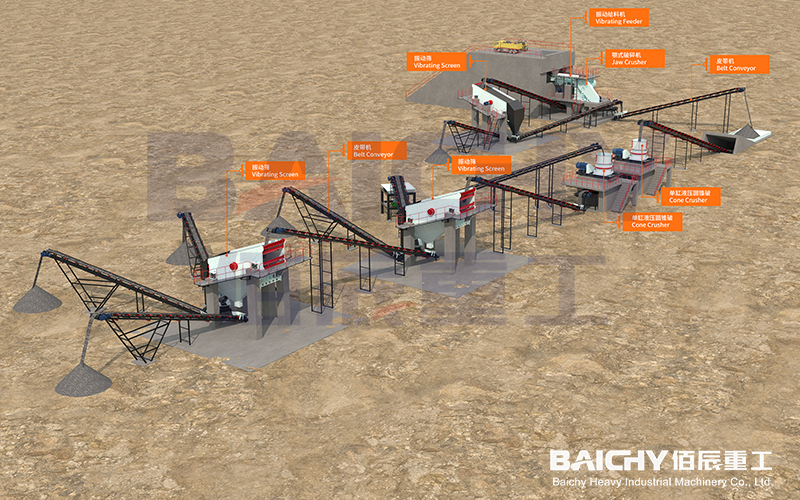
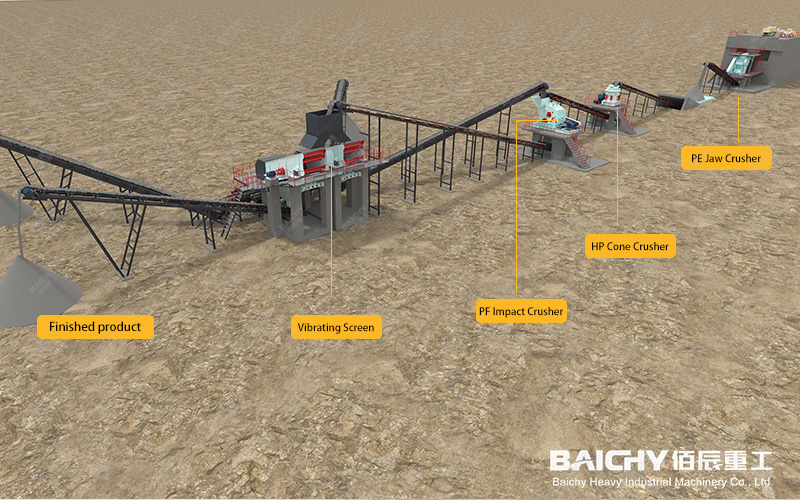
The standard configuration for a 100 t/h aggregate crushing production line is: ZSW380×96 vibrating grizzly feeder → PE600×900 jaw crusher (primary crushing) → PF1214 impact crusher (for medium-soft rock) or PYB1200 cone crusher (for hard rock) → 3YK1860 three-deck circular vibrating screen (closed-circuit classification), producing four finished product sizes in a single pass: 0–5 mm, 5–10 mm, 10–20 mm, and 20–31.5 mm.
I. Configuring the 100 t/h aggregate production line: Fixed vs. Mobile
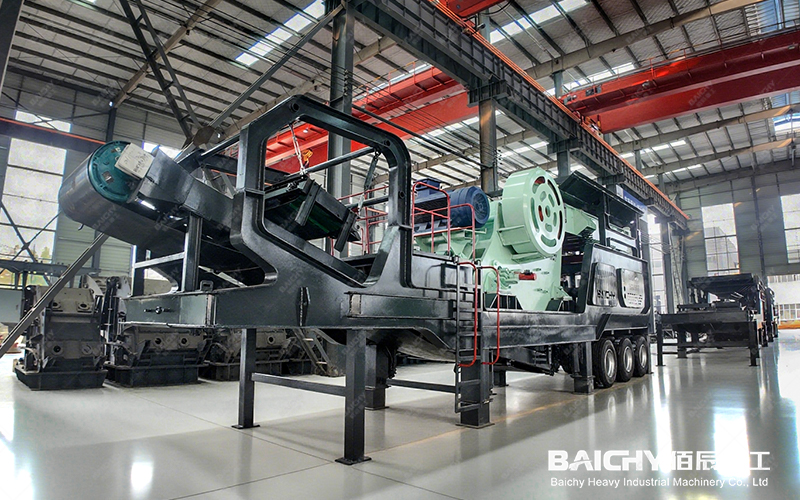
The deciding factor is not the hourly output, but the total lifecycle output. A fixed plant is superior if the quarry site is permanent, operations last over three years, and the expected total output exceeds 500,000 tons. Conversely, a wheeled mobile station is more cost-effective if quarry sites are scattered, the project duration is under one year, and the total output is below 300,000 tons. Forcing a 100 t/h aggregate line into a mobile configuration typically increases the cost per ton by 25%–40% (estimated)—due to the lack of a permanent structure, shorter conveyors, and limited maintenance space, efficiency is inherently lower and fuel costs are higher; however, the cost of relocating the plant is near zero. Decisions regarding this line should be based on "total tonnage" rather than just an "equipment list."
II. PE600×900 Jaw Crusher
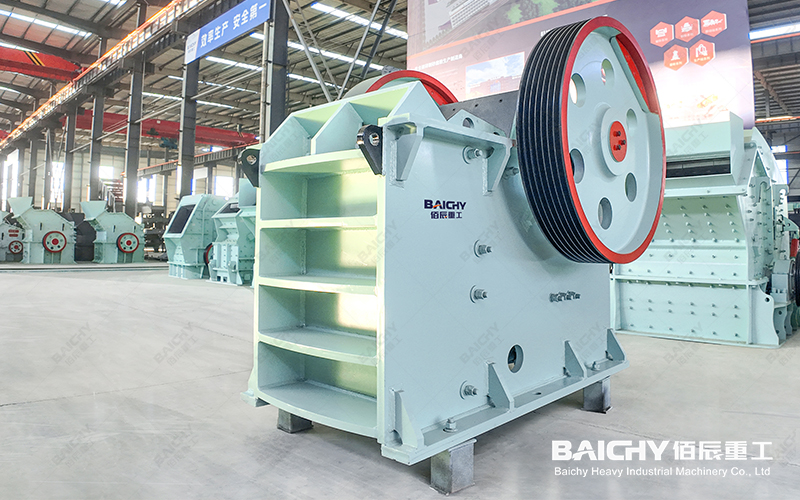
PE600x900 Jaw Crusher
The primary crusher model for the aggregate line is selected by working backward from the ratio: Feed Opening Width &pide; Maximum Raw Ore Lump Size ≥ 1.2. When the maximum raw ore lump size is ≤500 mm, the PE600×900 jaw crusher (feed opening: 600×900 mm; discharge opening: 65–160 mm; rated capacity: 48–180 t/h; power: 55–75 kW) serves as the benchmark for this class. For hard rock, the capacity is adjusted by a factor of 0.8, resulting in 38–144 t/h; a 100 t/h requirement falls within the mid-range rather than at the upper limit, ensuring the equipment can run continuously at full capacity during a shift. Let me state something that most suppliers are reluctant to say: do not configure a system for a throughput of 100 t/h using the PE750×1060 model simply because you might want to expand production later. The extra 110 kW motor and the larger frame and foundation represent sunk costs if the line operates at a load factor of less than 60%. The correct approach is to design the foundation and electrical control system to accommodate the PE750×1060, but install the PE600×900 crusher initially; this allows you to upgrade the crusher later without having to demolish the foundation.
III. Equipment Configuration for the Complete Line
| Process | Equipment | Model | Key Parameters (Limestone Calibration) | Power |
|---|---|---|---|---|
| Feeding | Grizzly Vibrating Feeder | ZSW380×96 | Trough 3800×960mm; Max. feed size ≤500mm; 100–160 t/h | 11 kW |
| Primary Crushing | Jaw Crusher | PE600×900 | Feed opening 600×900mm; Discharge opening 65–160mm; 48–180 t/h | 55–75 kW |
| Secondary/Fine Crushing (Medium-Soft Rock) | Impact Crusher | PF1214 | Feed opening 400×1430mm; Max. feed size ≤350mm; 100–180 t/h | 132 kW |
| Secondary/Fine Crushing (Hard Rock) | Spring Cone Crusher | PYB1200 | Max. feed size ≤145mm; Discharge opening 20–50mm; 110–168 t/h | 110 kW |
| Screening | Three-Deck Circular Vibrating Screen | 3YK1860 | Screen surface 1800×6000mm; Equipped with 5 / 10 / 20 (31.5) mm mesh | 22–30 kW |
| Conveying | Belt Conveyor | B800 / B650 | Main material flow: B800; Return material & finished product: B650 | — |
| Environmental Protection | Pulse-Jet Bag Dust Collector | DMC Series | Specification selected based on number of dust emission points | — |
Based on a screen power rating of 26 kW, the installed power for the main equipment of this aggregate production line is approximately 234 kW for the medium-soft rock branch and 212 kW for the hard rock branch; the calculated specific energy consumption is approximately 1.2–1.8 kWh/t (including conveying and dust collection; estimated value). Motors are customized according to local standards (380/400/440V, 50/60Hz).
IV. Secondary Crushing Selection: Focus on Abrasiveness, Not Budget
For medium-soft rock (limestone, dolomite, river pebbles, shale; compressive strength ≤150 MPa), choose the PF1214 impact crusher: it utilizes impact crushing, offers high single-pass yield and cubical shape quality, minimizes flaky/elongated particles, and produces material suitable for asphalt surfacing; for the same production capacity, the investment cost is 30%–40% lower than that of a cone crusher. For hard rock (granite, basalt, iron ore; compressive strength 150–350 MPa), the PYB1200 cone crusher is mandatory: it utilizes inter-particle (lamination) crushing, and the service life of wear parts far exceeds that of impact crusher blow bars.
There is no middle ground when selecting secondary crushers for aggregate lines: using an impact crusher for granite results in "savings on purchase price but losses due to downtime." When processing granite, blow bar life is merely 120–200 hours, with 8–16 hours of downtime per replacement; furthermore, lower unit output means a higher allocation of fixed costs per hour of downtime. Another point of restraint: multi-cylinder hydraulic cone crushers are unnecessary for this scale; the convenience of hydraulic discharge setting adjustment does not yield a sufficient return on investment for smaller lines—funds are better spent on screening and dust removal equipment.
V. How to Calculate the Cost Per Ton for Aggregate Crushing Lines?
Based on the installed power in the table above, a 0.75 load factor, and an electricity rate of 0.8 RMB/kWh, electricity costs for the medium-soft rock category are approximately 0.96–1.4 RMB/ton. However, electricity cost is not the primary variable; in the cost-per-ton breakdown for a 100 t/h aggregate line, labor, depreciation, and maintenance amortization account for a larger share than in a 200 t/h line, making "stable, continuous operation" more valuable than "peak capacity." Based on these three preferences:
① Prioritize bearing specifications and the service life of wear parts; the upper limit of capacity only affects the price quote, whereas service life directly impacts cash flow.
② Closed-circuit systems are more expensive than open-circuit ones (due to the extra return conveyor and a 15%–20% increase in screen deck load), but the price premium for aggregates comes from particle shape rather than sheer volume; notably, concrete mixing plants are most sensitive to the 5–10mm gradation.
③ Do not select feeders based on their lower-limit capacity; for a ZSW380×96 model, the 100–160 t/h range is merely "sufficient" at the 100 t/h level. If the raw ore contains clay or is wet and sticky, one must upgrade to the ZSW490×110 model.
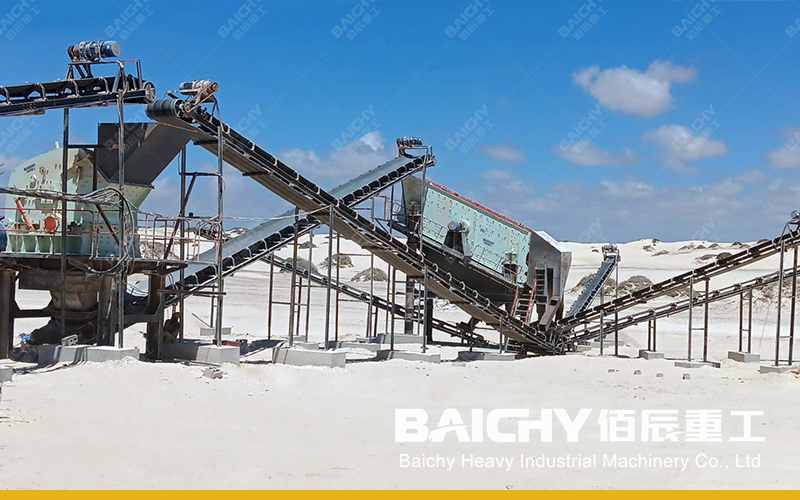
100tph gravel crushing plant
VI. Three Common Pitfalls in Aggregate Crushing Production Lines
All three pitfalls associated with this 100-ton aggregate crushing line stem from a single mindset: selecting equipment based solely on the target finished product output.
Pitfall 1: Matching secondary crushing and screening equipment to a 100 t/h capacity. In a closed-circuit setup with a 15% oversize return rate, the actual throughput required is 100 &pide; 0.85 ≈ 118 t/h. Matching equipment to the 100 t/h figure leads to fluctuating product quality, excessive screen bearing temperatures, and drastically reduced lifespans for liners and screen meshes.
Pitfall 2: Quoting only the main machinery while omitting dust removal and enclosure systems. Environmental compliance inspections often fail due to issues with dust emission points; the cost of retrofitting conveyor covers and dust extraction piping—plus the need for a second production shutdown—far exceeds the cost of installing a DMC dust collector correctly from the start.
Pitfall 3: Treating nameplate capacity as the acceptance standard. Nameplate ratings are typically based on limestone processing; acceptance criteria should be anchored to actual measured continuous hourly output, with correction factors and specific operating conditions clearly defined in the contract.
VII. FAQ
Q1: Can this 100-ton aggregate crushing line actually run at a full 100-ton capacity?
A1: Yes, provided the operating conditions are suitable. The values in the table are nominal (calibrated for limestone with a bulk density of approx. 1.6 t/m³); actual operational capacity is determined by applying a multiplier of 0.85–0.95 for medium-soft rock and 0.75–0.85 for hard rock. Equipment selection should include a 10%–15% margin, and acceptance testing should be based on measured continuous hourly output rather than nameplate figures.
Q2: Is a PE600×900 crusher sufficient for primary crushing, and when is it necessary to upgrade to a PE750×1060?
A2: It is sufficient if the maximum feed size is ≤500mm; even after adjusting for hard rock, the capacity remains 38–144 t/h. Upgrading is necessary in three scenarios: maximum feed size is 500–630mm; the target output is 150–200 t/h; or rock hardness fluctuates significantly, requiring a larger buffer margin. If the upgrade is merely to allow for future capacity expansion, the foundation and electrical controls can be sized for the PE750×1060 while the PE600×900 unit is installed initially.
Q3: Should an impact crusher or a cone crusher be chosen for the secondary crushing stage?
A3: It depends on abrasiveness. For limestone, dolomite, and river pebbles, choose the PF1214 (impact crusher); it produces good particle shape suitable for asphalt surface layers and requires 30%–40% less investment. For granite, basalt, and iron ore, choose the PYB1200 (cone crusher); it utilizes inter-particle (lamination) crushing, and the wear parts last several times longer than impact crusher blow bars. If an impact crusher is used for hard rock, blow bars last only 120–200 hours, and the downtime for replacements will quickly erode profits.
Q4: How is the cost per ton generally calculated?
A4: Taking the medium-soft rock processing line as an example, the installed capacity is approximately 234 kW. Based on a 0.75 load factor and an electricity rate of 0.8 RMB/kWh, the electricity consumption is about 1.2–1.8 kWh per tonne, resulting in an electricity cost of approximately 0.96–1.4 RMB/tonne (estimated). The total cost per tonne is derived by adding labor, wear-part amortization, and equipment depreciation to this figure. The critical variables are the service life of wear parts and the frequency of downtime, not the electricity price.
Q5: What provisions should be made for a future expansion to a capacity of 200 tonnes per hour?
A5: Provisions are needed in three areas: First, the foundation and anchor bolt holes for the jaw crusher should be sized for a PE750×1060 model. Second, the secondary crushing stage should have a reserved foundation location and electrical control circuit for a second crusher. Third, the screening building should have space reserved for installing a second circular vibrating screen and the corresponding conveyor belt interface; additionally, the width of the main conveyor belt should not be selected at the absolute limit of its capacity.
Baichy Heavy Industry
Baichy Heavy Industry is a high-tech mining equipment company integrating R&D, manufacturing, sales, and after-sales service. Focusing on crushing, grinding, and mineral processing equipment, we provide professional solutions to our customers. We are ISO9001:2015 、certified, and our products include mobile crushing palnts, crawler crushing plant, construction waste crushing plants, jaw crushers, sand making machines, cone crushers, fine crushers, grinding mills, ball mills, etc., all with reliable performance to meet diverse project needs.
Baichy Heavy Industry – Your Trusted Partner
To ensure optimal performance of your equipment, Baichy Heavy Industry offers:
- Professional on-site installation guidance
- Comprehensive operator training
- 24/7 technical support & maintenance services
Our complete after-sales service system guarantees long-term, stable operation of your machinery with minimal downtime.
Protect Your Rights – Only Use Official Channels
To avoid scams and ensure authentic support, contact us exclusively through:
• Official Website: www.baichychina.com
• WhatsApp: +8615093222637
• Email: [email protected]
Your satisfaction is our priority – expect prompt, professional service every time.
(Note: Beware of unauthorized third parties claiming to represent Baichy. Always verify through official contacts.)