vertical mill for gypsum
Electricity consumption for grinding typically accounts for over 30% of the processing costs for non-metallic minerals. The SRM1300 vertical gypsum mill integrates grinding, drying, and classification into a single main unit; it can process feed material with up to 15% moisture content by drying it simultaneously during grinding. The system's electricity consumption is 25%–35% lower than the traditional "drying plus ball milling" route—this is the fundamental reason why gypsum board factories and gypsum powder production lines designate it as the standard choice for new projects.
Selecting gypsum grinding equipment essentially comes down to balancing three factors: moisture content, fineness, and electricity consumption; the SRM1300 minimizes all three. Although gypsum has a low Mohs hardness (1.5–2) and a Bond Work Index of approximately 8 kWh/t (compared to ~11–13 for limestone), it is easy to grind but tricky to handle: it has a surface moisture content of 3%–15% and is sensitive to heat (prone to clogging/sticking). Traditional methods require a three-machine series setup: drying, then ball milling, then classification. The SRM1300 replaces steel ball impact with material bed compression, performing grinding, drying, and powder classification in one unit. It reduces system electricity consumption by 25%–35% and occupies only half to two-thirds of the space required by a ball mill system; the savings on the separate dryer and civil engineering costs directly offset the price difference of the main unit.
I. Why gypsum grinding is shifting to vertical mills: Analyzing the costs of the traditional three-machine series
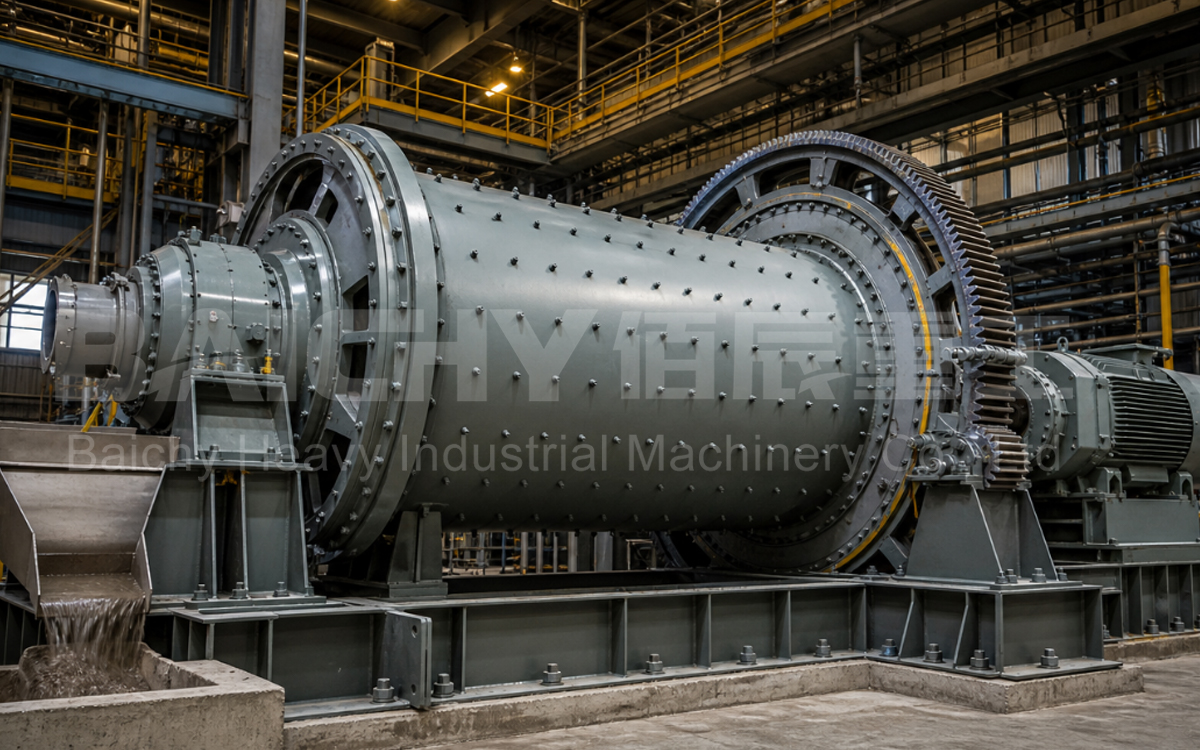
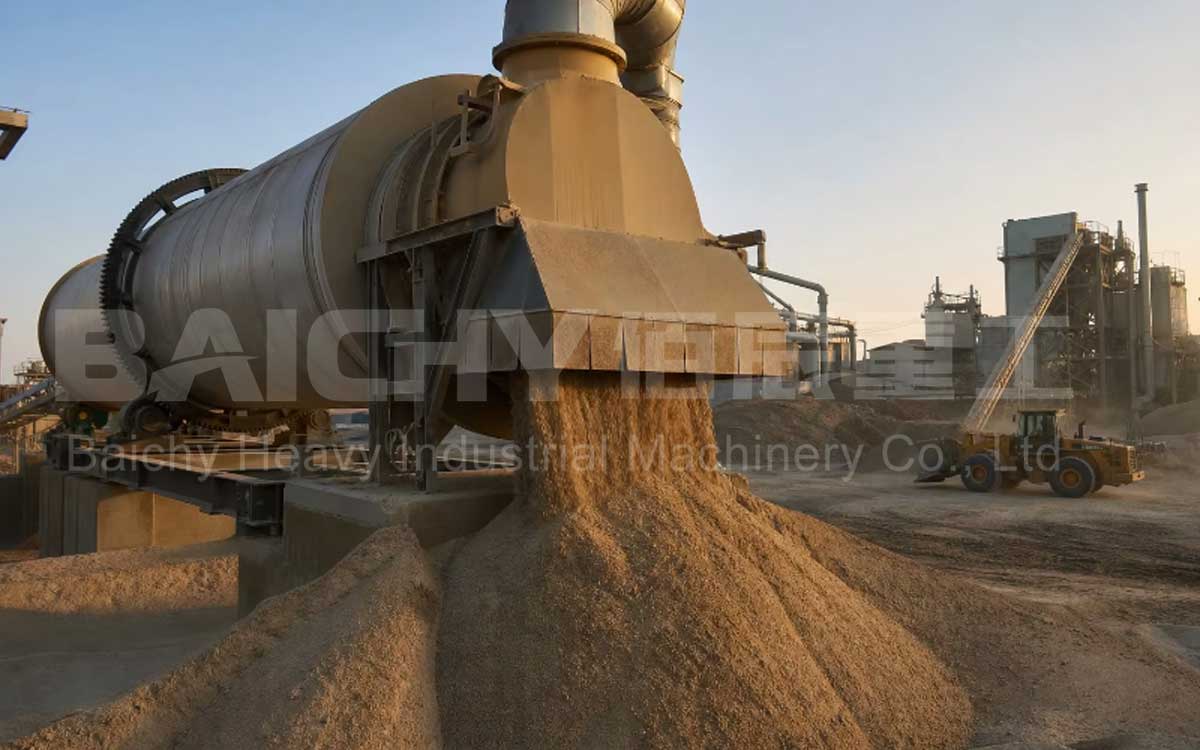
The traditional solution for gypsum grinding involves a rotary dryer, a ball mill, and an external powder classifier, resulting in numerous pieces of equipment, high power consumption, and a large footprint. Ball mill systems have strict requirements for feed moisture content (<1%–2%), necessitating the pre-drying of wet gypsum. In contrast, the SRM1300 handles feed moisture up to 15% by drying while grinding; the hot air serves as both the transport and drying medium, thereby eliminating the need for a dedicated pre-drying line and associated fuel costs. For the same output of 1 ton of powder, the power consumption of a vertical mill system is 25%–35% lower than that of a ball mill line. Based on a rough calculation—assuming 7,000 annual operating hours and an electricity price of $0.08/kWh—a production line with a 10 t/h capacity can save tens of thousands of dollars annually on electricity costs, with savings increasing as production capacity scales up.
| Comparison Item | SRM1300 Gypsum Vertical Mill | Ball Mill System | Raymond Mill |
|---|---|---|---|
| Feed Moisture Requirement | ≤15% (simultaneous drying & grinding) | <1%–2% (requires pre-drying) | ≤3%–5% (excess moisture causes roller clogging) |
| System Power Consumption | Baseline (25%–35% lower) | 25%–35% higher | Slightly higher than vertical mill |
| Fineness Adjustment | Variable-frequency dynamic classification; adjustable online without stopping | Requires shutdown to change grading | Requires shutdown to change classifier impeller |
| Single-Unit Capacity Limit | 6–18 t/h (gypsum application) | High | Typically ≤10–15 t/h |
| Footprint & Auxiliaries | Single main unit; smallest footprint | Dryer + mill + powder selection tower | Relatively small |
It should be noted that vertical mills and Raymond mills do not simply replace one another; rather, they serve different capacity needs. For small grinding stations with capacities under 6 t/h and a single fineness requirement, the Raymond mill remains a pragmatic choice due to its lower initial cost and simpler maintenance. However, once capacity exceeds approximately 8–10 t/h—and especially when raw materials contain moisture or the process requires switching between multiple fineness grades—the SRM1300’s advantages in power consumption and footprint become overwhelming. This is why gypsum board manufacturers specify vertical mills in the designs for new production lines.
II. SRM1300 Core Parameters: Typical Configuration Specifications for Gypsum Applications
The table below outlines the specifications for the compact models in the Baichy SRM gypsum vertical mill series, based on standard gypsum processing conditions (feed size ≤30 mm; surface moisture 3%–10%). Production capacity varies based on target fineness, feed moisture content, and gypsum source (natural ore vs. desulfurization gypsum). Before the contract is signed, Baichy provides free material grinding tests and guarantees production capacity based on the test data.
| Parameter | SRM1300 (Gypsum Application) |
|---|---|
| Grinding table diameter (mm) | 1300 |
| Number of grinding rollers | 2–3 (hydraulically pressurized) |
| Max. feed particle size (mm) | ≤30 |
| Finished product fineness | 80–325 mesh (0.18–0.045 mm; adjustable online via VFD-controlled dynamic classifier) |
| Typical capacity (t/h) | 6–18 (based on 120 mesh; varies with fineness and moisture) |
| Feed material moisture | ≤15% (simultaneous drying and grinding) |
| Finished product moisture | ≤1% |
| Hot air inlet temperature (°C) | ≤350 |
| Outlet air temperature (°C) | 70–95 (pure drying-grinding mode; calcination process requires separate specification) |
| Main motor power (kW) | 185–250 (customizable for 50/60 Hz and 380/400/440 V grids) |
| System components | Main unit + hot air furnace/waste heat interface + cyclone separator + bag filter + VFD-controlled draft fan |
Note on specifications: The values above are derived from public data for the Baichy SRM series (e.g., SRM1500: 1500 mm table, 250–355 kW motor) using proportional scaling and accounting for the specific grindability of gypsum. They represent typical industry ranges rather than a commitment for a specific model. Please verify details against official product documentation before a formal quote; actual performance is determined by material grinding tests and the signed technical agreement.
III. The Three Challenges of Gypsum Processing: Moisture, Temperature, and Fineness—How the Vertical Mill Addresses Each
Gypsum grinding differs from processing inert materials like calcium carbonate; the main challenges lie in three areas: sensitivity to moisture, sensitivity to heat, and the tendency to clog or "paste" (stickiness). The structural design of the SRM1300 is specifically engineered to address each of these issues.
Moisture Control: Direct feed for materials with ≤15% moisture; simultaneous drying and conveying via hot air.
FGD desulfurization gypsum typically contains 10–15% free moisture, whereas stockpiled natural gypsum usually ranges from 3% to 8%. Ball mill systems require feed moisture levels below 1–2%, necessitating pre-drying for wet materials; in contrast, the SRM1300 introduces hot air (≤350°C) through the annular gap of the grinding table—dehydration occurs as the airflow lifts the material, resulting in a stable final moisture content of ≤1%. For power plant clients, this transforms an environmental disposal cost into revenue from marketable powder; with China’s 2023 desulfurization gypsum output reaching approximately 158 million tons and a utilization rate of about 80%, the resource recovery of byproduct gypsum represents a clear growth market.
Temperature Control: Managing grinding heat to avoid the 150°C phase-change threshold.
Gypsum begins to lose 1.5 molecules of crystal water to form hemihydrate gypsum at approximately 150°C. During standard grinding operations, high-volume airflow rapidly dissipates heat from the grinding chamber, maintaining the outlet air temperature between 70°C and 95°C and preventing "over-burning" inside the mill—a temperature control strategy that distinguishes gypsum vertical mills from raw meal mills. If the desired product is construction gypsum powder (β-hemihydrate gypsum), a calcination stage (150–180°C) is required post-grinding; Baichy offers an integrated "vertical mill + fluidized bed calciner" solution, assigning the dehydration process to a dedicated calcination stage for precise control.
Fineness Control: Online adjustment via dynamic classifier allows a single production line to serve multiple price tiers.
The 80–200 mesh range covers mainstream particle sizes for cement retarder powder, plastering gypsum, and gypsum board core material, while filler-grade powders exceeding 600 mesh rely on consistent D97 values for market value. The SRM1300 features a top-mounted, variable-frequency dynamic classifier that allows for stepless adjustment of product fineness between 80 and 325 mesh during operation. For instance, a plant can produce 200-mesh retarder powder in the morning and switch to 120-mesh board core material in the afternoon without shutting down to change parts; since fineness dictates price points, the ability to produce multiple grades with a single machine effectively dilutes the cost per ton.
IV. From Raw Material Pile to Finished Product: SRM1300 Line Configuration and Three Commonly Omitted Components
Beyond the main unit, a continuous gypsum grinding line requires a complete set of auxiliary equipment. Baichy delivers the line as a complete system, following this standard sequence:
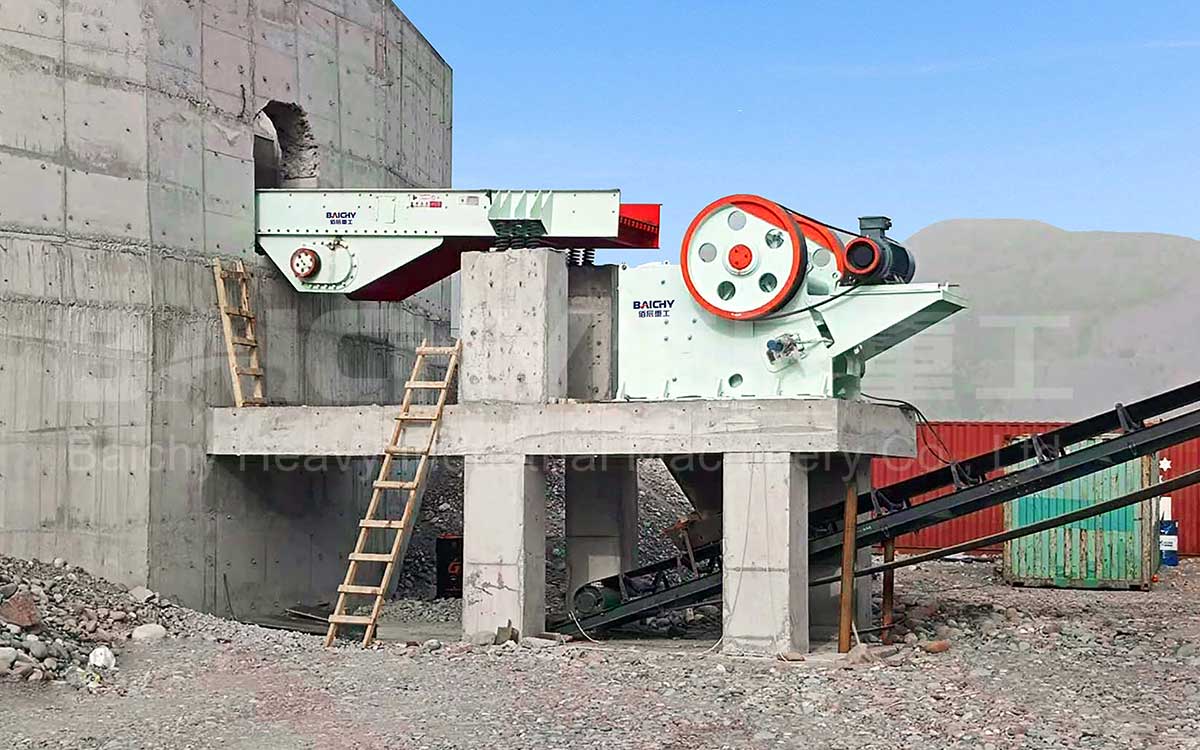
Jaw crusher (reducing lump ore from ≤210 mm to ≤30 mm) → Bucket elevator + storage silo → Electromagnetic iron remover + quantitative feeder → SRM1300 vertical mill (integrating grinding, drying, and classifying) → Cyclone collector → Pulse-jet bag filter → Finished product conveying and packaging.
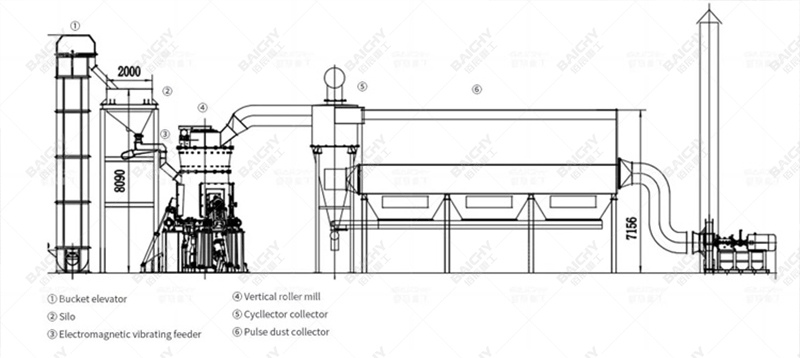
Schematic diagram of the vertical mill process
Three specific stages are frequently overlooked in "low-price quotations": First, pre-grinding iron removal and quantitative feeding—gypsum ore often contains metallic impurities, so an iron remover protects the grinding rollers and table, while stable feeding ensures a consistent material bed. Second, the pulse-jet bag filter—gypsum powder is fine and prone to dusting; negative-pressure dust collection is not only an environmental compliance requirement but also a means of recovering finished powder, effectively representing "hidden" production capacity. Third, the hot air source design—if waste heat is available (e.g., from kiln tails or boiler flue gas), it should be utilized; otherwise, a hot air furnace is required. This choice determines whether drying costs approach zero or become a constant drain on funds.
V. Selection Limits: When the SRM1300 Is Not the Right Choice
There is no such thing as inherently good or bad equipment—only the degree of suitability for the application. For three specific operating scenarios, alternative solutions are recommended: If the single-unit demand is consistently below 6 t/h and a single fineness grade is required, a Raymond mill offers lower investment costs and a faster payback period. If the gypsum contains high levels of SiO₂ or hard impurities, the cost of wear on grinding rollers and tables would negate energy-saving gains; impurity removal should be performed before evaluating the equipment. If the target product is α-hemihydrate (high-strength) gypsum or specialty gypsum requiring precise phase-change control, a dedicated calcination process should be selected rather than relying on the grinding stage for dehydration. The decision should be based on a unified financial assessment: comparing material data, production capacity, electricity cost differentials, and wear-related costs to determine which route offers the shortest payback period.
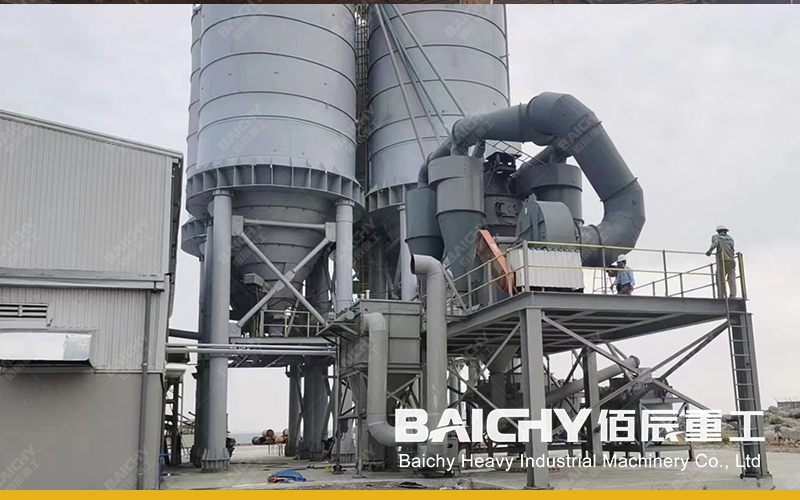
SRM1300 model Vertical Roller Mill For Gypsum
VI. FAQ (Frequently Asked Questions)
Q1: How should one choose between the SRM1300 vertical gypsum mill, the Raymond mill, and the ball mill?
A1: The choice depends on three key parameters: production capacity, moisture content, and fineness requirements. If feed moisture exceeds 5%, capacity consistently exceeds 8–10 t/h, or there is a need to switch between multiple fineness grades, the SRM1300 is the standard choice for new production lines due to its simultaneous grinding and drying capabilities and 25%–35% lower electricity consumption. If moisture is below 3%, a single fineness grade is required, and capacity is under 6 t/h, the Raymond mill offers a lower entry barrier. Ball mills remain valuable for processing highly abrasive materials or meeting specific particle size distribution requirements. When in doubt, send a 5–10 kg sample for free material testing and let the data guide your decision.
Q2: Gypsum is heat-sensitive; will the SRM1300 "pre-calcine" (dehydrate) the gypsum inside the mill and ruin its setting properties?
A2: No. During standard grinding operations, the SRM1300 maintains an outlet air temperature between 70°C and 95°C—well below the 150°C threshold for dehydration phase change. High-volume airflow continuously dissipates the heat generated during grinding, ensuring the gypsum exits the mill in a stable dihydrate state. If the finished product is construction-grade gypsum powder (β-hemihydrate gypsum), the dehydration process should take place in a dedicated calcination stage following the grinding process. Baichy configures the production line using a "vertical mill + fluidized bed calciner" setup; by controlling grinding and phase transformation separately, the company avoids the drift in initial setting time caused by "over-burning" inside the mill.
Q3: How is the nominal capacity of the SRM1300 determined? Is the calculation the same for desulfurization (FGD) gypsum and natural gypsum?
A3: A mill's nominal capacity is typically calculated based on a limestone benchmark. However, since gypsum has a low bulk density (only 1.3–1.5 t/m³) and excellent grindability, the calculated tonnage capacity often increases rather than decreases when adjusted for volume. The reliable approach is to require the manufacturer to provide a test report based on three specific parameters—dry basis, feed moisture content, and target sieve residue—and to include the guaranteed capacity in the contract. Because natural gypsum and FGD desulfurization gypsum differ in feed moisture and particle size, capacity inquiries should be handled separately; Baichy bases its contractual capacity figures on data from free material tests rather than making empty promises regarding "nominal capacity."
Baichy Heavy Industry
Baichy Heavy Industry is a high-tech mining equipment company integrating R&D, manufacturing, sales, and after-sales service. Focusing on crushing, grinding, and mineral processing equipment, we provide professional solutions to our customers. We are ISO9001:2015 、certified, and our products include mobile crushing palnts, crawler crushing plant, construction waste crushing plants, jaw crushers, sand making machines, cone crushers, fine crushers, grinding mills, ball mills, etc., all with reliable performance to meet diverse project needs.
Baichy Heavy Industry – Your Trusted Partner
To ensure optimal performance of your equipment, Baichy Heavy Industry offers:
- Professional on-site installation guidance
- Comprehensive operator training
- 24/7 technical support & maintenance services
Our complete after-sales service system guarantees long-term, stable operation of your machinery with minimal downtime.
Protect Your Rights – Only Use Official Channels
To avoid scams and ensure authentic support, contact us exclusively through:
• Official Website: www.baichychina.com
• WhatsApp: +8615093222637
• Email: [email protected]
Your satisfaction is our priority – expect prompt, professional service every time.
(Note: Beware of unauthorized third parties claiming to represent Baichy. Always verify through official contacts.)