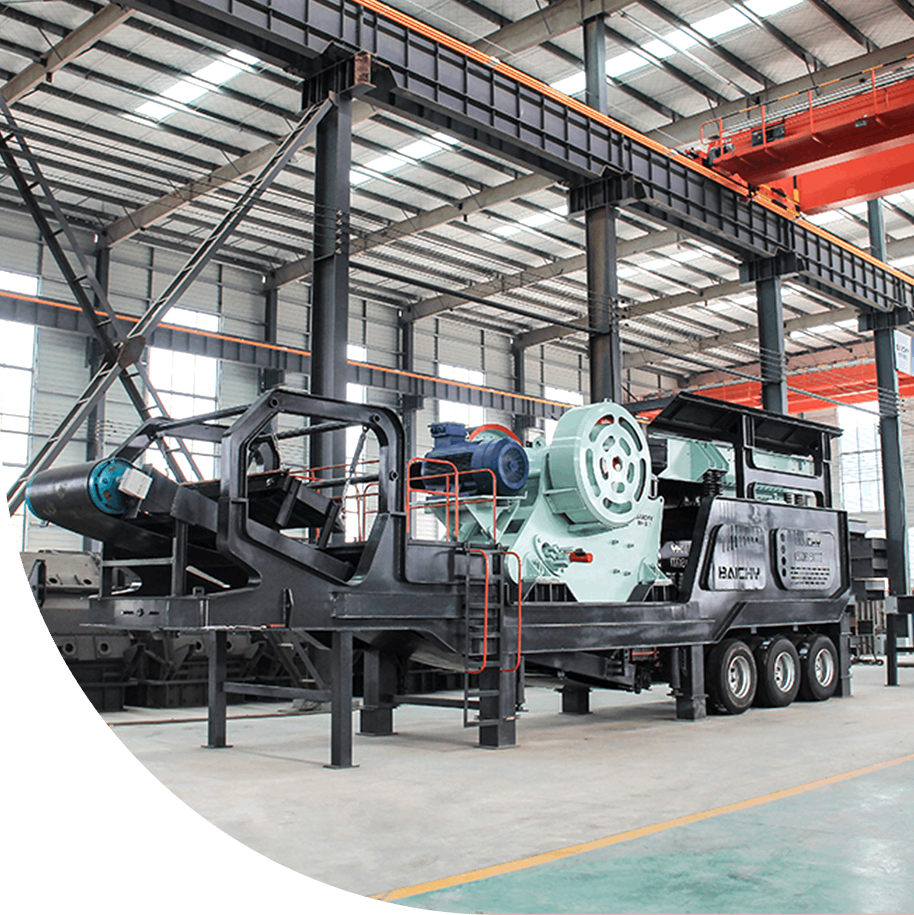

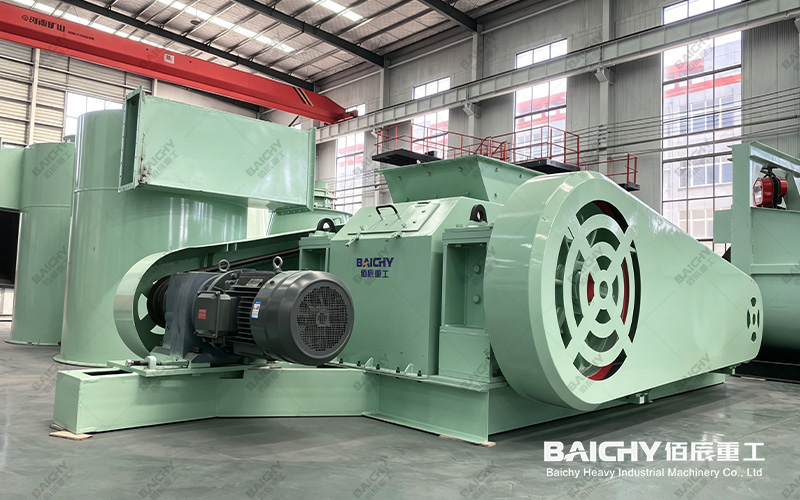
Toothed Double-Roll Crusher
The toothed double-roll crusher achieves size reduction through the shearing and splitting actions of two toothed rolls. Compared to compression-type equipment, it offers a lower rate of over-crushing (fines generation), superior resistance to jamming, and lower electricity consumption per ton. It is the preferred choice for the primary and secondary crushing of medium-soft materials such as coal, coal gangue, coke, limestone, and weathered rock. For production lines plagued by frequent machine jams and excessive fines, installing this crusher at the primary or secondary stage is often the quickest and most effective upgrade solution.
I. Overview of the Toothed Double-Roll Crusher: Structure and Working Principle
1.1 Shearing and Splitting Crushing Mechanism
The toothed double-roll crusher features two counter-rotating rolls with surfaces covered in teeth. As material enters the roll gap, it is gripped by the teeth and fractured along natural fissures or planes of weakness due to shearing and wedging forces. This process is one of "splitting" rather than "grinding" or "crushing"; consequently, the generation of fine powder is significantly lower than that of jaw or hammer crushers. The output contains a high proportion of lump material, which helps maintain the efficiency of downstream screening and grinding operations.
1.2 Core Structural Components
The machine consists of a frame, dual toothed rolls, a roll-gap adjustment mechanism, a dual-motor drive system, and an overload protection system. The tooth surfaces are cast from high-manganese steel or hard-faced with alloy, allowing for repair via welding after wear occurs. If uncrushable objects—such as iron chunks or roof bolts—are encountered, a hydraulic or spring-loaded retraction mechanism allows the rolls to momentarily shift aside; the rolls automatically reset after the foreign object passes, preventing damage to the toothed rolls and bearings.
II. Typical Application Scenarios for Toothed Double-Roll Crushers
The operational scope for this type of toothed roll equipment is clearly defined: it is ideally suited for materials with a Mohs hardness of medium or lower that are brittle or friable, and where an output size range of 25–200 mm is acceptable.
2.1 Coal and Coal Gangue: The Primary Application Arena
Run-of-mine coal typically has a moisture content of 15%–25% and contains clay impurities; consequently, clogging of hammer crusher grate bars and material adhesion within jaw crusher cavities are common issues. The toothed double-roll crusher operates without grate bars and features gaps between the teeth to accommodate material, allowing sticky or wet materials to pass through continuously. It is utilized in coal washing plants, coal preparation facilities, and coal gangue utilization lines for the primary crushing of raw coal; it reduces the material to under 50mm in a single pass, significantly lowering the generation of coal slime.
2.2 Coke and Metallurgical Auxiliaries
Coke requires uniform particle shape and minimal fines; the toothed rolls size the material through a shearing action, resulting in a low percentage of <10mm powder in the output and an improved coke blending yield. It is equally suitable for the primary crushing of sintered ore and metallurgical auxiliary materials.
2.3 Limestone, Cement, and Building Material Raw Materials
For the primary crushing of limestone, clay, and shale in cement raw meal lines, the output particle size can be adjusted by switching the roll gap between 50mm and 150mm. A single machine accommodates two different material processing requirements, saving on investment costs and floor space.
2.4 Chemical Industry, Slag, and Solid Waste Treatment
The equipment operates stably even with materials containing impurities or corrosive properties—such as calcium carbide residue, salt ore, boron ore, furnace slag, and construction waste—thanks to its overload protection and wide-gap design. Replacing hammer crushers with this equipment leads to simultaneous reductions in production line noise and dust emissions.
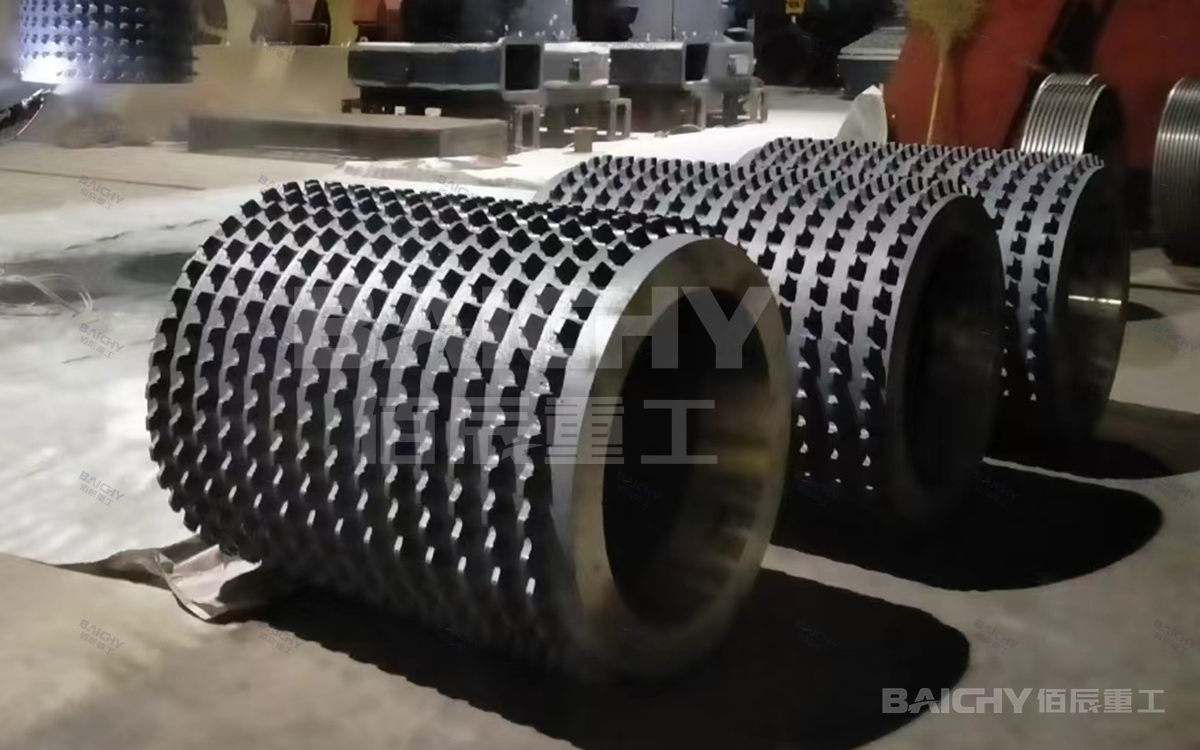
Detailed view of the toothed roll crusher
III. Core Advantages of the Toothed Double-Roll Crusher
1. Low over-crushing rate; the proportion of fines is reduced by 10–20 percentage points. The shearing and splitting crushing method significantly reduces <3mm fine particles, thereby lowering the load on coal slime water treatment in coal washing plants and reducing the coke breeze rate in coking plants. Translated into economic benefits: higher yields of qualified products for the same processing volume, and lower electricity consumption for screening and grinding.
2. Anti-jamming/clogging design; high-moisture materials do not cause machine blinding. The absence of grate bars and the presence of large gaps between teeth allow raw coal and clay with moisture content exceeding 20% to pass through continuously without clogging. This is the key differentiator compared to hammer crushers and ensures uninterrupted production during the rainy season.
3. Adjustable output particle size; one machine serves multiple purposes. The roll gap is adjusted via shims or a hydraulic system, allowing the discharge size to be switched within the 25–200 mm range; a single unit can handle both primary and secondary crushing stages, eliminating the need to replace the main machine when adjusting the production line.
4. Hydraulic overload protection ensures controllable maintenance costs. The system automatically retracts upon encountering foreign objects, and tooth surfaces can be repaired via hardfacing rather than requiring full roll replacement; consequently, spare parts and downtime costs are significantly lower than those of hammer crushers.
5. High capacity, low energy consumption, and simple foundation requirements. Featuring dual-motor direct drive and no large flywheels, a single unit achieves a throughput of 150–300 t/h; specific crushing energy consumption is 10%–25% lower than that of compression-type equipment—a critical advantage for markets sensitive to electricity costs.
IV. Technical Parameters of the 2PGC Series Toothed Double-Roll Crusher
The following specifications represent typical configurations for Baichy Heavy Industry’s 2PGC series; processing capacities are rated based on a limestone bulk density of 1.6 t/m³:
| Model | Roll Diameter × Length (mm) | Feed Size (mm) | Discharge Size (mm) | Capacity (t/h) | Motor Power (kW) | Total Weight (t) |
|---|---|---|---|---|---|---|
| 2PGC450×500 | φ450×500 | ≤200 | 25–50 | 10–30 | 2×7.5 | Approx. 6 |
| 2PGC600×750 | φ600×750 | ≤300 | 30–75 | 20–60 | 2×15 | Approx. 11 |
| 2PGC900×900 | φ900×900 | ≤500 | 50–150 | 60–120 | 2×30 | Approx. 22 |
| 2PGC1200×1500 | φ1200×1500 | ≤800 | 75–200 | 150–300 | 2×55 | Approx. 40 |
Selection Note: When crushing lightweight materials such as coal or coke, actual capacity should be adjusted based on density (multiply by approx. 0.5–0.7); for applications involving high moisture or clay content, selecting a larger model equipped with hydraulic adjustment and variable-frequency feeding is recommended. Motor voltage (380V/400V/440V/660V) and explosion-proof requirements can be customized according to project specifications.
V. Application Case Study: Toothed Double-Roll Crusher
Case Study 1: Coal gangue crushing system upgrade at a coal preparation plant in Shanxi. The original hammer crusher experienced clogging 2–3 times per shift, requiring manual clearing. After switching to the 2PGC600×750 toothed double-roll crusher, the unit's capacity stabilized at 40–55 t/h, the fine coal rate dropped by approximately 15 percentage points, and maintenance frequency decreased from 2–3 times per week to once per month.
Case Study 2: Dual-purpose limestone and clay processing at a cement plant. A single 2PGC900×900 crusher can produce materials sized below 50mm and 80mm respectively by adjusting the roll gap; this saves on the investment and footprint of a separate primary crusher and simplifies the proportioning line.
Case Study 3: Coke sizing at a coking plant. The 2PGC unit employs a shearing action for sizing to control the rate of coke fines; the proportion of <10mm fines in the output is low, coke blending yield is improved, and the comprehensive cost per ton of coke is significantly reduced.
(The above represents typical configuration references based on similar project processes; specific solutions require consideration of on-site material analysis and production line layout design.)
VI. Recommended Equipment Associated with Toothed Double-Roll Crushers
Toothed double-roll crushers are typically positioned at the primary or secondary crushing stage. Recommended process chain configurations include:
Upstream feeding: ZSW series vibrating feeder—ensures uniform feeding and pre-screening, preventing large lumps from directly impacting the rolls;
Secondary/fine crushing linkage: Smooth-roll crusher, PCK reversible hammer crusher, or impact crusher—continues crushing to sand-making or grinding particle sizes;
Screening and classification: YK series circular vibrating screen, paired with a high-frequency dewatering screen to control final product moisture;
Sand-making extension: VSI sand-making machine—further shapes and processes the toothed roll crusher's output into sand;
Downstream grinding: Ball mill or Raymond mill—processes the fine-grained material for the grinding stage.
Baichy Heavy Industry offers full-process equipment selection and turnkey production line services—covering feeding, crushing, screening, and grinding—based on material analysis reports.

double-toothed roll crusher
VII. Toothed Double-Roll Crusher FAQ
Q1: How do I choose between a toothed double-roll crusher and a smooth-roll crusher?
Consider material characteristics and target output: Toothed double-roll crushers primarily utilize a shearing and splitting action, making them suitable for medium-soft, brittle materials like coal, limestone, and clay; they offer an output size of 25–200 mm, a low rate of over-crushing (fines generation), and high resistance to jamming. Smooth-surface roll crushers rely on compression and grinding; they are suitable for harder materials or applications requiring fine output (3–10 mm), though wet, sticky materials tend to slip or adhere to the rolls. The basic rule of thumb is to choose toothed rolls for wet/sticky materials and smooth rolls for dry/hard materials requiring fine crushing.
Q2: Do toothed double-roll crushers get clogged? How wet can the material be?
They feature a grate-free design with clearance gaps between the teeth to accommodate material; under standard operating conditions, they can continuously process raw coal and clay with moisture contents of 15%–25% without clogging. For materials with higher moisture or clay content, continuous operation can be maintained by configuring hydraulic roll-gap adjustment and variable-frequency feeding systems to appropriately lower the rotational speed and increase the roll gap.
Q3: What parameters are needed to select a toothed double-roll crusher? How is capacity calculated?
Three key inputs are required: maximum feed particle size (determines roll diameter and tooth profile), target output particle size (determines roll gap range), and hourly throughput (determines roll length and motor power). Note that nominal capacity is rated based on a limestone bulk density of 1.6 t/m³; when crushing coal or coke, a conversion factor of 0.5–0.7 should be applied. It is recommended to provide a material analysis report (covering hardness, moisture content, and clay content) so that Baichy Heavy Industry can generate a selection proposal that includes capacity calculations, thereby avoiding potential shortfalls in actual throughput.
Baichy Heavy Industry
Baichy Heavy Industry is a high-tech mining equipment company integrating R&D, manufacturing, sales, and after-sales service. Focusing on crushing, grinding, and mineral processing equipment, we provide professional solutions to our customers. We are ISO9001:2015 、certified, and our products include mobile crushing palnts, crawler crushing plant, construction waste crushing plants, jaw crushers, sand making machines, cone crushers, fine crushers, grinding mills, ball mills, etc., all with reliable performance to meet diverse project needs.
Baichy Heavy Industry – Your Trusted Partner
To ensure optimal performance of your equipment, Baichy Heavy Industry offers:
- Professional on-site installation guidance
- Comprehensive operator training
- 24/7 technical support & maintenance services
Our complete after-sales service system guarantees long-term, stable operation of your machinery with minimal downtime.
Protect Your Rights – Only Use Official Channels
To avoid scams and ensure authentic support, contact us exclusively through:
• Official Website: www.baichychina.com
• WhatsApp: +8615093222637
• Email: [email protected]
Your satisfaction is our priority – expect prompt, professional service every time.
(Note: Beware of unauthorized third parties claiming to represent Baichy. Always verify through official contacts.)