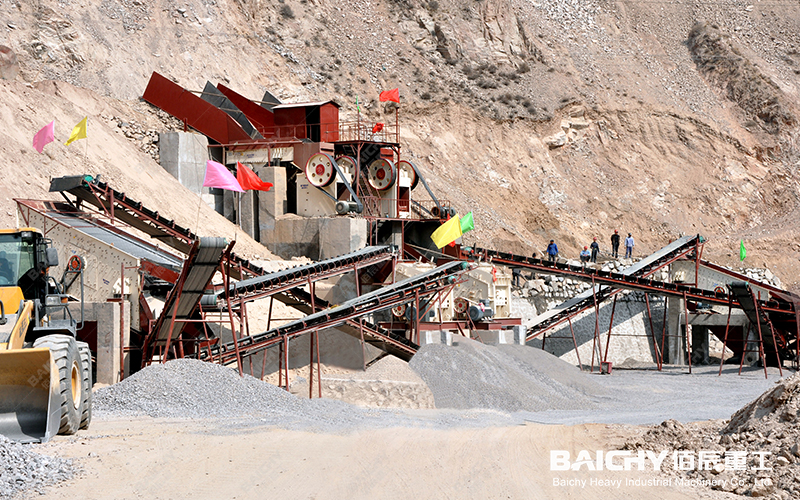
Limestone Crushing Production Line
A limestone crushing production line is not merely a matter of "buying a few crushers and piecing them together"; rather, it is a process system designed in reverse, starting from material characteristics and the desired final product structure. Baichy Heavy Industry, a manufacturer of stone crushing equipment, offers straightforward advice: for limestone with a Mohs hardness of 3–4 and a bulk density of approximately 1.6 t/m³, the standard solution is a two-stage process—primary crushing with a jaw crusher, followed by secondary/fine crushing with an impact crusher, all operating in a closed circuit with vibrating screens. This setup saves one major machine compared to three-stage crushing and offers better control over particle shape than a single-stage hammer crusher; for a 150–200 tph line, the comprehensive cost per ton is approximately ¥2.9.
To determine the true value of a production line, one should not look merely at nominal capacity, but rather at the gap between nominal and actual operational capacity, the service life of wear parts, and the quality of after-sales support—these three factors serve as the litmus test distinguishing genuine manufacturers from mere traders.
I. Overview: Why "Two-Stage, Closed-Circuit" is the Standard Solution
With a compressive strength of 50–150 MPa and low abrasiveness, limestone serves as the benchmark material for calibrating capacity in the crushing industry (most crushers are rated based on a bulk density of 1.6 t/m³). The crushing workflow is virtually undisputed: a jaw crusher reduces raw ore (≤630 mm) to 80–140 mm; an impact crusher takes over for secondary and fine crushing, producing a 0–40 mm graded product in a single pass, while oversized material is automatically recirculated to maintain a closed circuit. Impact crushers offer a high reduction ratio for medium-soft rock and produce cubical particles; blow bars can last over 180 hours, and the wear cost per ton is only one-third of that incurred when processing granite—this is the fundamental reason why the "jaw crusher + impact crusher" combination is preferred over "jaw crusher + cone crusher" for this application.
Limestone crushing lines often involve three common "parameter traps": inconsistent capacity rating standards; mismatches between feed size and reduction ratio (making grizzly pre-screening and buffer bins essential); and an inability to adjust the final product size distribution. Engineering expertise in addressing these aspects marks the piding line between professional crushing equipment manufacturers and distributors who simply sell inpidual machines.
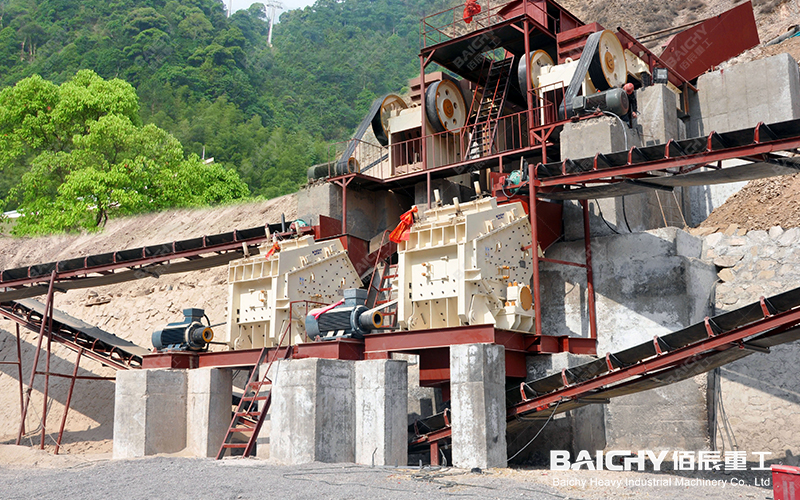
Limestone crushing production line
II. Application Scenarios: Four Main Demand Streams
Cement plants and ready-mix concrete stations require 0–31.5 mm continuously graded aggregate; impact crushing for shaping ensures a flaky/elongated particle content of <10%, allowing for direct bin storage. Lime kilns and steel plants require 40–80 mm flux-grade lump stone; adjustable discharge settings ensure stable kiln operation. Power plant desulfurization and agricultural lime applications require crushing to ≤10–15 mm for mill feeding; finer output reduces energy consumption during subsequent grinding. For mixed feedstocks containing clay and moisture (such as recycled construction waste), grizzly pre-screening and a closed-circuit design provide the necessary safeguards. All four scenarios share a common critical factor: the design of the upstream pre-screening and buffer systems determines whether the production line can achieve its rated capacity.
III. Core Parameter Table: Standard Configuration for a 150–200 TPH Limestone Crushing Line
Capacity is rated based on medium-hardness limestone (bulk density approx. 1.6 t/m³); for materials with >8% moisture content or high clay content, the rated capacity should be adjusted by a factor of 0.7–0.85, and upstream grizzly pre-screening is mandatory.
| Equipment Unit | Model | Quantity | Power (kW) | Feed Size | Discharge Size | Single-Unit Capacity (Limestone) |
|---|---|---|---|---|---|---|
| Vibrating Feeder (Grizzly Pre-screener) | ZSW490×110 | 1 | 15 | ≤630mm | Pre-screening (soil removal) | 120–280 t/h |
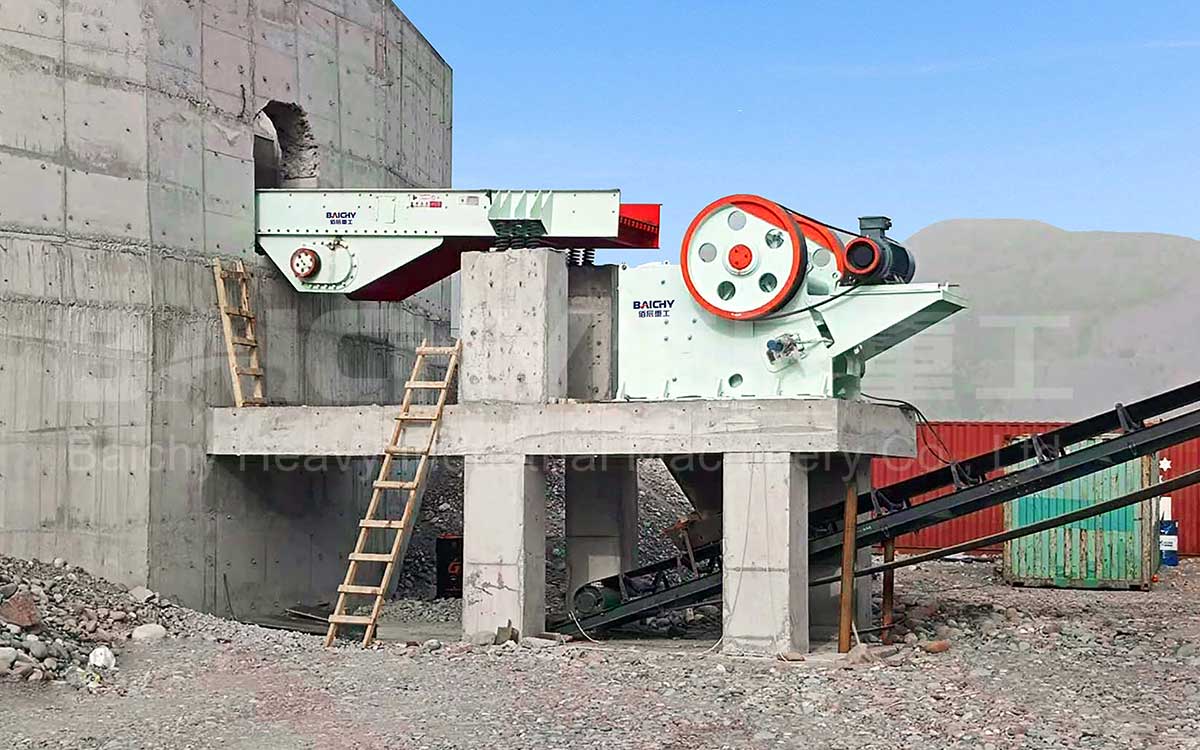
| Jaw Crusher (Primary Crushing) | PE750×1060 | 1 | 110 | ≤630mm | 80–140mm (adjustable) | 110–180 t/h |
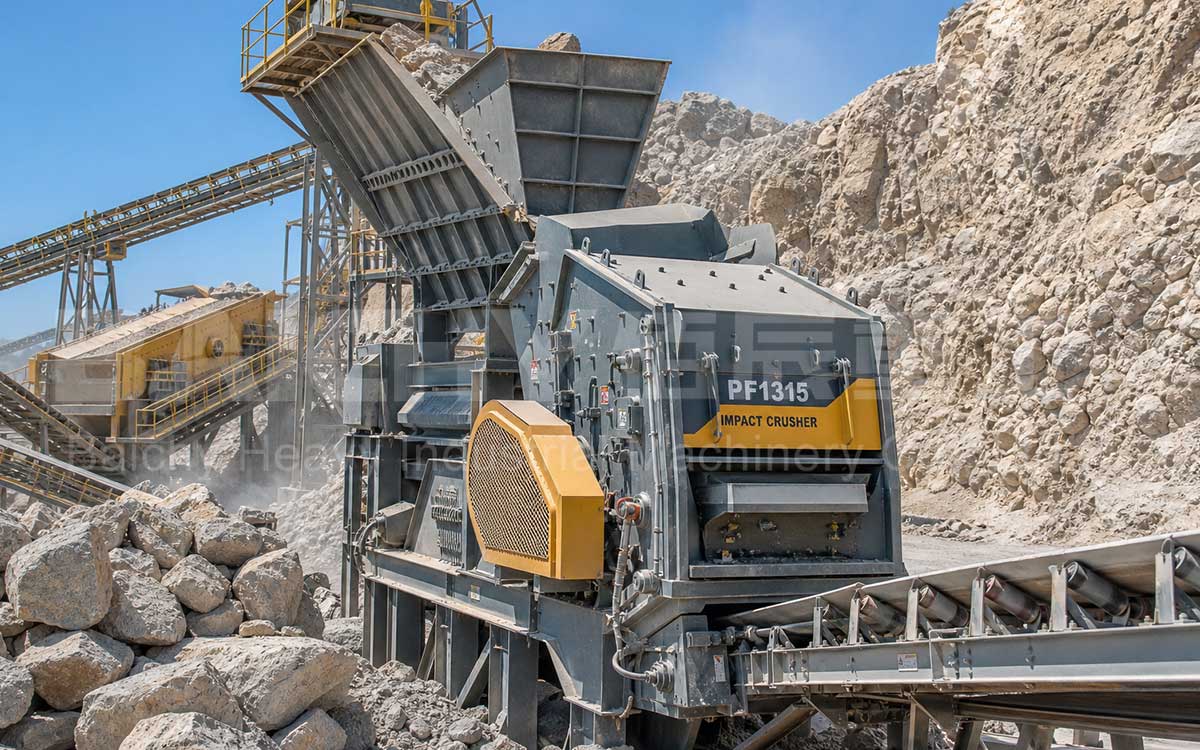
| Impact Crusher (Secondary/Fine Crushing) | PF1315 | 1 | 220 | ≤350mm | 0–40mm (adjustable) | 130–250 t/h |
| Circular Vibrating Screen (Closed-circuit) | 3YK2460 | 1 | 37 | ≤80mm | 0–5/5–20/20–40mm | 80–320 t/h |
| Total Line | — | — | Main units: ~382 | ≤630mm raw ore | 2–3 finished product grades | 150–200 t/h |
Quick Operating Cost Calculation (CNY/tonne; electricity at ¥0.8/kWh): Power consumption 2.2 kWh/t (¥1.76) + Jaw plates (¥0.36) + Blow bars (¥0.39) + Screen mesh (¥0.15) + Labor (¥0.24) ≈ Total cost of ¥2.90/tonne. Based on an annual output of 500,000 tonnes, this saves 8–12% on power and wear-part expenses compared to a three-stage crushing scheme.
Budget-Sensitive Alternative: If raw ore is ≤200mm and only a single finished product size of ≤20mm is required (e.g., for lime kilns or grinding mills), a PC/PCZ hammer crusher can be used for single-stage shaping. This reduces main equipment investment by approximately 25–30%, though it offers limited ability to adjust particle shape.
IV. Equipment Advantages: How Manufacturers Turn Specifications into Profit
Rated by "Actual Production Capacity" rather than "Nominal Capacity" — Baichy uses a baseline density of 1.6t/m³. A vibrating grizzly feeder removes soil, while a buffer bin synchronizes the intermittent discharge of the jaw crusher with the continuous feed of the impact crusher, eliminating the common discrepancy where a machine rated at 200tph delivers only 150tph in practice.
Two-Stage Crushing with One Closed Loop — Saves the cost of an extra machine compared to three-stage crushing, reducing expenses related to the main unit, electricity consumption, foundations, and footprint; this is the most cost-effective solution for the 150–200tph capacity range.
Impact Crusher + Limestone = Optimal Configuration — Limestone’s compressive strength falls perfectly within the "sweet spot" for impact crushing; the resulting product has a low flakiness/elongation index and meets concrete aggregate standards directly. Using a cone crusher for such soft material would be "using a sledgehammer to crack a nut."
Manufacturing Quality Determines Service Life — As a crusher manufacturer, our core value lies in high-manganese steel casting and water-toughening treatment for jaw plates, alloy customization for blow bars based on operating conditions, and ISO-standard flaw detection and stress relief for main shaft forgings and frames. Differences in casting processes can result in a 30–50% variance in jaw plate service life.
Global Compatibility for Power and Spare Parts — The entire line requires approximately 382kW and supports 380V/50Hz, 400V/50Hz, and 440V/60Hz power supplies, as well as diesel generator power; no local modifications are needed for 60Hz markets. Wear parts feature a modular design, allowing overseas projects to manage inventory on a quarterly basis.
V. Application Case Studies: The Data Speaks
Case Study 1: Aggregate Production Line for a Cement Group in Southeast Asia (200tph) — Configuration: ZSW490×110 → PE750×1060 → PF1315 → 3YK2460. Limestone processing throughput remains stable at 185–195 t/h, with a product compliance rate exceeding 95%; the content of flaky and elongated particles in the 5–20 mm aggregate fraction is <10%, meeting grading requirements for C30–C50 concrete; the comprehensive cost is approximately ¥2.9 per tonne, and the investment in the crushing section is recouped in about 16 months.
Case Study 2: Limestone kiln feed line in the Middle East (80 tph) — Configured with a PE600×900 jaw crusher, PF1210 impact crusher, and 2YK1860 vibrating screen. The compliance rate for 40–80 mm flux-grade stone exceeds 90%, and the reduction in production capacity during the rainy season is kept within 10%.
Key Takeaway: The design of primary pre-screening and buffer systems determines whether a production line can achieve its rated capacity; this relies on the manufacturer's system design capabilities rather than a mere aggregation of inpidual machine specifications.
VI. Recommended Equipment
ZSW Series Vibrating Feeder — Uniform feeding + grizzly bar pre-screening for soil removal
PE/PEX/C90 Series Jaw Crusher — Primary crushing workhorse; capacities ranging from 50 to 800 tph
PF Series Impact Crusher — Key equipment for secondary/tertiary limestone crushing; produces excellent particle shape
PC/PCZ Series Hammer Crusher — Budget-friendly, single-stage crushing solution
YK/GTS Series Circular Vibrating Screen — Product sizing and closed-circuit circulation
Sand Washer + Fine Sand Recovery Unit — For processing high-silt materials and recovering fine sand
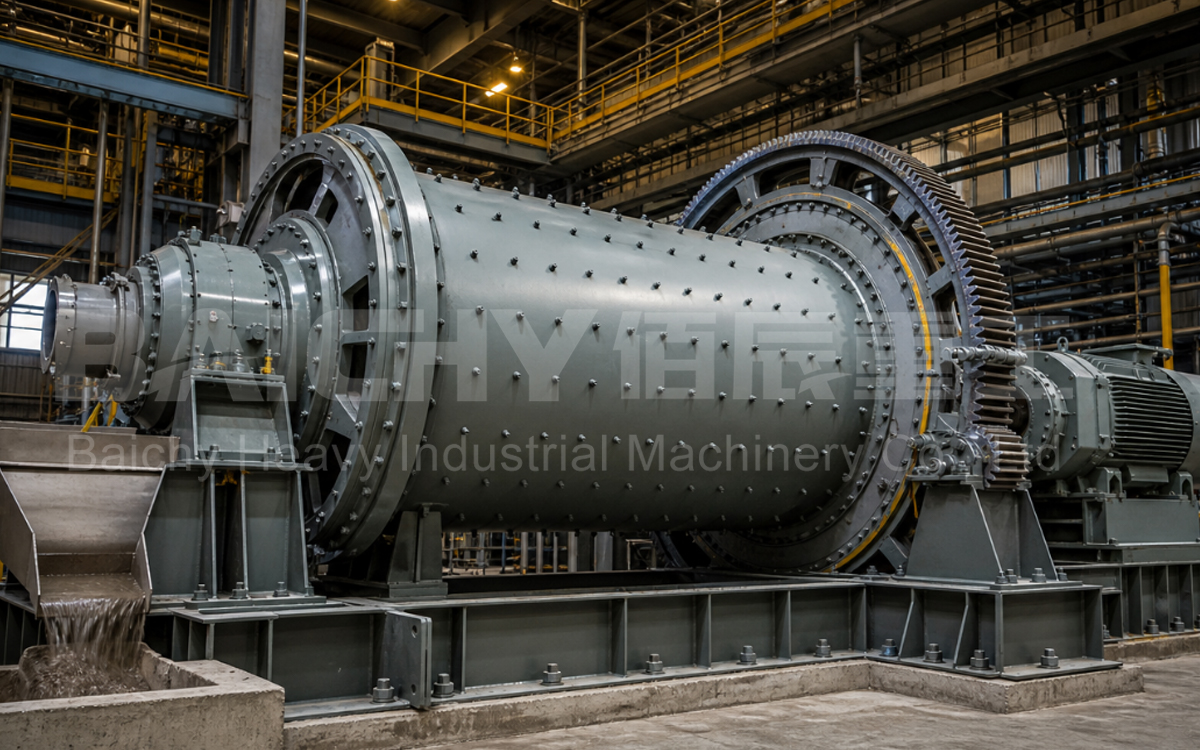
Raymond Mill/Ball Mill — For processing fines and extending the value chain to stone powder production
YDPZ Mobile Crushing Station — Flexible option for unstable mining rights or multi-site operations
VII. FAQ
Q1: How can one distinguish between a genuine stone crusher manufacturer and a trading company?
A: Consider three factors: First, the basis for capacity ratings—the manufacturer should be willing to provide conversion factors for different materials (limestone, granite, basalt) along with conditional specifications. Second, wear parts—the manufacturer should possess in-house casting and heat-treatment capabilities and be able to provide expected service life ranges for jaw plates and blow bars under various operating conditions. Third, spare parts and commissioning—the manufacturer should directly provide services for main unit assembly, integrated system commissioning, and remote technical guidance. You may request actual photos and quality inspection records from the factory before placing an order.
Q2: Will a limestone crushing line experience clogging or reduced capacity if the limestone has high clay and moisture content?
A: Yes. If moisture content exceeds 8%, fines tend to stick to the screen mesh and the blow bar chamber, causing a 20–30% drop in capacity. Solutions include using a ZSW feeder with grizzly bars at the front end to pre-screen and remove soil, or adding a sand-washing stage. During the rainy season, the feed hopper should be covered, and a pre-screening bypass should be included; the design capacity should be calculated using a reduction factor of 0.7–0.85. If you provide the raw ore's moisture and clay content, Baichy can integrate the appropriate processing units.
Q3: For limestone crushing, should I choose a single-stage hammer crusher or a two-stage setup (jaw crusher + impact crusher)?
A: If the feed size is ≤200mm and only a single finished product size of ≤20mm is required, choose a PC/PCZ hammer crusher; this saves 25–30% on the main equipment investment. If the feed size is 200–630mm or multiple aggregate sizes are needed, choose a two-stage closed-circuit setup (jaw crusher + impact crusher); this offers flexible adjustment, superior particle shape, and the scalability to add sand-washing or sand-making modules. Submit your raw ore size and finished product requirements to receive a selection proposal that includes an investment comparison.
Baichy Heavy Industry
Baichy Heavy Industry is a high-tech mining equipment company integrating R&D, manufacturing, sales, and after-sales service. Focusing on crushing, grinding, and mineral processing equipment, we provide professional solutions to our customers. We are ISO9001:2015 、certified, and our products include mobile crushing palnts, crawler crushing plant, construction waste crushing plants, jaw crushers, sand making machines, cone crushers, fine crushers, grinding mills, ball mills, etc., all with reliable performance to meet diverse project needs.
Baichy Heavy Industry – Your Trusted Partner
To ensure optimal performance of your equipment, Baichy Heavy Industry offers:
- Professional on-site installation guidance
- Comprehensive operator training
- 24/7 technical support & maintenance services
Our complete after-sales service system guarantees long-term, stable operation of your machinery with minimal downtime.
Protect Your Rights – Only Use Official Channels
To avoid scams and ensure authentic support, contact us exclusively through:
• Official Website: www.baichychina.com
• WhatsApp: +8615093222637
• Email: [email protected]
Your satisfaction is our priority – expect prompt, professional service every time.
(Note: Beware of unauthorized third parties claiming to represent Baichy. Always verify through official contacts.)