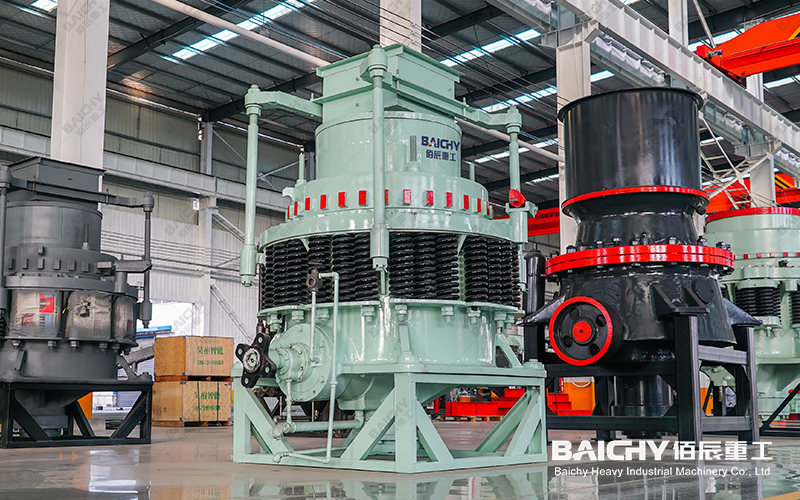
Spring cone crusher
In the secondary crushing stage, the spring cone crusher (PY series) has become the mainstream equipment for medium-to-fine crushing of medium-hard and harder materials, thanks to its dual design featuring "inter-particle (lamination) crushing" and "spring-based overload protection." Selecting the right model requires focusing on just three variables: feed size, discharge opening adjustment range, and the balance between capacity and power. This article uses official specification tables and three typical production line configurations to help you make the right choice the first time and avoid common pitfalls.
I. Overview: Secondary Crushing and the Intermediate Crushing Process
1. Process Positioning of Secondary Crushing
A standard crushing production line typically consists of three stages: primary crushing (jaw crusher) → intermediate crushing (secondary crushing) → fine crushing/sand making. The secondary crushing stage receives material from the primary stage, reducing 100–300mm lumps to 20–60mm, thereby providing appropriately sized feed for sand-making machines, ball mills, or finished aggregate silos. The capacity and discharge stability of the secondary crushing stage directly determine where the production line's bottleneck lies; while it does not directly produce the final product, it sets the baseline for the final product's quality.
2. Common Pain Points in the Intermediate Crushing Stage
In practice, many production lines encounter issues at the intermediate crushing stage: impact crushers struggle with high-hardness materials, hydraulic cone crushers entail high maintenance costs, and oversized equipment selection leads to wasted motor energy. The value of the PY series lies precisely in its ability to meet 80% of intermediate crushing needs using mature technology: leaving complexity to hydraulic models while prioritizing reliability with spring-based models.
3. Working Principle and Spring Safety System
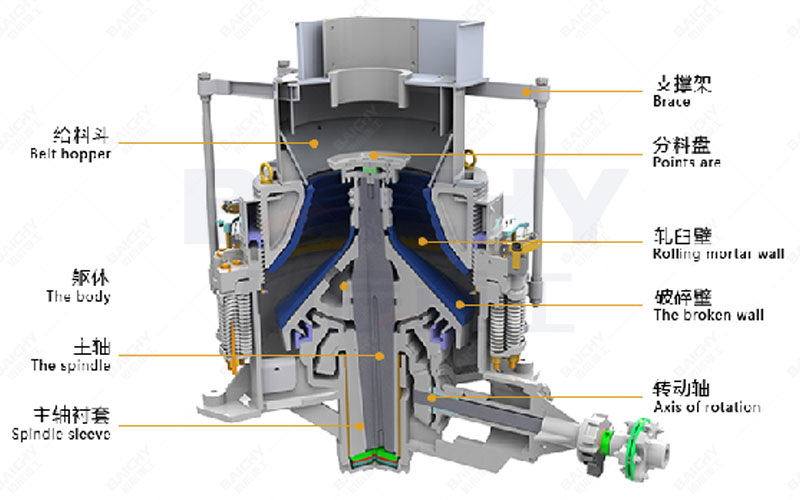
Structural diagram of the PY series spring cone crusher
This equipment is a classic compression-type cone crusher. Material is crushed through repeated compression and bending between the concave (stationary cone liner) and the mantle (moving cone liner)—a process known as "inter-particle crushing"—which results in low specific energy consumption and minimal over-crushing (excessive fines). Its name derives from its spring safety system: when uncrushable objects (such as tramp iron) enter the crushing chamber, the springs compress, allowing the moving cone to retract and release the foreign object before automatically resetting, leaving the equipment undamaged. This represents the fundamental difference between this model and hydraulic cone crushers: it trades a simpler structure for higher reliability and lower maintenance requirements.
II. Application Scenarios: Ideal Operating Conditions for Spring Cone Crushers
1. Hard Rock Aggregate Crushing (Granite, Basalt, Andesite)
Hard rocks typically have compressive strengths ranging from 150 to 300 MPa; while impact crushers struggle with such material, compression-based crushing is highly effective. These crushers produce material with low flake and elongation content, making them the preferred choice for secondary crushing in the production of high-grade concrete aggregates.
2. Secondary Crushing of Metal Ores (Iron, Copper, Gold)
Mineral processing plants commonly employ a three-stage circuit consisting of a jaw crusher, a cone crusher, and a ball mill. The cone crusher reduces ore from 115–300 mm down to under 50 mm, providing a uniform feed for the ball mill and directly enhancing grinding efficiency and hourly throughput.
3. River Pebble and Construction Aggregate Processing
River pebbles are characterized by high hardness and abrasiveness, placing rigorous demands on equipment wear resistance. Thanks to their manganese steel liners and the principle of inter-particle (lamination) crushing, cone crushers serve as a proven solution for the secondary crushing stage in river pebble sand-making lines.
4. High-Capacity Aggregate Plants and Mines
Models such as the PYB-1750 and PYB-2200 offer single-unit capacities ranging from 280 to 1,000 t/h, making them suitable for the transition between primary and secondary crushing stages in large-scale quarries and mining operations.
III. Six Key Advantages of the Spring Cone Crusher
| Advantage | Benefit (What it means for the owner) |
|---|---|
| Spring-based overload protection | Prevents broken shafts and machine damage when tramp iron or manganese steel parts enter the crushing chamber; minimizes downtime and repair losses. |
| Inter-particle (lamination) crushing principle | Produces low levels of flaky/elongated particles and superior grain shape; commands a higher market price for aggregates. |
| High reduction ratio (4:1–6:1) | Reduces the number of crushing stages required; saves on equipment investment and footprint. |
| No hydraulic system; simple structure | Fewer potential failure points; requires less specialized maintenance expertise; ideal for remote mining sites. |
| Mechanically adjustable discharge opening | Flexible switching of product specifications; a single production line can yield multiple particle sizes. |
| Manganese steel liners (wear parts) | Long service life; spare part costs are transparent and controllable. |
The hidden benefit of choosing this model lies in the Total Cost of Ownership (TCO): the absence of a hydraulic station eliminates risks associated with oil pump failures, hose leaks, and hydraulic fluid consumption; the simple structure means fewer spare parts and reduced inventory pressure; and the spring safety mechanism eliminates the risk of costly repairs caused by accidental tramp iron ingress. For small-to-medium production lines, the three-year TCO is often 15–25% lower than that of hydraulic models with equivalent capacity.
IV. Core Specifications: PY Series Cone Crusher
| Model | Crushing Cone Diameter (mm) | Max. Feed Size (mm) | Discharge Opening Range (mm) | Capacity (t/h) | Motor Power (kW) |
|---|---|---|---|---|---|
| PYB-600 | 600 | 66 | 12–25 | 15–25 | 30 |
| PYB-900 | 900 | 115 | 15–50 | 50–90 | 55 |
| PYZ-900 | 900 | 60 | 5–20 | 20–65 | 55 |
| PYD-900 | 900 | 40 | 3–13 | 15–50 | 55 |
| PYB-1200 | 1200 | 145 | 20–50 | 110–200 | 110 |
| PYZ-1200 | 1200 | 100 | 8–26 | 50–150 | 110 |
| PYB-1750 | 1750 | 215 | 25–60 | 280–480 | 155–160 |
| PYB-2200 | 2200 | 300 | 30–60 | 590–1000 | 260–280 |
Note: Capacity varies based on material hardness and feed particle size; the figures above are based on limestone operating conditions. Standard type (PYB) is suitable for medium crushing; medium type (PYZ) is suitable for fine crushing; short-head type (PYD) is suitable for superfine crushing.
V. Typical Application Cases and Production Line Configuration
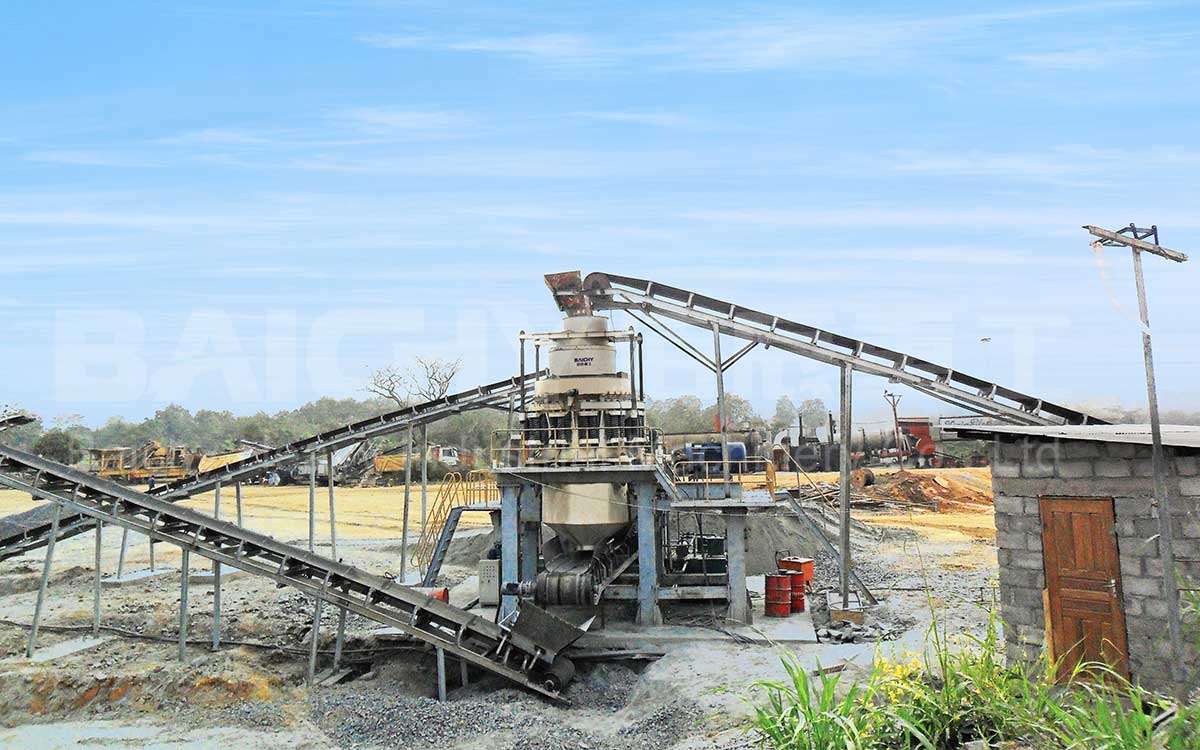
PY Series Spring Cone Crusher – Customer Site
Case 1: Granite Aggregate Line in Southeast Asia (150 t/h Capacity)
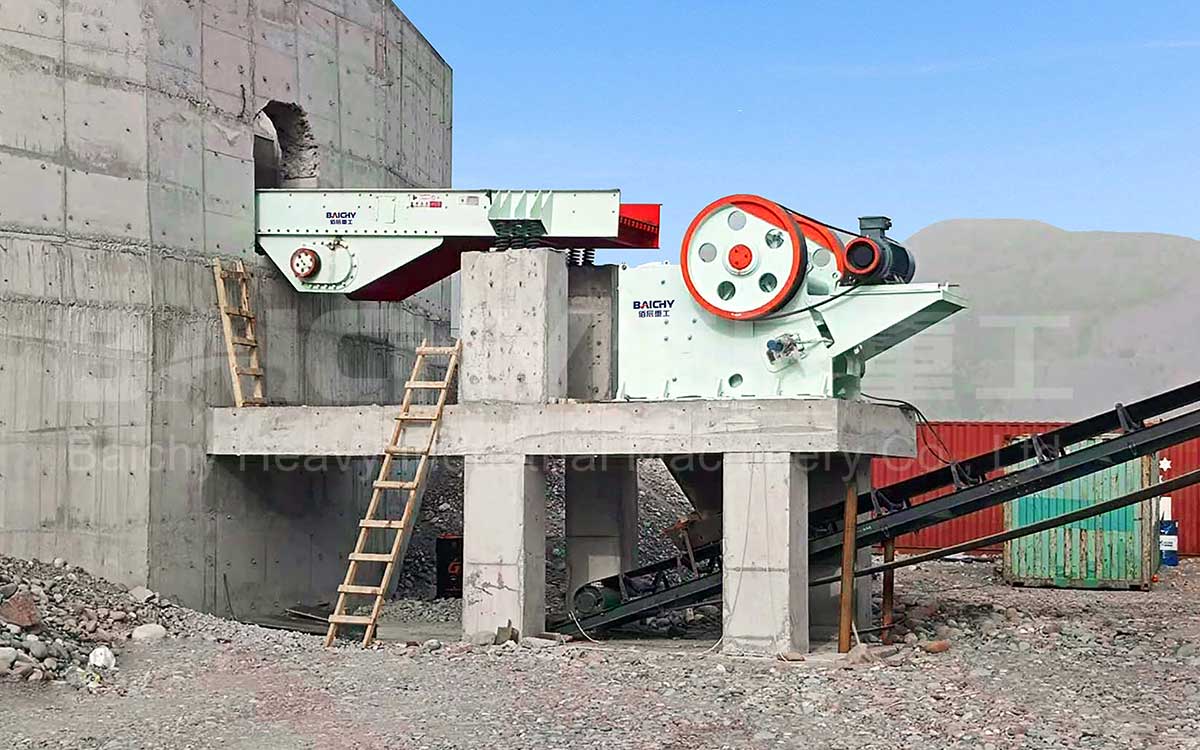
ZSW Vibrating Feeder → PE-750×1060 Jaw Crusher → PYB-1200 Cone Crusher → Circular Vibrating Screen → Finished Products: 0–5 / 5–15 / 15–31.5mm aggregate fractions. The PYB-1200 features an adjustable discharge opening (20–50 mm). When used in a closed-circuit screening loop, the qualified product rate remains consistently above 90%, and the particle shape meets the standards for high-grade concrete aggregates.
Case Study 2: Iron Ore Intermediate Crushing Section at a Mineral Processing Plant (100 t/h capacity)
PE-900×1200 Jaw Crusher → PYB-1750 → Ball Mill. The PYB-1750 crushes ore to 25–60 mm at a rate of 280–480 t/h, providing a uniform feed to the ball mill; this increases the mill's hourly output by approximately 15–20% and significantly reduces electricity consumption per ton of ore ground.
Case Study 3: River Pebble Sand-Making Line (100 t/h capacity)
PE Jaw Crusher → PYB-900 → Sand-Making Machine → Sand Washer. The cone crusher performs initial shaping, reducing impact loads on the sand-making machine and minimizing wear on hammers and liners. This significantly lowers the cost per ton for the entire line and is suitable for long-term operation with highly abrasive materials.
VI. Recommended Equipment
| Process Stage | Recommended Equipment | Selection Criteria |
|---|---|---|
| Primary Crushing (Coarse) | PE Series Jaw Crusher | Match feed size with cone crusher capacity; ensure continuous feeding |
| Feeding | ZSW Series Vibrating Feeder | Ensure uniform feeding; extend cone crusher liner life |
| Fine Crushing Upgrade | CS/HP Hydraulic Cone Crusher | High capacity; hydraulic adjustment; suitable for large-scale automated lines |
| Sand Making & Shaping | VSI Sand-Making Machine | Pair with cone crusher to produce high-quality 0–5 mm manufactured sand |
| Screening | Circular/Linear Vibrating Screen | Closed-circuit loop; strict control of finished product particle size |
| Grinding (Mineral Processing) | Ball Mill | Connects with the cone crusher's intermediate crushing stage to form a complete processing flow |
| Mobile Operations | YDPZ Mobile Crushing Station | Suitable for scenarios requiring frequent relocation or lacking fixed foundations |
VII. FAQ
1. How do I choose between a spring cone crusher and a hydraulic cone crusher?
Consider your budget, required capacity, and maintenance capabilities. This model features a simple structure, low cost, and ease of maintenance, making it suitable for small-to-medium production lines and remote mining sites. In contrast, hydraulic cone crushers offer convenient adjustment, high capacity, and a high degree of automation, making them ideal for large-scale mines and automated production lines. For the same production capacity, the initial investment for a spring-type crusher can be 20–30% lower, making it a cost-effective choice.
2. What are the differences between the PYB, PYZ, and PYD crushing chamber types?
For a given crushing cone diameter, the three chamber types serve different crushing tasks: the PYB (Standard) type is used for secondary crushing (handling larger feed sizes and producing coarser output); the PYZ (Medium) type is used for fine crushing; and the PYD (Short-head) type is used for superfine crushing (producing output as fine as 3–15 mm). Selection should be determined by working backward: first, define the target product particle size, then verify whether the chamber type's maximum feed size is compatible with the upstream feed.
3. Why is there a discrepancy between rated capacity and actual capacity?
Rated capacities in product literature are based on medium-hardness material (such as limestone). The harder the material and the coarser the feed, the lower the actual capacity; for instance, granite capacity is typically calculated at 70–80% of the rated value, while iron ore is calculated at 60–70%. By providing details on material hardness, feed particle size, and target output when inquiring, you allow the manufacturer to accurately calculate capacity, motor power, and liner service life based on actual operating conditions.
Baichy Heavy Industry
Baichy Heavy Industry is a high-tech mining equipment company integrating R&D, manufacturing, sales, and after-sales service. Focusing on crushing, grinding, and mineral processing equipment, we provide professional solutions to our customers. We are ISO9001:2015 、certified, and our products include mobile crushing palnts, crawler crushing plant, construction waste crushing plants, jaw crushers, sand making machines, cone crushers, fine crushers, grinding mills, ball mills, etc., all with reliable performance to meet diverse project needs.
Baichy Heavy Industry – Your Trusted Partner
To ensure optimal performance of your equipment, Baichy Heavy Industry offers:
- Professional on-site installation guidance
- Comprehensive operator training
- 24/7 technical support & maintenance services
Our complete after-sales service system guarantees long-term, stable operation of your machinery with minimal downtime.
Protect Your Rights – Only Use Official Channels
To avoid scams and ensure authentic support, contact us exclusively through:
• Official Website: www.baichychina.com
• WhatsApp: +8615093222637
• Email: [email protected]
Your satisfaction is our priority – expect prompt, professional service every time.
(Note: Beware of unauthorized third parties claiming to represent Baichy. Always verify through official contacts.)