If you treat your sawdust as "waste," you are essentially paying a disposal fee for a potential fuel source. A properly sized sawdust dryer—capable of reducing moisture content from 30–50% to below 10%—can transform a disposal cost of $15–30 per ton into a fuel value of $40–90 per ton. For continuous production rates exceeding 1 ton per hour, the rotary drum dryer is the only single-unit solution that allows for increased capacity without the need to operate multiple machines in parallel.
In the wood processing, furniture manufacturing, and plywood industries, the fate of sawdust and wood chips hinges on a single factor: moisture content. Properly dried sawdust serves as raw material for pellet fuel, machine-made charcoal, and biomass power generation; insufficiently dried sawdust results in storage burdens, losses due to mold, and environmental fines. This article addresses five key purchasing questions: What is the economic rationale for drying? What size specifications are needed? How should the heat source be selected? How is safety ensured? What is the total lifecycle cost?
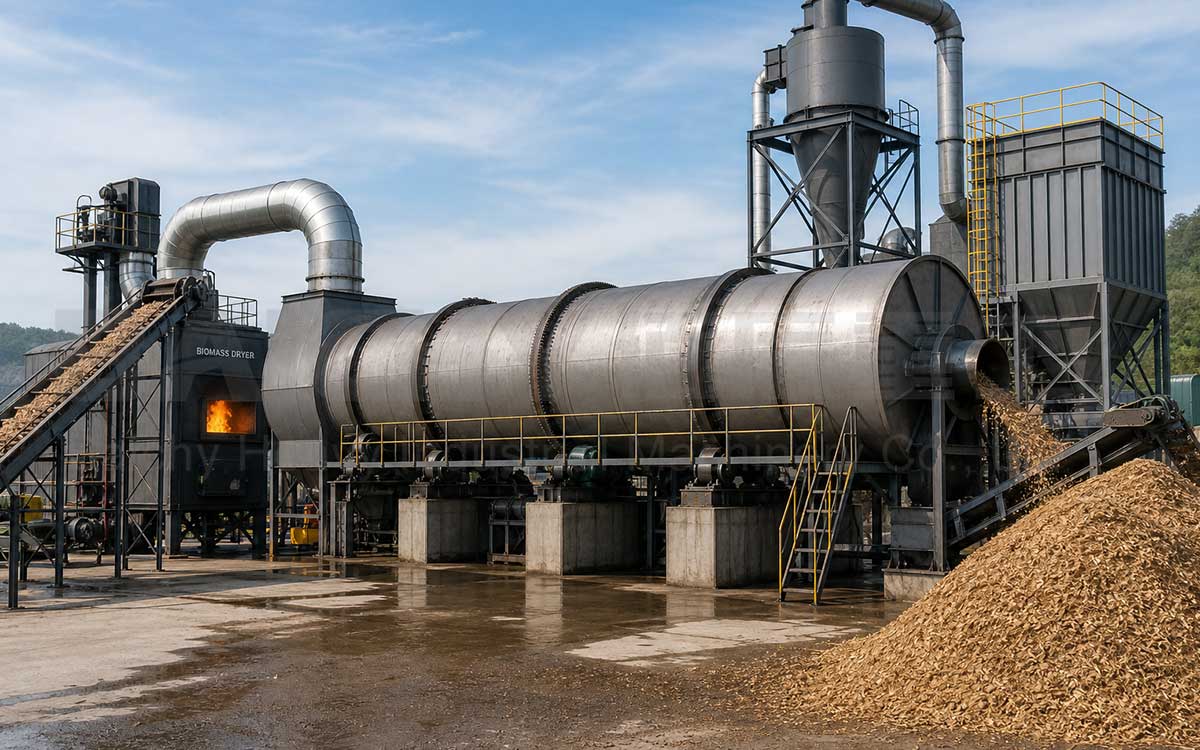
Sawdust Drying production line
1. Why moisture is a financial issue—analyzing three key cost factors
Factor One: Disposal costs versus fuel value. Disposal cost per tonne of wet sawdust (50% moisture):
15–30 (covering removal, stockpiling, and environmental compliance); dry sawdust (≤10% moisture) costs 40–90/tonne, with even higher prices for machine-made charcoal feedstock. Drying is the sole processing step accounting for this price difference.
Second factor: Calorific value loss. The net calorific value (dry basis) of wood is approximately 18 MJ/kg; at 50% moisture, this drops to about 8–9 MJ/kg—meaning half the energy is consumed evaporating water rather than generating electricity or heat. Pellet fuel standards (ENplus A1, EN ISO 17225-2) require moisture content ≤10%; exceeding this limit results in the loss of certification and the associated export price premium.
Third factor: Pelletization rate and storage. Wood chips with >15% moisture cannot be successfully pelletized, resulting in loose or cracked pellets; stockpiling for 2–3 weeks leads to mold and fermentation, creating risks of spontaneous combustion alongside a loss in quality.
Quantification basis: Drying 1 tonne of wet material (50% moisture) down to 10% involves evaporating approximately 0.44 tonnes of water to yield about 0.56 tonnes of dry material. The drying cost is entirely offset by the value of the "recovered fuel potential"; this is the starting point for equipment selection, not the end.
2. The core economic calculation for dryers: Cost per tonne of water evaporated
| Heat Source | Typical consumption per tonne of water evaporated | Reference fuel price | Fuel cost per tonne of water evaporated |
| Biomass pellets | 220–260 kg | $50–90/t | $11–23 |
| Bituminous coal | 150–190 kg | $60–120/t | $9–22 |
| Natural gas | 100–130 Nm³ | $0.25–0.40/Nm³ | $25–52 |
| Diesel | Approx. 110 L | $0.70–0.90/L | $77–99 |
Note: Typical values estimated based on 60–70% thermal efficiency; actual consumption depends on initial moisture content, inlet air temperature, and material particle size. Fuel is the single largest expense over the drying system's lifecycle; a 10% difference in thermal efficiency means burning 10% more fuel annually—which is why equipment selection shouldn't be based solely on price quotes.
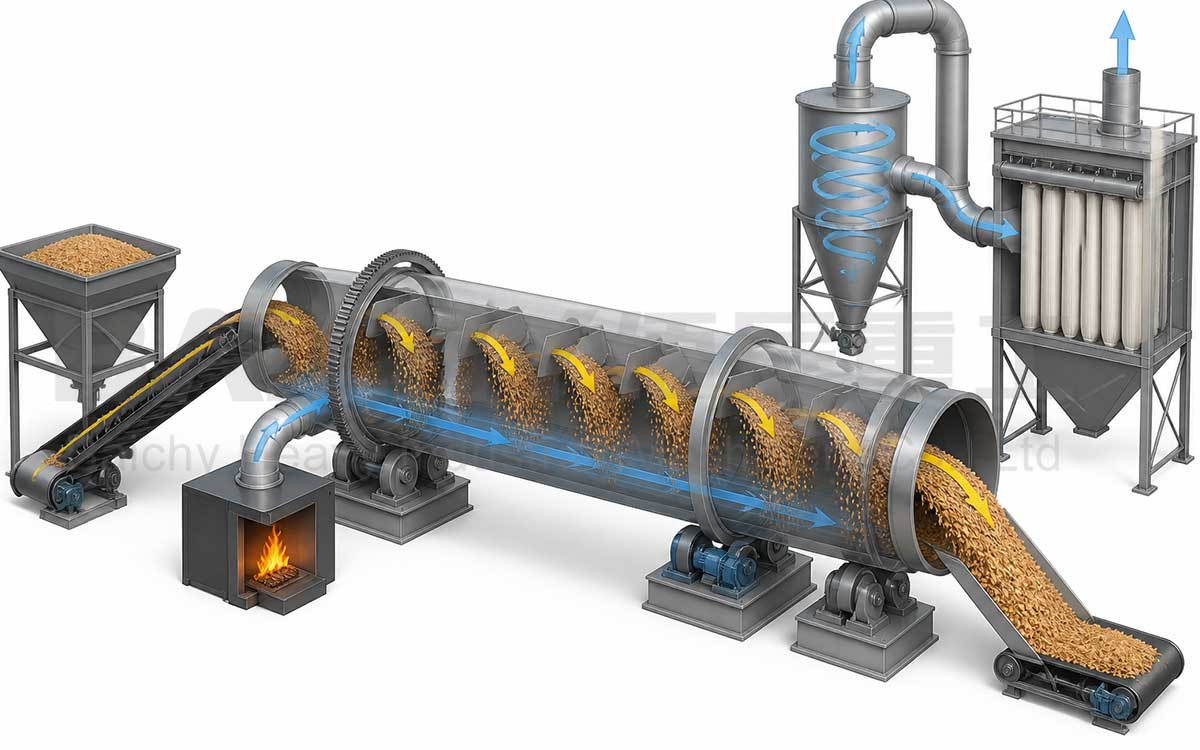
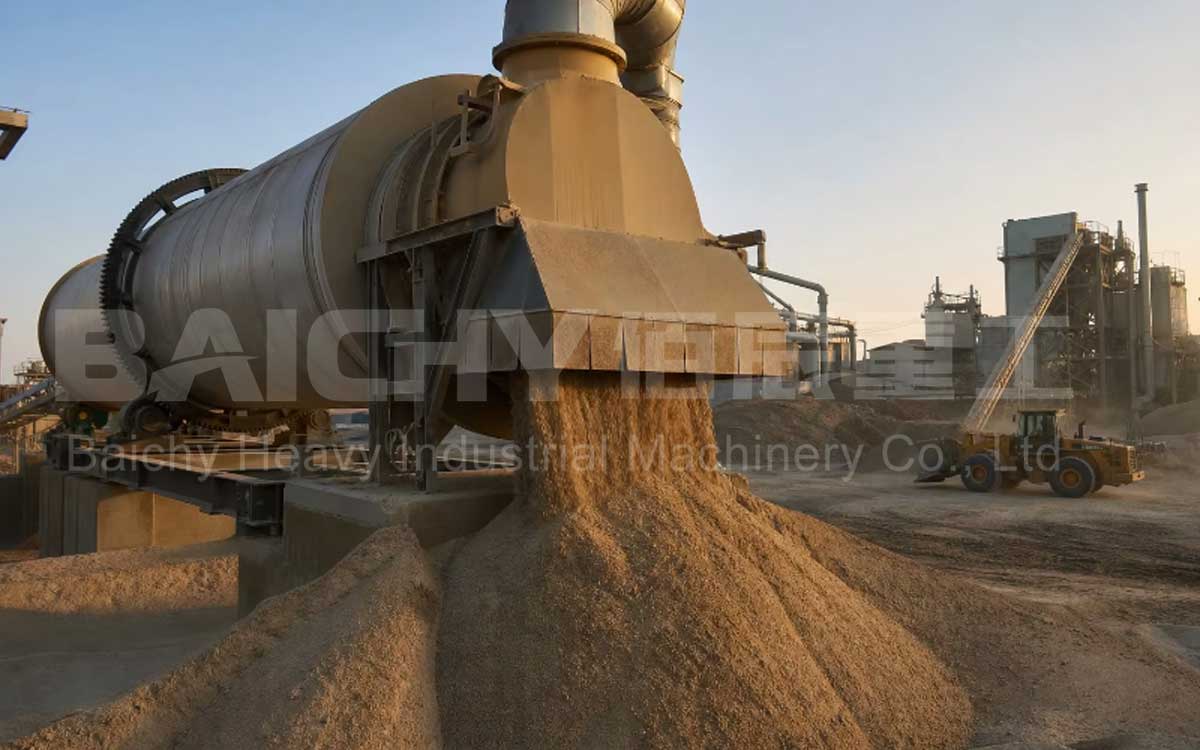
Sawdust Rotary Drying Process Flow: Feeding – Drying – Discharge – Dust Removal
3. Working Principle—Mainstream Rotary Drum Type (Explained in Three Steps)
Feeding → Drying → Discharge; a continuous process.
① Feeding: Wet sawdust is conveyed via belt conveyor into an inclined, rotating drum.
② Drying: Internal lifting flights continuously scoop up and scatter the sawdust, ensuring full contact with the high-temperature airflow from the hot-blast stove, causing rapid moisture evaporation; the material repeatedly tumbles within the drum, ensuring uniform final moisture content.
③ Discharge: Dried material exits from the drum tail; dust-laden exhaust gas is purified via a cyclone dust collector followed by a baghouse filter before emission.
The entire process runs continuously, offering high single-unit capacity, uniform output, and 60–80% thermal efficiency (exceeding 80% with a triple-pass structure). For loose, lightweight sawdust, the triple-pass structure requires approximately 40% less footprint for the same capacity, making it the mainstream configuration in the biomass industry.
4. Choosing Between the Three Drying Methods—A Four-Dimensional Comparison
| Drying Method | Max. Single-Unit Capacity | Suitable Conditions | Thermal Efficiency | Investment Intensity | Drawbacks |
| Rotary Drum | Evaporation >10 t/h (Wet material >20 t/h) | Continuous high-volume processing, uneven particle size, requirement for stable final moisture | 60–80% | Medium-High | Large footprint, higher initial investment |
| Pneumatic (Flash) | Evaporation ≤2 t/h | Fine particles (<1 mm), low moisture (≤20%), low capacity | 50–65% | Low | Particle size limitations, short residence time, poor final moisture control |
| Belt (Box) | Evaporation ≤1 t/h | Small-batch, multi-variety, thin material layers | 40–55% | Low | Low production capacity ceiling; mesh belt requires replacement every 2–3 years. |
Decision criteria: If capacity demand >2 t/h (wet material), material particle size is uneven, or final moisture content must consistently be ≤10% → Choose a rotary drum dryer directly; for small-capacity fine powders or budget-sensitive projects → Flash (pneumatic) dryers can serve as an interim solution.
5. Determining Specifications: Evaporation Capacity Reference Table
Dryer selection is based on evaporation capacity (tons of water/hour), not the tonnage of wet material. Example: Drying 5 t/h of wet material from 50% to 10% moisture requires evaporating approx. 2.2 t/h of water, corresponding to the φ1.5 × 12m class.
| Drum Diameter | Typical Evaporation Capacity | Wet Material Capacity (50%→10%) | System Investment Reference (incl. hot air furnace + dust removal) |
| φ1.2 × 8 m | 1–1.5 t/h | 2.5–3.5 t/h | $25,000–45,000 |
| φ1.5 × 12 m | 2–3 t/h | 4.5–7 t/h | $30,000–60,000 |
| φ2.2 × 18 m | 5–7 t/h | 11–16 t/h | $100,000–200,000 |
| φ3.0 × 20 m | 10–14 t/h | 23–32 t/h | $300,000–500,000 |
Important: The table above lists typical values; final specifications depend on initial moisture content, inlet air temperature, and sawdust particle size/bulk density (sawdust is loose and voluminous, so capacity is limited by evaporation capability rather than internal drum volume). Baichen offers free material drying tests—processing 5–10 kg samples on a test unit to generate a moisture curve. ...report issued within [X] working days, followed by specification finalization to avoid "waste from oversizing" or "rework from undersizing."
6. Choosing a heat source: Base it on local energy prices, not habit.
| Heat Source | Advantages | Limitations | Suitable Scenarios |
| Biomass hot-air furnace | Uses dried/screened waste as fuel (further reducing costs); aligns with carbon-neutrality goals | Requires dust removal systems; fluctuating calorific value | Pellet plants, machine-made charcoal plants (most common configuration) |
| Coal-fired hot-air furnace | Lowest fuel cost | Strict environmental regulations | Southeast Asia, Africa, and other regions with low coal prices |
| Natural gas | Precise temperature control; clean emissions; no coal storage needed | Dependent on pipeline networks; fluctuating gas prices | Europe, North America, and regions with low gas prices |
| Diesel/Electric | Plug-and-play; rapid startup | Fuel costs 3–8 times higher | Small-capacity operations; emergency use; sites lacking gas or coal infrastructure |
Selection principle: Energy bills are a 15-year issue, whereas equipment procurement is a one-time event. Select the heat source based on the local delivered energy price at the plant site, not based on what "everyone else uses."
7. Safety design specific to sawdust drying—a point most manufacturers overlook
Sawdust is a combustible dust; the drying system *must* be designed according to explosion-proof standards—this is not optional:
• Dust explosion: The lower explosive limit (LEL) for wood dust is approximately 40–60 g/m³ (typical value); exhaust ducts and the interior of cyclone separators are the highest-risk areas.
• Spark detection and extinguishing: Spark detectors installed at the feed inlet and dust collector inlet, linked to a spray-based extinguishing system.
• Temperature interlocking: Sawdust has a low ignition point (around 260°C); inlet air temperature must be set based on the material (typically 250–350°C, co-current operation); outlet temperature interlocking triggers automatic load reduction or shutdown upon overheating.
• Explosion venting and grounding: Cyclone separators and baghouse dust collectors equipped with explosion relief vents; entire system reliably grounded to prevent static electricity accumulation.
• Discharge temperature control: The discharge temperature of the dried material from the drum must be kept within a non-flammable range before the material enters the finished product silo after cooling.
When inquiring with manufacturers, ask three key questions: Is spark detection standard or optional? Is there an interlock for the discharge temperature? Does the dust collector feature explosion venting? If a supplier cannot answer these, look for another one.
8. Five Steps for Model Selection—Drafting Requirements in 30 Minutes
• Determine capacity: Based on wet feed input (t/h) or finished product output (t/h); use peak values, not averages.
• Measure moisture: Test initial and target moisture levels (pellets ≤10%; machine-made charcoal 8–10%).
• Select heat source: Check local delivered prices for coal, gas, or biomass, as well as environmental approval requirements.
• Determine dust removal: A standard cyclone plus bag filter setup usually meets compliance standards; for pellet production, a bag filter is recommended from the start.
• Request testing: Ask for a free material drying test; determine the drum diameter only after obtaining the moisture curve.
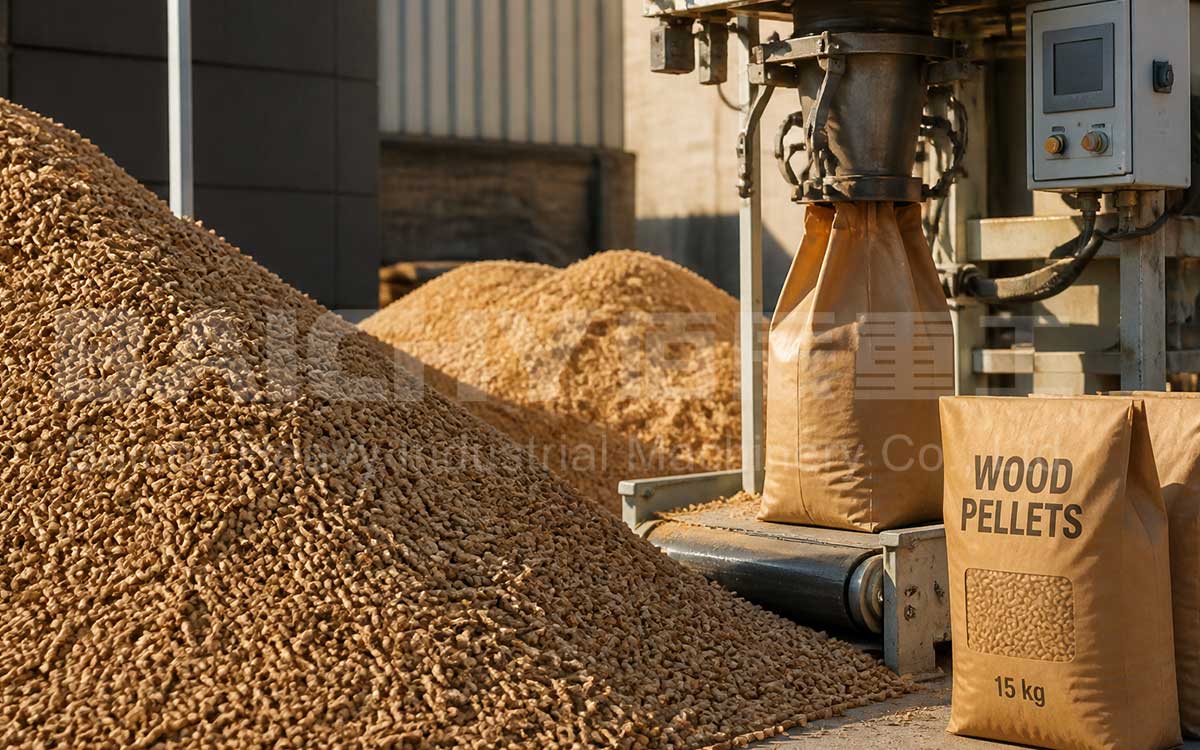
Dried sawdust product
9. FAQ
Q1: What size dryer is needed to dry 5 t/h of wet sawdust (50% moisture) down to 10%?
Evaporation demand is approximately 2.2 t/h of water, corresponding to a rotary drum in the φ1.5 × 12 m class, paired with a biomass hot-air furnace. Final specifications must be based on material drying tests—even with wood waste, drying rates for wood shavings versus sawdust powder can differ by more than 30%.
Q2: Can the dryer use biomass waste as fuel?
Yes, and this is the most common configuration in the wood waste industry. Screened fine powder and scraps can be fed directly into the biomass hot-air furnace; fuel costs can be reduced to under $11 per tonne of evaporated water, while also supporting an eco-friendly "closed-loop utilization" narrative for the finished product.
Q3: Is there a risk of fire or explosion when drying wood waste?
The risk is real but manageable. Standard features for a compliant system include: spark detection + Features include fire-suppression spray systems, outlet temperature interlocking, explosion-proof pressure relief for dust collectors, and comprehensive electrostatic grounding. Inlet air temperature is set based on the material and strictly monitored, while outlet temperature is controlled within a safe range. Verify every item during procurement; do not accept vague sales pitches involving "extra charges for anything beyond the standard configuration."
Q4: How do I choose between flash drying and rotary drum drying?
For fine materials (<1 mm), initial moisture ≤20%, capacity ≤2 t/h, and budget sensitivity → Flash drying is sufficient. For continuous high-volume production, uneven particle sizes, and a requirement for stable final moisture ≤10% → Rotary drum drying; the triple-pass structure offers higher thermal efficiency and a smaller footprint.
Q5: Which is better: triple-pass or single-pass?
Triple-pass dryers offer thermal efficiency exceeding 80% and require about 40% less space for the same capacity, making them ideal for continuous production with high-moisture sawdust. Single-pass dryers feature a simple structure, low maintenance costs, and fewer potential failure points, making them suitable for low-moisture applications or budget-conscious clients. Provide the supplier with a moisture curve and let the data—not the salesperson—drive the decision.
Q6: Can dried sawdust be used directly for pelletizing?
Yes. An outlet moisture content of ≤10% meets ENplus A1 pellet fuel standards. Cool the material (to ≤50°C) before feeding it into the pellet mill to ensure the finished product meets strength and calorific value requirements. Drying and cooling can be integrated into a single combined system to eliminate an intermediate transfer step.
10. CTA
Planning a sawdust drying or biomass fuel production line? Baichen offers end-to-end services, from material testing to full-line delivery:
• Free material drying tests (5–10 kg sample; moisture curve report within 5 working days)
• Customized heat source solutions based on local energy prices (coal, gas, biomass, or diesel)
• Complete system supply: dryer, hot air furnace, dust collection, conveying, and electrical controls—shipped in a single container
• On-site installation guidance by two engineers; 30–60 days from delivery to output
• Share your capacity, initial moisture, and target moisture levels to receive a budgetary quote and preliminary equipment selection on the same day.
WhatsApp +86 150 9322 2637
Email: [email protected]
Website: www.baichychina.com