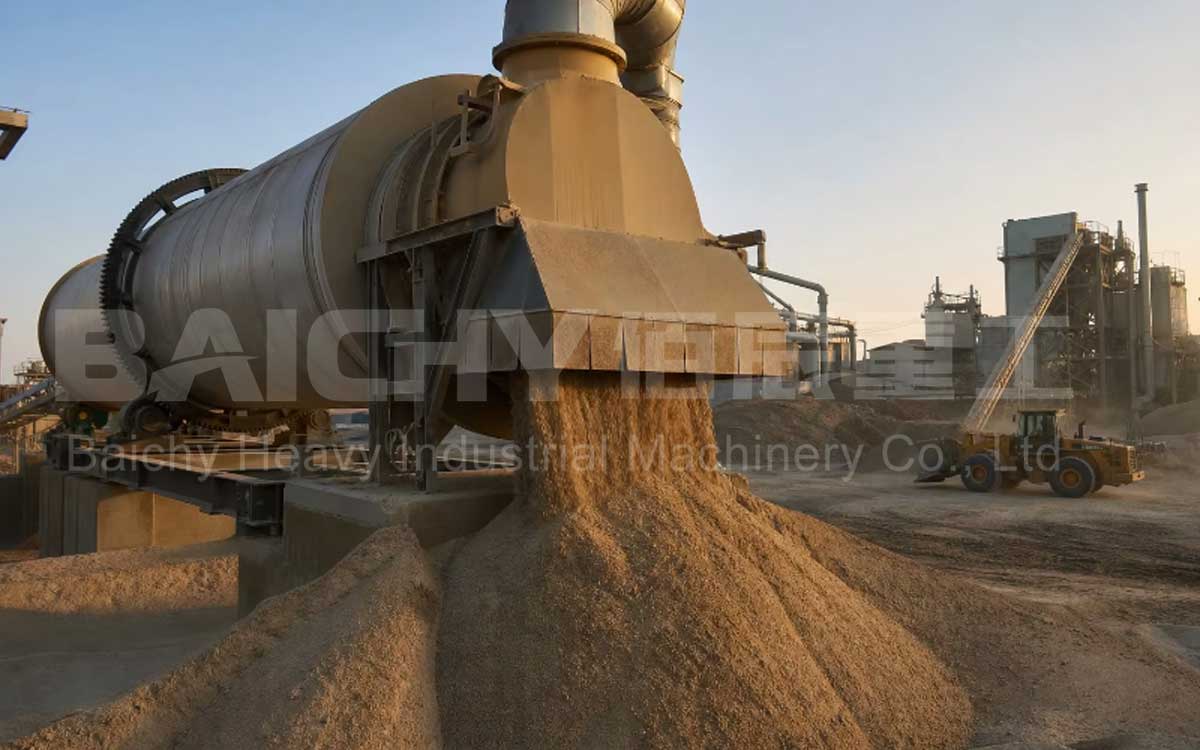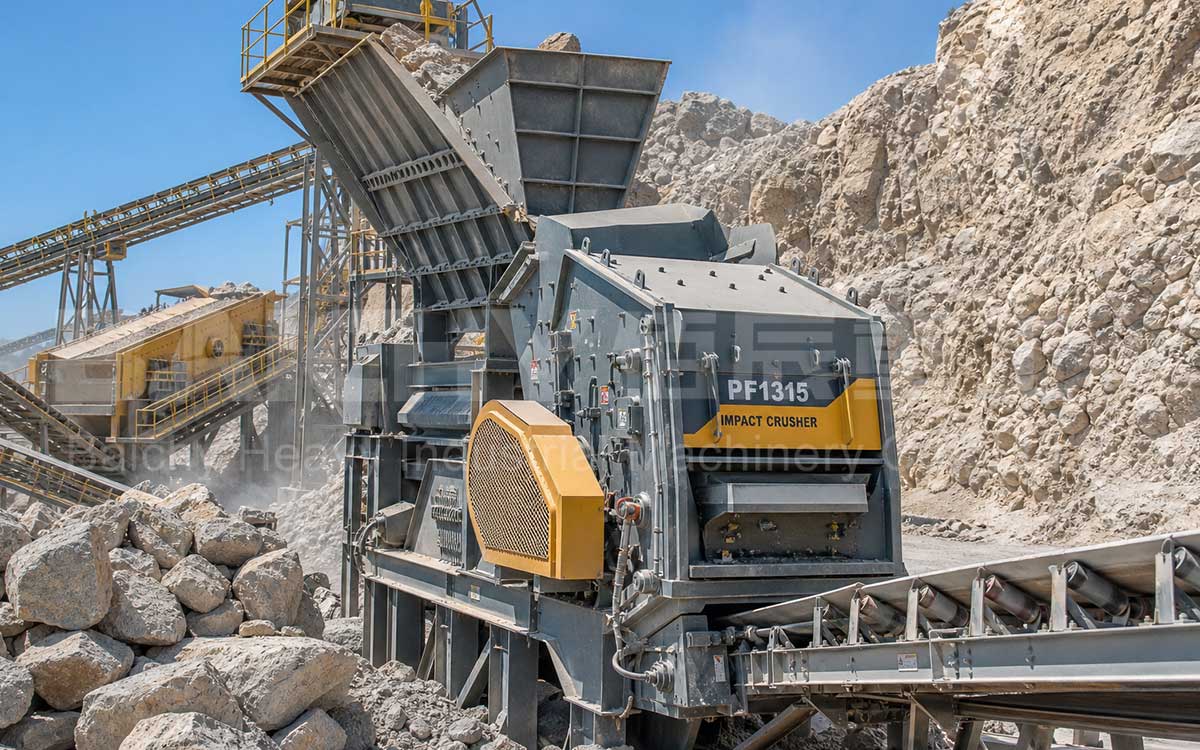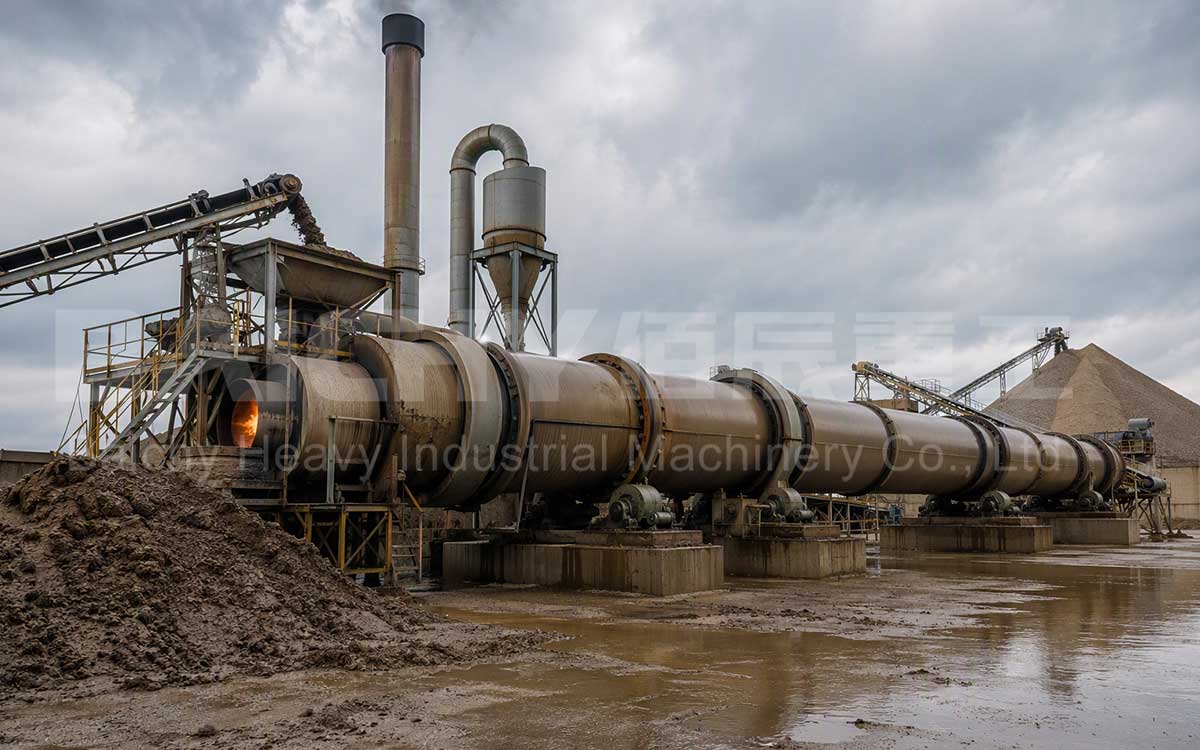
Baichy three-pass rotary sand dryer operating in an aggregate plant
If your sand leaves the washing line at 8–20% moisture, you are paying to ship water. A 15% moisture content means 15 tons of water in every 100-ton truckload — freight you pay for, storage space you rent, and a product whose quality drifts with the weather. A three-pass rotary sand dryer brings moisture down to 1% or below, cuts transport weight by roughly 7–14%, and runs at 45% thermal efficiency versus 35% for a single-drum dryer. For sand plants, dry-mix mortar producers and mineral processors, it is the fastest-payback upgrade in the washing line.
1 The hidden cost of wet sand
Wet sand is not a raw material problem — it is a money problem that repeats on every truck, every silo and every batch:
• Transport weight. Moisture is dead weight. At 15% moisture, 14 tons of every 100 tons of wet sand is water (calculated after drying to 1%). Every ton of water moved by truck or barge is freight paid on nothing.
• Storage and seasonality. Wet sand cakes, freezes and bridges in winter; dry sand flows freely, keeps your plant running 12 months a year and simplifies silo handling.
• Quality consistency. Moisture swings destabilize mortar mix ratios, concrete batching and downstream screening. Buyers of dry-mix mortar and foundry sand demand guaranteed ≤1% moisture — and pay a premium for it.
• Unusable resource. High-moisture fines that cannot be sold or stored become stockpile write-offs. Drying converts them back into saleable product.
2 How a three-pass rotary dryer works
The most widely used solution is the three-pass (triple-pass) rotary dryer — three nested cylinders that use the drum cross-section three times over:
1. Inner cylinder. High-temperature air (up to 700–750 °C) mixes with wet sand in co-current flow, evaporating most of the moisture at high speed.
2. Middle cylinder. Material is lifted repeatedly into a uniform curtain and travels in a two-steps-forward, one-step-back path in counter-current contact with the hot air — this is where most of the drying happens.
3. Outer cylinder. Final tempering drying in a rectangular multi-loop path. Dried sand exits quickly with the air stream, while wetter particles stay longer by their own weight.
The key engineering result: the three-tube structure forms a self-insulating shell that cuts the cylinder's heat-dissipation area dramatically. Baichy's three-pass dryer reaches 45% thermal efficiency — the same comparison figure for a traditional single-drum dryer is 35% — and the overall length is about 60% shorter than a single-drum unit of equal capacity, which directly reduces plant footprint and civil-engineering cost.
3 What the specs mean for your profit
| Parameter/Feature | Advantage |
| 45% vs. 35% thermal efficiency | For the same steam output, fuel consumption is approximately 20% lower (1 − 35/45). A factory with an annual fuel expenditure of $50,000 would save approximately $10,000 per year (illustrative). |
| Moisture content: 8–20% → ≤1% | For every 100 tons of wet sand (15% moisture), weight drops by ~14 tons after drying → 7–14% direct reduction in transport costs. |
| 60% reduction in length | Reduced plant footprint and civil engineering investment; drying lines can be installed in compact spaces. |
| Fuel options: Coal, natural gas, oil, biomass, or waste heat | Select the cheapest local heat source; not locked into a single fuel type. |
| Trunnion roller drive (no large/small gears) | Fewer drive components, lower noise levels, and reduced maintenance frequency and spare parts costs. |
| Handles ≤20mm lumps, granules, or powders | One machine processes river sand, manufactured sand, mineral powder, coal slime, and slag; high production line versatility. |
4 Core specification table
| Spec. (Dia.x Length mm) |
Volume(m³) | Capacity (t/h) | Gradient(%) | Highest Inlet Air Temperature(℃) |
Rotate Speed(r/min) | Main Motor(kw) |
| Φ600x6000 | 1.7 | 0.5-1.5 | 3~5 | 700~800 | 3~8 | 3 |
| Φ800x8000 | 4.1 | 0.8-2.0 | 3~5 | 700~800 | 3~8 | 4 |
| Φ800x10000 | 5.1 | 0.8-2.5 | 3~5 | 700~800 | 3~8 | 4 |
| Φ1000x10000 | 7.9 | 1.0-3.0 | 3~5 | 700~800 | 3~8 | 7.5 |
| Φ1000x12000 | 9.4 | 1.2-3.2 | 3~5 | 700~800 | 3~8 | 11 |
| Φ1200x8000 | 9 | 1.9-2.4 | 3~5 | 700~800 | 3~8 | 7.5 |
| Φ1200x10000 | 11.3 | 2.2-3.0 | 3~5 | 700~800 | 3~8 | 7.5 |
| Φ1200x12000 | 13.6 | 2.4-3.2 | 3~5 | 700~800 | 3~8 | 7.5 |
| Φ1500x12000 | 21.2 | 4.5-5.7 | 3~5 | 700~800 | 2~6 | 15 |
| Φ1500x14000 | 24.7 | 5.3-6.6 | 3~5 | 700~800 | 2~6 | 15 |
| Φ1500x16000 | 26.5 | 5.7-7.1 | 3~5 | 700~800 | 2~6 | 15 |
| Φ1800x12000 | 30.5 | 6.5-8.1 | 3~5 | 700~800 | 2~6 | 18.5 |
| Φ1800x14000 | 35.6 | 7.6-9.5 | 3~5 | 700~800 | 2~6 | 18.5 |
| Φ1800x16000 | 40.7 | 7.8-10.2 | 3~5 | 700~800 | 2~6 | 18.5 |
| Φ2000x18000 | 56.5 | 8.4-12.3 | 3~5 | 700~800 | 1.5~6 | 22 |
| Φ2000x20000 | 62.8 | 9.0-13.6 | 3~5 | 700~800 | 1.5~6 | 22 |
| Φ2200x16000 | 60.8 | 11.4-15.8 | 3~5 | 700~800 | 1.5~6 | 22 |
| Φ2200x18000 | 68.3 | 12.8-16.2 | 3~5 | 700~800 | 1.5~6 | 22 |
| Φ2200x20000 | 75.9 | 13.0-16.5 | 3~5 | 700~800 | 1.5~6 | 30 |
| Φ2400x16000 | 72.3 | 13.5-16.9 | 3~5 | 700~800 | 1.5~5 | 37 |
| Φ2400x18000 | 81.4 | 17.4-21.7 | 3~5 | 700~800 | 1.5~5 | 45 |
| Φ2400x20000 | 90.4 | 19.3-24.1 | 3~5 | 700~800 | 1.5~5 | 55 |
| Φ2600x24000 | 127.4 | 27.2-34.0 | 3~5 | 700~800 | 1.5~5 | 75 |
| Φ2600x28000 | 148.6 | 28.6-36.2 | 3~5 | 700~800 | 1.5~5 | 75 |
| Φ3000x20000 | 141.3 | 30.1-37.7 | 3~5 | 700~800 | 1.5~5 | 85 |
| Φ3000x25000 | 176.6 | 37.7-47.1 | 3~5 | 700~800 | 1.5~5 | 90 |
| Φ3200x25000 | 201 | 42.9-53.6 | 3~5 | 700~800 | 1.5~5 | 110 |
Output varies with material moisture, particle size and feed conditions. Capacity figures assume typical washed sand; high-moisture or sticky feeds reduce throughput — factor in a margin when sizing.
5 How to choose the right sand dryer
• Raw material. Initial moisture (8–20% typical for washed sand), particle size (≤20 mm for the three-pass design), viscosity and clay content. Sticky or clay-heavy feed needs a pre-screening or blending step — ask about it in your inquiry.
• Output target. Define tons of dry sand per hour, then select from the table above. Rule of thumb: if your feed is at the high end of the moisture range, size up one model — a 15% moisture feed can cut effective throughput by 20–30% versus a dry feed.
• Heat source. Compare local prices per unit of heat: coal, natural gas, diesel, biomass pellets or waste heat. The dryer's fuel flexibility (coal/oil/gas) means you are never locked to one energy market.
• Environmental compliance. Confirm the plant's emission standard and the dryer's dust-collection package (cyclone, baghouse) before ordering — retrofit costs more than specification.
6 FAQ
Q1: What is the price of a sand dryer?
A: It depends on model size, heat source, dust-collection package and auxiliary equipment. Send your initial moisture, target capacity and fuel type — Baichy replies with a matched model and quotation within 24 hours.
Q2: How much moisture can a sand dryer remove?
A: Typically from 8–20% down to 1% or below, depending on residence time, inlet air temperature (700–750 °C max) and feed characteristics. Guaranteed final moisture is confirmed during the design proposal stage.
Q3: Three-pass rotary dryer vs single-drum dryer — which is better?
A: For sand and granular materials, the three-pass design wins on three points: about 45% thermal efficiency vs 35%, roughly 60% shorter length (smaller footprint and civil works), and lower fuel consumption per ton of water evaporated. Single-drum dryers remain competitive only for very large, low-moisture continuous duties where footprint is not a constraint.
Q4: Which fuel can the dryer use?
A: Coal, natural gas, diesel, biomass pellets or waste heat. The heat source is configured to local availability and energy prices — this is part of the free plant design proposal.
Q5: What capacity sand dryer do I need?
A: Match your required dry output (t/h) against the specification table. From Ф2.0×4m (8–15 t/h) to Ф4.0×10m (70–100 t/h), there is a standard model for most plants; Baichy also tailors the auxiliary package (feeder, dust collector, cooler) to your line.
7 CTA
Stop paying to ship water. Send your raw-material moisture, target capacity and fuel type to our engineers — get a matched dryer model, plant layout and quotation within 24 hours.