Sludge dryers, industrial/municipal sludge drying equipment
Sludge dryers address the single most expensive cost item for wastewater treatment plants: the cost associated with water content. Dewatered sludge typically contains about 80% water; in 10 tons of "sludge," only about 2 tons consist of dry solids, while the rest is water that incurs costs for transport, landfilling, or incineration. Baichy Heavy Industry utilizes a direct-heating rotary sludge dryer as the core unit, equipped with internal components for material breakup and back-mixing, as well as negative-pressure sealing, deodorization, and explosion-proof systems. This setup can reliably reduce the moisture content of municipal and industrial sludge from 75–80% down to 40% (volume reduction), 30% (co-incineration compatibility), or even below 15% (fuel conversion). Evaporation capacity is designed based on measured operational parameters, ensuring full production capacity is achieved immediately upon commissioning.
I. Overview of Sludge Dryers
According to public data based on Ministry of Housing and Urban-Rural Development statistics, my country's annual production of wet urban sludge (with a moisture content of approximately 80%) exceeds 60 million tons, yet this translates to only about 12 million tons of dry solids—meaning the majority of sludge treatment costs are spent on "transporting water."
• 80% → 40%: Weight is reduced by approximately two-thirds per ton of wet sludge; transport and disposal costs drop proportionally, offering the fastest return on investment.
• 40% → 30%: Meets the moisture requirements for furnace incineration and cement kiln co-processing, ensuring stable calorific value.
• 30% → Below 15%: Calorific value of the dried material increases, allowing it to be used as RDF/SRF fuel or as raw material for construction products.
Selecting a sludge dryer requires a "reverse engineering" approach: first determine the end-use of the product, then set the target moisture content, and finally determine equipment specifications and the heat source based on the required evaporation load. If this sequence is reversed—resulting in equipment that is either oversized or undersized—fuel costs will spiral out of control.
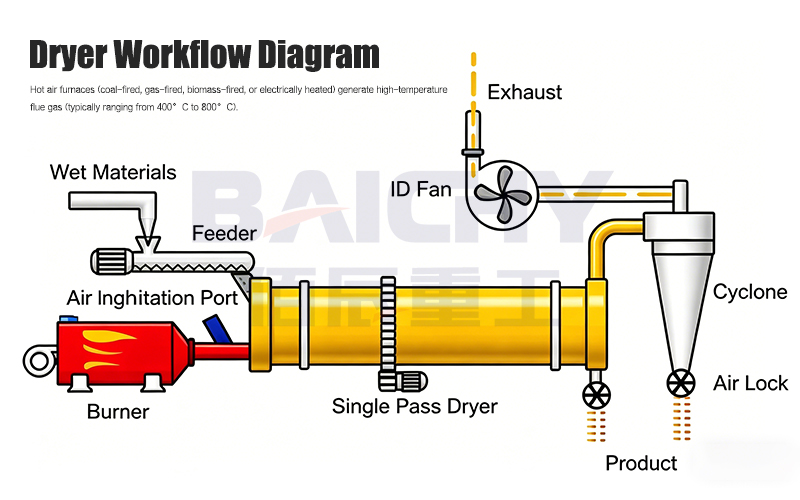
Dryer Workflow Diagram
II. Typical Application Scenarios
| Scenario | Feed Moisture Content | Target Moisture Content | Drying Objective |
|---|---|---|---|
| Municipal Wastewater Treatment Plant | 78%–82% | 40% or 30% | Volume reduction by two-thirds; sent for incineration or co-processing |
| Industrial Park Centralized Sludge Center | 75%–80% | ≤15% | Fuel conversion (RDF); dried material supports self-sustaining co-firing |
| Cement Kiln/Power Plant Waste Heat Drying | 60%–80% | 35%–40% | Waste heat utilization; fed into kiln to replace fuel and raw materials |
| Printing & Dyeing, Papermaking, Leather Sludge | 75%–85% | 40%–50% | Solid waste volume reduction; lower unit disposal costs |
| Landscaping/Agricultural Composting Pre-treatment | 75%–80% | 60%–65% | Moisture adjustment prior to aerobic composting |
III. Four Major Operational Challenges: Why General-Purpose Dryers Fail with Sludge
The fundamental difference between sludge dryers and mineral dryers lies in the four critical stages sludge must pass through:
1. Sticky Phase (60%–45%): Wet sludge transitions through three states—wet sludge, paste, and granules. During the paste phase, it tends to stick to walls and bridge; direct-feed capacity is often only 60% of the design value—making this the material with the widest gap between "nominal capacity" and "actual operational capacity."
2. Odor and VOCs: Ammonia, hydrogen sulfide, and mercaptans are released alongside moisture; the entire system requires a sealed, negative-pressure design with organized collection.
3. Dust Explosion: Dried sludge contains organic matter; combustible dust can deflagrate upon contact with an open flame. Systems must comply with NFPA 654/GB 15577 standards, incorporating oxygen-level interlocks, explosion venting, and explosion-proof electrical components.
4. Thermally Induced Spontaneous Combustion: Organic matter may undergo exothermic reactions in high-temperature zones; improper discharge temperature control can lead to smoldering within storage silos.
Failure to successfully navigate any of these four stages prevents the system from operating continuously and stably—this is precisely the piding line between specialized sludge dryers and "repurposed mineral dryers."
IV. Core Advantages of Baichy Sludge Dryer
1. Internal components for material dispersion and dry-material back-mixing: Wet sludge disperses immediately upon entering the drum, breaking up clumps in the high-viscosity zone to ensure actual production capacity meets targets;
2. Controllable co-current thermal process: Inlet hot air at 500–800°C with low discharge temperature; prevents charring or smoldering;
3. Fully enclosed negative-pressure system: Odors are collected systematically, preventing leakage into the workshop or atmosphere;
4. Explosion-proof safety interlocks: Features oxygen monitoring, temperature gradient interlocks, explosion relief vents, and explosion-proof electrical components; ensures dual isolation of open flames and dust;
5. Two-stage dust recovery: Cyclone plus bag filter; recovery rate ≥99%, with all dry powder returned to the final product stream;
6. Modular heat source: Options include natural gas, coal, biomass, steam, and kiln waste heat; selected based on local energy prices.
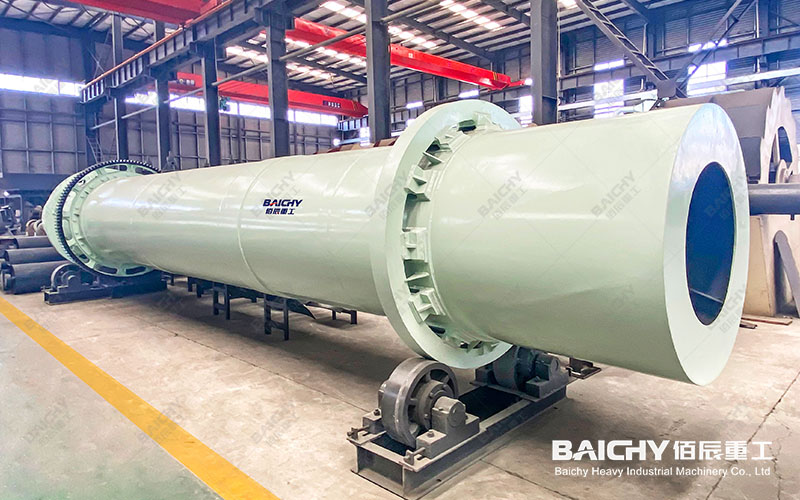
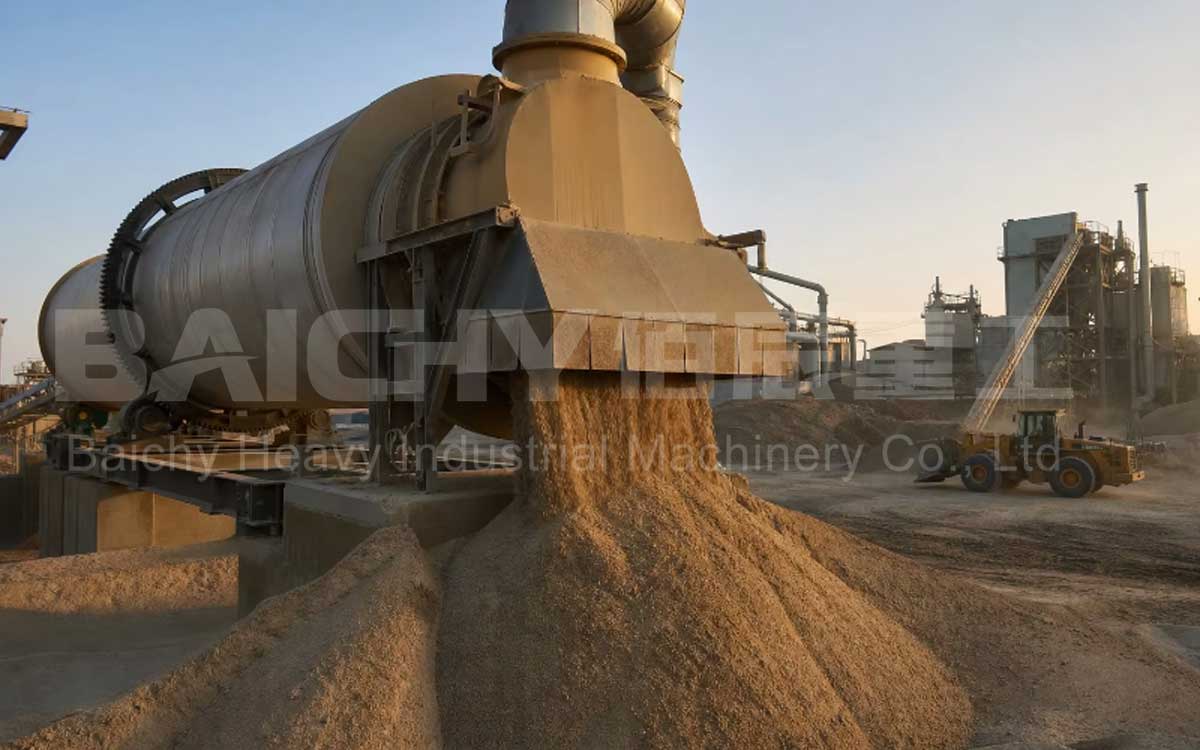
rotary sludge dryers
V. Technical Parameters of Sludge Dryer (Baichy Typical Configuration)
The processing capacities below are calculated based on drying wet sludge from 80% moisture content to 40%; for feedstocks from plate-and-frame dewatering (60%–65% moisture) or targets requiring lower final moisture, capacities are adjusted proportionally based on evaporation load—specific figures are subject to material drying test results.
| Specifications (Diameter × Length, m) | Reference Evaporation Capacity (t/h) | Reference Processing Capacity (t/h, wet sludge) | Discharge Moisture Content | Main Motor (kW) | Typical Application |
|---|---|---|---|---|---|
| Φ1.5×12 | 1.5–2.2 | 2.5–3.5 | Adjustable (40%/30%/15%) | 15 | Small-scale wastewater treatment plant |
| Φ1.8×14 | 2.5–3.3 | 4–5 | Adjustable (40%/30%/15%) | 18.5 | 50,000–100,000 t/a wet sludge line |
| Φ2.0×16 | 3.5–4.7 | 5.5–7 | Adjustable (40%/30%/15%) | 22 | Medium-scale wastewater treatment plant |
| Φ2.2×18 | 5–6.6 | 8–10 | Adjustable (40%/30%/15%) | 30 | 100–150 t/d centralized drying |
| Φ2.4×20 | 6.5–8.5 | 10–13 | Adjustable (40%/30%/15%) | 37 | Large-scale municipal sludge center |
| Φ2.6×22 | 8.5–11 | 13–16.5 | Adjustable (40%/30%/15%) | 45 | Industrial park-level centralized disposal |
Key Point: The evaporation load for deep drying (reducing moisture from 40% to below 15%) is approximately 15% higher than that of conventional drying stages. Furthermore, as moisture content decreases, thermal efficiency drops and heat consumption per ton rises significantly—calculate the "fuel costs" carefully before deciding whether to pursue the 15% target.
VI. Relevant Application Cases
Case A: Municipal wastewater treatment plant in East China (120 t/d); wet sludge volume reduced by two-thirds.
The plant's dewatered sludge had a moisture content of 79%–81%; off-site transport costs were calculated based on wet tonnage, and transport distances were continuously increasing. By adopting Baichy's complete Φ2.2×18 sludge drying system solution (featuring a gas-fired hot air furnace, negative-pressure sealed operation, two-stage dust removal, and an odor control tower), the facility achieved a stable output moisture content of 38%–42% and reduced sludge weight by approximately two-thirds per ton. This resulted in reduced transportation frequency and disposal costs, while successfully passing environmental compliance inspections. (Client name omitted per confidentiality agreement.)
Case B: Southeast Asian textile printing and dyeing industrial park—sludge dried to 15% moisture for use as fuel.
The park's mixed industrial sludge—containing 75%–80% moisture, fibers, and textile processing auxiliaries—was banned from direct landfill disposal. A Φ2.4×20 sludge dryer was selected, featuring customized corrosion-resistant internal components and a back-mixing structure. The output moisture content stabilized at 13%–16%, and the calorific value of the dried material rose to a level suitable for self-sustaining co-firing. The material is supplied as Refuse-Derived Fuel (RDF) to the park's thermal power plant, transforming sludge disposal from a cost burden into a revenue-generating activity. (Client name omitted per confidentiality agreement)
VII. Recommended Equipment
The sludge dryer is the core unit of the complete sludge drying line, configured as an integrated system comprising "pre-treatment – drying – dust collection – deodorization – conveying":
| Equipment | Recommended Configuration | Role/Positioning |
|---|---|---|
| Single-drum rotary dryer (sludge-specific) | Φ1.5×12 ~ Φ2.6×22 | Core drying unit; customized internal drum components |
| Sludge breaking/pelletizing feeder | Matched to main unit | Prevents clogging from high-viscosity feed material |
| Gas/steam/biomass hot air furnace | Sized based on evaporation load | Flexible heat source; supports waste heat integration |
| Cyclone separator + Baghouse filter | Recovery rate ≥99% | Dry powder recovery; ensures emissions compliance |
| Deodorization system (scrubber/bio-filter/activated carbon) | Sized based on airflow | Controlled treatment of odors and VOCs |
| Enclosed screw/bucket elevator conveyor | Matched to product output | Enclosed transport of dry material; prevents re-absorption of moisture |
Related reading: Rotary dryer cost analysis (full lifecycle breakdown of fuel, electricity, and labor); explosion-proof safety design for mineral rotary dryers (dust protection and interlocking logic). For equipment selection, please provide details on sludge type, dewatering method, moisture content, disposal destination, and production capacity; Baichy provides free drying test reports and delivers drying solutions and quotations within 5 working days.
FAQ
Q1: What is the lowest moisture content a sludge dryer can achieve? Is lower always better?
A: Direct-heating rotary sludge dryers can stably reduce moisture content to 40%, 30%, or even below 15%, achieving deep drying levels as low as 10%–15%. However, lower is not necessarily better: the evaporation load for the 40% → 15% range is about 15% higher than standard ranges; as moisture decreases, thermal efficiency drops, and heat consumption per ton rises significantly. The correct approach is to first determine the product's destination (landfill, incineration, cement kiln, or fuel conversion), then work backward to set the target moisture content, using drying tests to identify the most economical moisture level.
Q2: Does sludge drying entail odor and explosion risks? How are these controlled?
A: Yes, and this distinguishes sludge dryers from standard mineral dryers; these factors must be integrated into the initial design rather than addressed as afterthoughts. Odor control measures involve maintaining the entire line under negative pressure and containment, with collected gases treated via chemical scrubbing, bio-filtration, or activated carbon. Explosion prevention follows NFPA 654 and GB 15577 standards, incorporating online oxygen-level interlocking, temperature gradient control, explosion vents, and explosion-proof electrical components; physical isolation is established between open-flame heat sources and dust, while discharge-end material temperature is controlled to prevent smoldering or spontaneous combustion within the storage bin.
Q3: What are the differences between sludge dryers and dryers for coal slime or minerals? Can they be used interchangeably?
A: Mechanically, they belong to the same family of rotary dryers, but mineral dryers cannot simply be repurposed as sludge dryers. Sludge presents specific challenges—such as agglomeration during the sticky phase, foul-smelling gases, dust explosion risks, and potential corrosiveness (due to chlorine or sulfur in industrial sludge)—that impose far stricter requirements on internal drum components, sealing systems, odor control, and safety interlocks compared to mineral processing. Simply replicating a mineral dryer configuration often leads to material clogging, inflated capacity ratings, or failure to meet environmental compliance standards. It is recommended to customize internal components based on sludge-specific operating conditions and to submit a 5–10 kg sample for drying tests to determine optimal air temperature and residence time based on the measured "moisture vs. time" curve.
Baichy Heavy Industry
Baichy Heavy Industry is a high-tech mining equipment company integrating R&D, manufacturing, sales, and after-sales service. Focusing on crushing, grinding, and mineral processing equipment, we provide professional solutions to our customers. We are ISO9001:2015 、certified, and our products include mobile crushing palnts, crawler crushing plant, construction waste crushing plants, jaw crushers, sand making machines, cone crushers, fine crushers, grinding mills, ball mills, etc., all with reliable performance to meet diverse project needs.
Baichy Heavy Industry – Your Trusted Partner
To ensure optimal performance of your equipment, Baichy Heavy Industry offers:
- Professional on-site installation guidance
- Comprehensive operator training
- 24/7 technical support & maintenance services
Our complete after-sales service system guarantees long-term, stable operation of your machinery with minimal downtime.
Protect Your Rights – Only Use Official Channels
To avoid scams and ensure authentic support, contact us exclusively through:
• Official Website: www.baichychina.com
• WhatsApp: +8615093222637
• Email: [email protected]
Your satisfaction is our priority – expect prompt, professional service every time.
(Note: Beware of unauthorized third parties claiming to represent Baichy. Always verify through official contacts.)