

Rotary dryer costs
I. Rotary Dryer Costs: Look at the Big Picture Before Discussing Price
How much does a rotary dryer cost? The answer is never just the figure on a price quote. The true cost of a rotary dryer comprises equipment purchase, supporting heat source systems, environmental dust removal, installation and infrastructure, and years of operating expenses. Based on the industry-standard Total Cost of Ownership (TCO) model, operating expenses often account for over 60% of the total cost, with fuel being the largest variable within those expenses.
The bottom line: Focusing solely on the price of the main unit when comparing quotes is the most expensive way to "save money." Drawing on our practical experience in configuring drying lines for materials such as sand and gravel, coal slime, mineral powder, and biomass, this article breaks down the cost components and the six key parameters influencing price. We also provide calculations for two typical operating scenarios to help you invest your budget in production capacity and thermal efficiency, rather than in downtime and system rectification.
II. What Is a Rotary Dryer? Why Is It a Mainstay of Drying Operations?
A rotary dryer (also known as a drum dryer) utilizes a slightly inclined, slow-rotating cylinder. Internal lifting flights continuously toss and turn the material, ensuring full contact and heat exchange with high-temperature flue gas to facilitate continuous moisture evaporation. Its core value lies in continuous operation, high single-unit capacity, and broad material adaptability—with hourly throughputs ranging from a few tons to over a hundred tons. It is currently the most mature continuous drying equipment used in the sand and gravel, mineral processing, coal, and solid waste sectors.
The equipment assembly consists of the cylinder body, support rollers and thrust rollers, lifting flights, the drive system, feeding and discharging devices, and sealing systems. Hot air is supplied by coal-fired hot blast stoves, fluidized bed furnaces, gas burners, or waste heat recovery systems; the type of heat source directly determines the drying cost per ton of material, which is a core variable in the cost calculations presented later.
III. Key Application Scenarios for Rotary Dryers
1. Sand, Gravel, and Manufactured Sand: Products such as sand for dry-mixed mortar, foundry sand, and fracturing sand require a final moisture content of less than 1%. Drying is an essential step in the process and represents the fastest-growing market segment.
2. Coal and Coal Slime: Upgrading coal slime and reducing moisture in clean coal at preparation plants to boost calorific value and selling price—a classic "drying-for-revenue" scenario.
3. Mineral Processing and Powders: Drying dewatered materials such as iron concentrate, nickel ore, fluorite powder, and calcium carbonate to facilitate storage, transport, and downstream grinding/processing.
4. Sludge and Solid Waste: Semi-drying and volume reduction for municipal and industrial sludge; requires integrated design for odor control, dust removal, and explosion safety.
5. Agricultural and Forestry Biomass: Drying sawdust, wood chips, and straw to a moisture content of 8%–15% for use as biomass fuel or raw material for composite boards.
6. Chemicals and Building Materials: Continuous drying of materials such as phosphogypsum, desulfurization gypsum, compound fertilizers, and river sand.
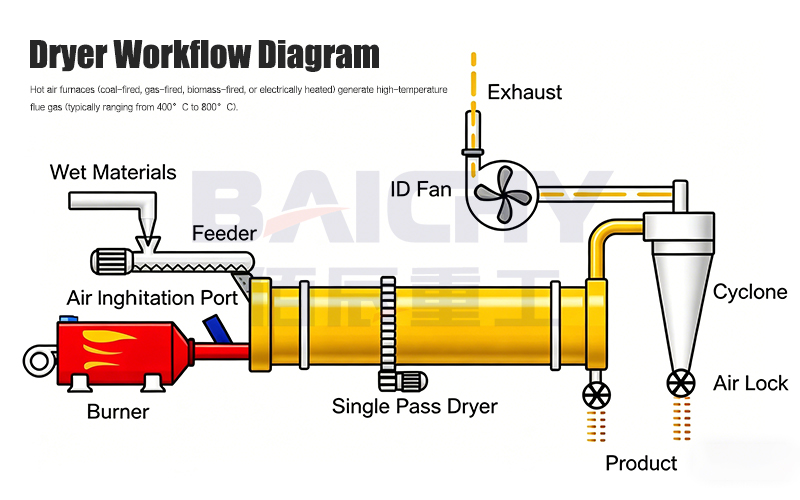
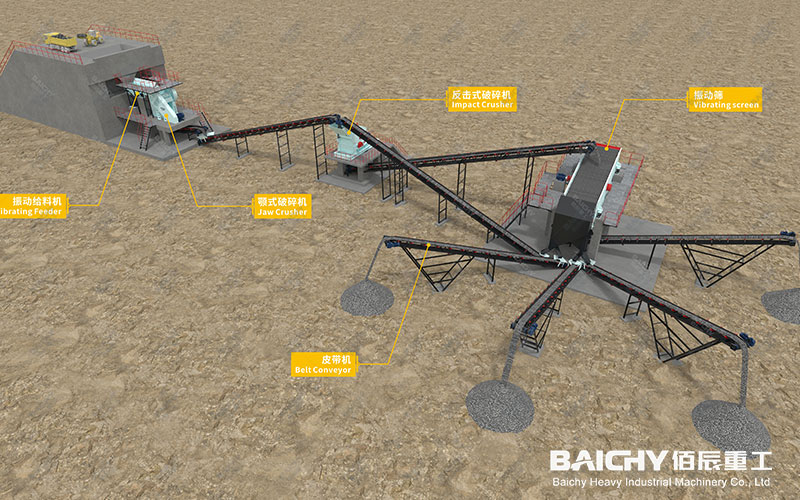
Dryer Workflow Diagram
IV. What are the cost components of a rotary dryer?
4.1 Equipment Purchase Costs
The main unit (drum, lifters, drive system, and seals) accounts for the largest share, typically 45%–60% of the total equipment price; the heat source system accounts for approximately 15%–25%; and dust removal/environmental protection systems account for 8%–15%. Gas-fired models also require investment in explosion-proof combustion controls and gas piping.
4.2 Installation and Infrastructure Costs
Includes civil foundation work, steel structures, thermal insulation, hoisting, piping connections, and commissioning/training; generally accounts for 10%–15% of the total project investment. Site leveling and the availability of natural gas pipelines significantly influence this expenditure.
4.3 Operating Costs (OPEX)
Fuel is the largest variable, accounting for approximately 70% of operating costs; the remainder consists of electricity consumption, labor, and the replacement of wear parts (lifters, support rollers, seals). Differences in fuel unit prices and equipment thermal efficiency can result in an annual cost gap of hundreds of thousands of yuan between two pieces of equipment with similar initial purchase prices.
4.4 Hidden Costs
Losses from unplanned downtime, rectification and fines due to non-compliance with environmental standards, and safety risks. These costs do not appear on the initial quotation but often become the most expensive items after the plant goes into operation.
| Cost Category | Cost Share Range | Notes |
|---|---|---|
| Main Equipment | 45%–60% | Priced based on drum diameter × length, material, and internal structure |
| Heat Source System | 15%–25% | Hot blast stove / fluidized bed furnace / burner; determines fuel cost per ton |
| Dust Removal & Environmental Protection | 8%–15% | Cyclone + baghouse dust collectors, stack, monitoring systems |
| Installation, Civil Works & Commissioning | 10%–15% | Foundations, steel structures, insulation, hoisting, training |
| Annual Operating Costs | Depends on conditions | Fuel accounts for ~70%; includes electricity, labor, and wear parts |
Note: Percentages represent typical ranges; actual costs depend on the specific equipment list and local operating conditions.
V. Six Key Parameters Affecting Rotary Dryer Price and Operating Costs
1. Processing Capacity & Evaporation Rate: The true determinants of drum diameter and length are the "tons of water evaporated per hour," not the input tonnage. Quoted prices are incomparable if capacity is discussed without reference to moisture removal.
2. Drum Specifications & Material: Q235 steel suffices for standard materials; corrosive materials require stainless steel or acid-resistant linings, significantly increasing costs.
3. Heat Source Type: Choice of coal, natural gas, biomass, or waste heat. Coal offers the lowest cost per ton but requires high environmental investment; natural gas costs 2–3 times more than coal but is cleaner and facilitates automation.
4. Dust Removal & Environmental Configuration: Cyclone plus baghouse dust collection is a common combination; higher emission standards require larger investments.
5. Internal Structure & Model Type: Single-drum designs are simple and suitable for high capacity and sticky materials; three-drum (nested) designs utilize flue gas over multiple passes, saving ~30% energy for the same capacity while significantly reducing the equipment footprint.
6. Electrical & Automation: Variable frequency drives (VFD), online discharge moisture monitoring, and temperature-linked explosion protection. Export models can be customized for 50Hz/60Hz and local voltages (380V/400V/440V).
| Model | Drum Specifications (Diameter × Length) | Reference Processing Capacity | Typical Applicable Materials |
|---|---|---|---|
| Single-drum | Φ1.2 × 8m | 2–5 t/h | River sand, gypsum, mineral powder |
| Single-drum | Φ1.8 × 12m | 6–12 t/h | Sand and gravel, mineral powder, coal slime |
| Single-drum | Φ2.2 × 14m | 12–20 t/h | Coal slime, mineral processing materials |
| Single-drum | Φ2.8 × 18m | 20–35 t/h | Coal, high-capacity sand and gravel lines |
| Three-drum | Φ2.0 × 6m | 8–15 t/h | Sand, sawdust, mineral powder |
| Three-drum | Φ2.4 × 7m | 15–25 t/h | Sand and gravel, coal slime upgrading |
Note: Processing capacity is a reference range; actual figures vary based on feed moisture, particle size, material density, and heat source. Please refer to the parameters provided by the manufacturer based on your specific material and operating conditions.
VI. Core Advantages of Rotary Dryers
1. High capacity and continuous operation: Hourly processing capacity ranges from several tons to over a hundred tons per unit, meeting production-line scale requirements;
2. Uniform and controllable discharge moisture: Final moisture levels remain stable and meet standards through adjustments to rotation speed, hot air temperature, and residence time;
3. Wide material adaptability: Capable of processing everything from fine sand (1mm grade) to lump coal and sticky coal slime;
4. Three-drum models offer high thermal efficiency and a small footprint: Lower specific fuel consumption for the same capacity and reduced investment in factory facilities;
5. Low maintenance requirements and high uptime: Mature structural design, simple replacement of wear parts, and a comprehensive spare parts system.
VII. Cost Estimation Reference: Two Typical Operating Scenarios
7.1 Case 1: 30 t/h River Sand Drying (Feed moisture 5% → Discharge <0.8%)
Based on a feed rate of 30 t/h, approximately 1.3 tons of water must be evaporated per hour. The recommended configuration consists of a triple-pass dryer, a hot-blast stove, a bag-type dust collector, and inlet/outlet conveying systems.
Based on typical thermal efficiency calculations:
Coal/Biomass heat source: Fuel cost is approximately 6–10 RMB per ton of sand (assuming a coal price of ~900 RMB/ton);
Natural gas heat source: Fuel cost is approximately 18–25 RMB per ton of sand;
Electricity consumption is approximately 2–3 kWh per ton of sand, equivalent to ~1–1.5 RMB.
Payback period formula: Payback period (years) ≈ Total line investment &pide; [Annual output × (Selling price of dry sand − Selling price of wet sand − Drying cost per ton)]. Taking the example of sand for dry-mixed mortar—which commands a price premium of 15–25 RMB per ton over wet sand—and an annual output of 200,000 tons, the annual revenue increase is approximately 3–5 million RMB. Equipment investment can typically be recovered within 1–2 years, provided the equipment is selected based on the required water evaporation capacity rather than purchasing oversized equipment based on nominal capacity.
7.2 Case Study 2: 15 t/h Coal Slime Drying (Moisture content: 25% → 12%)
This application requires the evaporation of approximately 2.2 tons of water per hour. Due to the significant change in moisture content, a single-drum dryer with high evaporation capacity or a triple-pass upgrading line is recommended. Based on a coal price of 900 RMB/ton, the fuel cost for drying wet coal slime is approximately 25–35 RMB per ton, accounting for about 6%–8% of the coal slime's selling price. However, the price premium gained from the increased calorific value after drying and upgrading is usually far higher than this cost; this is the key financial metric coal preparation plants use to evaluate the "revenue increase through drying" strategy. Since coal slime is highly viscous, equipment selection must prioritize designs that break up clumps and prevent clogging, and the dust collection system should be designed to fully comply with local emission standards from the outset.
The above figures are estimates based on typical operating conditions and serve as a framework for investment assessment; actual figures depend on material analysis, local energy prices, and the specific manufacturer's proposal.
VIII. How to reduce the total cost of rotary dryers? Six Selection Recommendations
1. Compare prices based on evaporation capacity rather than product names: Ask manufacturers to quote based on "input moisture, hourly output, and final moisture" to prevent inflated capacity claims;
2. Prioritize triple-drum dryers for equivalent capacity: They offer ~30% energy savings and a compact footprint; choose single-drum dryers for high capacity, high moisture content, or sticky materials;
3. Calculate local heat source economics first: In regions with waste heat or cheap biomass, the advantage in operating costs far outweighs the difference in initial equipment purchase price;
4. Ensure environmental compliance from the start: Avoid the high costs of retrofitting or rectification after the plant is operational;
5. Focus on wear-part lifespan and after-sales service: Consider the ease of replacing lifters and support rollers; spare part availability and response speed directly impact downtime costs;
6. Request small-scale drying tests: Have the manufacturer test your specific material and provide a comparison between "nominal capacity" and "actual operational capacity" to address risks before signing the contract.
IX. Recommended Equipment (Based on scenarios in this article)
| Recommended Configuration | Applicable Scenarios | Selection Key Points |
|---|---|---|
| Triple-drum rotary dryer line (HZG Series) | Sand/gravel, sawdust, mineral powder; compact sites; focus on low specific fuel consumption | ~30% energy savings; integrated hot-blast stove and dust removal |
| Single-drum rotary dryer line | Coal slime, high-moisture materials, high hourly output requirements | High evaporation capacity; simple structure; easy maintenance |
| Drying + Sand Making/Grinding Combined Line | Dry-mixed mortar sand, gypsum, deep processing of calcium carbonate | Seamless process integration; avoids capacity mismatches between equipment units |
Auxiliary Equipment: Coal/biomass hot-blast stove, fluidized bed furnace, cyclone + baghouse dust collector, screw feeder, belt conveyor, online moisture detection system. Send us your material details, input/output moisture levels, and target hourly output; we will provide a proposal and quote based on evaporation capacity.
X. Frequently Asked Questions (FAQ)
Q1: Roughly how much does a rotary dryer cost? Why do quotes vary so much between manufacturers?
A: The price of the main unit ranges from over 100,000 RMB to several million RMB; price differences stem from the drum diameter and length (evaporation capacity), material composition, heat source type, and environmental protection configurations. Price quotes detached from specific operating conditions cannot be compared—the correct approach is to ask the manufacturer to quote based on "feed moisture content, hourly output, and final moisture content," and to clarify whether the quote includes the heat source and dust removal system.
Q2: How do I choose between a single-drum and a three-drum rotary dryer? Which offers lower operating costs?
A: Three-drum models utilize flue gas through multiple passes, typically resulting in about 30% lower specific fuel consumption for the same capacity and a smaller footprint; they are suitable for loose, fine-grained materials like sand, sawdust, and mineral powder. Single-drum models feature a simple structure and are easy to maintain, making them better suited for high-capacity operations or materials with high moisture or stickiness (such as coal slime). Choose the model based on the required evaporation volume and material characteristics, then include the specific fuel consumption in the technical agreement to keep operating costs under control.
Q3: How are dryer operating costs calculated? How long does it take to recoup the investment?
A: Annual operating cost ≈ Annual processing volume × (Fuel cost per ton + Electricity consumption + Allocated labor costs + Allocated wear-part costs). Fuel cost per ton is roughly equal to "Evaporated water per ton of material × Specific fuel consumption per ton of water × Unit fuel price." Payback period ≈ Total line investment &pide; [Annual output × (Value added to dried product − Total drying cost per ton)]. Before signing the contract, you can ask the manufacturer for a written guarantee regarding the maximum specific fuel consumption "per ton of evaporated water" to serve as a reliable input for calculating the payback period.
Baichy Heavy Industry
Baichy Heavy Industry is a high-tech mining equipment company integrating R&D, manufacturing, sales, and after-sales service. Focusing on crushing, grinding, and mineral processing equipment, we provide professional solutions to our customers. We are ISO9001:2015 、certified, and our products include mobile crushing palnts, crawler crushing plant, construction waste crushing plants, jaw crushers, sand making machines, cone crushers, fine crushers, grinding mills, ball mills, etc., all with reliable performance to meet diverse project needs.
Baichy Heavy Industry – Your Trusted Partner
To ensure optimal performance of your equipment, Baichy Heavy Industry offers:
- Professional on-site installation guidance
- Comprehensive operator training
- 24/7 technical support & maintenance services
Our complete after-sales service system guarantees long-term, stable operation of your machinery with minimal downtime.
Protect Your Rights – Only Use Official Channels
To avoid scams and ensure authentic support, contact us exclusively through:
• Official Website: www.baichychina.com
• WhatsApp: +8615093222637
• Email: [email protected]
Your satisfaction is our priority – expect prompt, professional service every time.
(Note: Beware of unauthorized third parties claiming to represent Baichy. Always verify through official contacts.)