Rotary Drum Dryer
A rotary drum dryer manufacturer is an enterprise capable of large-scale production of rotary drum dryers (also known as rotary dryers) and able to calibrate production capacity based on actual material testing. These dryers utilize an inclined, rotating drum equipped with internal lifting flights to facilitate full heat exchange between high-temperature hot air and wet material, continuously reducing the moisture content of materials—such as sand and gravel, mineral concentrates, coal slime, and sludge—from an initial 12%–25% down to 1%–8%.
I. Overview of Rotary Drum Dryers: What the equipment is and what it does
1. Structure and Working Principle
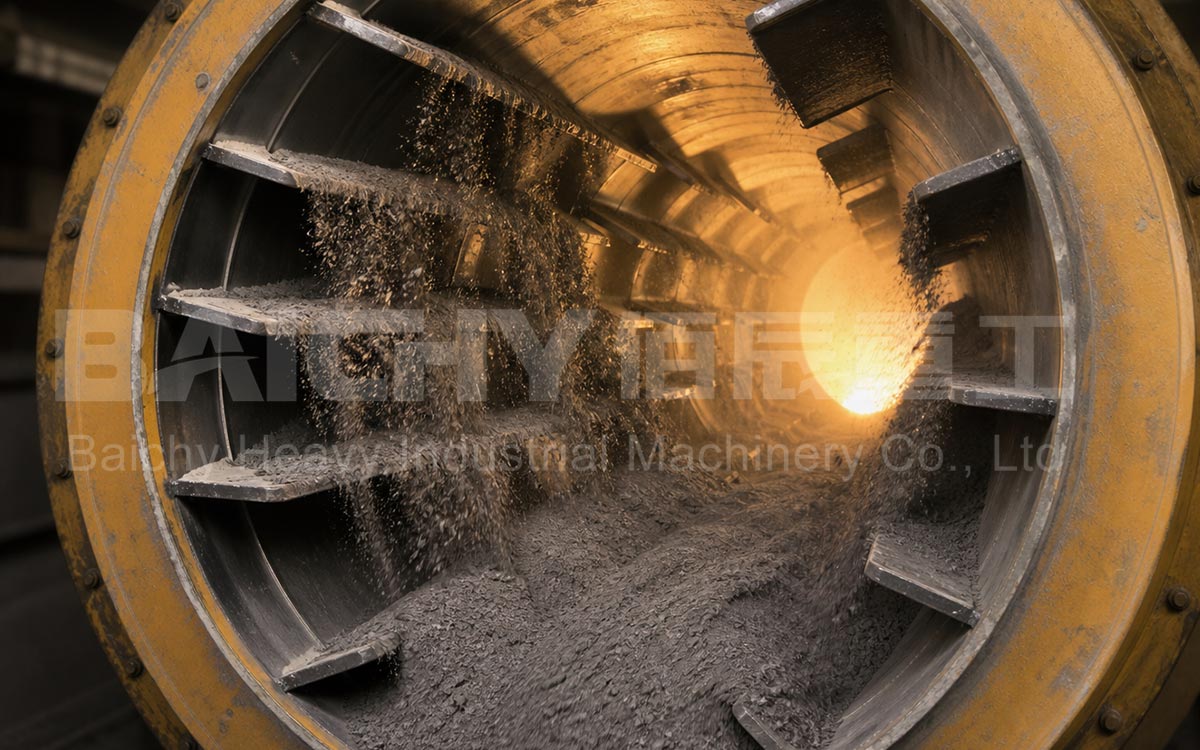
The working principle of a dryer
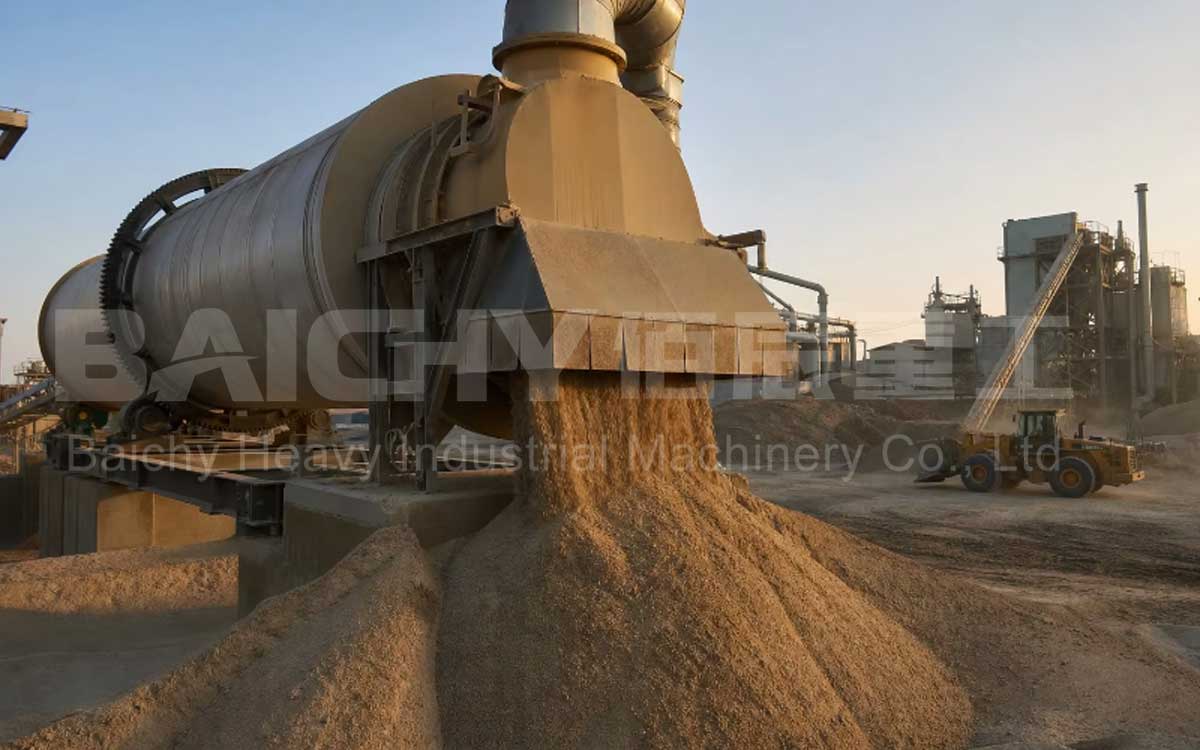
The main body of the rotary drum dryer consists of a low-speed rotating drum inclined at 3°–5° and supported by riding rings and rollers. Wet material enters from the high end and is repeatedly lifted and dropped by internal flights, forming a uniform curtain of material. High-temperature flue gas from a hot-blast stove passes through the drum—either in the same direction (co-current) or the opposite direction (counter-current) to the material flow. Moisture vaporizes and is extracted by an induced draft fan, then purified through a two-stage system (cyclone dust collector and baghouse filter) before discharge. A variable-frequency motor drives the drum with stepless speed regulation, allowing for adjustable material retention time; it is a high-capacity dryer designed for continuous operation.
2. Two Process Modes: Co-current and Counter-current
Co-current: Hot air and material move in the same direction; temperatures are high at the inlet and low at the outlet. This mode is suitable for heat-sensitive materials like sludge and sawdust, ensuring safety and preventing material scorching.
Counter-current: Hot air and material move in opposite directions; temperatures are high at the discharge end, resulting in higher thermal efficiency. This mode is suitable for heat-resistant materials like sand, gravel, and mineral concentrates, offering lower fuel costs.
A responsible manufacturer recommends the airflow direction based on the material's heat sensitivity and target moisture content, rather than applying a one-size-fits-all process. The list of processable materials includes river sand and manufactured sand, iron/copper/fluorite concentrates, coal slime and lignite, sludge and desulfurization gypsum, sawdust and straw, as well as fertilizers and chemical intermediates, covering an initial moisture range of 1%–60%.
II. Typical Application Scenarios for Rotary Drum Dryers
1. Sand, Aggregate, and Manufactured Sand Production Lines
Sand discharged from washing machines typically has a moisture content of 8%–20%; wet sand can freeze in winter, cause bridging in storage silos, and lead to inaccurate downstream mix ratios. Drying the sand to below 1% moisture reduces weight by approximately 7%–14% per 100 tons transported, and customers in the dry-mixed mortar and foundry sand sectors are willing to pay a premium for low-moisture material. A φ1.5×12 m model is sufficient for small-to-medium production lines with capacities of 8–15 t/h, making this one of the drying applications with the fastest investment payback.
2. Mineral Concentrate and Ore Powder Drying
Mineral concentrates (such as iron ore, copper ore, and fluorite) often retain 12%–15% moisture after filtration; batches exceeding moisture limits are frequently rejected by pelletizing plants or refused during trade settlements. Due to the highly abrasive nature of these concentrates, wear-resistant liners and a high-temperature (600–700°C) counter-current drying process are required. Single-unit capacities can exceed 200 t/h, making these dryers standard equipment for large mineral processing plants.
3. Coal Slime, Lignite, and Coal Drying
Filter-pressed coal slime typically has a moisture content of 22%–25%; shipping it directly results in low unit prices and logistical bottlenecks. Drying the material to below 8% moisture allows it to be blended with high-quality coal for sale, significantly increasing the value per ton. Given the risks associated with volatile matter and carbon monoxide (CO) in coal, professional rotary drum dryer manufacturers incorporate temperature interlocks and explosion-proof measures—features often omitted by low-cost, generic equipment providers.
4. Environmental Materials: Sewage Sludge and Desulfurization Gypsum
Municipal sludge and desulfurization gypsum are highly viscous and prone to agglomeration, requiring L-shaped anti-sticking lifters and reliable sealing systems; sludge drying applications also require wet scrubbing towers for odor control. Once dried, desulfurization gypsum serves as a raw material for construction products, simultaneously facilitating solid waste disposal and generating revenue.
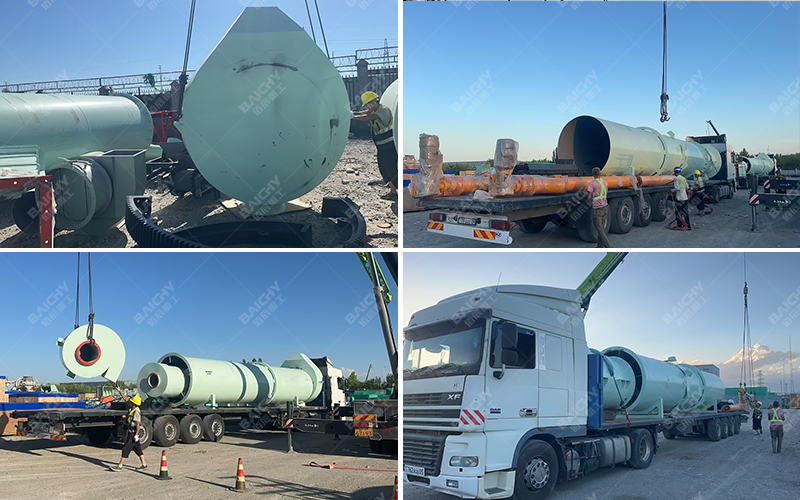
Photo of a Single-Drum Dryer Ready for Shipment
III. Core Advantages of Rotary Drum Dryers
Equipment advantages ultimately come down to delivery and performance data: a reliable rotary drum dryer manufacturer will confidently include verified production capacity in the contract and provide a complete system—including the hot air furnace, dust collection unit, and electrical control system—rather than simply selling a standalone machine.
1. High Single-Unit Capacity and Continuous Operation
The product range covers single-drum models with capacities from 3 to 200 t/h, supporting 24-hour continuous operation and ensuring seamless integration with upstream crushing and grinding production lines.
2. High Thermal Efficiency and Flexible Heat Sources
Counter-current processing improves thermal efficiency by 15%–25% compared to co-current processing; compatible with various heat sources—including coal, gas, biomass, and waste heat—allowing for switching based on local energy market conditions rather than being tied to a single fuel price.
3. Wide Material Adaptability and High Safety
Lifting flights are designed in sections tailored to specific material characteristics: preventing wall adhesion for high-moisture materials and minimizing dust generation for dry materials. Heat-sensitive materials can be processed via low-temperature co-current flow or indirect heating, balancing output with safety.
4. Environmental Compliance and Controllable Maintenance Costs
A two-stage dust collection system (cyclone plus bag filter) comes standard, with options to upgrade to a wet scrubber. Components such as forged steel tires, hardened support rollers, and wear-resistant liners extend maintenance intervals, while variable-frequency drives reduce power consumption.
5. Integrated System Capabilities Reduce Hidden Costs
The dryer is just one link in the production line. Manufacturers like Baichy—who produce equipment for crushing, grinding, mineral processing, and drying—can supply an integrated system covering everything from sand washing and crushing to drying and dust collection. This ensures compatibility between interfaces and capacities, while a single point of contact handles after-sales support for the entire line.
IV. Technical Specifications for Rotary Drum Dryers
The table below lists the primary specifications for single-drum rotary dryers manufactured by Baichy Heavy Industry (categorized by drum diameter × length).
Ratings are based on quartz sand processing under wet-basis conditions:
| Model Specification | Capacity (Feed 10% → Discharge 0.5%) | Capacity (Feed 20% → Discharge 0.5%) | Main Unit Power | System Footprint (incl. hot air furnace & dust collector) |
|---|---|---|---|---|
| φ1.5×12 m | 8–15 t/h | 5–8 t/h | 15 kW | Approx. 120 m² |
| φ2.0×16 m | 20–35 t/h | 12–20 t/h | 22 kW | Approx. 180 m² |
| φ2.4×18 m | 35–55 t/h | 22–35 t/h | 37 kW | Approx. 240 m² |
| φ2.8×20 m | 55–85 t/h | 35–55 t/h | 55 kW | Approx. 300 m² |
| φ3.0×22 m | 70–110 t/h | 45–70 t/h | 75 kW | Approx. 360 m² |
| φ3.6×25 m | 120–200 t/h | 80–130 t/h | 132 kW | Approx. 460 m² |
Rated for quartz sand (loose bulk density approx. 1.6 t/m³), counter-current operation, inlet air temperature 600–700°C. Convert capacity by material density for iron ore concentrate and other minerals; the higher the inlet moisture, the lower the actual throughput. Confirm the final model against the moisture reduction curve from free sample testing.
V. Application Cases from the Rotary Drum Dryer Manufacturer
The following are typical delivery cases (anonymized) completed by Baichy over the past three years across Southeast Asia, South America, and the domestic market, covering three application scenarios: sand and gravel, iron ore concentrate, and eco-friendly materials.
Case 1: Sand drying for a manufactured sand plant in Southeast Asia (approx. 30 t/h). The output from the customer's sand-washing line had a moisture content of 15%–18%; wet sand was difficult to sell during the rainy season and incurred moisture-related price deductions during transport. A triple-pass dryer (Φ2.8×6 m) was selected to reduce the moisture content to below 0.8%, enabling the product to meet dry-mixed mortar specifications. This generated an added value of approximately US$2–3 per ton, allowing the investment in the drying system to be recouped within 13 months.
Case 2: Iron ore concentrate drying for a beneficiation plant in South America (approx. 50 t/h). Hematite concentrate had a moisture content of 12%, leading to batch rejections by the pelletizing workshop. A single-pass counter-flow dryer unit (Φ2.4×18 m) stably reduced the moisture content to below 1%. Savings on freight costs and the elimination of moisture-related price deductions alone allowed the equipment cost to be recovered within 18 months.
Case 3: Resource utilization of desulfurization gypsum from a domestic coal-fired power plant (approx. 15 t/h). The gypsum had a moisture content of around 15%, occupying valuable storage space and incurring disposal fees. A rotary drum dryer was used to reduce moisture to below 1%, allowing the material to be sold as a construction raw material. Equipment and operating costs were recouped in approximately 10 months, successfully transforming solid waste into a marketable product. (The cases presented represent typical operating conditions; specific data will vary based on the material and site conditions.)
VI. Recommended Auxiliary Equipment for Rotary Drum Dryers
A complete drying system comprises the main dryer unit, a hot-air furnace, and dust collection and conveying systems. It is recommended to source all components from the same rotary dryer manufacturer to ensure balanced production capacity across all stages:
1. Triple-pass (three-drum) dryer: 3–80 t/h capacity; suitable for sites with space constraints (see the triple-pass dryer product page).
2. Indirect-heating rotary dryer: Suitable for silica sand purification and heat-sensitive materials; hot air does not come into direct contact with the material.
3. Coal/gas-fired hot-air furnace plus cyclone and baghouse dust collectors: A comprehensive solution for heat generation and environmental compliance.
4. Spiral sand washer and fine sand recovery machine: Upstream sand washing equipment (see the spiral sand washer selection guide).
5. Raymond mill, ball mill, and mineral processing equipment: Dried fine powder can be fed directly into the mill or processing circuit for a seamless production line.
6. Toothed roll crusher: For pre-crushing lump materials (such as coal slime) prior to drying (see the toothed roll crusher coal crushing solution).
VII. Rotary Drum Dryer Manufacturer: Frequently Asked Questions (FAQ)
Q1: What is the difference between a standard rotary drum dryer and a triple-pass dryer, and how do I choose?
The single-drum dryer features a simple structure and is easy to maintain, making it suitable for high-capacity operations and abrasive materials. The triple-pass dryer nests three drums within one another, reducing the required length by approximately 60% for the same capacity; while ideal for retrofit projects with limited space, its internal structure is more complex. Choose the single-drum model if you have ample space and prioritize capacity; choose the triple-pass model if space is limited or budget is a primary concern. Send your material specifications and site dimensions to Baichy to receive a comparative proposal that includes a layout plan.
Q2: Does the capacity listed in the parameter table represent the nominal capacity? How do I calculate the capacity for my specific material?
Drying capacity is heavily dependent on material density, initial moisture content, and target moisture content. Therefore, the parameter table is only meaningful when it lists capacities for specific initial moisture levels (e.g., 10% and 20%). Send 5–10 kg of representative samples before signing the contract; Baichy will conduct free test runs and provide a measured moisture content curve within five working days. Acceptance is based on the test data—no guesswork regarding production capacity.
Q3: What information is required to request a quote from Baichy for a rotary drum dryer?
Just five items: material type and initial moisture content, particle size and viscosity, target production capacity (based on dry material), target final moisture content, and on-site voltage and available heat sources. Once the complete information is received, we will provide a matching model, a production line layout, and an FOB/CIF quote within 48 hours.
Baichy Heavy Industry
Baichy Heavy Industry is a high-tech mining equipment company integrating R&D, manufacturing, sales, and after-sales service. Focusing on crushing, grinding, and mineral processing equipment, we provide professional solutions to our customers. We are ISO9001:2015 、certified, and our products include mobile crushing palnts, crawler crushing plant, construction waste crushing plants, jaw crushers, sand making machines, cone crushers, fine crushers, grinding mills, ball mills, etc., all with reliable performance to meet diverse project needs.
Baichy Heavy Industry – Your Trusted Partner
To ensure optimal performance of your equipment, Baichy Heavy Industry offers:
- Professional on-site installation guidance
- Comprehensive operator training
- 24/7 technical support & maintenance services
Our complete after-sales service system guarantees long-term, stable operation of your machinery with minimal downtime.
Protect Your Rights – Only Use Official Channels
To avoid scams and ensure authentic support, contact us exclusively through:
• Official Website: www.baichychina.com
• WhatsApp: +8615093222637
• Email: [email protected]
Your satisfaction is our priority – expect prompt, professional service every time.
(Note: Beware of unauthorized third parties claiming to represent Baichy. Always verify through official contacts.)