
A Comprehensive Analysis of Raymond Mill Systems
In modern mining crushing and grinding processes, the Raymond mill system has emerged as a core equipment choice for numerous mineral processing enterprises, distinguished by its mature technology, stable performance, and high-efficiency output. As a specialized manufacturer of mining crushing and grinding equipment, we fully understand that a reliable and efficient grinding system is critical to enhancing production line efficiency and reducing operational costs. This article will provide an in-depth, multi-dimensional analysis of the Raymond mill system, helping you gain a comprehensive understanding of its value and applications.
System Overview and Core Analysis
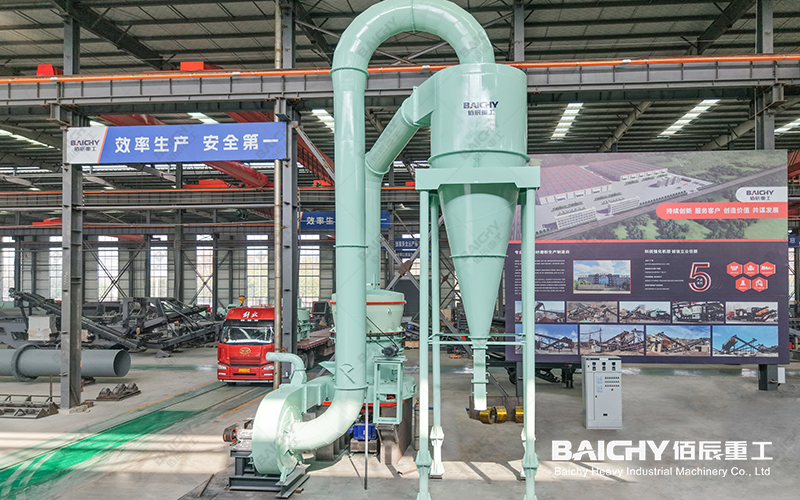
The Raymond mill—also known as the pendulum mill—has undergone multiple rounds of optimization and structural upgrades since its inception, evolving into a complete powder processing system. It comprises not only the main grinding unit but also integrates auxiliary equipment for feeding, classifying, collecting, and conveying, thereby forming a closed-loop, continuous, and automated production system.
From a technical perspective, current mainstream Raymond mill systems significantly enhance powder collection efficiency and reduce dust emissions through the adoption of advanced blowers and high-efficiency cyclone separators. Its core grinding principle relies on grinding rollers that, driven by centrifugal force, press firmly against the grinding ring to crush the raw materials. An analyzer then classifies the ground material; fine powder meeting the required fineness is carried by the airflow into the cyclone collector, while coarse particles are returned to the grinding chamber for further processing. This cyclical process ensures both product particle size uniformity and high production output.
Key Advantages of the System
Compared to traditional ball mills or other rudimentary grinding equipment, the modern Raymond mill system offers a series of indispensable advantages:
• High Efficiency and Low Energy Consumption: Featuring a vertical structural design, the system occupies a minimal footprint and functions as a highly integrated, self-contained production line—handling the entire process from raw lumps to finished powder. The system demonstrates relatively low energy consumption, and the fineness of the finished product can be flexibly adjusted within a specific range.
• High Reliability and Durability: Critical components are manufactured using high-quality castings and structural profiles, produced with precision craftsmanship to ensure the overall durability of the equipment. In particular, wear-prone parts—such as the grinding rollers and grinding rings—are reinforced with specialized materials to ensure a long service life.
• Superior Environmental Performance: The entire airflow system operates in a negative-pressure environment, effectively minimizing dust leakage and external emissions. Equipped with a high-efficiency pulse dust collector, the workshop environment remains clean and fully compliant with national environmental protection standards.
• Intelligent Control: Modern systems can be equipped with automated feeding and electrical control systems, enabling "one-touch start/stop" operation and remote monitoring. This simplifies operation while significantly reducing labor costs and operational complexity.
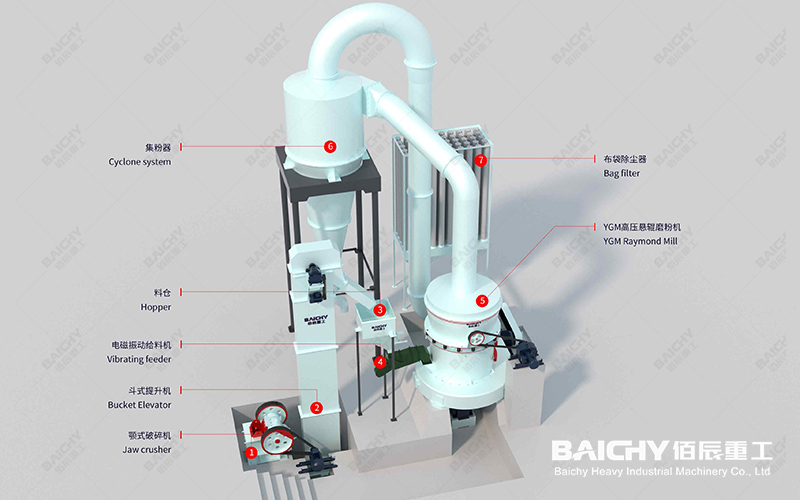
Raymond Mill Grinding System Structure Diagram
Key Components and Technical Parameter Examples
A complete Raymond mill grinding system typically comprises several core components. The table below outlines the main constituents of a standard configuration and their respective functions:
| Component Name | Main Function | Remarks |
| Main Unit | The core device for material grinding; includes grinding rollers, grinding rings, scraper blades, etc. | Different models determine processing capacity and fineness range. |
| Feeder | Conveys the material to be ground into the main unit in a uniform and continuous manner. | Electromagnetic vibrating feeders or belt feeders are commonly used. |
| Classifier | Classifies the ground powder; unqualified coarse particles are returned for re-grinding. | Features variable frequency speed control for precise regulation of finished product fineness. |
| Blower | Provides the circulating airflow for the system, facilitating the conveyance and drying of powder materials. | Airflow volume influences both output capacity and product fineness. |
| Cyclone Collector | Separates powder from the airflow, collecting the majority of the qualified finished product. | Collection efficiency is a critical factor in the system's overall output. |
| Pulse Dust Collector | Purifies the airflow and collects residual dust, ensuring environmentally compliant emissions. | Safeguards the working environment and recovers additional product. |
| Electrical Control Cabinet | Centralizes the control of system start/stop, parameter adjustment, and safety protection functions. | Enables automated and intelligent system control. |
Successful Application Cases
Our Raymond mill grinding systems have been successfully implemented in numerous countries and regions worldwide, processing a perse range of non-metallic minerals including limestone, calcite, barite, gypsum, feldspar, and others.
Case Study 1: Large-scale Calcium Carbonate Powder Processing Plant in Central China
The client previously utilized outdated grinding equipment, which suffered from low output, high energy consumption, and excessive dust generation. We customized an HCQ Series Enhanced Raymond Mill System to meet their specific needs. Following the upgrade, the production line's capacity increased by approximately 40%, product fineness stabilized within the 200–400 mesh range, and electricity consumption dropped by 25%. Furthermore, the workshop environment underwent a fundamental improvement, resulting in extremely high client satisfaction. • Case Study 2: Southeast Asia Gypsum Powder Production Line
This project required a production line featuring a high degree of automation and a compact footprint. We provided a comprehensive solution covering every stage—from crushing, conveying, and grinding to packaging—centered around our company's new-generation intelligent Raymond mill system. The system operates with exceptional stability; the entire line can be managed by just 1–2 operators, and the final product fully complies with local standards for construction-grade gypsum powder, thereby enabling the client to rapidly secure a dominant position in the market.
Equipment Selection and Recommendations
When selecting a Raymond mill system, it is essential to comprehensively consider factors such as material hardness, moisture content, feed particle size, desired product fineness, and target output capacity. We highly recommend conducting a trial grinding test on your specific material prior to making a final decision.
• For clients who are just starting out or have modest output requirements, we recommend the 3R/4R Series Standard Raymond Mills. These offer lower initial investment costs while effectively meeting basic grinding needs.
• For clients requiring large-scale, high-precision production capabilities, the 5R/6R Series and the HCQ Enhanced Series represent superior choices, offering distinct advantages in terms of output volume, fineness range, and equipment stability.
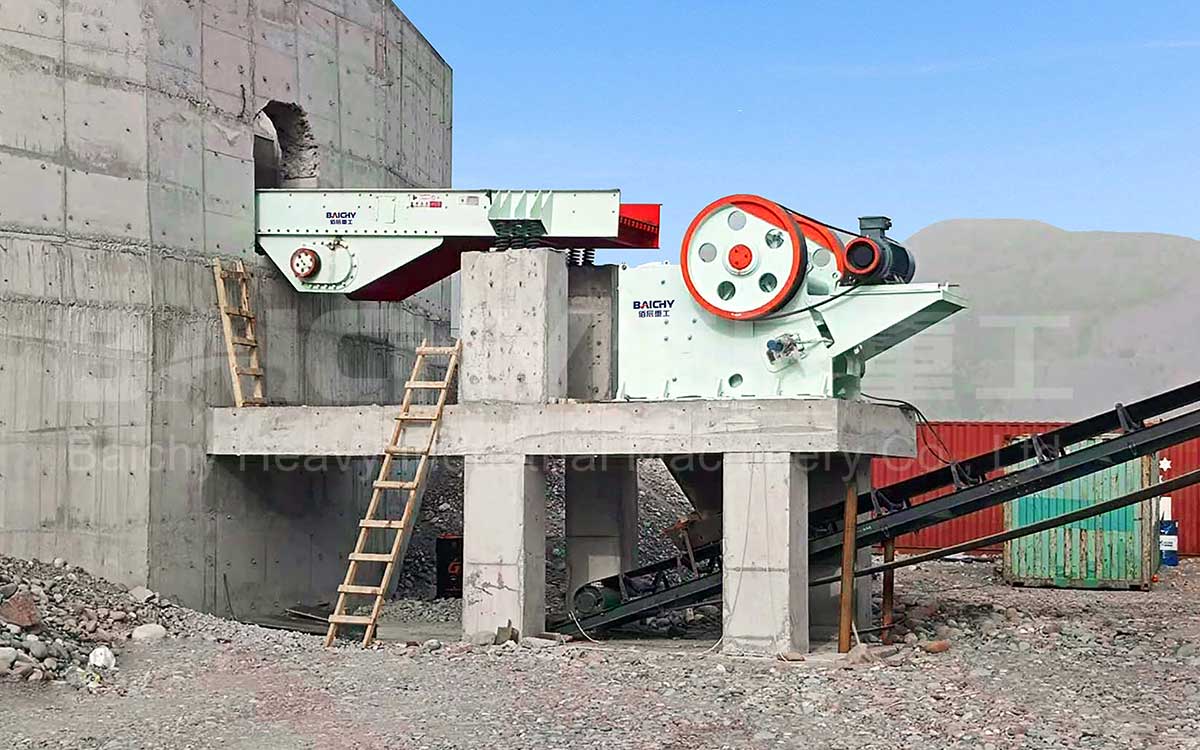
• Recommended Ancillary Equipment: We suggest incorporating a Jaw Crusher for preliminary coarse crushing, paired with a Vibrating Screen to ensure uniform feed particle size entering the mill, thereby maximizing the overall efficiency and performance of the Raymond mill system.
Frequently Asked Questions (FAQ)
Q1: What is the finest particle size (mesh count) that a Raymond mill system can achieve?
A1: Traditional Raymond mill systems typically produce powder within a fineness range of 80 to 400 mesh. However, newer-generation Raymond mills—such as our HCQ Series—which utilize enhanced spring mechanisms or hydraulic boosting technology, can achieve a stable fineness of up to 600 mesh (approximately 23 microns) when paired with a precision classifier. If even finer powder is required (e.g., above 1250 mesh), you should consider an ultra-fine vertical mill or an air-classifier mill.
Q2: Is the system's maintenance and upkeep complex? What are the key maintenance points?
A2: Routine maintenance for a Raymond mill system is not complex. The core requirements involve periodically lubricating all bearing points, inspecting wear-prone components (such as grinding rollers and rings) for signs of wear, and replacing them in a timely manner. Additionally, it is necessary to periodically clean the fan ducts and inspect the filter bags within the dust collector. A standardized maintenance protocol can effectively extend equipment lifespan; therefore, we provide our clients with comprehensive training and detailed maintenance manuals upon delivery.
Q3: What are the advantages of the Raymond mill system compared to a vertical roller mill?
A3: Both are excellent pieces of dry-grinding equipment. The advantages of the Raymond mill system include: ① Relatively lower investment costs, offering high cost-effectiveness; ② Extremely mature and stable technology for processing medium-to-fine powders (ranging from 80 to 400 mesh), with controllable operating costs; and ③ A relatively simple equipment structure, making operation and maintenance easier to master. Conversely, vertical roller mills may hold advantages in terms of high processing capacity, requirements for extremely high product fineness (exceeding 800 mesh), and energy consumption efficiency; however, they entail higher initial investment costs and demand more advanced technical expertise for maintenance.