PE750x1060-Jaw-Crusher
While the jaw crusher is not a universal solution, it remains the most cost-effective choice for the primary crushing stage in the vast majority of quarries. The decision-making process hinges on a single key criterion: whether the material hardness, feed size, and production capacity targets fall within the jaw crusher's optimal operating range. This article uses five key metrics, a specification table, and three real-world case studies to help you make a selection decision in just 10 minutes.
I. Five Key Metrics: Determining Suitability for a Jaw Crusher
1. Material Hardness (Protodyakonov Hardness Coefficient, *f*)
Jaw crushers operate by compressing material between a moving jaw and a fixed jaw; they offer the best capability for handling hard rock among all primary crushing equipment:
| Rock Type | Hardness Coefficient (f) | Suitability Conclusion |
|---|---|---|
| Limestone / Dolomite | 8–10 | Perfectly suited; jaw crusher is the top choice |
| Granite / Basalt | 15–20 | Highly suitable; the primary application area for jaw crushers |
| Quartzite / Diabase | 18–20 | Suitable; consider jaw plate wear costs |
| Shale / Marl | 4–6 | Not recommended; impact crushers are more economical for soft materials |
Key Point: Choose a jaw crusher for primary crushing if *f* ≥ 8; for soft materials with *f* < 6, use an impact crusher or hammer crusher directly to avoid "using a cannon to kill a mosquito" (overkill).
2. Feed Size vs. Inlet Width
The maximum feed particle size must not exceed 80% of the inlet width. For the PE-600×900 model (inlet 600×900 mm), the maximum feed size is 500 mm; if blasted raw blocks frequently exceed 550 mm, you must either upgrade to a larger model or install a grizzly screen upstream—otherwise, frequent material jamming will severely drag down hourly production rates.
3. Capacity Conversion and Redundancy
Jaw crusher capacity ratings are based on limestone (bulk density 1.6 t/m³); for granite and basalt, capacity figures must be adjusted using a conversion factor of 0.85–0.9. To achieve a finished hard rock output of 100 t/h, select a model with a rated capacity of 110–120 t/h to allow for a 15% capacity margin.
4. Moisture and Clay Content
Stable crushing is achieved with a moisture content of ≤8%. High clay content requires a pre-screening grizzly or ore washing equipment to prevent chamber clogging—a critical factor for quarries in Southeast Asia and Africa during the rainy season.
5. Finished Particle Size Requirements
The discharge opening is adjustable between 40 mm and 200 mm, positioning the machine for primary crushing. If the final product is 0–5 mm manufactured sand or 10–20 mm aggregate, the jaw crusher handles only the first stage; subsequent stages must integrate impact crushers or cone crushers and sand-making machines in series.
II. Application Scenarios: Where is the Jaw Crusher Best Suited?
Suitable for: Primary crushing stage
• Limestone aggregate lines (Protodyakonov hardness f=8–10): Maximizes jaw crusher capacity and minimizes cost per ton;
• Granite/basalt hard rock lines: Compression crushing is ideal for high-hardness rock, offering a jaw plate lifespan of 3,000–8,000 hours;
• River pebble mobile stations: Jaw crushers serve as the main unit, offering flexible feeding and rapid site relocation;
• Construction waste recycling lines: Robust structure handles mixed materials containing rebar and brick debris.
Not suitable for
• Pure medium-to-fine crushing stages: Low efficiency for reducing particle size; impact or cone crushers are the correct choice;
• Direct sand production from soft rock (f<6): Using sand-making equipment directly simplifies the process;
• Oversized ore blocks (>1,200 mm): Requires a hydraulic gyratory crusher or staged blasting.
III. PE Series Jaw Crusher Specifications Comparison Table
| Model | Feed Opening (mm) | Max. Feed Size (mm) | Discharge Opening (mm) | Capacity (t/h) | Motor (kW) |
|---|---|---|---|---|---|
| PE-400×600 | 400×600 | 340 | 40–100 | 16–65 | 30 |
| PE-500×750 | 500×750 | 425 | 50–100 | 45–100 | 55 |
| PE-600×900 | 600×900 | 500 | 65–160 | 50–160 | 75 |
| PE-750×1060 | 750×1060 | 630 | 80–180 | 80–220 | 110 |
| C90 | 750×1060 | 630 | 80–180 | 90–200 | 90–110 |
Selection Guide: Choose PE-400×600 for 30–60 t/h; PE-500×750 for 60–100 t/h; PE-600×900 for 100–160 t/h; and PE-750×1060 or C90 for over 160 t/h. Remember to adjust capacity estimates downward for hard rock.
IV. Core Advantages of Jaw Crushers
Handles hard rock well: Crushing ratio of 4–6; uses compression rather than impact, resulting in significantly lower wear from abrasive materials compared to impact crushers.
Low failure rate: Simple structure and centralized lubrication points allow mine electricians to handle daily maintenance.
Affordable spare parts: Jaw plates are reversible; spare part costs for hard rock are approximately $0.02–0.05 per ton.
Flexible operating conditions: Suitable for both stationary lines and YDPZ mobile stations; can relocate and resume production within 2 hours.
Superior TCO: For a 100 t/h production line, the 5-year total cost of ownership is 20–30% lower than a gyratory crusher setup of the same capacity.
V. Real-World Cases: Solutions for Three Types of Quarries
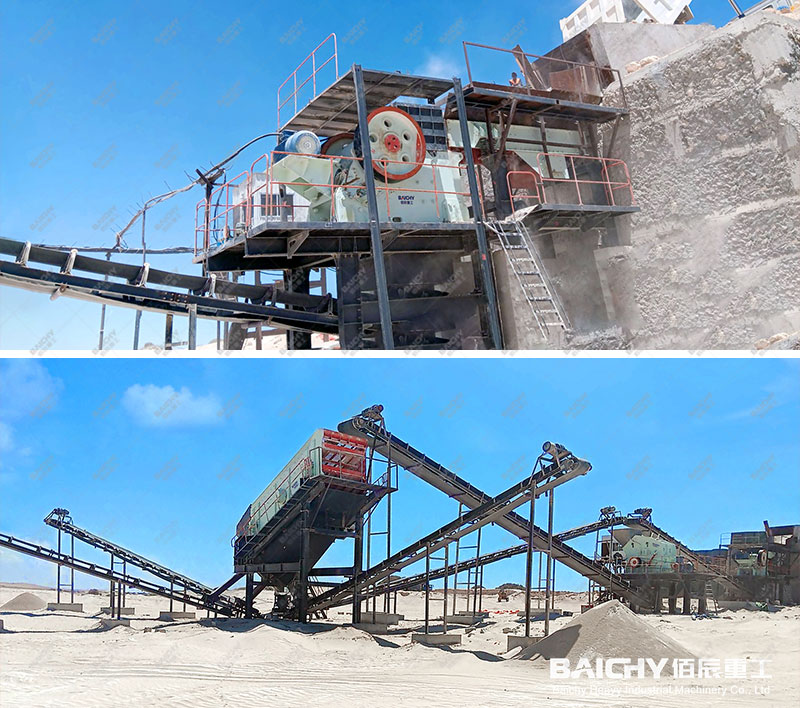
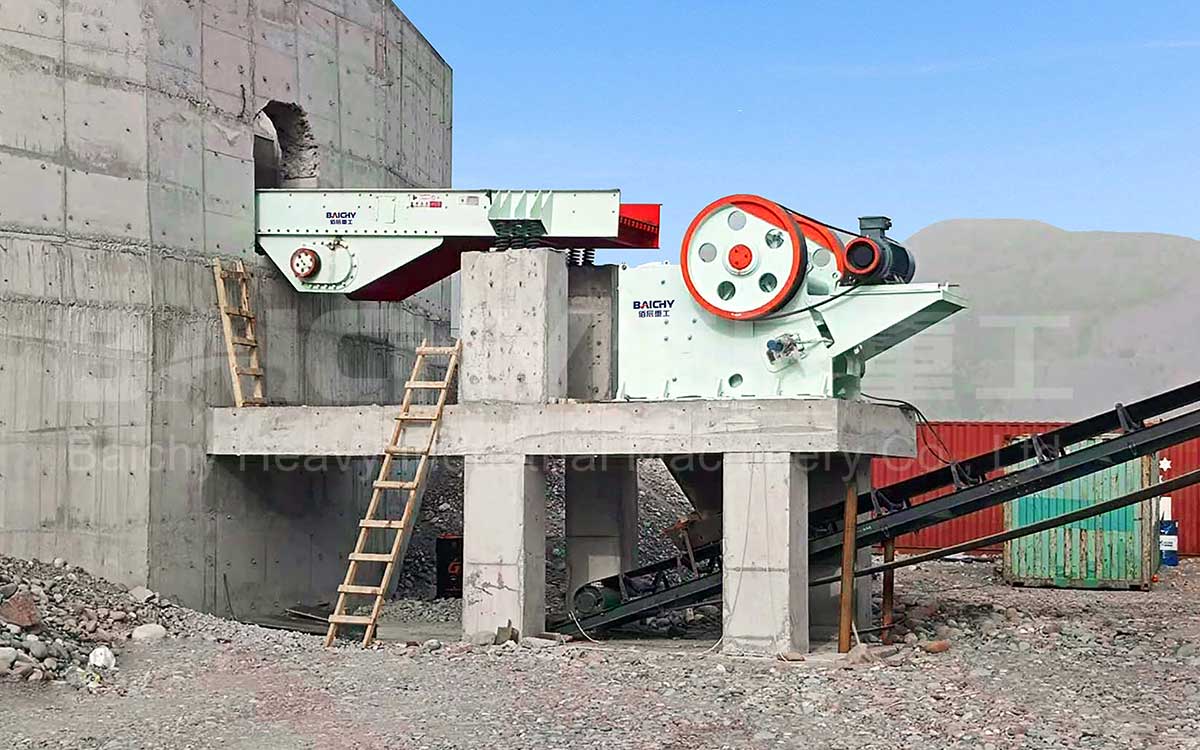
Stone Quarry Jaw Crusher Production Line
Case 1: Rwanda Granite Line (PE-600×900 + PF1214)
Granite with a Protodyakonov hardness (f) of 17; required 100–150 t/h of aggregate. Actual output reached 110 t/h; the first set of jaw plates lasted 5,200 hours.
Case 2: Ethiopia Airport Aggregate (PE-400×600)
On-site crushing of basalt; directly compatible with 380V/50Hz power; production began just 5 days after arrival.
Case 3: Philippines River Stone Stationary Line (C90)
River pebbles contained mud and debris; the C90’s large feed opening combined with a pre-screening grizzly feeder ensured a stable output of 90–200 t/h; the client reported virtually no material jamming.
VI. Verdict: Suitability
Suitable for: Coarse crushing of rock with f ≥ 8; feed size ≤ 80% of feed opening width; capacity range of 16–500 t/h.
Not suitable for: Rock with f < 6 requiring single-stage sand making; continuous feed size > 1200 mm; plants requiring only sand making.
VII. Recommended Equipment
• ZSW Vibrating Feeder: Ensures uniform feeding and protects the jaw crusher's crushing chamber;
• Impact Crusher / Cone Crusher: Use an impact crusher for soft rock and a cone crusher for hard rock for secondary crushing;
• VSI Sand-Making Machine: Further processes aggregates into 0–5mm manufactured sand;
• Circular Vibrating Screen: Performs closed-circuit screening to ensure the quality of the final product;
• YDPZ Mobile Crushing Station: An integrated unit suitable for operations where the mining site is not fixed.
By providing details on raw material lithology, feed size, and target capacity, Baichy Heavy Industry can generate a full lifecycle solution that includes CAPEX and OPEX estimates.
FAQ
1. Can a jaw crusher handle the demands of a granite quarry?
Yes. A rock hardness of f=15–20 falls squarely within the jaw crusher's area of expertise; the compressive crushing method results in a much lower wear rate on high-hardness rock compared to impact crushing. We recommend using manganese steel or high-chromium jaw plates and maintaining a 15% capacity margin; a reference case in Rwanda demonstrates stable production rates of 100–150 t/h.
2. How are the roles of the jaw crusher and impact crusher pided?
The jaw crusher handles the first stage of coarse crushing (discharging 40–200mm material), while the impact crusher handles the second stage of medium crushing (10–40mm) and shapes the particles. The "Jaw Crusher + Cone Crusher" configuration is most economical for hard rock lines, while "Jaw Crusher + Impact Crusher" is best for soft rock lines; relying on either machine alone cannot balance production capacity with the required final particle size.
3. What size jaw crusher should be selected for a quarry with an hourly output of 100 tons?
For limestone, the PE-600×900 model is sufficient; for hard rock, applying a 0.85–0.9 efficiency factor suggests upgrading to the PE-750×1060 to ensure the actual operational capacity meets targets while maintaining a safety margin.
Baichy Heavy Industry
Baichy Heavy Industry is a high-tech mining equipment company integrating R&D, manufacturing, sales, and after-sales service. Focusing on crushing, grinding, and mineral processing equipment, we provide professional solutions to our customers. We are ISO9001:2015 、certified, and our products include mobile crushing palnts, crawler crushing plant, construction waste crushing plants, jaw crushers, sand making machines, cone crushers, fine crushers, grinding mills, ball mills, etc., all with reliable performance to meet diverse project needs.
Baichy Heavy Industry – Your Trusted Partner
To ensure optimal performance of your equipment, Baichy Heavy Industry offers:
- Professional on-site installation guidance
- Comprehensive operator training
- 24/7 technical support & maintenance services
Our complete after-sales service system guarantees long-term, stable operation of your machinery with minimal downtime.
Protect Your Rights – Only Use Official Channels
To avoid scams and ensure authentic support, contact us exclusively through:
• Official Website: www.baichychina.com
• WhatsApp: +8615093222637
• Email: [email protected]
Your satisfaction is our priority – expect prompt, professional service every time.
(Note: Beware of unauthorized third parties claiming to represent Baichy. Always verify through official contacts.)