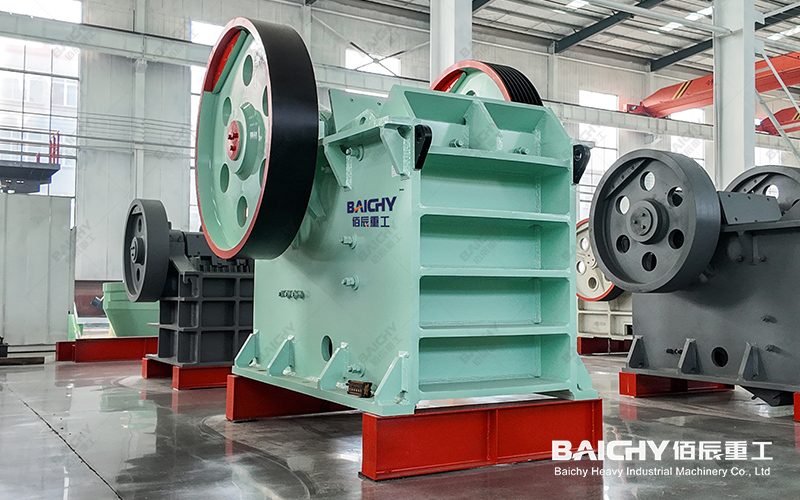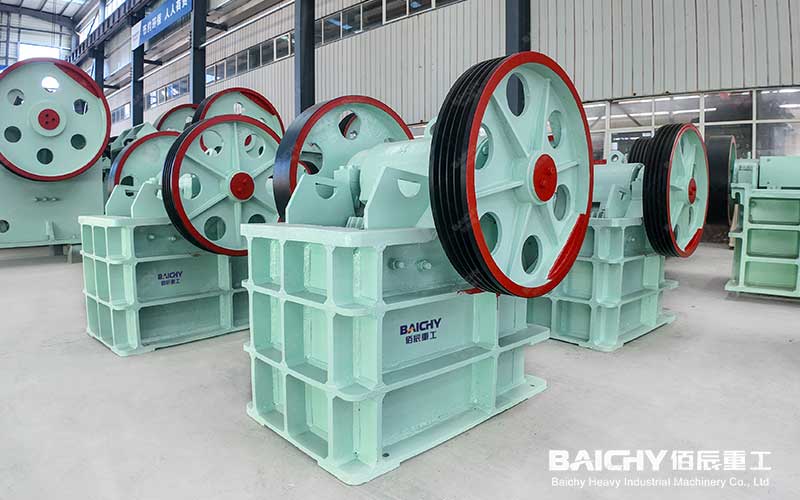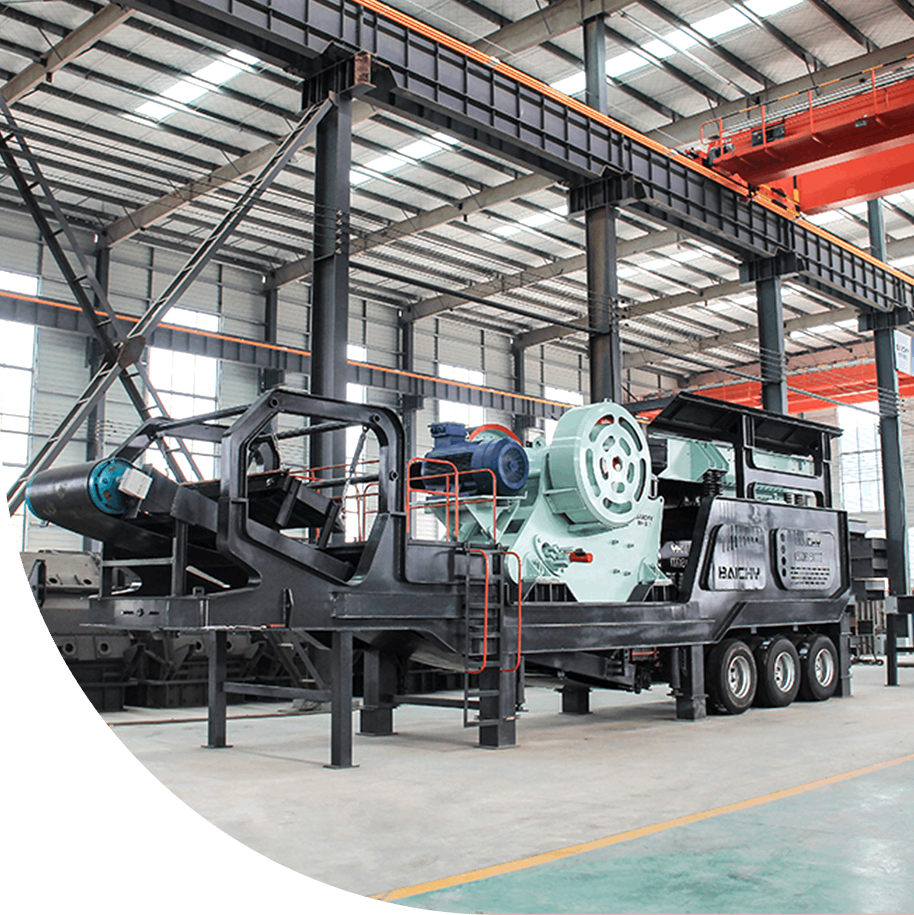

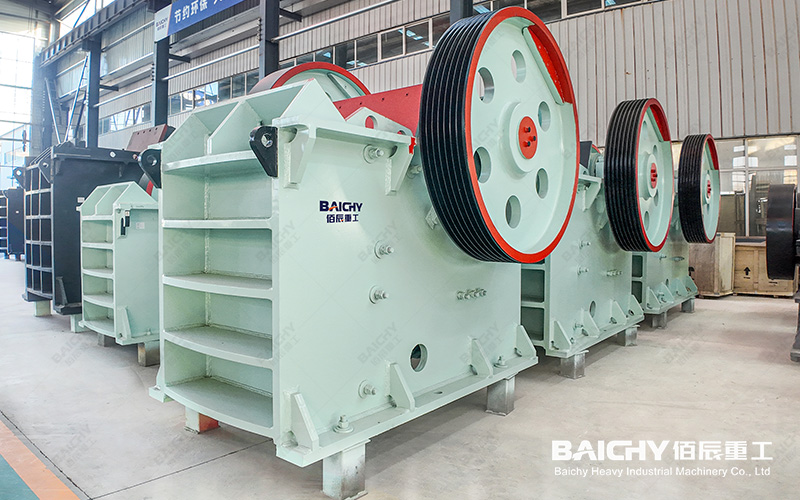
PE Jaw Crusher
Adjusting the discharge opening (CSS—Closed Side Setting) of a jaw crusher essentially involves shifting the position of the toggle seat located at the bottom of the swing jaw: moving the toggle seat outward increases the opening size, while moving it inward decreases it. Mainstream models (including the Baichy PE/PEX series) utilize three adjustment methods: shim-based, wedge-based, and hydraulic.
Principle of Jaw Crusher Discharge Opening Adjustment
The discharge opening (CSS) refers to the gap at the bottom when the swing jaw is at its closest point to the fixed jaw.
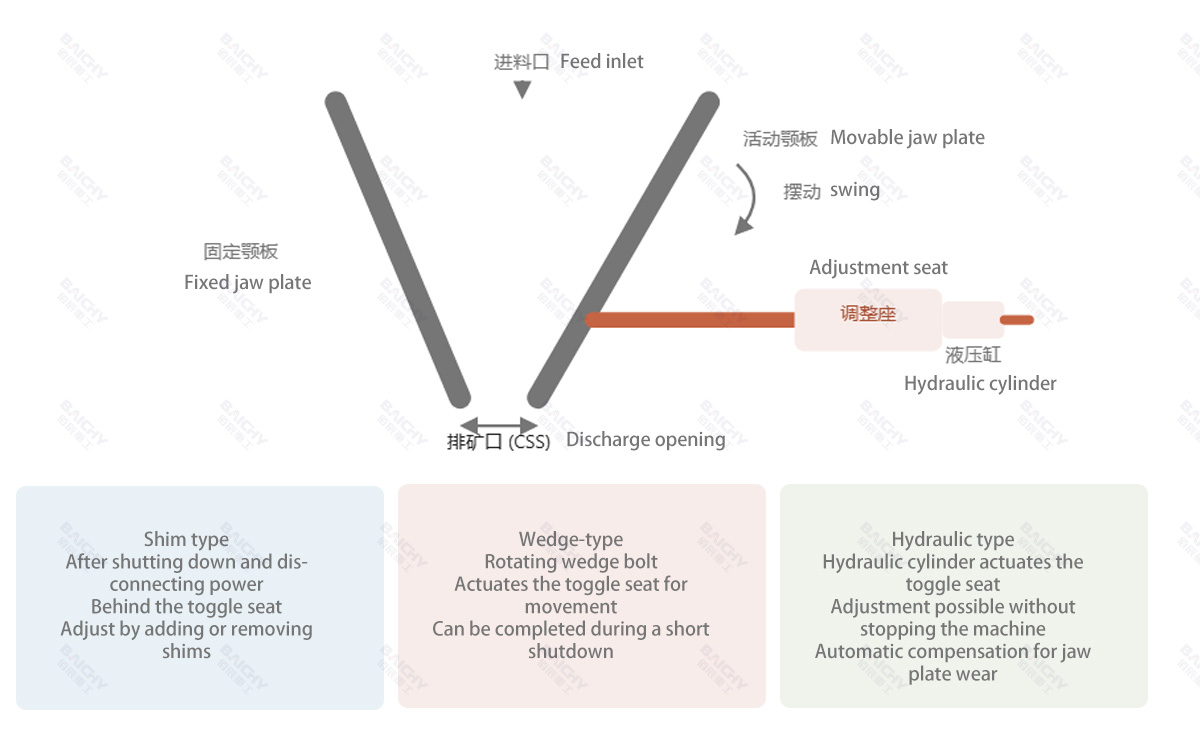
Schematic diagram of the discharge opening adjustment for a jaw crusher
Three Adjustment Methods
1. Shim-based (Most traditional) — Shims are added or removed behind the toggle seat (adjustment seat) to alter its position. This method offers the simplest structure and lowest cost, but requires machine shutdown and disassembly for each adjustment, making it the most time-consuming.
2. Wedge-based (Mainstream mechanical method) — Turning the wedge bolt causes the wedge's inclined surface to push the toggle seat, sliding it into position. It offers higher precision and can be completed in minutes, though a brief shutdown is still required.
3. Hydraulic (Modern models) — A hydraulic cylinder directly pushes the toggle seat; some models can even lift the jaw in reverse to clear material jams. It allows for fine-tuning without stopping the machine, automatically compensates for jaw wear, and provides superior overload protection. However, it entails the highest cost and is best suited for large-scale equipment or high-output production lines.
General Adjustment Procedure (using wedge/shim types as examples)
1. Shut down, disconnect power, and lock the flywheel — prevents reverse rotation due to inertia or accidental startup; this is a fundamental safety requirement.
2. Loosen the locking bolts on the adjustment housing.
3. Perform adjustment — add/remove shims (shim type); rotate bolts (wedge type); operate the hydraulic system (hydraulic type).
4. Tighten the locking bolts.
5. Verification (lead block compression test).
6. No-load test run — operate for 2–3 minutes to ensure there are no abnormal knocking sounds.
Measurement and Verification
• Lead block compression test (most accurate): Place a lead block with a thickness 1.5–2 times the target CSS into the crushing chamber; perform a single compression cycle without load, retrieve the block, and measure the thickness at its thinnest point using calipers—this value represents the actual CSS.
• Particle size estimation: The maximum product discharge size is approximately 1.3–1.7 times the CSS (depending on material hardness and machine model).
Precautions
• The discharge opening has design limits (minimum and maximum); adjusting beyond these ranges can damage the toggle plate, frame, or even the flywheel. Refer to the nameplate for specific ranges (e.g., the PE-400×600 typically ranges from 40–100 mm, while PEX fine-crushing models have smaller ranges).
• Jaw plate wear causes the actual CSS to increase over time; it is recommended to verify the setting using the lead block method once per shift or once a week.
• Adjustment during operation is strictly prohibited; for hydraulic models, ensure the accumulator pressure is normal before adjusting.
FAQ: Jaw Crusher Discharge Opening Adjustment
Q1. How to adjust the discharge opening of a jaw crusher?
Adjust the toggle seat position — outward enlarges the CSS, inward reduces it. Three methods: shim adjustment (stop the machine, add/remove shims behind the toggle seat), wedge adjustment (rotate wedge bolts to slide the toggle seat, done in minutes after a short stop), and hydraulic adjustment (a hydraulic cylinder moves the toggle seat, allows adjustment without stopping and auto-compensates jaw plate wear).
Q2. What is the discharge opening (CSS) of a jaw crusher?
CSS (closed side setting) is the narrowest gap between the fixed and movable jaw plates at the bottom, measured when the movable jaw swings closest to the fixed jaw. The actual maximum product size is about 1.3–1.7 × CSS, depending on material hardness and crusher model.
Q3. How do I measure the jaw crusher discharge opening accurately?
Use the lead block test: place a lead block 1.5–2 times the target CSS into the crushing chamber, run one empty cycle, then measure the thinnest part with a caliper — that value is the actual CSS.
Q4. How often should the discharge opening be checked?
At least once per shift or weekly. Jaw plates wear during operation, which gradually enlarges the actual CSS and coarsens the product. Regular lead block checks keep output size consistent and protect downstream equipment.
Q5. Can I adjust the CSS while the crusher is running?
Only hydraulic models allow adjustment without stopping (or with a short pause). Shim and wedge types require a full stop, power-off, and flywheel lock before any adjustment. Never adjust a running crusher — it risks serious injury and can damage the toggle plate or frame.