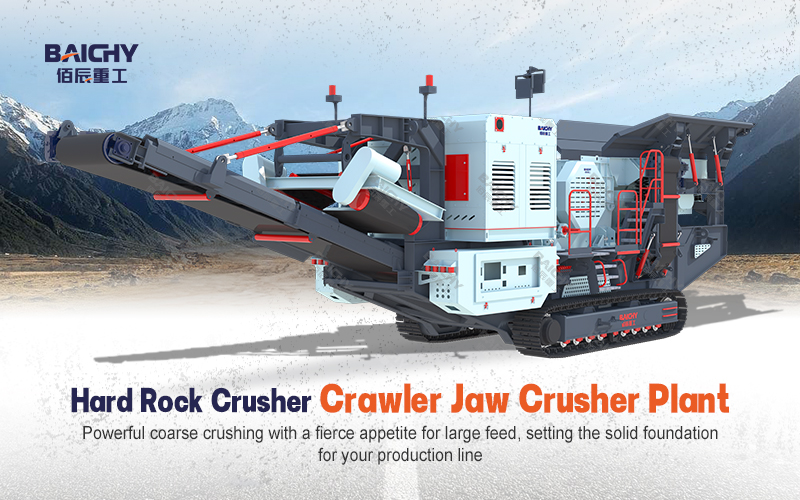
Tracked Jaw Crusher
In mining, construction aggregate production, and other fields, tracked jaw crushers serve as core primary crushing equipment, and their performance directly impacts the efficiency and profitability of the entire production line. The two most critical indicators for measuring their performance are the crushing ratio and output. Accurately understanding and calculating these two parameters is crucial for equipment selection, process design, and production management. This article will provide an in-depth analysis of the calculation methods, influencing factors, and optimization strategies for the crushing ratio and output of tracked jaw crushers.
I. Core Concept Analysis: Crushing Ratio and Output
1.1 What is the Crushing Ratio?
The crushing ratio is a core parameter for measuring the crushing effect of a crusher, referring to the ratio of the average particle size of the material before crushing to the average particle size after crushing. It directly reflects the ability of a single crusher to reduce the size of materials.
Calculation Formula: Total Crushing Ratio (i) = Maximum Feed Size (Dmax) / Discharge Opening Width (e) In practical applications, the ratio of the effective width of the feed opening to the width of the discharge opening is also commonly used as an approximation.
Staged Crushing: For high-hardness or large materials, multi-stage crushing (e.g., jaw crusher for coarse crushing, cone crusher for medium and fine crushing) is often required to achieve the final product particle size. In this case, the total crushing ratio is the product of the crushing ratios of each stage.
1.2 What is Output?
Output, also known as processing capacity, refers to the mass of material processed by a crusher per unit time (usually tons/hour, t/h). It is a direct basis for evaluating the matching degree of equipment production efficiency and capacity.
II. Calculation Method and Significance of Crushing Ratio
2.1 Detailed Explanation of Calculation Method
The calculation of the crushing ratio of a tracked jaw crusher is relatively straightforward, mainly depending on the structural parameters of the equipment and the feeding characteristics.
• Nominal Crushing Ratio: Expressed as the ratio of the effective width B of the crusher's feed opening to the width e of the discharge opening, i.e., i = B / e. This method is simple to calculate and is often used for preliminary selection.
• Actual Crushing Ratio: Expressed as the ratio of the maximum particle size Dmax of the material before crushing to the maximum particle size dmax of the product after crushing, i.e., i = Dmax / dmax. This method better reflects actual production conditions, but requires measured data.
Example Calculation: Assuming a tracked jaw crusher has a feed opening width of 1200mm and a discharge opening adjusted to 150mm, its nominal crushing ratio is: i = 1200 / 150 = 8.
This means that the equipment can theoretically reduce the average size of materials to 1/8 of their original size.
2.2 Key Factors Affecting the Crushing Ratio
• Material Characteristics: Material hardness, compressive strength, moisture content, viscosity, etc. High-hardness materials are difficult to crush, and the actual crushing ratio may be lower than the theoretical value.
• Equipment Parameters: Jaw swing stroke, bite angle (pincer angle) design. The optimal bite angle can provide greater crushing force without clogging.
• Discharge Opening Adjustment: The discharge opening width is the most direct means of adjusting product particle size and crushing ratio. Reducing the discharge opening increases the crushing ratio, but the output may decrease.
III. Output Calculation and Influencing Factor Analysis
3.1 Theoretical Output Calculation Formula
The output Q (t/h) of the jaw crusher can be estimated using the following empirical formula:
Q = K1 * K2 * K3 * Qs
Where:
• Qs is the basic theoretical output, Qs = 0.001 * b * (e + s) * d * n * μ.
• b (m): Discharge port length
• e (m): Discharge port width
• s (m): Horizontal swing stroke of the moving jaw
• d (m): Average bulk density of the crushed product (t/m³)
• n (r/min): Eccentric shaft speed
• μ: Material bulking coefficient (usually 0.3-0.7)
• K1: Material hardness correction factor
• K2: Material particle size correction factor
• K3: Material moisture correction factor
For ease of understanding, the following table lists the estimated output range of different specifications of tracked jaw crushers when crushing medium-hardness granite:
| Equipment Model Example | Feed Port Size (mm) | Discharge Port Adjustment Range (mm) | Estimated Output Range (t/h) | Applicable Material Hardness |
| Small Mobile Jaw Crusher | 600x900 | 65-180 | 60-180 | Medium to Low Hardness |
| Medium Mobile Jaw Crusher | 850x1100 | 75-200 | 120-350 | Medium Hardness |
| Large Mobile Jaw Crusher | 1200x1500 | 150-350 | 300-800 | Medium-High Hardness |
Note: The above table provides approximate values. Actual output needs to be determined based on specific material characteristics and operating conditions.
3.2 Core Factors Affecting Output
1. Material Properties: Materials with high hardness, high toughness, and high moisture content will reduce output and increase energy consumption.
2. Feeding Conditions: Continuous, uniform feeding that fills the entire width of the feed opening is a prerequisite for ensuring maximum output. Feeding with excessively large particle sizes or excessive "over-crushing" of fine powder will affect efficiency.
3. Equipment Operating Parameters: Discharge opening width, moving jaw oscillation frequency (speed), and stroke. The speed must be matched with the discharge speed.
4. Equipment Condition: Jaw plate wear will reduce crushing efficiency and requires regular inspection and replacement.
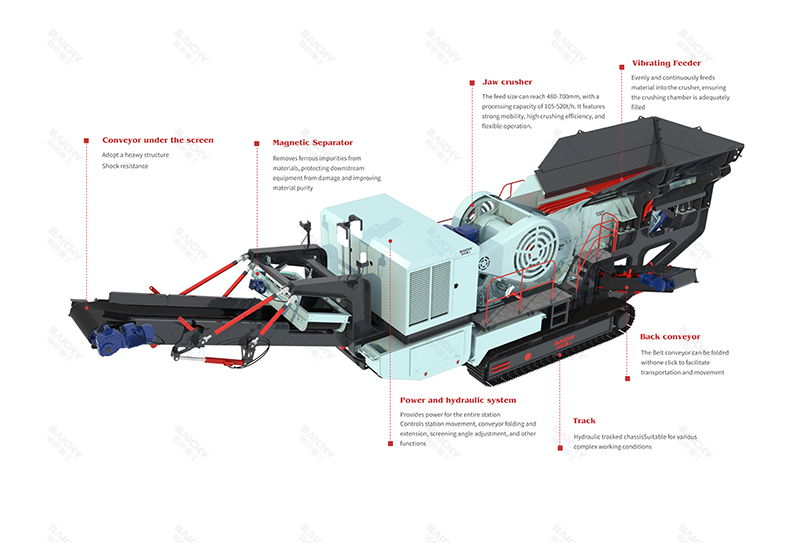
Structural diagram of a tracked jaw crusher
IV. Unique Advantages of Tracked Jaw Crusher
Compared to stationary jaw crushers, the tracked design offers revolutionary advantages, directly impacting production efficiency:
• Rapid relocation, increasing overall output: No foundation installation is required; it can move flexibly with raw material points or construction sites, significantly reducing non-operational time and improving equipment utilization and overall annual output.
• Strong adaptability, stable output: The low ground pressure of the tracks allows it to adapt to rugged and rough mining sites, creating conditions for continuous and stable feeding and crushing, ensuring actual output approaches theoretical optimal values.
• Integrated design, reducing failure points: The feeder, pre-screening unit, and crusher are integrated into one unit, ensuring a smooth process and reducing blockages or idling caused by mismatches in various components, thus optimizing actual operating efficiency.
V. Application Case: A Granite Mine Project
Project Challenges: The mining face is dispersed, the material has high hardness (compressive strength > 180MPa), and the final product particle size is required to be < 40mm.
Solution: Select a large tracked jaw crusher (feed opening 1200x1500mm) for primary crushing.
• Crushing Ratio Control: Set the discharge opening to 180mm. The measured maximum feed particle size Dmax = 1000mm. The calculated actual crushing ratio i = 1000 / 180 ≈ 5.6.
• Output Achievement: By uniform feeding and controlling material moisture content, the equipment achieves a stable output of approximately 450 t/h, meeting the needs of the downstream production line.
• Value Realization: The equipment moves 3-4 times per year following the mining face, saving significant costs on fixed infrastructure construction and material transfer transportation, resulting in an overall capacity increase of over 30%.
VI. Equipment Selection and Related Recommendations
When selecting a tracked jaw crusher, the crushing ratio and output calculations should be incorporated into the selection considerations:
1. Determine Requirements: Clarify the maximum feed particle size, target product particle size, and required output, and then deduce the required total crushing ratio.
2. Matching Model: Select a model with a nominal crushing ratio slightly larger than the required total crushing ratio, ensuring its theoretical output covers 1.1-1.2 times the required output (with a margin to account for fluctuations in operating conditions).
3. Focus on Configuration: Choose a model with pre-screening functionality. This allows for the early removal of fine materials, reducing the load on the crushing chamber and effectively increasing actual output. Simultaneously, a hydraulically adjustable discharge port device can quickly respond to changes in product particle size.
VII. Frequently Asked Questions (FAQ)
1: Is a higher crushing ratio always better?
Not necessarily. An excessively high crushing ratio means a greater compression rate is required within a single unit, which leads to:
• A sharp increase in power consumption.
• Accelerated jaw plate wear.
• Severe over-crushing of the product, producing more useless fine powder.
• Increased clogging risk. A high total crushing ratio should be achieved through a multi-stage crushing process, with each stage undertaking a reasonable crushing task.
2: How can I increase the output of my existing equipment in actual operation?
• Optimize feeding: Ensure continuous, uniform feeding along the full length and width of the feed inlet, avoiding material on one side and idling on the other.
• Inspect jaw plates: Regularly check the wear of the fixed and movable jaw plates, and promptly rotate or replace them to maintain a high-efficiency crushing chamber.
• Adjust parameters: Within allowable limits, appropriately increase the eccentric shaft speed and adjust the discharge port accordingly.
• Pre-screening and soil removal: If the material has a high soil content, add a pre-screening step to prevent sticky materials from clogging the discharge port.
3: How should the output of the tracked jaw crusher be matched with the downstream equipment?
It is recommended to adopt the principle of "light at the front and heavy at the back." That is, the rated output of the tracked jaw crusher, used for coarse crushing, can be slightly lower than that of the downstream medium and fine crushing cone crusher or impact crusher (for example, a ratio of 0.9:1). This is because the coarse crushing process is greatly affected by feed fluctuations, and the tracked jaw crusher has the flexibility to operate at full load for concentrated periods, providing a stable stockpile for the downstream equipment. Buffering and adjusting through intermediate silos or storage yards is key to achieving efficient and continuous operation of the entire production line.
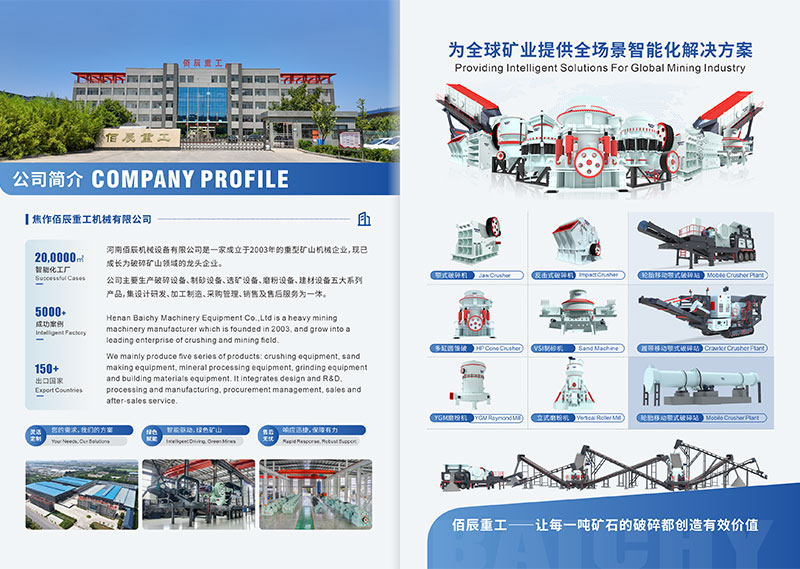
About of Baichy Heavy Industry
Baichy Heavy Industry is a high-tech mining equipment company integrating R&D, manufacturing, sales, and after-sales service. Focusing on crushing, grinding, and mineral processing equipment, we provide professional solutions to our customers. We are ISO9001:2015 、certified, and our products include mobile crushing palnts, crawler crushing plant, construction waste crushing plants, jaw crushers, sand making machines, cone crushers, fine crushers, grinding mills, ball mills, etc., all with reliable performance to meet diverse project needs.
Our advantages:
• Professional pre-sales support: Free project design and comprehensive solutions to help you accurately select the right equipment;
• Comprehensive on-site service: Providing installation guidance and worker training to ensure smooth equipment commissioning;
• Reliable after-sales guarantee: A complete after-sales system, timely response to technical inquiries and equipment maintenance, ensuring long-term stable operation.
To protect your rights, please contact us through the following official channels for professional service:
Official Website Customer Service
WhatsApp: 0086-15093222637
Email: [email protected]
We are committed to providing high-quality equipment and full-cycle services to deliver comprehensive intelligent solutions for the global mining industry!