When processing hard rocks such as granite and basalt—which have compressive strengths ranging from 150 to 350 MPa—any production line that simply replicates a limestone processing setup will suffer from high wear-part costs. For hard rock crushing and screening lines with capacities of 120–200 tph, the mainstream solution is a "two-stage, one-closed-loop" process: primary crushing with a jaw crusher, secondary and tertiary crushing with a hydraulic cone crusher, and screening via a circular vibrating screen in a closed-loop configuration. This setup yields a product with ≤12% flaky/elongated particles, a cone crusher liner lifespan of 1,200–2,000 hours, and an operating cost of approximately ¥4.9 per tonne (for granite); its overall performance surpasses that of the "jaw crusher + impact crusher" configuration.
I. Overview: Why Hard Rock Crushing Is a Distinct Subject
1.1 Defining "Hard Rock"
In mining operations, "hard rock" refers to rock with a uniaxial compressive strength exceeding 150 MPa and high abrasiveness; examples include granite, basalt, diabase, andesite, gneiss, and certain types of iron ore. A common characteristic of these rocks is that they cause wear parts in crushing equipment to wear out 3 to 6 times faster than limestone does. Consequently, the primary logic for selecting equipment for hard rock lines is to avoid impact crushing in favor of inter-particle (lamination) crushing.
1.2 Why the "Jaw Crusher + Cone Crusher" Combination Is Essential for Hard Rock

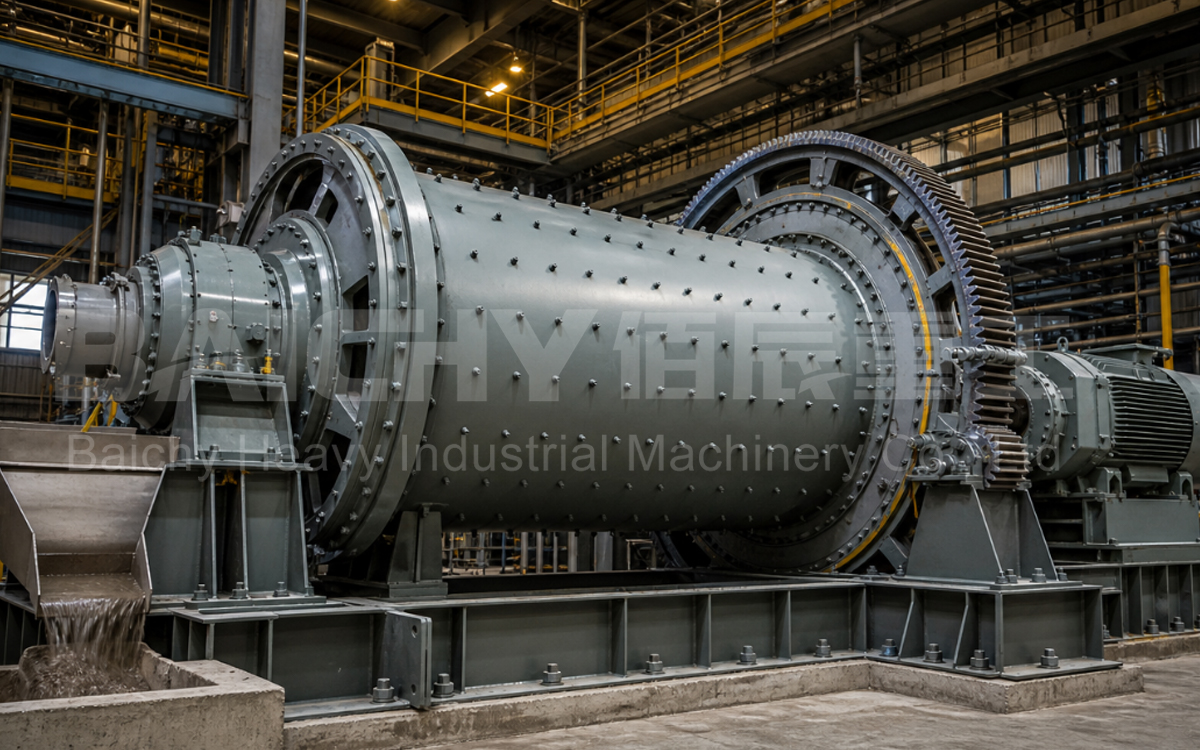
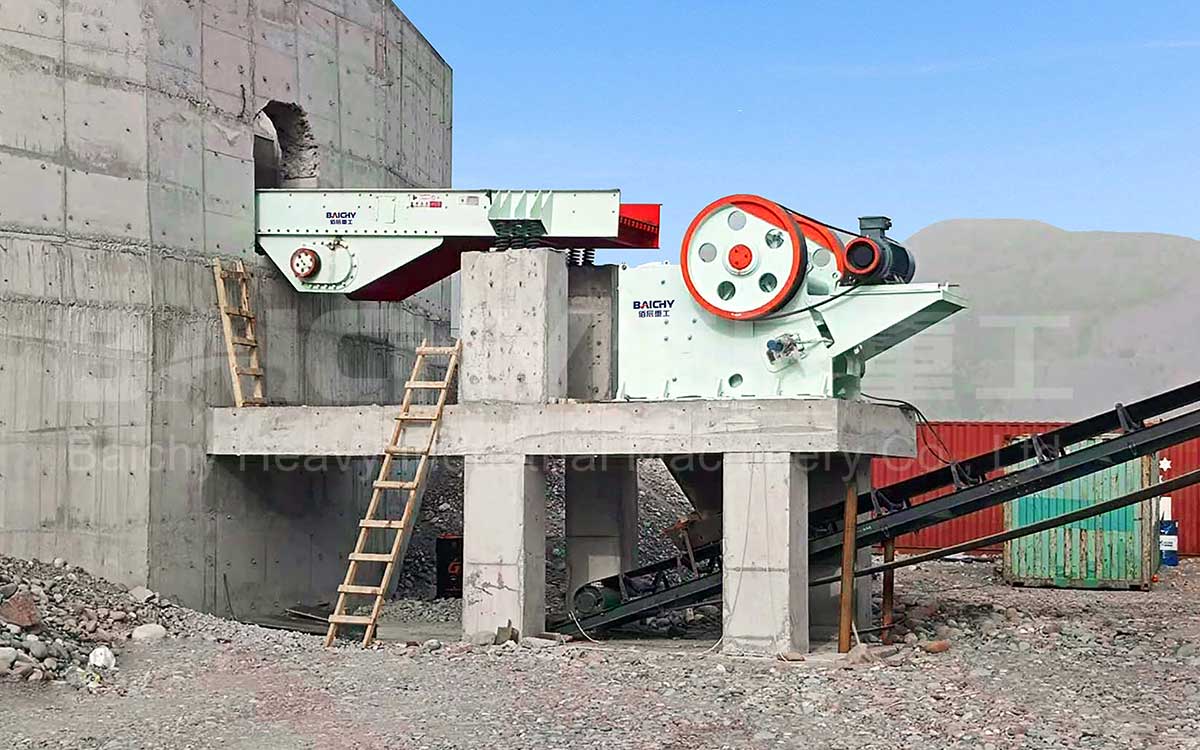
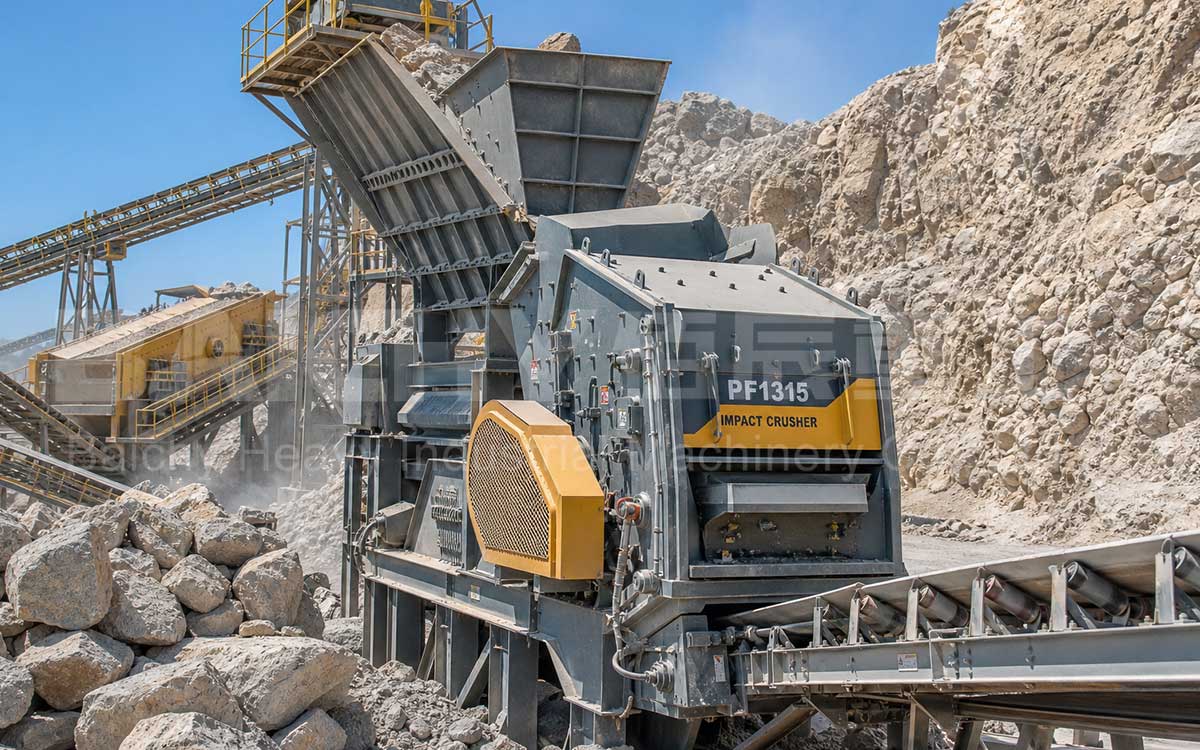
120–200 tph hard rock crushing and screening production line
Impact crushers rely on high-speed impact from blow bars; when processing granite, blow bar lifespan is typically only 120–200 hours, necessitating replacement once or twice a month and resulting in exorbitant downtime and spare-part costs. In contrast, cone crushers operate on the principle of inter-particle crushing; their mantle and concave liners achieve a lifespan of 1,200–2,000 hours when processing granite—6 to 10 times that of impact crusher blow bars. This is precisely why hard rock crushing and screening production lines with an hourly capacity of 120–200 tons primarily utilize a "jaw crusher for primary crushing and cone crusher for secondary/tertiary crushing" configuration. Although the initial purchase cost of a cone crusher is approximately 30% higher, calculations based on a five-year production line lifecycle show that savings on wear parts and reduced downtime costs are sufficient to offset the price difference. This conclusion is not merely a theoretical deduction but an empirically verified pattern derived from Baichy’s liner replacement records and cost-per-ton analyses across numerous hard rock projects in Africa and Southeast Asia.
II. Typical Application Scenarios
The 120–200 tph range represents the "sweet spot" in production capacity for medium-sized aggregate plants and large-scale infrastructure supply operations; the investment for a single line remains manageable, while the daily output is sufficient to fulfill continuous supply contracts. The following six scenarios represent the most common applications for this production line:
| Scenario | Typical Requirements | Value of This Line |
|---|---|---|
| Aggregate station supporting a ready-mix concrete plant | Continuous grading: 0-5/5-10/10-20/20-31.5mm | Four-deck screen produces four fractions in one pass; stable grading |
| Pavement materials for high-grade highways and airport runways | Skid-resistant basalt aggregate; flake/elongation ratio ≤12% | Cone crusher inter-particle crushing (shaping); particle shape meets standards |
| Railway ballast and bridge/tunnel engineering | High-strength ballast: 20-40mm/40-63mm | Adjustable discharge opening; fraction sizes switchable based on orders |
| Aggregate for hydraulic/hydroelectric dams | High-volume, continuous supply | Closed-circuit screening + buffer bin; minimal supply fluctuation |
| Hard rock manufactured sand supplementation | 0-5mm manufactured sand as a byproduct | Reserved interface for VSI sand-making unit |
| Recycling of tunnel muck and waste mine rock | On-site crushing; rapid setup | Modular layout; construction to commissioning in 45-60 days |
III. Standard Configuration and Core Parameters
The following details the standard two-stage, closed-circuit configuration delivered by Baichy for the 120–200 tph capacity range (nominal capacity based on granite with a bulk density of 2.6–2.8 t/m³):
| Equipment Unit | Model | Qty | Power (kW) | Feed Size | Discharge Size | Single-Unit Capacity (Granite) |
|---|---|---|---|---|---|---|
| Vibrating Feeder | ZSW490×110 | 1 | 15 | ≤500mm (grizzly pre-screening) | — | 120-280 t/h |
| Jaw Crusher (Primary) | PE750×1060 | 1 | 110 | ≤630mm | Adjustable 80-140mm | 110-180 t/h |
| Hydraulic Cone Crusher (Secondary/Fine) | HP300 | 1 | 220 | ≤230mm | Adjustable CSS 10-40mm | 80-170 t/h |
| 4-Deck Circular Vibrating Screen (Closed-circuit) | 4YK2160 | 1 | 37 | ≤200mm | 0-5/5-10/10-20/20-31.5mm | 80-320 t/h |
| Belt Conveyor | B800-B1000 | Multiple | — | — | — | — |
| Total Line | — | — | Main Equipment: ~382 | ≤630mm | 4 Product Sizes | 120-200 t/h |
Capacity Conversion Basis (Granite = 1.0): Basalt ×0.9–0.95, Diabase ×0.9, Andesite ×0.95; when processing limestone, the secondary crushing stage can switch to an impact crusher, increasing output by 20–30%. Design capacities are calculated using this standard to avoid discrepancies between "nominal 200 tph" and "actual 150 tph." If raw ore has high clay or moisture content (>8%), pre-screening and sand washing stages must be added to the feeding section.
Budget-Sensitive Alternative: Replace the HP300 with a PYB1750 spring cone crusher (160 kW; feed size ≤215 mm; hard rock capacity 100–180 t/h). Main equipment investment drops by ~25–30%, making it suitable for markets with high electricity costs or limited maintenance capabilities; the trade-off is slightly inferior liner lifespan and product shape compared to hydraulic models.
Quick Calculation of Operating Costs (Granite, Electricity Price ¥0.8/kWh): Power consumption ~3.2 kWh/t (¥2.6) + Jaw plate wear (¥0.6) + Cone liner (¥0.9) + Screen mesh (¥0.2) + Labor & Lubrication (¥0.6) ≈ Cost per ton of ¥4.9. Based on an annual output of 600,000 tons, annual operating costs are approximately ¥2.94 million; the cost of wear parts for the cone crusher configuration is only one-quarter to one-third that of the impact crusher configuration.
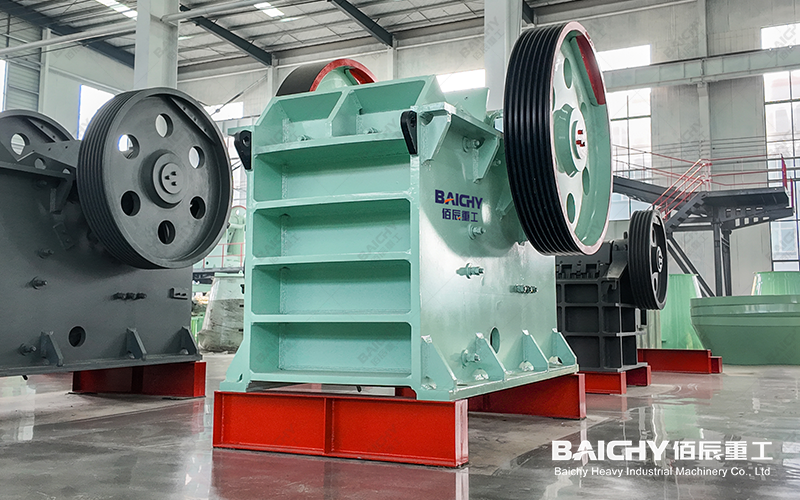
granite crushing and screening equipment
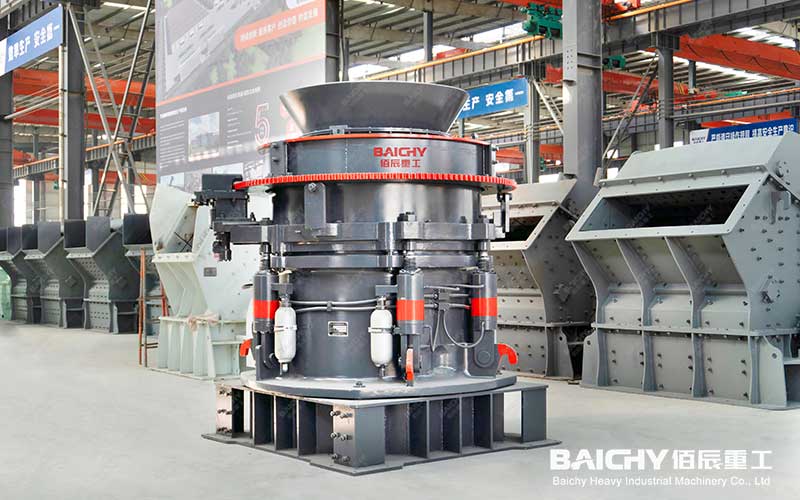
basalt crushing line
IV. Core Advantages: Translating Specifications into Profit
Inter-particle (lamination) crushing for superior shape and wear resistance — The HP300’s lamination crushing process limits the content of flat and elongated particles in the final product to ≤12%, meeting specifications for C30–C50 concrete and asphalt pavement aggregates; liner service life ranges from 1,200 to 2,000 hours—6 to 10 times that of impact crusher blow bars.
Two-stage closed-circuit process: No extra machinery costs — The jaw crusher offers a reduction ratio of 4–6, crushing raw ore (≤630mm) down to ≤140mm in a single pass, with the cone crusher taking over to achieve the final product size; compared to three-stage crushing, this saves the cost of one primary machine, as well as associated electricity, foundation, and footprint requirements.
Nominal capacity ≈ Actual operational capacity — Feeders and buffer bins eliminate timing mismatches between the jaw crusher’s intermittent discharge and the cone crusher’s continuous feed; with a closed-circuit recirculation rate of 15–25% and screening efficiency exceeding 90%, the production line can operate at full capacity according to design specifications.
Compatibility with global power standards — Supports 380V/50Hz, 400V/50Hz, 440V/60Hz, and diesel generator power supplies, eliminating the need for localization modifications in export projects; features centralized electrical controls, with options for remote commissioning and multilingual operation manuals.
Flexible product mix — Simply changing screen meshes allows for switching between four aggregate grades, aggregate plus manufactured sand, or large-particle railway ballast, avoiding the need to rebuild the production line in response to market changes.
V. Relevant Case Studies (On-site records; data anonymized)
Specifications exist on paper; on-site operational records tell the real story. The following is a record of hard-rock projects delivered in recent years (data anonymized at the client's request):
Granite quarry project in an African country (delivered by Baichy; 120–200 tph capacity class): The rock consists of granite and gneiss with varying degrees of weathering and a compressive strength of 200–300 MPa. The production line utilizes a ZSW490×110 feeder, PE750×1060 jaw crusher, HP300 cone crusher, and 4YK2160 closed-circuit screen:
Actual capacity: Designed for 120–180 t/h; stable on-site operation at 135–175 t/h; performance compliance rate exceeding 96%;
Product gradation: Four fractions (0–5, 5–10, 10–20, and 20–31.5 mm); measured flake/elongated particle content for the 10–20 mm fraction is ≤12%, meeting local acceptance standards for highway concrete aggregates;
Wear part performance: The initial set of HP300 liners remained usable after 1,400 hours of continuous operation; the client extended the spare parts inventory cycle from monthly to quarterly;
Client decision: A Phase II expansion assessment was initiated in the sixth month of operation, with plans to add a closed-circuit fine-crushing stage to increase the proportion of manufactured sand.
The same series of hard-rock configurations in the 200–250 tph class (C100 jaw crusher + dual CS160 cone crushers in parallel) is operating stably in over 20 quarries worldwide; the parallel cone crusher setup ensures the line retains 60–70% of its capacity during the maintenance of a single unit—a critical advantage for projects involving continuous supply contracts.
VI. Recommended Equipment
PE/PEX/C90 Series Jaw Crushers — Upgrade primary crushing to C100/C90 class if raw ore size exceeds 630mm or if planned capacity expansion exceeds 250 tph;
HP/CS/PY Series Cone Crushers — Two product lines (Spring PYB and Hydraulic HP/CS) to suit different budgets; crushing chamber profiles are selected based on material hardness;
VSI Vertical Shaft Impact Crusher — When configured in a closed-circuit sand-making loop, the 0–5mm byproduct is upgraded to high-quality manufactured sand (fines content <5%) as a substitute for natural sand;
Spiral Sand Washer + Fine Sand Recovery Unit — Integrated when raw ore has high clay content or finished sand exceeds limits for fines/dust;
YK/GTS Series Circular Vibrating Screens — Added for capacity expansion or finer particle size classification;
YDPZ Wheeled/Tracked Mobile Crushing Stations — Flexible options for scenarios involving unstable mining rights, multiple work faces, or leased-land operations.
VII. FAQ
Q1: What equipment is included in the standard configuration for a hard rock crushing and screening production line with an hourly capacity of 120–200 tons?
A: Standard two-stage closed-circuit configuration: ZSW490×110 Vibrating Feeder (with pre-screening) → PE750×1060 Jaw Crusher (primary crushing; reduces feed ≤630mm to 80–140mm) → HP300 Hydraulic Cone Crusher (secondary/fine crushing) → 4YK2160 Four-deck Circular Vibrating Screen (closed-circuit; oversize material returns to the cone crusher); also includes belt conveyors, a buffer bin, and an electrical control system. Total installed power for main machinery is approx. 382kW; output consists of four finished product sizes: 0–5mm, 5–10mm, 10–20mm, and 20–31.5mm. For budget-sensitive projects, the HP300 can be replaced with a PYB1750 Spring Cone Crusher, reducing the investment in main machinery by approximately 25–30%.
Q2: Why aren't impact crushers used for hard rock? Aren't they cheaper?
A: While the initial purchase price of an impact crusher is indeed lower, it relies on blow bars for impact crushing; when processing granite or basalt, the blow bar lifespan is only 120–200 hours, requiring replacement 1–2 times a month. In contrast, the liner lifespan of a cone crusher is 1,200–2,000 hours—6 to 10 times longer. Based on an annual throughput of 600,000 tons and a 5-year lifecycle, the cumulative costs of wear-part replacements and downtime associated with an impact crusher outweigh the higher initial investment of a cone crusher. In hard rock applications, the "cheaper" impact crusher often proves to be the most expensive choice. Impact crushers are best suited for materials of low to medium hardness, such as limestone and dolomite.
Q3: Does "200 tons per hour" refer to nominal capacity or stable operating capacity? How is this target achieved?
A: The 120–200 t/h figure cited refers to stable operating capacity when processing granite. This is a conservative estimate based on a material bulk density of 2.6–2.8 t/m³, a jaw crusher discharge setting of 100–140 mm, a closed-circuit cone crushing setup, and continuous feeding; actual on-site performance typically meets or exceeds this target 95% of the time. To maintain this output, several conditions must be met: raw ore blast fragmentation size ≤630 mm (with acceptable clay and moisture content), continuous and uniform feeding (using a buffer bin), and correct screen aperture and closed-circuit configuration. If raw ore conditions or final product specifications differ, Baichy can provide capacity conversion calculations and a customized equipment configuration plan based on provided rock samples and particle size distribution data.
Baichy Heavy Industry
Baichy Heavy Industry is a high-tech mining equipment company integrating R&D, manufacturing, sales, and after-sales service. Focusing on crushing, grinding, and mineral processing equipment, we provide professional solutions to our customers. We are ISO9001:2015 、certified, and our products include mobile crushing palnts, crawler crushing plant, construction waste crushing plants, jaw crushers, sand making machines, cone crushers, fine crushers, grinding mills, ball mills, etc., all with reliable performance to meet diverse project needs.
Baichy Heavy Industry – Your Trusted Partner
To ensure optimal performance of your equipment, Baichy Heavy Industry offers:
- Professional on-site installation guidance
- Comprehensive operator training
- 24/7 technical support & maintenance services
Our complete after-sales service system guarantees long-term, stable operation of your machinery with minimal downtime.
Protect Your Rights – Only Use Official Channels
To avoid scams and ensure authentic support, contact us exclusively through:
• Official Website: www.baichychina.com
• WhatsApp: +8615093222637
• Email: [email protected]
Your satisfaction is our priority – expect prompt, professional service every time.
(Note: Beware of unauthorized third parties claiming to represent Baichy. Always verify through official contacts.)