If you're selecting equipment for a granite crushing line, remember three words: jaw crusher + cone crusher. The question isn't whether an impact crusher can be used on granite—it can, but the cost per ton will be twice that of a cone crusher. This isn't a conservative approach of playing it safe; it's a lesson learned the hard way by countless mines through annual maintenance bills.
Why is this so absolute? Because the physical properties of granite dictate this.
I. Granite: A Natural "Wear Accelerator"
Granite is not ordinary stone. Its Mohs hardness is 6–7, its uniaxial compressive strength is 100–300 MPa, and its silica content generally exceeds 65%. This means that every time it passes through the crushing chamber, it repeatedly scrapes your wear parts with high-hardness quartz crystals.
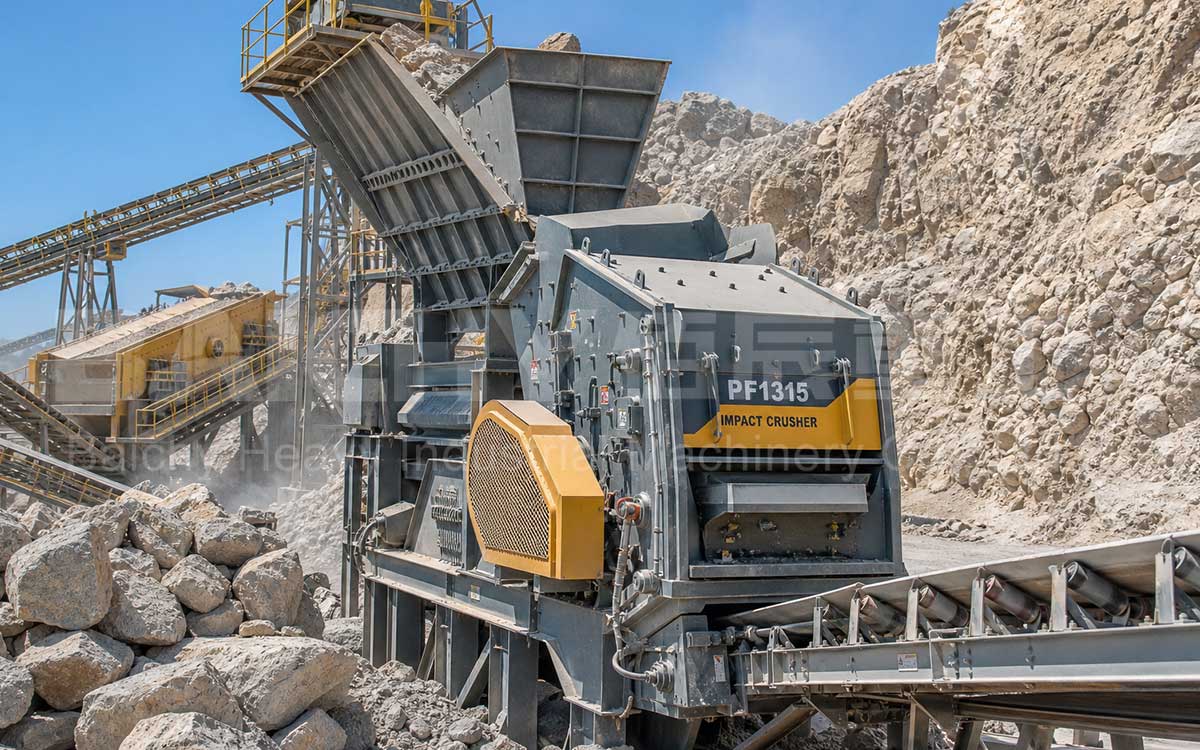
Under laboratory conditions, a standard impact crusher hammer (high-chromium cast iron, Cr26) can last 800–1000 hours crushing limestone. The same hammer, when placed in a granite hopper, will show severe uneven wear after 200 hours, resulting in uncontrolled discharge particle size and increased equipment vibration. This isn't a quality issue—it's the law of physics at work.
This is why the equipment selection logic for granite crushing is completely different from that for limestone crushing. Limestone projects can be handled with a single, continuous crushing operation, while granite projects must be selected stage by stage.
<<Granite Stone Crushing Plant 80-100tph>>
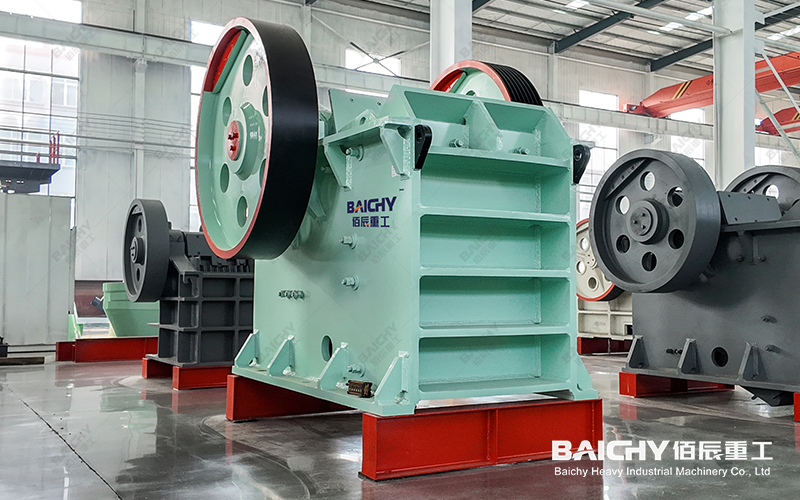
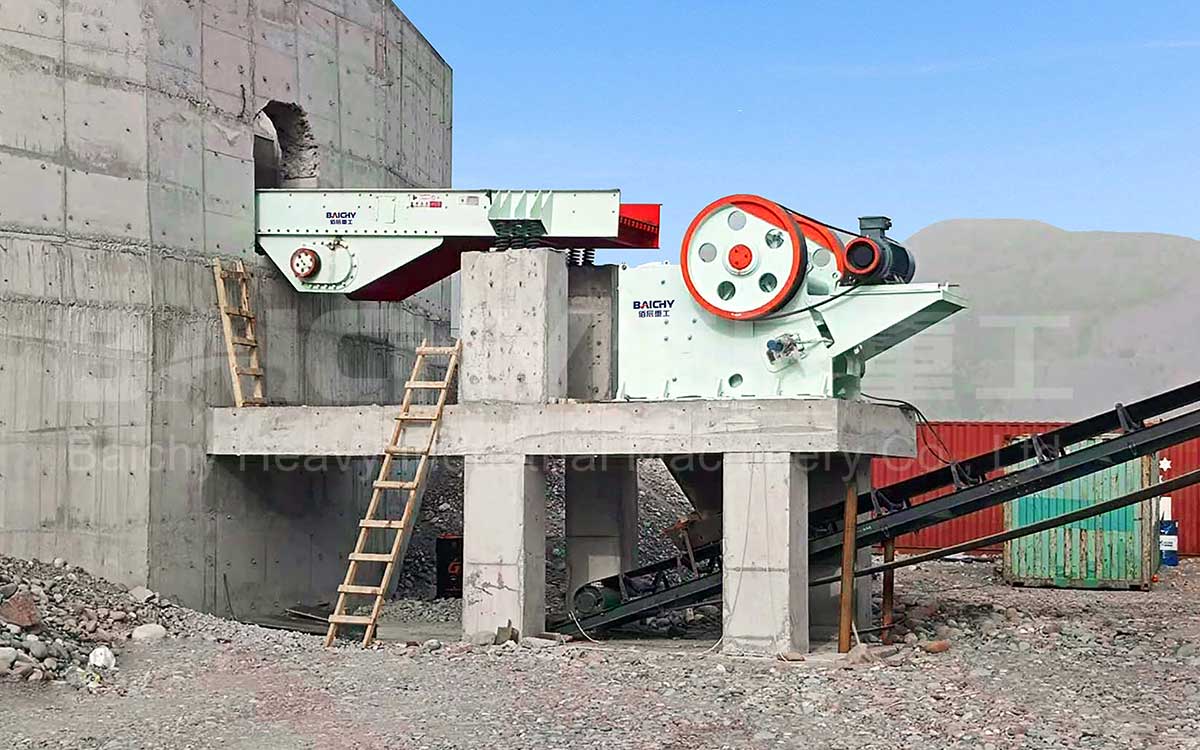
granite jaw crusher
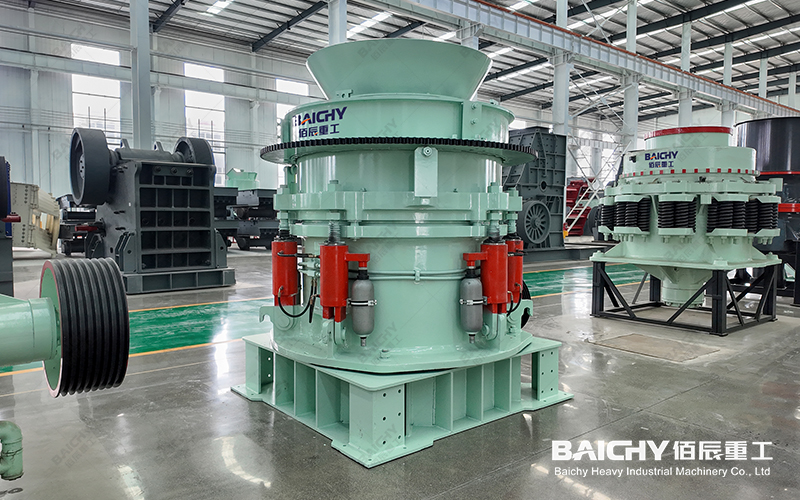
Hydraulic Cone Crusher
II. Real-world performance of four mainstream crushers in granite conditions
The table below is a core comparison compiled by the Baichy engineering team based on field data from dozens of granite production lines. It's just one table, but it's enough to help you make a decision.
| Comparison Dimensions | PE Jaw Crusher (Coarse Crushing) | PYB/CS Cone Crusher (Medium and Fine Crushing) | PF Impact Crusher (Medium Crushing) | VSI Sand Making Machine (Sand Making/Shaping) |
| Applicable Stages for Granite | Primary Coarse Crushing — The Only Standard Answer | Secondary/Third-Level Medium and Fine Crushing — Absolute Mainstay | Secondary Medium Crushing — Not Recommended for Granite | Third-Level Sand Making + Needle-and-Flax Shaping |
| Feed/Discharge Range | 340–1200 mm → 40–225 mm | 50–300 mm → 3–64 mm | 250–600 mm → 10–100 mm | 30–55 mm → 2–10 mm |
| Single Machine Capacity for Granite | Nominal Capacity × 0.80–0.85 | Nominal Capacity × 0.80–0.85 | Nominal Capacity × 0.60–0.75 | Nominal Capacity × 0.80–0.85 |
| Wear Component Life (Granite Conditions) | Jaw Plate Mn18Cr2: 400–600 hours | Mantle Mn18Cr2: 600–1200 hours | Hammer Cr26: Only 120–250 hours | Distributor Cone + Thrower: 350–500 hours |
| Annual Wear Cost (2000h Operation) | ≈8,000–15,000 | ≈ 12,000–25,000 | ≈ 30,000–60,000 | ≈ 6,000–12,000 |
| Finished Product Particle Shape Quality | Flaky/Needle-like 15–20% — Acceptable coarse crushing | Cubic Content > 85% — Excellent particle shape | Cubic 80–90% but unsustainable cost | Cubic > 90% — Best shaping effect |
| Role of Granite Production Line | ✅ First paragraph, required | ✅ Second/Third paragraph, required | ❌ Skip | ✅ Last paragraph, optional |
From this table, a clear conclusion can be drawn: the framework of a granite crushing line must be a jaw crusher + cone crusher. The particle shape advantage of impact crushers is meaningless in the face of high-silica hard rock—because you're not competing on who produces the prettiest output, you're competing on whose production line can still operate tomorrow.
III. The "Golden Combination" and Actual Cost of a Granite Aggregate Production Line
A typical granite aggregate production line (target output 150–200 tph, finished product 0-5mm / 5-15mm / 15-31.5mm), Baichy recommends the following standard configuration:
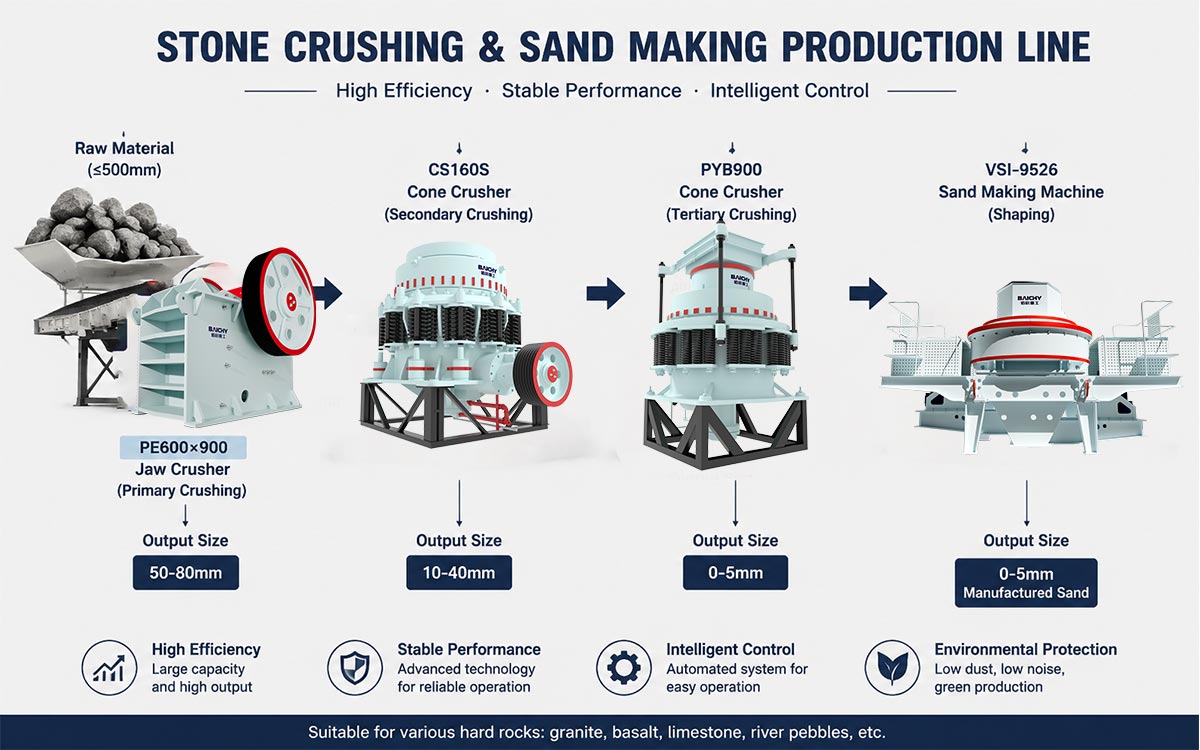
STONE CRUSHING& SANDMAKING PRODUCTION LINE
PE600×900 Jaw Crusher (Coarse Crushing) → CS160S Cone Crusher (Medium Crushing) → PYB900 Cone Crusher (Fine Crushing) → VSI-9526 Sand Making Machine (Shaping)
Based on 2000 hours of operation per year, the total cost of wear parts for this configuration is controlled at 25,000–45,000/year. If an impact crusher is used to replace the cone crusher in the middle section, the annual cost of wear parts will jump to 60,000–90,000. The extra money isn't a one-time investment—it's burned every year.
IV. Three Most Common Pitfalls
Pitfall 1: "Impact crushers are cheap, so I'll use one first and replace it when it wears out."
This is incorrect. While the initial purchase price of an impact crusher is 15-25% lower than a cone crusher, the additional cost of wear parts in the first year for granite applications can easily offset this price difference. In terms of three-year Total Cost of Ownership (TCO), the cone crusher option saves at least 40%.
Pitfall 2: "My granite isn't very hard, so an impact crusher should be fine."
There's no such thing as "soft" granite. A SiO₂ content exceeding 55% crosses the economic threshold for impact crushers. Don't gamble—sampling and testing to check the silicon content data is far more reliable than any subjective judgment.
Pitfall 3: "Cone crushers are too complex and difficult to maintain."
Modern hydraulic cone crushers (such as the CS series) have significantly lowered the operational threshold with hydraulic clearing and iron overload protection. Compared to impact crushers, which require downtime to replace a set of hammer crushers every 200 hours, cone crushers have lower maintenance requirements.
V. FAQ
Q: If my budget only allows for a two-stage crushing system, how should I process granite?
A: A two-stage system using a jaw crusher (PE600×900) + cone crusher (PYB900) produces 0-40mm aggregate, suitable for roadbed materials and low-grade concrete aggregates. The particle shape is not as good as a three-stage system, but the cost is controllable.
Q: Can a mobile crushing plant process granite?
A: Yes. A combination of a tire-mounted mobile jaw crusher and a mobile cone crusher is already in operation in several Southeast Asian granite mines. The core logic remains the same—the mobile station simply mounts the equipment on a chassis; the selection principles are exactly the same.
Q: Can a hammer crusher be used for granite?
A: Absolutely not recommended. The lifespan of a hammer crusher on granite is typically no more than 100–150 hours, and the overall cost is even higher than that of an impact crusher. Hammer crushers are only suitable for materials with medium to low hardness, such as limestone and dolomite.