
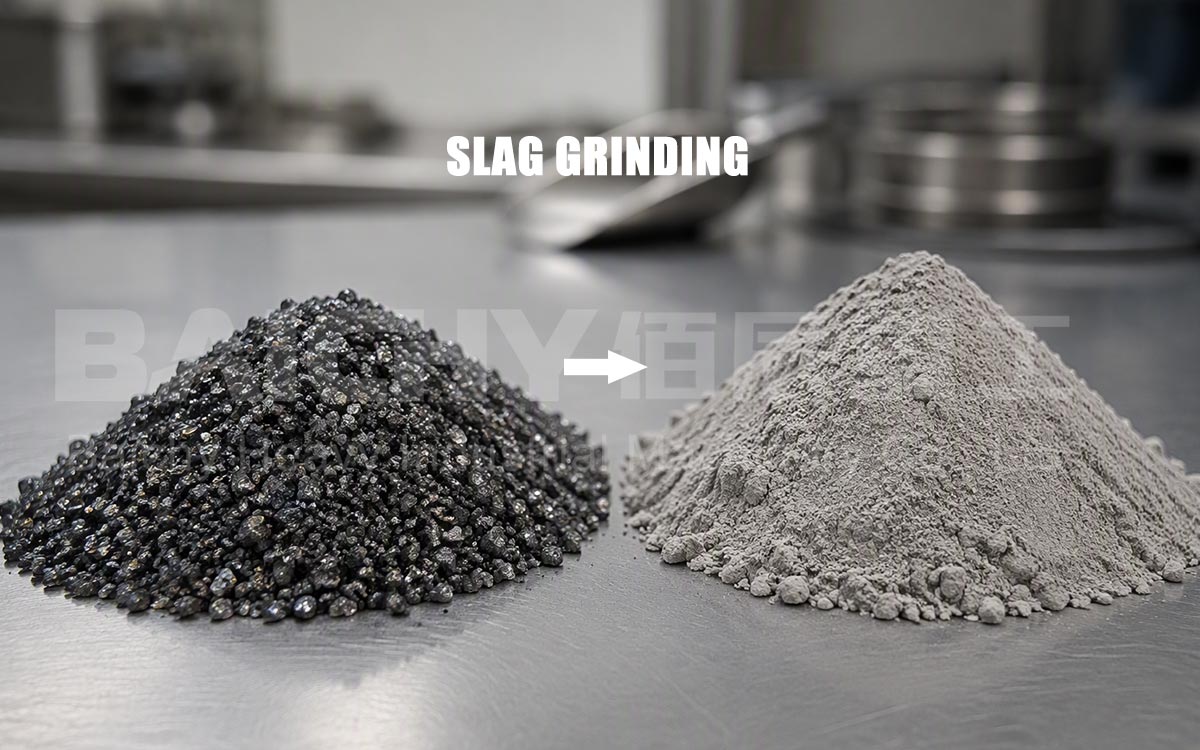
Slag grinding
If you grind granulated blast furnace slag (GBFS) into GGBS powder, a vertical roller mill is the lowest-energy route: it cuts specific power consumption by 30–50% versus a ball mill, dries feed slag with 4–15% moisture inside the same machine, and holds finished GGBS at 400–450 m²/kg Blaine — the fineness cement and concrete plants pay for.
Why the market is shifting to GGBS
Demand is compounding. The global GGBS market was valued at USD 18.5 billion in 2025 and is projected to reach USD 30.2 billion by 2032, a 6.2% CAGR (Verified Market Reports). The driver is carbon: one tonne of Portland clinker emits roughly 0.8–0.9 tonnes of CO₂ (GCCA data), so each tonne of GGBS substituted into blended cement directly cuts Scope 3 emissions and their cost.
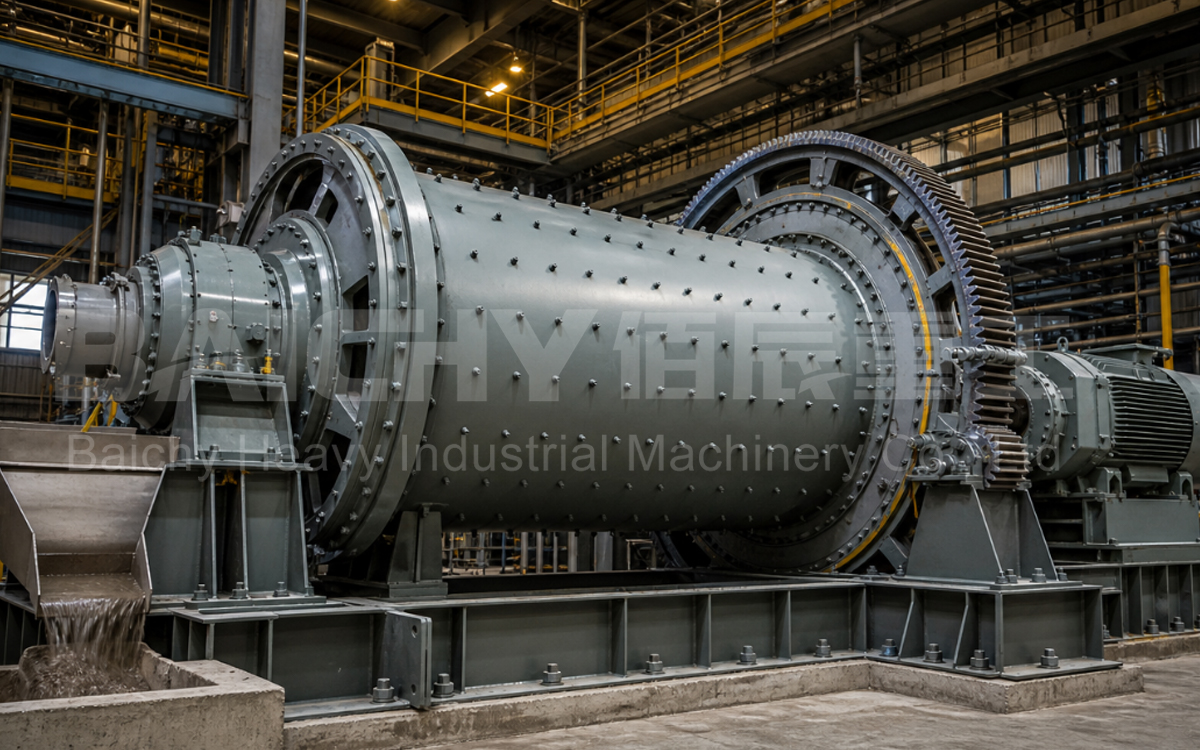
Why a vertical roller mill beats a ball mill on slag?
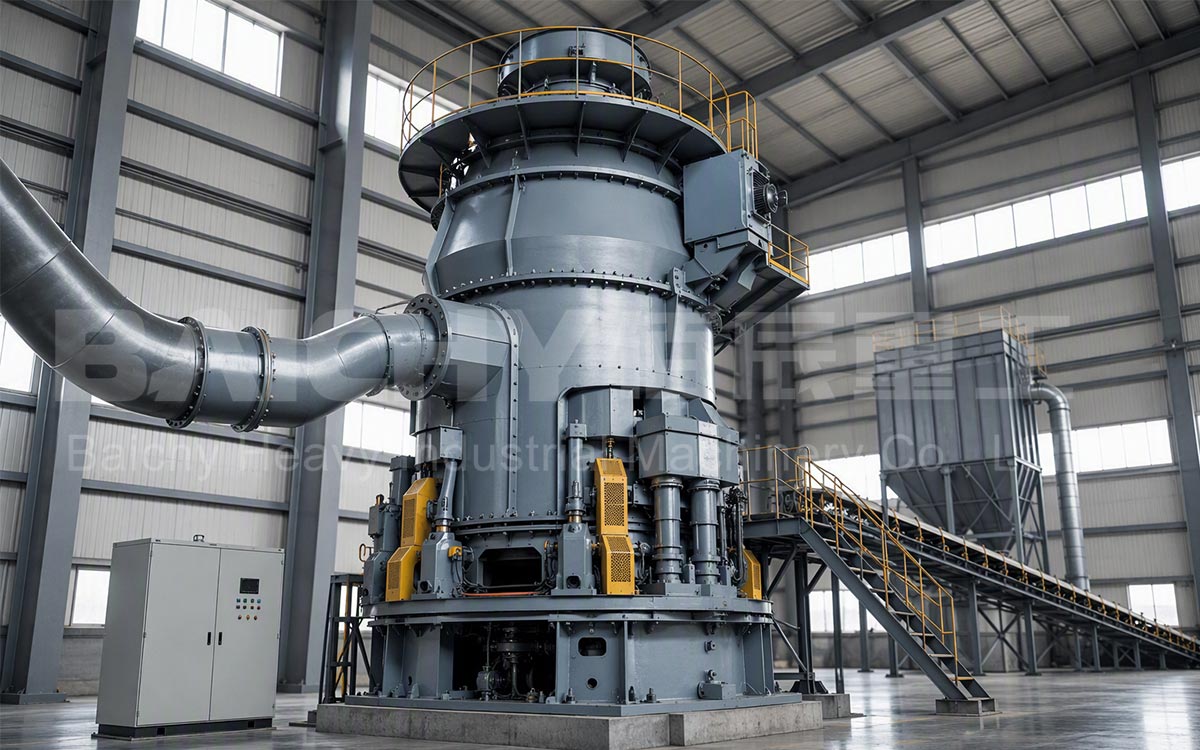
Vertical Roller Mill for GGBS Grinding
Slag is hard, abrasive and energy-hungry — exactly what exposes a ball mill's weaknesses.
• Material-bed grinding. A vertical roller mill crushes slag between a rotating table and hydraulically loaded rollers instead of tumbling steel balls, so 30–50% less power is consumed — see Baichy's VRM vs ball mill analysis.
• Dry, grind and classify in one unit. Hot gas up to 350°C passes through the grinding zone, drying 4–15% moisture slag to ≤1% without a separate rotary dryer.
• In-built dynamic classifier. Coarse particles return to the table; product exits at 212–45 µm with a tight particle size distribution.
• Compact, low-noise plant. One vertical roller mill replaces mill + dryer + classifier tower, shrinking foundations and civil CAPEX.
SRM1500 vertical roller mill for GGBS: technical parameters
The SRM1500 is Baichy's vertical roller mill for slag and steel slag, sized for 13–48 t/h of powder. These figures are the baseline for a GGBS line:
| Parameter | SRM1500 |
|---|---|
| Grinding table diameter (mm) | 1500 |
| Max feed size (mm) | ≤38 |
| Product fineness | 212–45 µm (70–325 mesh) |
| Hot gas inlet temperature (°C) | ≤350 |
| Gas outlet temperature (°C) | 70–95 |
| Feed material moisture | 4–15% |
| Final product moisture | ≤1% |
| Capacity (t/h) | 13–48 |
| Main motor power (kW) | 250–355 |
Indicative for slag duty; confirm by test grinding. Full details: SRM1500 vertical roller mill.
GGBS quality targets to design for
Buyers order S95 slag powder against GB/T 18046 — the specification the vertical roller mill must hold:
| Quality parameter | S95 GGBS target |
|---|---|
| Specific surface (Blaine) | 400–450 m²/kg |
| Residue on 45 µm sieve | ≤3% |
| Product moisture | ≤1% |
| Activity index, 7 days | ≥75% (typical) |
| Activity index, 28 days | ≥95% |
Remove scrap iron first. Granulated slag carries 0.5–1% metallic iron; a magnetic separator and metal detector before the weighing feeder protect rollers and table from tramp damage. Match the hot gas source — kiln exhaust or cooler waste heat costs nothing to run; standalone stations use a hot gas generator. Close the loop: elevator → feeder → mill → cyclone and bag filter → slag silo, all under negative pressure so dust stays in the circuit.
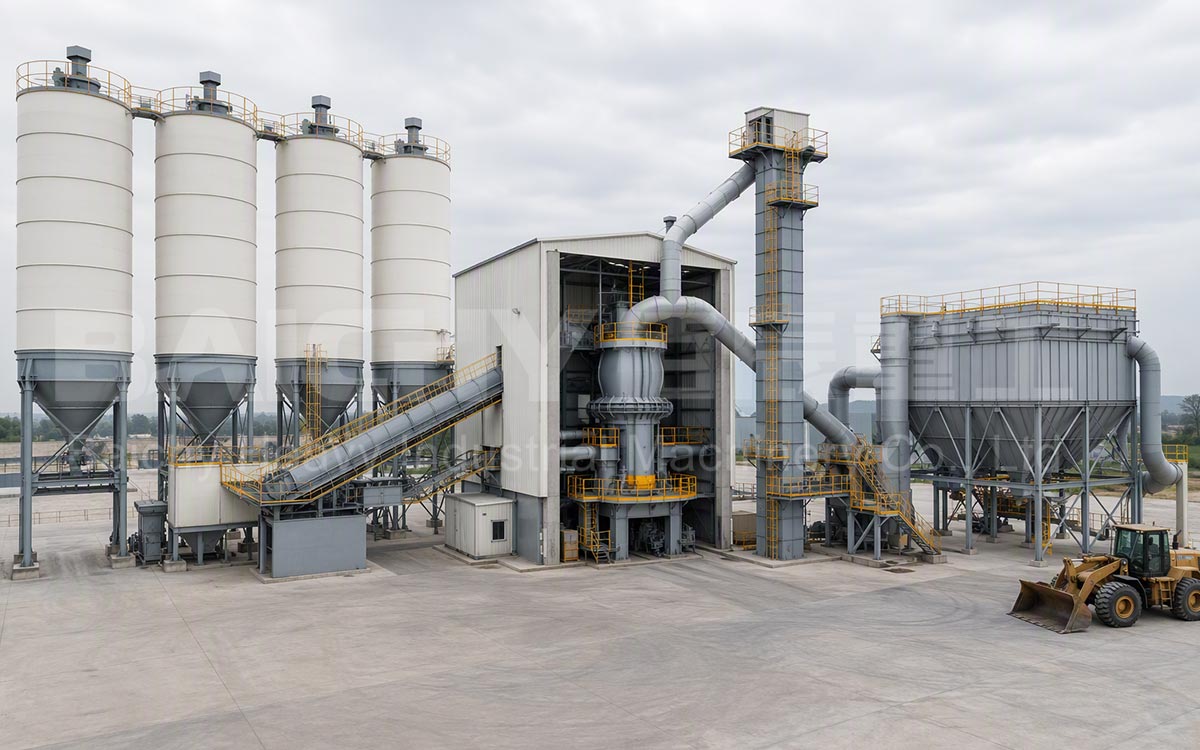
Vertical Roller Mill for GGBS
Selection pitfalls
• Specify fineness in both Blaine and 45 µm residue — "325 mesh" alone does not define marketable GGBS.
• Do not size on dry-basis capacity; real throughput depends on moisture, grindability and gas volume. Demand a test grind before fixing motor power.
• Budget for roller/table hardfacing — slag is abrasive, and wear parts are the price of the energy you save.
• Match the drive to your grid: 50/60 Hz and 380/400/440 V packages must be engineered for local power standards.
FAQ
Q1: Can a vertical roller mill grind wet granulated slag without pre-drying?
Yes. Hot gas enters at up to 350°C and dries slag with 4–15% moisture to ≤1% while grinding proceeds in the same chamber. Plants with kiln waste heat do this at near-zero extra fuel cost.
Q2: What fineness can a vertical roller mill reach for GGBS?
The SRM1500 produces 212–45 µm product, comfortably covering the 400–450 m²/kg Blaine range required for S95 GGBS. The dynamic classifier adjusts fineness in real time as market prices shift.
Q3: How much energy does a vertical roller mill actually save on slag?
VRM slag grinding systems typically use 30–50% less power than ball mill circuits and remove the separate dryer's fuel demand. On a 30 t/h GGBS line running 7,000 h/yr, a conservative 25% power saving repays the mill difference within a few years.
Baichy Heavy Industry
Baichy Heavy Industry is a high-tech mining equipment company integrating R&D, manufacturing, sales, and after-sales service. Focusing on crushing, grinding, and mineral processing equipment, we provide professional solutions to our customers. We are ISO9001:2015 、certified, and our products include mobile crushing palnts, crawler crushing plant, construction waste crushing plants, jaw crushers, sand making machines, cone crushers, fine crushers, grinding mills, ball mills, etc., all with reliable performance to meet diverse project needs.
Baichy Heavy Industry – Your Trusted Partner
To ensure optimal performance of your equipment, Baichy Heavy Industry offers:
- Professional on-site installation guidance
- Comprehensive operator training
- 24/7 technical support & maintenance services
Our complete after-sales service system guarantees long-term, stable operation of your machinery with minimal downtime.
Protect Your Rights – Only Use Official Channels
To avoid scams and ensure authentic support, contact us exclusively through:
• Official Website: www.baichychina.com
• WhatsApp: +8615093222637
• Email: [email protected]
Your satisfaction is our priority – expect prompt, professional service every time.
(Note: Beware of unauthorized third parties claiming to represent Baichy. Always verify through official contacts.)