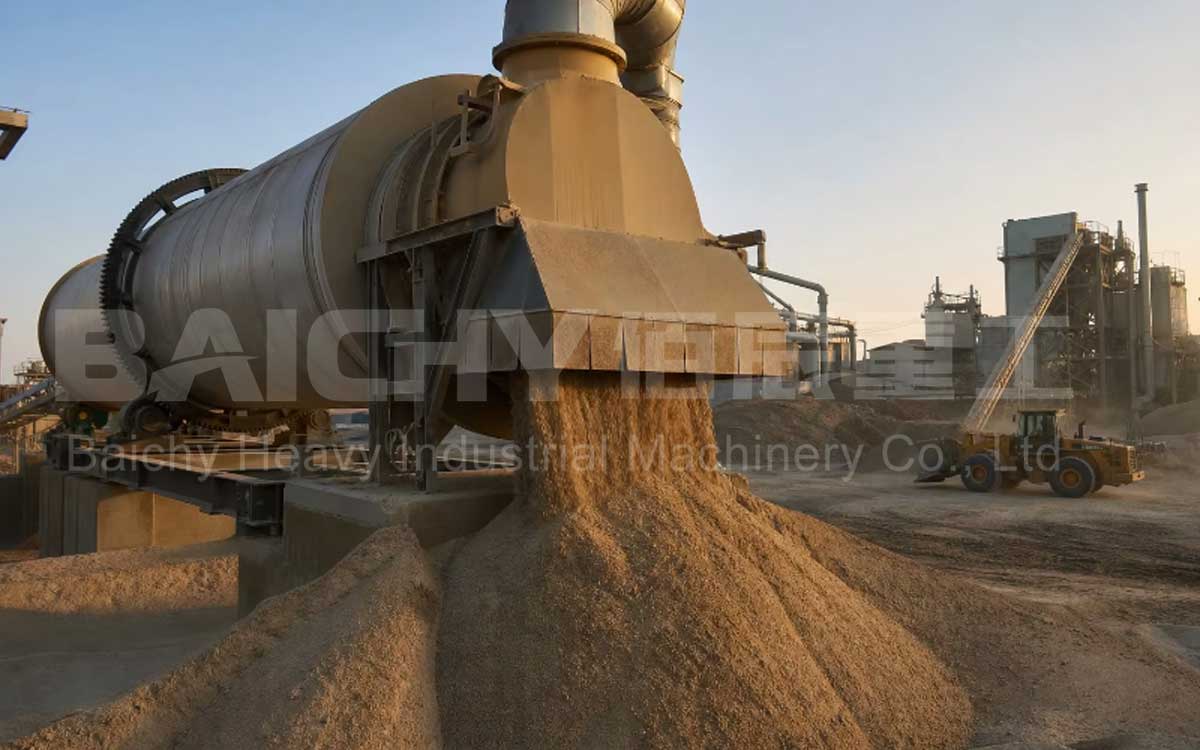
Complete system comprising a single-drum dryer, hot-blast stove, and cyclone/bag dust collector.
Lifters (or flights) are core components within the rotary dryer drum that directly determine thermal efficiency and the stability of the discharge moisture content. For sticky materials like sludge and clay, poor lifter design leads to material sticking and agglomeration; for abrasive materials like quartz sand and iron ore concentrate, it results in the lifters wearing through within months; and for fine-particle materials like fly ash and mineral powder, it causes the material to be carried away by the airflow before drying is complete.
I. Why lifters determine half of the dryer's capacity and thermal consumption
Rotary dryers rely on lifters arranged around the drum's interior to scoop up and scatter material, creating a continuous "curtain" of material through which hot air passes to facilitate moisture exchange. Lifters perform three functions: turning and dispersing material to increase surface area (boosting gas-solid contact area by 10–20 times), controlling residence time (typically 15–45 minutes), and preventing adhesion while guiding flow (crucial for sticky materials). If lifters fail, material slips at the bottom of the drum and hot air bypasses the material bed (short-circuiting), causing thermal consumption to rise by 20–30% and discharge moisture content to fluctuate. With the right lifter design, drum capacity can increase by 15–25%; with the wrong design, the cost of wasted fuel in a single year can exceed the price of the entire lifter system.
II. Matching lifters to material characteristics: Design logic for three types of difficult-to-dry materials
Selecting lifters involves considering three dimensions: stickiness (moisture and clay content), abrasiveness (hardness and particle shape), and particle size/bulk density (susceptibility to being carried away by airflow). Different combinations of these factors dictate specific lifter shape designs.
1. Sticky materials (sludge, clay, coal slime, filter cake): Prioritizing anti-sticking designs
Sticky materials with moisture content between 20% and 80% become tacky on the surface during the initial drying stage; standard straight lifters will become completely clogged with accumulated material within 1–2 hours. Countermeasures: Install a chain curtain at the feed section to break up large clumps; use bent, self-cleaning lifter plates in the middle section, allowing the material layer to detach naturally via the angled bend; if necessary, recycle 20–30% of dry material to lower the surface moisture content below the critical threshold for clumping.
2. Abrasive materials (quartz sand, iron concentrate, river sand, slag): Prioritize wear resistance.
Hard, angular particles cause "sandpaper-like" abrasion on lifter plates; standard Q235 steel plates last only 3–6 months, with each replacement requiring 2–3 days of downtime. Countermeasures: Upgrade materials to 16Mn or NM400 wear-resistant steel and apply chromium carbide hardfacing to plate edges; use quick-release bolted connections between plates and the drum shell, allowing inpidual plates to be replaced in 4–8 hours without requiring welding repairs on the entire drum.
3. Fine-grained materials (fly ash, mineral powder, sawdust): Prioritize controlling air velocity to prevent dust entrainment.
Fine powders have low bulk density and are easily carried away by even moderate airflow, leading to discharge before drying is complete and overloading the dust collector; conversely, excessively low air velocity causes the material to merely slide along the drum bottom without being lifted or tumbled. Countermeasures: Use shallow, curved lifting plates to reduce the lifting height; maintain internal air velocity between 2 and 3.5 m/s; and install a retaining ring at the discharge end to extend material residence time.
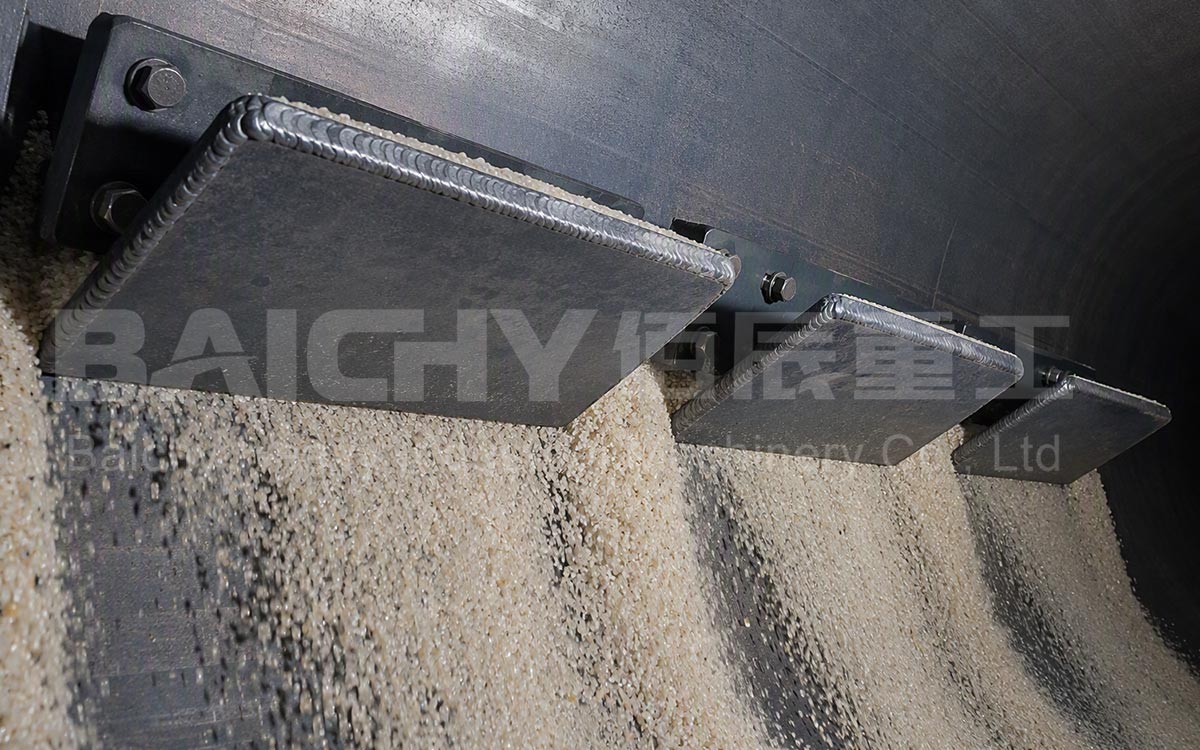
Texture and Grit-Tumbling Finish of NM400 Plate Edge Hard-Facing
Lifter Selection Parameter Table
| Material Type | Typical Materials | Moisture Content | Lifter Configuration | Material & Surface Treatment | Key Parameters |
|---|---|---|---|---|---|
| Sticky Materials | Sludge, clay, coal slime | 20–80% | Chain curtain + bent self-cleaning plates | 16Mn, polished surface | Bend angle 110–135°; 20–30% dry material back-mixing |
| Abrasive Materials | Quartz sand, iron concentrate, river sand | 5–20% | Lifting straight plates with stiffeners | NM400 + hard-faced edges | Plate height 8–12% of drum diameter; quick-release connection |
| Fine-grained Materials | Fly ash, mineral powder, sawdust | 8–30% | Shallow curved plates + discharge retaining ring | 16Mn | Internal gas velocity 2–3.5 m/s; low-profile lifting |
| Standard Granular Materials | Mineral particles, organic fertilizer pellets | 10–25% | Standard lifting straight plates (evenly distributed) | 16Mn | 6–12 circumferential rows; retention time 15–45 min |
III. Four Engineering Essentials for Lifter Structural Design
Axial segmented layout: The feed section handles the wettest material, utilizing chain curtains and widely spaced short plates; the middle section employs denser plate rows to enhance lifting and turning; the discharge section uses shallow plates to prevent secondary dust generation—an approach superior to using a uniform plate shape throughout the drum. Circumferential row count scales with drum diameter: 6–12 evenly distributed rows; insufficient rows result in ribbon-like material curtains, allowing hot air to escape through the gaps. Bend angle matched to angle of repose: Sticky materials require steep bend angles (110–135°) to promote the detachment of the material layer as a whole, whereas loose materials utilize shallow angles and shallow plates; plate height is typically 8–12% of the drum diameter. Ease of plate replacement integrated into design: Segmented manufacturing with quick-release bolting transforms plate replacement in abrasive applications from a "major drum overhaul" into "routine maintenance," representing the single most significant factor in reducing downtime losses within the Total Cost of Ownership (TCO).
IV. Application Scenarios and Typical Case Studies
1. Covered Scenarios: Municipal and industrial sludge drying, coal slime dewatering, quartz sand purification and drying, iron concentrate drying, comprehensive utilization of fly ash, sawdust biomass pretreatment, and processing of organic fertilizer and gypsum granules.
2. Case A (Sticky Materials): A sludge drying line with an initial moisture content of ~60% and a target of 30% experienced moisture fluctuations of ±6 percentage points during a 48-hour trial using standard lifting flights. After retrofitting with a chain curtain and self-cleaning bent flights, combined with a 30% dry material recycle ratio, material accumulation inside the drum was eliminated, moisture content stabilized at 28–30%, and thermal energy consumption per ton dropped by approximately 22%.
3. Case B (Abrasive Materials): A glass sand plant processing quartz sand found that original Q235 steel lifting flights lasted less than 4 months, requiring three shutdowns per year. Upgrading to NM400 steel with hard-faced edges extended the service life to over 12 months, reduced annual downtime by 6–8 days, and resulted in production gains that far outweighed the cost difference of the upgraded flights.
4. Case C (Fine-Grained Materials): A fly ash project initially suffered from excessive airflow velocity, causing large amounts of fine powder to enter the dust collector and limiting the finished product recovery rate to ~80%. After switching to shallow-arc lifting flights, controlling airflow velocity to under 3 m/s, and installing material retention rings, the recovery rate increased to over 95%.
V. Recommended Equipment from Baichy Heavy Industry
Lifting flights are merely internal components; the complete system ensures production output. Baichy Heavy Industry supplies single-drum and triple-drum rotary dryer series, complete with hot blast stoves, cyclone and bag-type dust collectors, and feeding/conveying systems, while customizing internal drum components based on material samples.
| Series | Representative Model | Reference Capacity (Wet Basis) | Applicable Materials |
|---|---|---|---|
| Single-drum Rotary Dryer | φ1.5×12m | 5–10 t/h | Sludge, mineral powder, gypsum, organic fertilizer |
| Single-drum Rotary Dryer | φ2.2×18m | 20–40 t/h | Quartz sand, iron concentrate, etc. (medium-to-large production lines) |
| Single-drum Rotary Dryer | φ3.0×20m / φ3.6×25m | 60–200 t/h | Large-scale mineral and aggregate drying |
| Three-drum Rotary Dryer | Φ2.0×4m – Φ4.0×10m | 8–100 t/h | River sand, manufactured sand, etc. (compact site layouts) |
Selection Tip: If the feed moisture content is at the high end of the range, select the next larger model size (e.g., 15% moisture content reduces throughput by 20–30% compared to dry feed). The lifter plate design must be fully matched to the drum diameter, rotation speed, and heat source; free drying tests for 5–10 kg samples are available, with moisture curves and matching solutions delivered within 5 working days.
FAQ
Q1: Sticky materials keep sticking to the plates and clumping; how should the lifter plates be modified?
A: Use a three-stage approach: add a chain curtain in the feed section to break up clumps; switch to bent, self-cleaning lifter plates in the middle section, utilizing the folding angle to allow the material layer to peel off naturally; and blend in 20–30% dry material to lower the surface moisture content of the mixture below the clumping threshold. Combining these three measures eliminates persistent sticking for most sticky materials.
Q2: How often do lifter plates need replacing when handling abrasive materials? How long is production halted for replacement?
A: Standard Q235 plates typically wear out after 3–6 months when processing quartz sand; switching to NM400 wear-resistant steel with chromium carbide hardfacing on the plate edges can extend the typical service life to over 12 months. The modular lifters feature a quick-release bolted connection, allowing for the replacement of inpidual units in just 4–8 hours without requiring a major overhaul of the entire drum.
Q3: Can existing rotary dryers be retrofitted by replacing only the lifters?
A: Yes. The lifters are independent internal components, so there is no need to replace the drum shell or the drive system. The process involves: providing material samples and drum dimension drawings → free drying tests → redesigning the lifter shape, arrangement, and material based on the drum diameter → off-site prefabrication of segments followed by on-site bolted installation. The investment for this retrofit is far lower than replacing the entire machine, making it an ideal solution for upgrading existing equipment to improve product quality or accommodate changes in material types.
Baichy Heavy Industry
Baichy Heavy Industry is a high-tech mining equipment company integrating R&D, manufacturing, sales, and after-sales service. Focusing on crushing, grinding, and mineral processing equipment, we provide professional solutions to our customers. We are ISO9001:2015 、certified, and our products include mobile crushing palnts, crawler crushing plant, construction waste crushing plants, jaw crushers, sand making machines, cone crushers, fine crushers, grinding mills, ball mills, etc., all with reliable performance to meet diverse project needs.
Baichy Heavy Industry – Your Trusted Partner
To ensure optimal performance of your equipment, Baichy Heavy Industry offers:
- Professional on-site installation guidance
- Comprehensive operator training
- 24/7 technical support & maintenance services
Our complete after-sales service system guarantees long-term, stable operation of your machinery with minimal downtime.
Protect Your Rights – Only Use Official Channels
To avoid scams and ensure authentic support, contact us exclusively through:
• Official Website: www.baichychina.com
• WhatsApp: +8615093222637
• Email: [email protected]
Your satisfaction is our priority – expect prompt, professional service every time.
(Note: Beware of unauthorized third parties claiming to represent Baichy. Always verify through official contacts.)