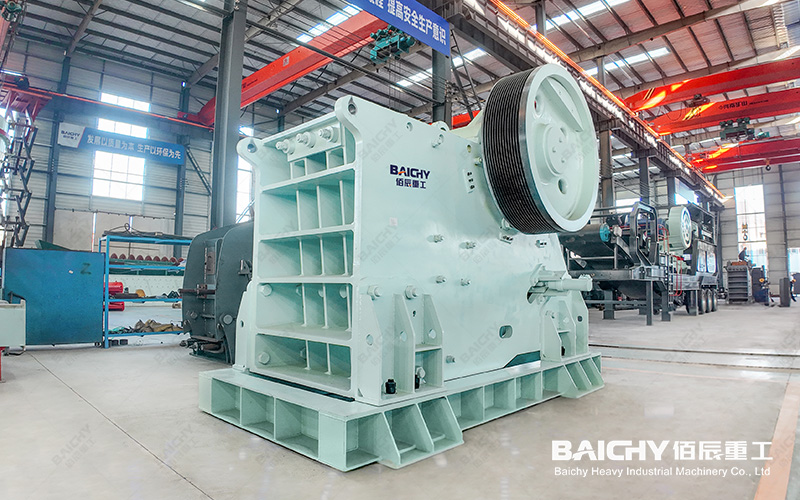
Large-scale Jaw Crusher
The difference between the C120 and C160 is not merely a "size up"; it represents a leap to a higher production capacity tier: maximum feed size increases from 700mm to 1000mm, rated capacity from 160–500 t/h to 500–1200 t/h, motor power from 160kW to 250kW, and total machine weight from approximately 33t to 76t. There is no "better" model—only the one that matches your specific operation: choose the C120 if the raw ore size is ≤700mm and the target capacity is ≤500 t/h; opt for the C160 if the raw ore contains large blocks exceeding 800mm or if capacity requirements exceed 500 t/h.
I. Quick Overview of Model Positioning
| Dimension | C120 | C160 |
| Product Positioning | Mainstay for medium-to-large primary crushing; suitable for both stationary and mobile applications | Primary crushing for ultra-large mines; primarily for stationary production lines |
| Suitable Scale | 300–500 t/h aggregate lines and primary crushing stages in mineral processing plants | 500–1200 t/h large-scale quarries and metal mines |
| Typical Applications | Granite/basalt aggregate, iron/copper/gold raw ore, construction waste | Ultra-large open-pit raw ore, massive aggregate bases, cement mine operations |
| Mobility | Compatible with wheeled/tracked mobile stations (YDPZ series) | Primarily stationary; modular design for disassembly and transport |
Positioning in a Nutshell: The C120 is the "most flexible primary crusher for high-capacity lines," while the C160 represents the "capacity ceiling for large stationary mines." The former can move with the mining site, whereas the latter is designed to be anchored in place to maximize output.
II. Side-by-Side Comparison of Key Specifications
| Parameter | C120 | C160 | Analysis of Differences |
| Feed Opening Dimensions | 1200 × 870 mm | 1600 × 1200 mm | C160 is 1/3 wider and deeper; feed opening area is 83% larger |
| Max. Feed Size | ≤700 mm | ≤1000 mm | Determines the upper limit for raw ore blasting/feed size |
| Discharge Setting Range | 70–200 mm | 150–300 mm | C160 is designed for "pure primary crushing"; discharge size range is shifted upwards |
| Rated Capacity | 160–500 t/h | 500–1200 t/h | Upper limit is approx. 2.4 times higher |
| Motor Power | 160 kW | 250 kW | C160 installed power is 56% higher |
| Main Shaft Speed | ~230 rpm | ~220 rpm | Minimal difference; shared structural design |
| Total Machine Weight | ≈33 t | ≈76 t | C160 is 1.3 times heavier; foundation and transport costs are significantly higher |
| Material Compressive Strength | ≤320 MPa | ≤320 MPa | Both feature the same deep-cavity V-shaped crushing chamber design |
Capacity rated based on limestone (1.6 t/m³); adjusted by a factor of 0.8–0.9 for granite and 0.7–0.8 for iron ore. C120 parameters are based on industry-standard ratings; C160 parameters are based on the Baichy official website's C-series specifications. Specific configurations (motor, voltage rating, hydraulic assistance) are subject to the final selection plan; compatible with regional power standards such as 380V/400V/440V/60Hz.
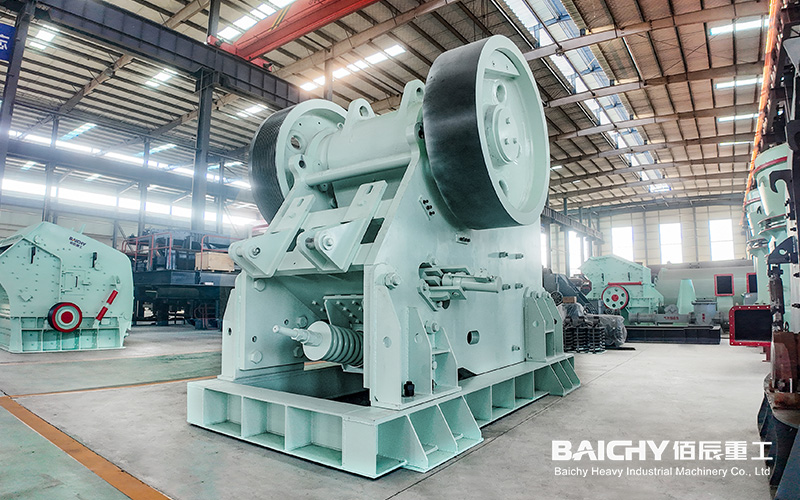
High-capacity Primary Crushing Equipment
III. Breakdown of Five Key Differences
3.1 Feed Capacity: 700mm vs. 1000mm—The piding Line for Ore Handling
The feed opening depth (870mm vs. 1200mm) and maximum feed size (700mm vs. 1000mm) determine more than just "how large a rock can be processed"; they serve as the design basis for upstream mining and feeding systems:
• Run-of-mine (ROM) ore ≤700mm: Can be directly handled by the C120; no secondary blasting or additional pre-screening required.
• ROM ore 700–1000mm: Only the C160 can directly accept this size; forcing the use of a C120 would require adding grizzly screens and secondary crushing or strictly controlling blast fragmentation sizes—resulting in hidden costs far exceeding the price difference between the two machines.
• Decision Signal: If the maximum fragment size in the blast design exceeds 750mm, rule out the C120 immediately.
3.2 Throughput Capacity: An Order-of-Magnitude Difference
Comparison at the same setting (Metso official ratings; CSS 150mm; pre-screened feed): C120 is approx. 340–475 mtph, while C160 is approx. 430–610 mtph; without pre-screening, the C160 can reach 599–811 mtph. Translating this to production lines:
500 t/h class line: A single C120 suffices, leaving a margin of approx. 0–20% (depending on material hardness).
800 t/h+ class line: The C160 is the standard solution; using a C120 would require two units in parallel—doubling the number of machines, conveyors, foundations, and footprint, resulting in a higher total investment.
3.3 Power Consumption and Cost Per Ton: The Advantage of C160’s High Capacity
A rough calculation based on theoretical power consumption per ton (motor power &pide; average capacity):
| Model | Average Capacity (Limestone) | Theoretical Power Consumption (kWh/t) | Calculated Cost (at $0.08/kWh) |
| C120 | ~300 t/h | ~0.53 kWh/t | ~$0.042/ton |
| C160 | ~700 t/h | ~0.36 kWh/t | ~$0.029/ton |
The C160’s power consumption per ton is approximately 32% lower. Based on an annual throughput of 3 million tons, the C160 saves about $39,000 annually in electricity costs; combined with the wear-distribution benefits of a larger jaw plate area (reducing wear per ton by approximately 15–25%), the C160’s operational cost advantage per ton becomes even more pronounced in high-capacity scenarios. However, this relies on running at full capacity—if output is low, the no-load losses of the larger motor will instead negatively impact the cost per ton.
3.4 Weight, Transport, and Installation: 76t Isn't Just "A Bit More Expensive"—It's a Whole Order of Magnitude Heavier
The complete C160 unit weighs approximately 76 tons, requiring modular disassembly for transport (splitting the frame and separating bearing housings); the lifting and on-site assembly timelines are significantly longer than those for the C120. Furthermore, concrete foundation volumes and anchor bolt specifications must be calculated to withstand higher impact loads.
The C120 weighs approximately 33 tons; it can be transported on standard flatbed trucks and mounted on mobile stations. Installation uses vibration-damping pads and limit blocks rather than requiring high-precision embedded anchor bolts. For projects involving frequent relocation or tight schedules, the C120 is the only practical choice.
3.5 Supporting Production Line: Feeding and Downstream Processes Determine Overall Profitability
Feeding End: The C120 is paired with a ZSW-600×150 class feeder; the C160 requires a larger heavy-duty feeder (ZSW-800 class) equipped with a grizzly screen to ensure large rocks (up to 1000mm) enter the crushing chamber evenly. Downstream stage: The C160 produces a 150–300mm output, necessitating a large cone crusher (e.g., HP series) for the secondary crushing stage; the C120 produces a 70–200mm output, allowing for more flexible downstream configurations.
System logic: The choice of primary crusher dictates the scale of the secondary crushing stage; the decision is based on comparing the entire "primary crushing + secondary crushing + screening" combination, rather than just comparing inpidual machines.
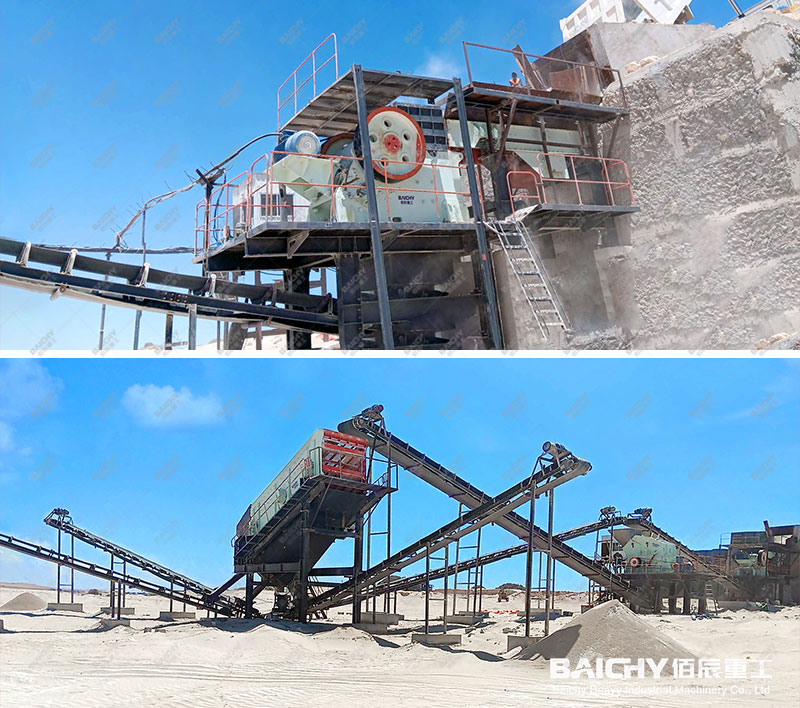
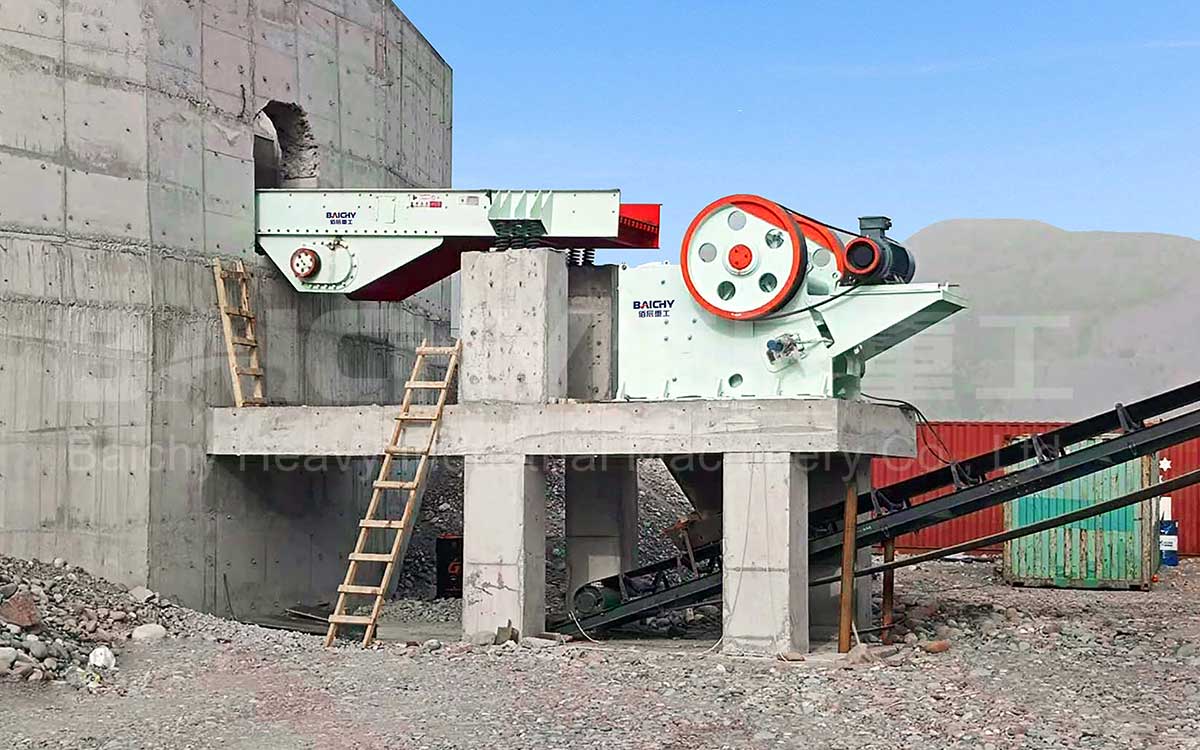
C-Series Jaw Crusher Granite Crushing Site
IV. Selection Decision: When to choose the C120 vs. the C160
| Decision Criteria | Choose C120 | Choose C160 |
| Max feed size ≤700mm | ✅ | Optional (throughput capacity wasted) |
| Max feed size 800–1000mm | ❌Requires pre-crushing/controlled blasting | ✅ |
| Target capacity ≤500 t/h | ✅ Standard solution | Overkill (underutilization) |
| Target capacity 500–1200 t/h | ❌ Requires two units in parallel | ✅ Standard single-unit solution |
| Mobile plant/frequent relocation | ✅ | ❌ |
| Fixed large-scale mine/long-term operation | Optional | ✅ Optimal cost-per-ton |
| Sensitive to investment & civil works budget | ✅ | Proceed with caution (high foundation & transport costs) |
| Output requirement: 70–150mm (medium-fine fraction) | ✅ CSS adjustable to 70mm | ❌ Lower limit is 150mm |
Recommendation logic (three-step process):
1. Determine feed size first: Is the maximum blasted feed size ≤700mm? No → C160 (or a compromise solution like the C125).
2. Determine capacity next: Is the target capacity >500 t/h? Yes → C160; No → C120 (single unit).
3. Consider operational mode last: Frequent relocation/short project duration → C120; long-term fixed operation/lowest cost-per-ton goal → C160. Note: If a project falls into the "gray area" between the two (feed size ≤800mm, capacity 400–600 t/h, budget-sensitive), consider a C-series intermediate model (e.g., C125, feed opening 950×1250mm, capacity 300–800 t/h). It offers a deeper feed opening to handle larger rocks while maintaining a 160kW-class motor, with an investment cost between that of the C120 and C160.
V. Typical Configuration Schemes
C120 Primary Crushing Line (300–500 t/h aggregate): ZSW-600×150 vibrating feeder → C120 jaw crusher (feed ≤700mm → output 70–200mm) → HP/CS cone crusher (secondary crushing) → Double-shaft/linear screen (grading) → Finished aggregate.
C160 Primary Crushing Line (500–1000 t/h mining): Ore bin → ZSW-800 heavy-duty feeder + grizzly screen → C160 jaw crusher (feed ≤1000mm → output 150–300mm) → Large cone crusher (HP series) for secondary crushing → Closed-circuit screening → Finished product.
VI. Risk Warnings
Overstated Capacity: The C160’s rated capacity of 500–1200 t/h is based on limestone; for granite, multiply by 0.8–0.9, and for iron ore, by 0.7–0.8. Always calculate capacity based on the actual material before signing a contract.
Uncontrolled Feeding: Impact from large rocks is the primary cause of jaw crusher failure. The C160 must be equipped with a heavy-duty feeder and grizzly screen; "dumping loads directly into the crushing chamber" is strictly prohibited. Transport and foundation cost overruns: The landed cost of the C160 (including disassembly/reassembly, heavy-haul transport, and lifting) can account for 10–15% of the equipment price, and the concrete volume for the civil foundation is roughly double that of the C120; these costs should be factored into the CAPEX at the time of quotation.
Power compatibility: Verify local grid specifications (e.g., 400V/50Hz, 380V/60Hz); for the 250kW motor, transformer capacity and the starting method (soft start vs. star-delta) must be calculated.
Wear part budget: When processing highly abrasive materials (such as granite or iron ore), the C160’s jaw plates have a higher unit price but a lower wear cost per ton; annual wear costs should be estimated based on actual operating hours rather than simply comparing jaw plate prices.
VII. FAQ
Q1: Which has a higher production capacity, the C120 or the C160?
The C160. Its rated capacity is 500–1200 t/h, approximately 2.4 times that of the C120 (160–500 t/h); at the same setting (CSS 150mm, with prescreened feed), the C160 yields approximately 430–610 mtph, while the C120 yields approximately 340–475 mtph.
Q2: The maximum size of my run-of-mine (ROM) ore is 800mm; can I choose the C120?
Not recommended. The C120 has a maximum feed size of 700mm; 800mm boulders would frequently cause chamber jams and blockages, necessitating pre-crushing or secondary blasting, with hidden costs far exceeding the price difference between the models. For this application, the C160 (max feed 1000mm) or an intermediate C-series model (such as the C125, with an 800mm-class feed size) should be selected.
Q3: The C160 is much more expensive than the C120; why do people still choose it?
High capacity results in lower per-tonne costs: The C160 consumes approximately 0.36 kWh/t of electricity—about 32% less than the C120. At an annual throughput of 3 million tonnes, this saves roughly $39,000 in electricity costs annually. When combined with the advantages of amortized wear-part costs, operating at full capacity for 3–5 years yields enough savings to offset the initial investment price difference.
Q4: Can the C160 be mounted on a mobile crushing station?
It is generally not feasible. The C160 weighs approximately 76 tonnes, far exceeding the reasonable load-bearing and transport limits for mobile station chassis; it is classified as stationary equipment. For high-capacity projects requiring mobility, the standard approach is to use multiple mobile jaw crushers in parallel (such as the YDPZ mobile station equipped with a C120-class crusher).
Q5: Are there differences in the crushing principles and structure between the C120 and C160?
They share the same design lineage: both feature a deep V-shaped crushing chamber, a reciprocating crank-link mechanism for inter-particle (lamination) crushing, and a bolt-connected frame (no welding) secured by pins. The only core wear parts are the jaw plates and the toggle plate. The C160 is essentially a scaled-up, reinforced version (featuring larger bearings and a thicker frame), while the operating principles and maintenance logic remain identical.
Baichy Heavy Industry
Baichy Heavy Industry is a high-tech mining equipment company integrating R&D, manufacturing, sales, and after-sales service. Focusing on crushing, grinding, and mineral processing equipment, we provide professional solutions to our customers. We are ISO9001:2015 、certified, and our products include mobile crushing palnts, crawler crushing plant, construction waste crushing plants, jaw crushers, sand making machines, cone crushers, fine crushers, grinding mills, ball mills, etc., all with reliable performance to meet diverse project needs.
Baichy Heavy Industry – Your Trusted Partner
To ensure optimal performance of your equipment, Baichy Heavy Industry offers:
- Professional on-site installation guidance
- Comprehensive operator training
- 24/7 technical support & maintenance services
Our complete after-sales service system guarantees long-term, stable operation of your machinery with minimal downtime.
Protect Your Rights – Only Use Official Channels
To avoid scams and ensure authentic support, contact us exclusively through:
• Official Website: www.baichychina.com
• WhatsApp: +8615093222637
• Email: [email protected]
Your satisfaction is our priority – expect prompt, professional service every time.
(Note: Beware of unauthorized third parties claiming to represent Baichy. Always verify through official contacts.)