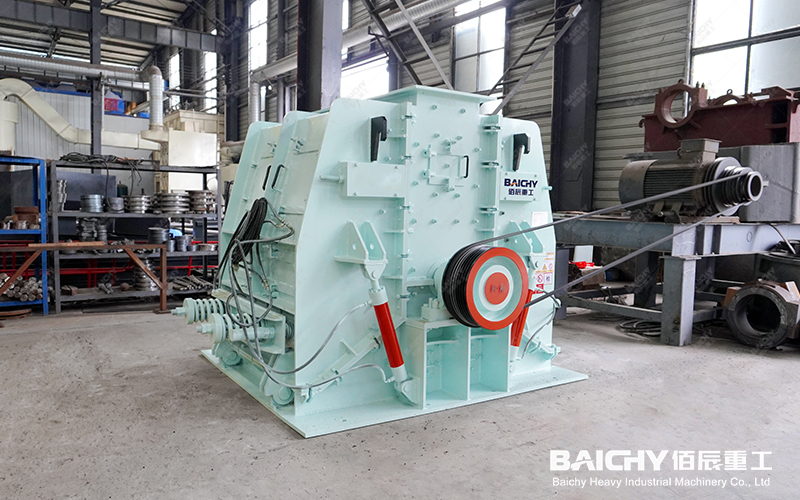
Reversible Hammer Crusher
The reversible hammer crusher is a highly effective tool for the fine crushing—or "single-pass pulverization"—of medium-soft materials such as coal, coke, limestone, and gypsum. It achieves a product output where over 85% of particles are ≤3mm and delivers a crushing ratio as high as 20:1 to 30:1. By alternating the rotation direction of the hammers, the service life of wear parts is nearly doubled. In "crushing-instead-of-grinding" process flows, it can directly replace the traditional two-stage "fine jaw crusher + impact crusher" setup, providing a stable supply of fine material to the downstream mill and serving as the most direct route to reducing crushing costs per ton.
I. What is a Reversible Hammer Crusher?
The reversible hammer crusher is a fine-crushing machine that utilizes high-speed rotating hammers to impact material, with discharge particle size controlled by a grate screen. The key distinction between this and a standard hammer crusher lies in the word "reversible": the motor's rotation direction can be switched, allowing the wear surfaces on both sides of the hammers to take turns performing the crushing work.
Forward rotation: Hammer side A performs the work, while side B undergoes natural wear and remains in reserve;
Reverse rotation: Hammer side B performs the work, allowing side A to regain its sharpness.
This effectively means one set of hammers does the work of two, nearly doubling the replacement interval and halving the labor costs associated with downtime and hammer replacement. Furthermore, bidirectional impact ensures more uniform force application on the material, resulting in a more regular particle shape and a significantly lower rate of over-pulverization compared to unidirectional crushing equipment. For production lines where continuous operation is critical and downtime incurs high costs, this design translates directly into increased annual operating hours.
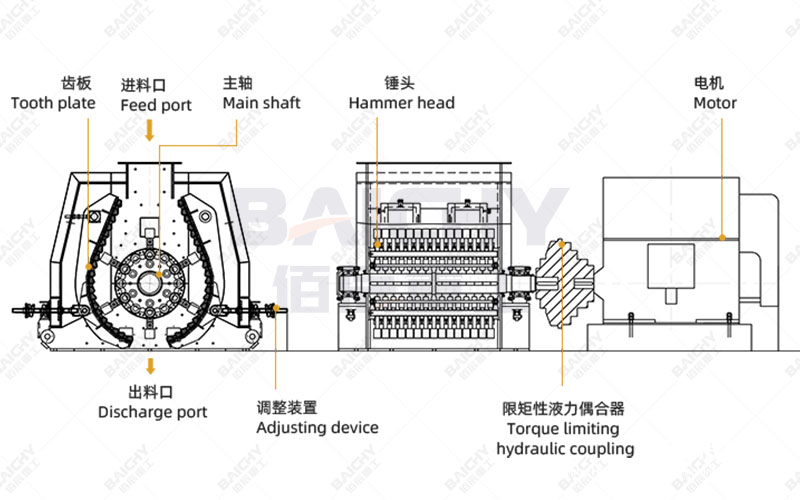
Structural diagram of a reversible hammer crusher
Comparison with Conventional Hammer Crushers
| Comparison Item | Conventional Hammer Crusher | Reversible Hammer Crusher |
|---|---|---|
| Rotor Rotation | Unidirectional | Bidirectional (Forward & Reverse) |
| Hammer Wear | Single-sided wear; short lifespan | Alternating wear on both sides; ~2x lifespan |
| Product Uniformity | Average | Higher uniformity; high proportion of fines |
| Downtime for Hammer Replacement | Frequent | Reduced by approx. 50% |
| Application Scenario | Coarse/Medium Crushing | Medium/Fine Crushing (Single-stage pulverization) |
II. Application Scenarios
Reversible hammer crushers are primarily designed for operations involving "medium-soft materials requiring fine crushing." Typical scenarios include:
• Coal and Coke: Fine crushing of fuel coal for power plants, raw coal for coal washing plants, and metallurgical coke for coking plants; the output feeds directly into boilers, coal mills, or coal blending systems.
• Cement and Building Materials: Crushing limestone and gypsum (including desulfurization gypsum) for direct feed into raw meal mills or use as cement additives, supporting energy-saving "crushing-instead-of-grinding" processes.
• Chemicals and Metallurgy: Fine crushing of materials with medium-to-low hardness, such as salt, fertilizers, sinter, coal gangue, and shale.
• Resource Recycling: Fine crushing stages in recycling lines for brick-concrete construction waste and industrial slag.
• Selection Tip: Operates normally with material moisture content ≤15%; if moisture is high, upstream drying or feed size control is recommended to prevent clogging of the grate screen plates.
III. Core Advantages
1. Doubled hammer lifespan; spare parts costs cut in half. The reversible design ensures even wear on both sides of the hammer, nearly doubling the service life compared to conventional hammer crushers. For a production line processing 500,000 tons annually, this saves approximately 10%–15% of the spare parts budget related to hammer procurement and replacement downtime.
2. High reduction ratio; single-stage pulverization eliminates the need for an additional stage of equipment. It offers a maximum reduction ratio of 30:1, capable of crushing 150mm feed material directly to under 3mm. This replaces the traditional two-stage configuration of a fine-crushing jaw crusher followed by an impact crusher, eliminating the need for one primary machine and its associated power requirements, thereby reducing both total line power consumption and the equipment footprint.
3. The output particle size is fine and consistent, ensuring optimal feed quality for downstream grinding mills. With over 85% of the product measuring ≤3mm, the machine provides a uniform, stable feed for ball mills and Raymond mills; field tests show a 10%–15% increase in mill hourly output and reduced electricity consumption per ton of powder.
4. Discharge is controlled by grate screen plates, resulting in a low over-grinding rate. Properly sized particles are discharged promptly, preventing energy waste caused by excessive grinding and reducing the load on downstream screening equipment.
5. The design is compact and easy to maintain. The housing can be opened hydraulically or mechanically, allowing for the replacement of grate bars and hammer heads without dismantling the entire machine; the bearing housing and rotor dynamic balance design ensure stable, high-speed operation over the long term.
IV. Technical Specifications
The table below lists standard configurations for the PCK series reversible hammer crusher (values are for reference only; actual figures depend on material properties and process calculations):
| Model | Rotor Diameter × Length (mm) | Feed Size (mm) | Discharge Size (mm) | Capacity (t/h) | Motor Power (kW) |
|---|---|---|---|---|---|
| PCK-0808 | 800×800 | ≤80 | ≤3 (≥85% proportion) | 25–40 | 75–110 |
| PCK-1010 | 1000×1000 | ≤100 | ≤3 | 40–60 | 110–160 |
| PCK-1212 | 1200×1200 | ≤120 | ≤3 | 60–100 | 160–220 |
| PCK-1414 | 1400×1400 | ≤150 | ≤3 | 100–160 | 280–355 |
| PCK-1616 | 1600×1600 | ≤180 | ≤3 | 160–220 | 400–450 |
| PCK-1818 | 1800×1800 | ≤200 | ≤3 | 220–300 | 500–630 |
Capacity Conversion Note: Capacities in the table above are rated based on limestone (bulk density approx. 1.6 t/m³). When crushing lightweight materials such as coke or coal gangue, apply a conversion factor of 0.45–0.55 to the capacity. For materials with higher hardness or moisture content, the rated capacity should be adjusted downward, and a larger motor power margin should be selected.
V. Application Cases
Case 1: Limestone Fine Crushing in a Cement Plant ("Crushing Instead of Grinding" Retrofit)
A 5,000 t/d cement clinker production line replaced its original two-stage process (fine jaw crusher + impact crusher) with a single reversible hammer crusher. After primary crushing, limestone enters the machine; approximately 85% of the output is ≤3mm, allowing it to feed directly into the raw meal mill. Post-retrofit, the raw meal mill's hourly output increased by about 10%–15%, and electricity consumption per ton of raw meal decreased, while maintenance requirements for one major piece of equipment were eliminated. (Calculations based on typical industry operating conditions; specific data subject to on-site verification.)
Case 2: Raw Coal Fine Crushing in a Coal Preparation Plant
A plant with an annual processing capacity of 1.2 million tons handles raw coal with 8%–12% moisture content and a feed size of 150mm. A reversible hammer crusher reduces the material to below 3mm in a single pass for use in the dense-medium separation system. Thanks to the reversible rotation design, the hammer service life extended from approximately 6 months to over 11 months, with estimated annual savings of 80,000–120,000 RMB on spare parts and maintenance downtime. (Scenario-based example; data represents industry ranges.)
VI. Recommended Equipment
Reversible hammer crushers typically serve the intermediate stage of a production line; the following equipment combination is recommended:
• ZSW Vibrating Feeder: Ensures uniform feeding, prevents material impact on the rotor, and extends hammer life;
• PE Series Jaw Crusher: Primary crusher for large lumps, controlling feed size to ≤200mm;
• YK Circular Vibrating Screen: Classifies output; oversize material can be returned for secondary crushing;
• Raymond Mill / Ball Mill: Processes fine material (≤3mm) into powder, forming a complete "crushing + grinding" system;
• Bag-type Dust Collector: Fine crushing generates significant dust; a dust collection system ensures environmental compliance and material recovery.
For complete production line solutions, Baichy Heavy Industry offers equipment selection and process design tailored to material properties and target particle sizes.
VII. Frequently Asked Questions (FAQ)
Q1: What is the difference between a reversible hammer crusher and a standard hammer crusher?
The main difference lies in the rotor's rotation direction. The motor of a reversible hammer crusher can rotate in both forward and reverse directions, allowing the hammer heads to wear evenly on both sides; this roughly doubles their service life and cuts the frequency of downtime for hammer replacement by about half. Additionally, the output particle shape is more uniform, making it better suited for fine crushing and "single-pass pulverization" applications. Standard hammer crushers feature a simpler structure and a slightly lower price point, making them suitable for medium-crushing operations.
Q2: What materials can a reversible hammer crusher process? Are there requirements regarding moisture content?
It is suitable for medium-soft materials such as limestone, gypsum, coal, coke, salt, fertilizers, coal gangue, and shale (ideally with a Mohs hardness ≤5). Generally, the material moisture content should be ≤15%; excessive moisture can clog the grate screen plates, so it is recommended to install drying equipment upstream or control the feed particle size.
Q3: What output particle size can a reversible hammer crusher achieve? Can it replace a grinding mill?
With the standard configuration, the proportion of output material sized ≤3mm can exceed 85%, meeting the feed requirements for most grinding mills; however, it cannot completely replace a grinding mill. It addresses "fine crushing to below 3mm," whereas grinding mills handle "micron-level pulverization." Combining the two—a process known as "crushing instead of grinding"—can significantly reduce the total power consumption of the grinding system.
Baichy Heavy Industry
Baichy Heavy Industry is a high-tech mining equipment company integrating R&D, manufacturing, sales, and after-sales service. Focusing on crushing, grinding, and mineral processing equipment, we provide professional solutions to our customers. We are ISO9001:2015 、certified, and our products include mobile crushing palnts, crawler crushing plant, construction waste crushing plants, jaw crushers, sand making machines, cone crushers, fine crushers, grinding mills, ball mills, etc., all with reliable performance to meet diverse project needs.
Baichy Heavy Industry – Your Trusted Partner
To ensure optimal performance of your equipment, Baichy Heavy Industry offers:
- Professional on-site installation guidance
- Comprehensive operator training
- 24/7 technical support & maintenance services
Our complete after-sales service system guarantees long-term, stable operation of your machinery with minimal downtime.
Protect Your Rights – Only Use Official Channels
To avoid scams and ensure authentic support, contact us exclusively through:
• Official Website: www.baichychina.com
• WhatsApp: +8615093222637
• Email: [email protected]
Your satisfaction is our priority – expect prompt, professional service every time.
(Note: Beware of unauthorized third parties claiming to represent Baichy. Always verify through official contacts.)