
Sand Dryer: Types, Working Process & Price Guide
What Is a Sand Dryer and Why Do You Need One?
A sand dryer is a rotary drying machine that removes moisture from wet sand, gravel, and mineral aggregates through direct contact with hot gas inside a rotating cylinder. Whether you run a river sand washing plant, a silica sand line, or a mineral beneficiation circuit, the sand dryer brings moisture content down from 20–25% to below 1%, producing free-flowing sand for downstream use.
For any sand producer, moisture control is not optional. Wet sand raises transport weight and fuel cost, causes caking in silos, and destabilizes the quality of concrete, asphalt, and mortar. A well-selected sand drying machine solves all of these problems at once.
Why moisture control matters
- Lower logistics cost: Dry sand weighs less, so every truckload carries more usable product.
- Accurate grading: Screening and classification are more reliable when sand is free-flowing.
- Stable quality: Concrete, glass, foundry molds, and dry mortar all need precise moisture control.
- No caking or freezing: Dry material flows smoothly through silos, even in cold climates.
How a Rotary Sand Dryer Works
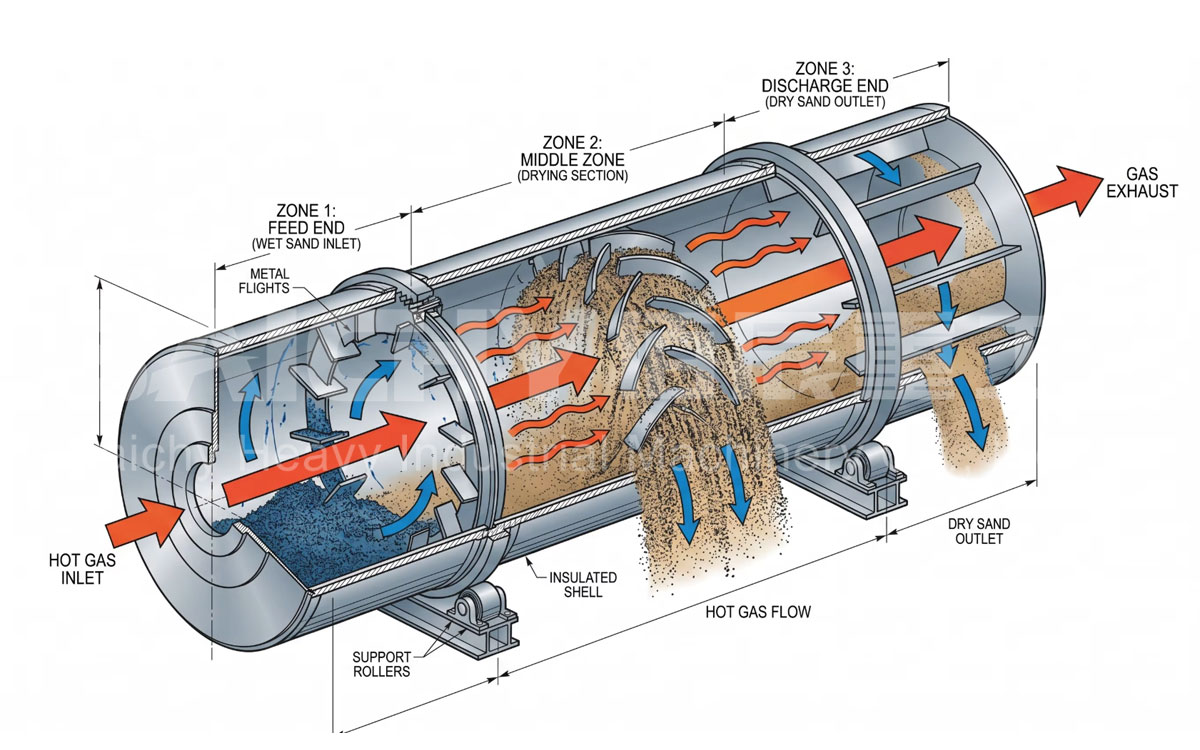
Demonstration of the working principle of a dryer
The principle is simple but highly effective. Wet sand is fed into the higher end of a slowly rotating drum, where lifting plates carry it up and drop it through a hot gas stream in a cascading curtain, maximizing heat contact. Moisture evaporates rapidly, and dried sand discharges continuously at the lower end while a cyclone or bag filter cleans the exhaust gas.
The main working stages
1. Feeding: Wet sand enters the drum at a controlled rate.
2. Drying zone: Hot gas (400–800 °C at the inlet) evaporates surface and internal moisture.
3. Discharge: Dried sand exits the cooler end, typically below 60 °C.
4. Dust collection: Cyclones and filters recover fines and clean the flue gas.
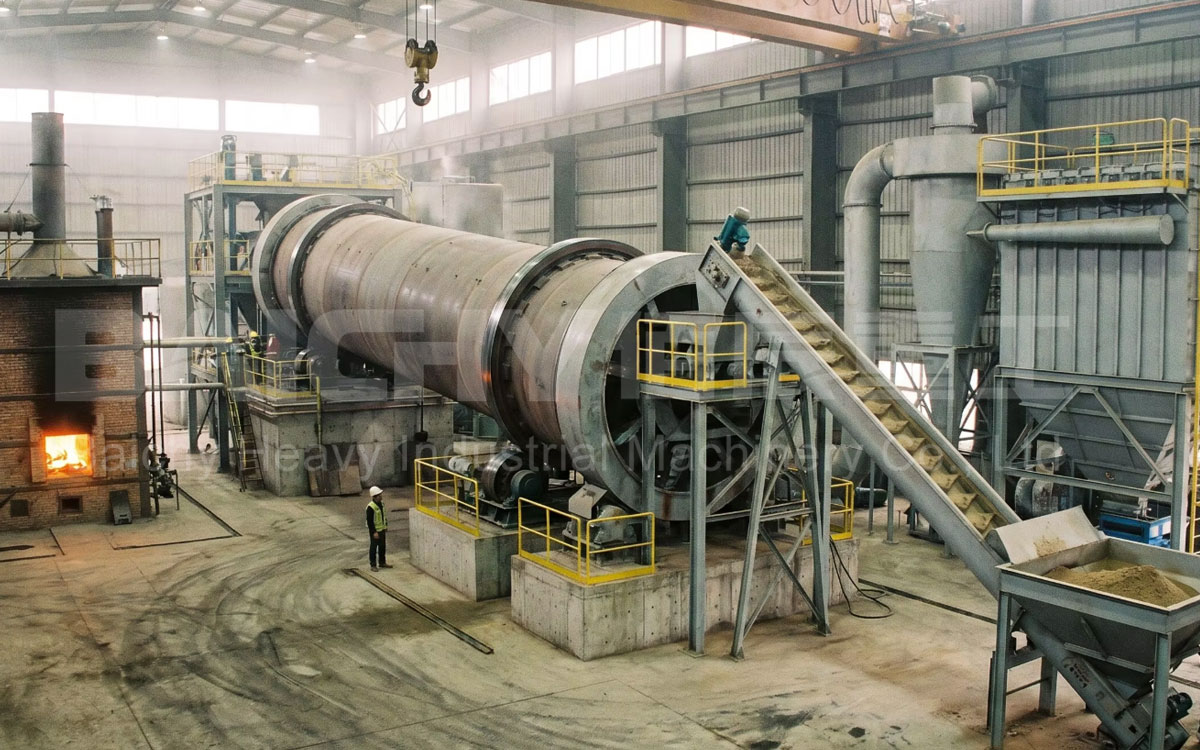
Because the drum rotates continuously and lifting plates keep refreshing the material surface, the sand dryer achieves high thermal efficiency in a compact footprint. Most models are driven by a motor and reducer, supported on riding rings and trunnion rollers, with a 3–5% inclination that controls retention time.
Key Components of a Sand Drying Machine
A durable sand dryer is a coordinated system built for continuous, high-tonnage operation:
- Rotary drum: The main drying body, made of wear-resistant steel with lifting plates inside.
- Driving and supporting system: Motor, reducer, pinion ring, riding rings, and rollers that rotate and carry the drum.
- Sealing device: Reduces air leakage to maintain drying temperature.
- Heat source: Coal, gas, diesel, biomass, or waste-heat furnace matched to your site.
- Dust collection: Cyclone, bag filter, or wet scrubber to meet emission standards.
At Baichy Heavy Industry, each sand drying machine is engineered with thickened shells, hardened lifting plates, and reliable seals so maintenance intervals stay long and total cost of ownership stays low.
Rotary Sand Dryer Technical Parameters
The table below shows typical specifications. Exact capacity depends on feed moisture, target moisture, and particle size, so confirm with our engineers before selection.
| Model | Drum Dia. × Length (m) | Capacity (t/h) | Inlet Temp (°C) | Motor Power (kW) | Weight (t) |
|---|---|---|---|---|---|
| BY-0.8×8 | 0.8 × 8 | 3–5 | 500–700 | 5.5 | 6 |
| BY-1.2×8 | 1.2 × 8 | 6–10 | 500–700 | 7.5 | 11 |
| BY-1.5×12 | 1.5 × 12 | 12–18 | 500–700 | 15 | 18 |
| BY-1.8×14 | 1.8 × 14 | 18–25 | 500–700 | 18.5 | 28 |
| BY-2.0×16 | 2.0 × 16 | 25–35 | 500–700 | 22 | 36 |
| BY-2.4×20 | 2.4 × 20 | 45–60 | 500–700 | 37 | 58 |
Values are indicative for sand with 15–20% initial moisture. Baichy provides a free sizing calculation based on your feed material.
Types of Sand Dryers
- Rotary drum sand dryer: The most common type, ideal for large-capacity sand and aggregate drying. High throughput and reliable, easy to operate with coal or gas heating.
- Fluidized bed sand dryer: Uses hot air to suspend and dry fine, uniform particles with very even moisture control, usually at lower capacities.
- Three-pass dryer: A compact, high-efficiency design where material passes through three concentric drums, saving floor space and energy.
- Sand dryer with heat recovery: Recycles hot air to cut fuel consumption, popular where energy and carbon limits are strict.
Factors That Affect Sand Dryer Efficiency
The real output of any sand drying machine depends on more than the machine itself:
- Initial and target moisture: The wider the gap, the more heat and time required.
- Particle size: Fine sand dries faster but creates more dust; coarse material needs longer retention.
- Inlet temperature and airflow: Higher temperature and proper gas velocity speed evaporation without overheating material.
- Rotational speed and lifting plate design: These set retention time and ensure even cascading for full heat contact.
Getting these right is where a professional manufacturer adds value. Baichy Heavy Industry tunes the drum speed, plate layout, and heat-source configuration for your specific feed, so you get rated capacity with stable product moisture.
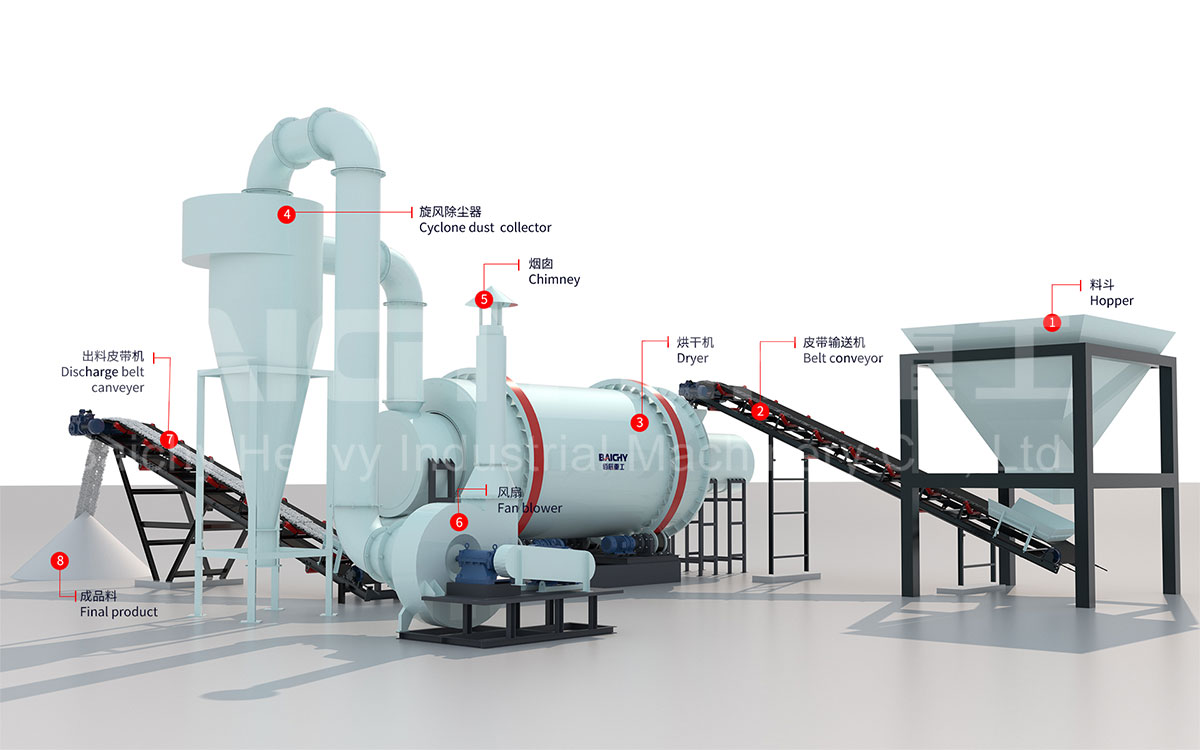
Schematic diagram of the dryer process flow
Sand Dryer Price: What Determines the Cost?
A common question is how much a sand dryer costs. The answer depends on several variables:
- Capacity and drum size: Larger models cost more but lower the cost per ton.
- Heat source: Gas and oil systems are costlier to install than coal or biomass furnaces.
- Automation level: PLC control and sensors add cost but improve stability.
- Accessories: Dust collectors, feeders, and conveyors are often needed for a complete system.
Rather than chasing the lowest quote, focus on total cost of ownership. A competitively priced sand drying machine from a reliable manufacturer typically pays back through lower fuel consumption and fewer breakdowns.
How to Choose the Right Sand Dryer
1. Define your material: type of sand, feed moisture, target moisture, and production rate.
2. Set your heat source: coal, gas, diesel, biomass, or waste heat available on site.
3. Check site constraints: floor space, power supply, and emission limits.
4. Compare energy efficiency: lower fuel consumption per ton means faster payback.
5. Request a free sizing: send your raw material details to Baichy for a matched recommendation.
Sand Dryer Maintenance Tips
A well-maintained sand dryer can run for a decade or more. Key checks include lubricating trunnion rollers, gears, and bearings; inspecting lifting plates and shell thickness; replacing worn seals; cleaning the dust collector; and checking motor and reducer alignment to prevent vibration.
Applications Across Industries
The sand dryer serves many sectors, including construction materials (river sand, machine-made sand, and aggregates), glass manufacturing (silica sand), foundry molding sand, mining and beneficiation (ore concentrates and mineral fines), and chemicals and ceramics (quartz and feldspar). Because Baichy manufactures complete crushing, grinding, and beneficiation lines, we can integrate your sand dryer with existing crushers, screens, and mills for a turnkey solution.
Frequently Asked Questions (FAQ)
1. What is the moisture content after sand drying?
A well-run rotary sand dryer reduces moisture from around 20–25% to below 1%, with a typical target of 0.5–1% for construction and glass-grade sand.
2. What heat sources can a sand dryer use?
Most Baichy sand dryers support coal, natural gas, diesel, biomass, and waste-heat furnaces. We match the burner to your available fuel for the lowest operating cost.
3. How much does a sand dryer cost?
The price depends on capacity, heat source, automation, and accessories. Small units start at a few thousand USD, while large industrial systems run much higher. Request a quotation with your capacity and moisture data for an accurate figure.
4. Can I dry silica sand and ore fines with the same machine?
Yes, with proper adjustment of retention time, inlet temperature, and lifting plate layout. Baichy engineers configure the drum for your specific material to prevent over-drying or thermal damage.
5. What is the lifespan of a rotary sand dryer?
With regular lubrication, seal replacement, and plate inspection, a quality sand drying machine typically operates reliably for 8–12 years before major rebuilds are needed.
Conclusion
A sand dryer is essential for any sand, aggregate, or mineral processing operation that needs consistent, low-moisture product. By understanding the working principle, comparing the technical parameters, and choosing the right capacity and heat source, you can maximize efficiency and return on investment. As a professional manufacturer of mining crushing, ore grinding, and mineral processing equipment, Baichy Heavy Industry delivers high-quality rotary sand dryers backed by free sizing, professional installation, and reliable spare parts. Contact us with your raw material details and let our engineers help you select the perfect sand drying machine for your project.
Baichy Heavy Industry
Baichy Heavy Industry is a high-tech mining equipment company integrating R&D, manufacturing, sales, and after-sales service. Focusing on crushing, grinding, and mineral processing equipment, we provide professional solutions to our customers. We are ISO9001:2015 、certified, and our products include mobile crushing palnts, crawler crushing plant, construction waste crushing plants, jaw crushers, sand making machines, cone crushers, fine crushers, grinding mills, ball mills, etc., all with reliable performance to meet diverse project needs.
Baichy Heavy Industry – Your Trusted Partner
To ensure optimal performance of your equipment, Baichy Heavy Industry offers:
- Professional on-site installation guidance
- Comprehensive operator training
- 24/7 technical support & maintenance services
Our complete after-sales service system guarantees long-term, stable operation of your machinery with minimal downtime.
Protect Your Rights – Only Use Official Channels
To avoid scams and ensure authentic support, contact us exclusively through:
• Official Website: www.baichychina.com
• WhatsApp: +8615093222637
• Email: [email protected]
Your satisfaction is our priority – expect prompt, professional service every time.
(Note: Beware of unauthorized third parties claiming to represent Baichy. Always verify through official contacts.)