Roller Crusher for Processing Slag
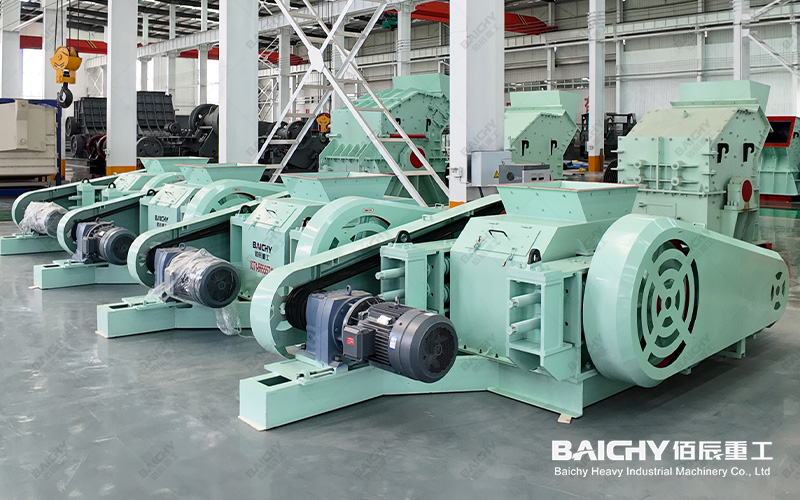
Given the characteristics of slag—specifically its high hardness and strong abrasiveness—the Double-Toothed Roll Crusher is ideally suited for primary crushing and the processing of large-sized lumps. Conversely, the Hydraulic Double-Roll (Smooth Roll) Crusher is best suited for high-precision medium-to-fine crushing. By combining these two types of machinery, the resource utilization of slag can be maximized.
I. Core Selection Logic for Specialized Roll Crushers in Slag Processing
Slag processing cannot be effectively handled by a single, universal machine model; instead, a precise match must be determined based on the slag's moisture content, hardness, and the required final discharge particle size (in accordance with GB/T 26541-2011, *Roll Crushers*).
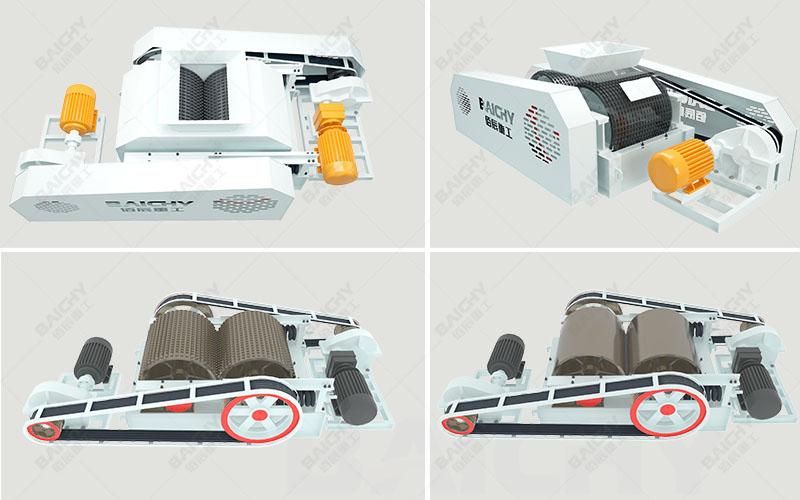
Double-Roll Crusher and Double-Toothed Roll Crusher
1. Comparison of Mainstream Models and Applicable Scenarios
| Model Classification | Core Principle | Optimal Slag Types | Core Advantages | Limitations |
| Double-Toothed Roll Crusher | Shear + Compression | Wet-discharged slag, large boiler slag lumps, municipal solid waste incineration bottom ash | Strong anti-clogging capability, high gripping force, low over-crushing rate | Relatively coarse discharge particle size (typically > 20 mm) |
| Hydraulic Double-Roll (Smooth) Crusher | High-pressure Compression | Dry slag, steel slag, slag intended for use as construction aggregates | Precise discharge particle size (adjustable 2–10 mm), high yield of finished product | Prone to slight roll adhesion when processing high-moisture materials |
2. Enhanced Design Features Tailored to Slag Processing Conditions
• Wear-Resistant Layer Technology: The roll shells must be manufactured using high-chromium alloy composite casting or hard-facing (hard-surfacing) techniques (referencing DL/T 680-2015, *Technical Conditions for Wear-Resistant Pipelines in the Electric Power Industry*). The hardness must reach HRC ≥ 62 to effectively withstand the abrasive effects of quartz and unburned coke present in the slag.
• Hydraulic Overload Protection: The system comes standard with a hydraulic automatic retraction mechanism. When encountering uncrushable objects—such as iron blocks or refractory bricks—the rolls instantly retract and then automatically reset, thereby protecting the core transmission components.
• Bearing Sealing System: Employs a dual-structure sealing system combining "labyrinth seals + grease seals" to prevent the ingress of fine slag dust into the bearing housings (in accordance with ISO 11345:2024 sealing standards).
II. Slag Resource Utilization Pathways and Application Scenarios
The market value of slag processed by roller crushers depends primarily on its particle size distribution; it is predominantly directed toward three high-value sectors: building material manufacturing, road engineering, and metal recovery.
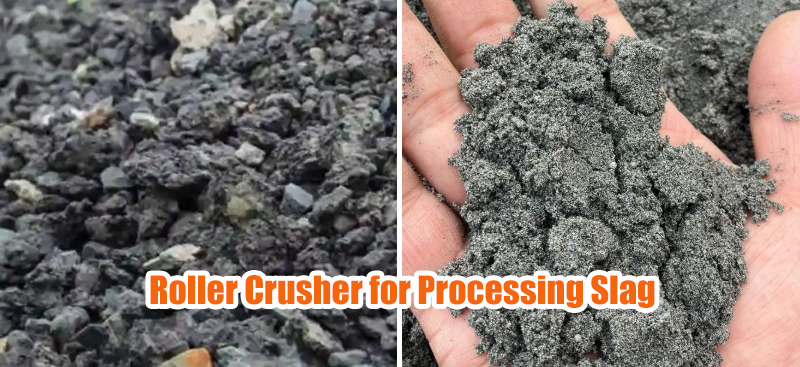
Roller Crusher for Processing Slag
1. Particle Size Classification and Application Mapping Table
| Crushing Stage | Typical Output Size | Core Application Areas | Economic Added Value |
| Primary Crushing | 50–200 mm | Roadbed Backfill, Stockpile Covering | Low |
| Secondary Crushing | 10–50 mm | Concrete Aggregate, Asphalt Pavement Aggregate | Medium |
| Fine Crushing | <10 mm | Cement Admixtures, Non-fired Bricks, Glass-Ceramic Raw Materials | High |
2. Depth of Application in Specific Sub-sectors
• [Building Materials] Active Cement Admixtures: After crushing and pulverizing, slag must meet the requirements of the GB/T 1596-2017 standard, *Fly Ash Used for Cement and Concrete*; it serves to replace over 30% of cement clinker, thereby reducing carbon emissions.
• [Metallurgy] Steel Slag Metal Recovery: When integrated with a magnetic separation process following roller crushing, 7%–10% of metallic iron can be recovered. Data from a 2025 technical upgrade project at a specific steel plant indicates that a single processing line can recover over 5,000 tons of scrap steel annually.
• [Environmental Protection] Municipal Solid Waste (MSW) Incineration Bottom Ash: After crushing and stabilization treatment, bottom ash can be utilized for brick manufacturing or as roadbed material (in accordance with the CJ/T 537-2019 standard, *Aggregates from Municipal Solid Waste Incineration Slag*).
III. Equipment Operation, Maintenance, and Cost Control in High-Abrasion Environments
In slag processing lines, the core of roller crusher maintenance lies in "dust prevention" and "roller surface preservation." A scientifically established maintenance schedule can reduce unplanned downtime by over 60%.
1. List of Core Wear Parts and Service Life Benchmarks
| Wear Part Name | Material Standard | Normal Service Life | Consequences of Failure |
| Roller Shells/Sleeves | High-Chrome Cast Iron (HCr), High-Manganese Steel (Mn13) | 3–6 months (depending on operating conditions) | Uncontrolled discharge particle size, reduced output |
| Bearings | Sweden SKF / Germany FAG | 1–2 years | Equipment seizure, main shaft fracture |
| Crushing Teeth | Hard Alloy Surfacing | 1–3 months | Reduced crushing efficiency, jamming by oversized lumps |
2. Standardized Maintenance Schedule
1. Per Shift (8h): Check bearing housing temperature (alert threshold: 75°C), listen for abnormal noises in gear meshing, and clear accumulated debris from the surrounding area.
2. Weekly: Perform forced lubrication (use lithium-based grease; the injection volume should be sufficient to purge old grease and impurities).
3. Monthly: Measure the gap between the two rollers; adjust via the hydraulic system or shims to compensate for wear.
4. Quarterly: Perform in-situ surfacing repair (welding) on worn areas of the tooth tips or roller surfaces to extend service life.
3. Expert Recommendations for Cost Reduction and Efficiency Improvement
• Strictly Prohibit Single-Sided Feeding: Prolonged single-sided feeding causes the rollers to wear into a "hourglass" shape, resulting in uneven discharge particle size. It is mandatory to strictly enforce uniform material distribution using a spreader/feeder.
• Upstream Iron Removal: Although the equipment features iron-passing protection, frequent activation of this mechanism reduces efficiency. Ensure that the upstream belt-type iron remover (RCYD series) is functioning correctly at all times.

About of Baichy Heavy Industry
Baichy Heavy Industry is a high-tech mining equipment company integrating R&D, manufacturing, sales, and after-sales service. Focusing on crushing, grinding, and mineral processing equipment, we provide professional solutions to our customers. We are ISO9001:2015 、certified, and our products include mobile crushing palnts, crawler crushing plant, construction waste crushing plants, jaw crushers, sand making machines, cone crushers, fine crushers, grinding mills, ball mills, etc., all with reliable performance to meet diverse project needs.
Our advantages:
• Professional pre-sales support: Free project design and comprehensive solutions to help you accurately select the right equipment;
• Comprehensive on-site service: Providing installation guidance and worker training to ensure smooth equipment commissioning;
• Reliable after-sales guarantee: A complete after-sales system, timely response to technical inquiries and equipment maintenance, ensuring long-term stable operation.
To protect your rights, please contact us through the following official channels for professional service:
Official Website Customer Service
https://wa.me/+8615093222637
Email: [email protected]
We are committed to providing high-quality equipment and full-cycle services to deliver comprehensive intelligent solutions for the global mining industry!
4. Frequently Asked Questions (FAQ)
Q1: Which type of crusher is least prone to clogging when processing high-moisture boiler wet slag?
A: The Double-Toothed Roller Crusher is the preferred choice. Its toothed structure features a "forced bite" action and self-cleaning capabilities, effectively resolving the issue of wet slag adhering to and clogging the screen plates—a common problem with hammer crushers.
Q2: What are the particle size requirements for crushed slag intended for the production of non-fired bricks?
A: The production of non-fired bricks typically requires the slag particle size to be controlled within the range of 1–3 mm, with a requirement for good particle size gradation. We recommend a two-stage crushing process consisting of a "Jaw Crusher + Hydraulic Double-Roller Crusher," supplemented by a vibrating screen at the downstream end to facilitate closed-circuit screening.
Q3: What should be done if the roller shells wear out too quickly when processing steel slag with a roller crusher?
A:
① Select high-chromium alloy composite roller shells (with a hardness of HRC > 62);
② Establish a weekly schedule for on-site hardfacing (surface welding) to repair the teeth at the first signs of wear;
③ Inspect the feed material for any large pieces of scrap steel mixed in, and if necessary, enhance the magnetic separation process upstream.
Q4: What are the environmental protection requirements for a slag crushing line?
A: The facility must comply with GB 16297-1996, the *Integrated Emission Standard of Air Pollutants*. While roller crushers inherently generate fewer dust points, it is still necessary to install water spray systems or baghouse dust collectors at the feed and discharge ports, and to ensure that the processing workshop is fully enclosed.
Q5: What is the cost difference between using double-toothed rollers versus double-smooth rollers for slag processing?
A: Double-toothed rollers have a slightly higher initial purchase cost; however, due to their lower rate of over-crushing and lower energy consumption, they offer a lower overall operating cost when processing large, wet slag lumps. Smooth rollers are better suited for fine crushing applications, though they entail relatively higher electricity costs.
Q6: Why do the bearings on my crusher keep failing?
A: In 90% of cases, the failure is caused by dust ingress leading to grease contamination. Please verify that the bearing housing seals are of the labyrinth type, and strictly adhere to a lubrication regimen of "greasing every shift and changing the oil every week."
Q7: Will iron lumps mixed into the slag damage the machine?
A: Modern hydraulic roller crushers are equipped with a hydraulic protection system; when an iron lump is encountered, the rollers automatically retract to discharge it, preventing any structural damage. However, frequent iron discharge will reduce production efficiency; therefore, we recommend installing a suspended magnetic separator upstream of the crusher.