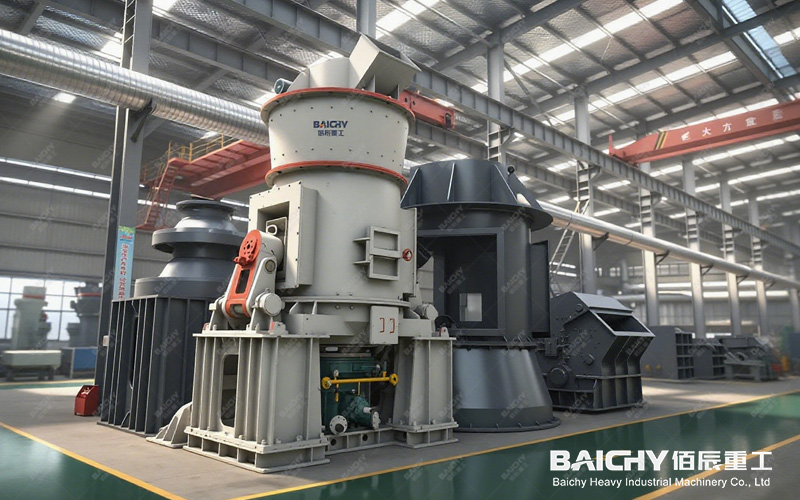
Bentonite Vertical Mill
The Vertical Roller Mill (VRM) currently stands as the most efficient grinding equipment for processing bentonite characterized by high moisture content and a tendency to agglomerate. It is capable of simultaneously performing drying, grinding, and classifying operations in a single pass, thereby enabling the large-scale production of finished products with a fineness of 100 microns (150 mesh).
Given the inherent characteristics of raw bentonite—specifically its high moisture content (20%–30%) and high viscosity—traditional Raymond mills or ball mills often encounter significant challenges, such as material clogging and low operational efficiency. The VRM addresses these issues by utilizing high-temperature gases supplied by a hot air furnace to establish a closed-loop airflow circulation within the mill chamber. This design facilitates simultaneous drying and grinding, allowing the mill to directly process high-moisture raw ore. Consequently, the moisture content of the finished product discharged from the mill is consistently maintained below 1%, thereby providing a perfect solution to the critical "sticking" problem commonly associated with bentonite processing.
I. Core Technical Specifications and Performance Advantages
When processing bentonite, the VRM demonstrates three core competitive strengths: high single-unit production capacity (5–100 t/h), low energy consumption (saving 30%–40% on electricity compared to ball mills), and superior environmental performance.
| Key Indicator | Standard/Parameter Range | Remarks |
| Feed Size | < 40–50 mm | No additional crushing required; raw ore can be fed directly into the mill. |
| Product Fineness | 80–600 mesh (100–20 μm); specifically 100 microns (150 mesh) | Classified as medium-fine particle size; offers extremely high processing efficiency. |
| Product Moisture | < 1% – 10% | Flexibly adjustable to suit downstream processing requirements (e.g., drilling mud, cat litter). |
| System Power Consumption | 18–26 kWh/t | Significantly lower than that of traditional ball mill systems. |
| Environmental Emissions | < 20 mg/Nm³ | Operates under full negative pressure, ensuring zero dust spillage. |
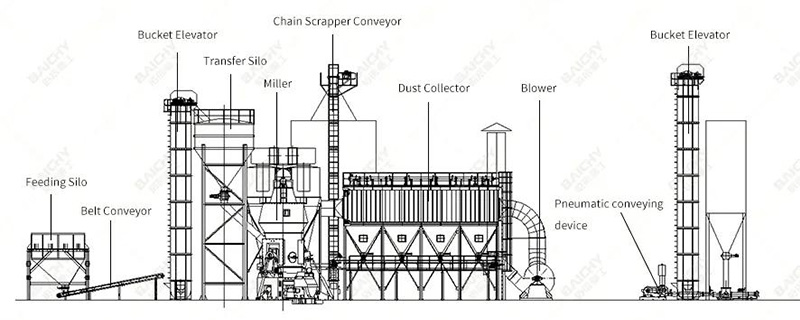
Vertical mill coal grinding process diagram
1. Integrated Process Flow
The system integrates five key functions into a single unit: crushing, drying, grinding, classifying, and conveying.
• Robust Drying Capability: Equipped with a dedicated hot air furnace (fueled by coal, natural gas, or waste heat), the system achieves an inlet air temperature of up to 300–350°C, enabling the instantaneous evaporation of free moisture contained within the bentonite. • High Classification Precision: Features a built-in, highly efficient dynamic-static classifier, allowing for stepless adjustment of fineness within the range of 80 to 600 mesh. When targeting a fineness of 100 microns, the classifier speed can be adjusted to a medium-to-low range, significantly boosting throughput.
2. Operational Cost Control
The long-term comprehensive operating costs of a vertical mill are significantly lower than those of traditional grinding mills.
• Low Power Consumption: The roller-type grinding mechanism is more energy-efficient than impact-type mechanisms (such as ball mills).
• Minimal Wear: The grinding rollers and grinding table do not come into direct contact; furthermore, the unit is equipped with a hydraulic roller-lifting device, ensuring resistance-free startup under no-load conditions.
• Small Footprint: The system features a compact layout with high utilization of vertical space, resulting in a 30% reduction in infrastructure investment costs.
II. Broad Spectrum of Applications for Vertical Mills: Beyond Bentonite
Vertical mills are suitable for grinding non-metallic minerals and industrial waste residues with a Mohs hardness of 7 or less and a moisture content ranging from 6% to 15%. They serve as versatile, general-purpose equipment across the building materials, electric power, and metallurgy industries.
In addition to bentonite, this equipment can be widely applied in the following fields, enabling "one machine, multiple uses":
| Industry Category | Representative Materials | Grinding Purpose & Application Scenarios |
| New Building Materials | Limestone, Calcite, Marble | Production of heavy calcium carbonate; used as fillers in papermaking and coatings. |
| Cement Industry | Cement Raw Meal, Clinker, Slag | Core equipment for cement production lines; grinding of blast furnace slag (Grades S95/S105). |
| Power & Energy | Raw Coal, Petroleum Coke | Preparation of pulverized coal for kiln heads in power plants and cement factories (explosion-proof design). |
| Environmental Protection | Limestone Powder | Preparation of wet-process desulfurization agents for power plant flue gas treatment. |
| Chemical & Metallurgy | Kaolin, Talc, Phosphate Rock | Raw materials for ceramics; fertilizer additives; refractory materials. |
Important Boundary Conditions: Vertical mills are *not* suitable for extremely hard materials with a Mohs hardness greater than 7 (e.g., corundum) or for fibrous materials; attempting to grind such materials will result in abnormal wear on the grinding roller liners.
III. Key Risk Points in Equipment Selection and Operations & Maintenance (A Guide to Avoiding Pitfalls)
Excessive vibration and thermal system imbalances are the two primary causes of vertical mill shutdowns. Therefore, during the selection process, it is imperative to specify comprehensive iron removal and temperature control systems.
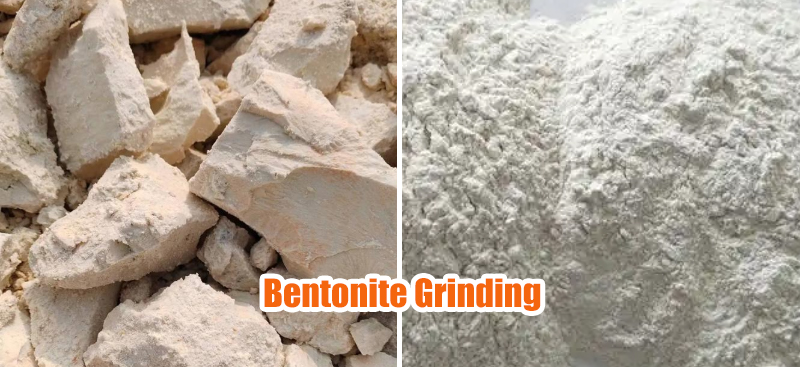
Bentonite Grinding
1. Mechanical Stability: Vibration Prevention
• The "Iron Killer": Bentonite ore often contains impurities such as sand, gravel, and ferrous objects. It is mandatory to install high-intensity magnetic separators and metal detectors at the feed inlet to prevent metal objects from entering the grinding chamber. Such intrusions can trigger severe vibrations, potentially leading to gear reducer tooth breakage or grinding liner fractures.
• Material Bed Thickness: During operation, a stable material bed thickness of 30–80 mm must be maintained. The hydraulic system applies real-time pressure to the grinding rollers to prevent them from "slamming" directly against the grinding table.
2. Thermal System: Preventing Clogging and Sticking
• Outlet Temperature Control: For bentonite processing, the outlet air temperature is typically controlled within the range of 80°C to 100°C. Temperatures that are too low can lead to excessive moisture levels and condensation, causing material to adhere to the filter bags; conversely, temperatures that are too high may damage the crystalline structure of the bentonite, thereby compromising its colloidal value.
• Air-Locking Devices: The feed inlet must be equipped with a heavy-hammer flap valve or a rotary air-lock feeder to prevent cold air infiltration and ensure optimal drying efficiency.
3. Wear Protection
• Liner Materials: Given the medium-to-low abrasiveness of bentonite, the use of high-chromium cast iron composite liners is recommended. These liners offer a balanced combination of wear resistance and impact toughness, providing a service life of over 8,000 hours.
About of Baichy Heavy Industry
Baichy Heavy Industry is a high-tech mining equipment company integrating R&D, manufacturing, sales, and after-sales service. Focusing on crushing, grinding, and mineral processing equipment, we provide professional solutions to our customers. We are ISO9001:2015 銆乧ertified, and our products include mobile crushing palnts, crawler crushing plant, construction waste crushing plants, jaw crushers, sand making machines, cone crushers, fine crushers, grinding mills, ball mills, etc., all with reliable performance to meet diverse project needs.
Our advantages:
• Professional pre-sales support: Free project design and comprehensive solutions to help you accurately select the right equipment;
• Comprehensive on-site service: Providing installation guidance and worker training to ensure smooth equipment commissioning;
• Reliable after-sales guarantee: A complete after-sales system, timely response to technical inquiries and equipment maintenance, ensuring long-term stable operation.
To protect your rights, please contact us through the following official channels for professional service:
Official Website Customer Service
https://wa.me/+8615093222637
Email: [email protected]
We are committed to providing high-quality equipment and full-cycle services to deliver comprehensive intelligent solutions for the global mining industry!
IV. Frequently Asked Questions (FAQ)
Q1: Can a vertical mill directly process wet bentonite with a moisture content of 30%?
A: Yes, it can be processed directly. Vertical mills feature an integrated hot air system; provided the material possesses sufficient flowability (i.e., is not in a semi-liquid, muddy state), it can be conveyed into the mill via a belt conveyor for simultaneous drying and grinding—eliminating the need for pre-drying or the use of a separate drying tower.
Q2: What is the corresponding mesh count for a fineness of 100 microns? Does this meet the standards required for drilling-grade bentonite slurry?
A: 100 microns is approximately equivalent to 150 mesh. For standard API-grade bentonite used in drilling mud, a passing rate of ≥95% through a 200-mesh sieve is sufficient, meaning a fineness of 100 microns fully meets the standard. If higher standards are required (such as API 13A), a fineness of 200 mesh (74 microns) can be achieved by increasing the rotational speed of the classifier.
Q3: Between a vertical roller mill and a Raymond mill, which is better suited for processing bentonite?
A: For large-scale production, the vertical roller mill is the preferred choice. Raymond mills are prone to clogging when processing high-moisture materials and have a low capacity ceiling (typically <10 t/h); in contrast, a single vertical roller mill unit can achieve capacities ranging from tens to hundreds of tons per hour and integrates drying capabilities, offering superior overall economic benefits.
Q4: What core components does the complete system comprise?
A: The main unit (grinding table, grinding rollers, classifier), gearbox, motor, hydraulic station, lubrication station, hot air furnace, cyclone collector, pulse bag filter, blower, and electrical control system.
Q5: Approximately how much investment is required for the equipment?
A: This depends on the required capacity and configuration. A small-scale production line with an hourly output of 10 tons typically requires an investment of several million RMB, whereas a large-scale line with an hourly output exceeding 50 tons requires an investment in the tens of millions. A precise quotation must be customized based on specific factors such as the raw ore's moisture content, the required fineness of the finished product, and local environmental protection regulations.