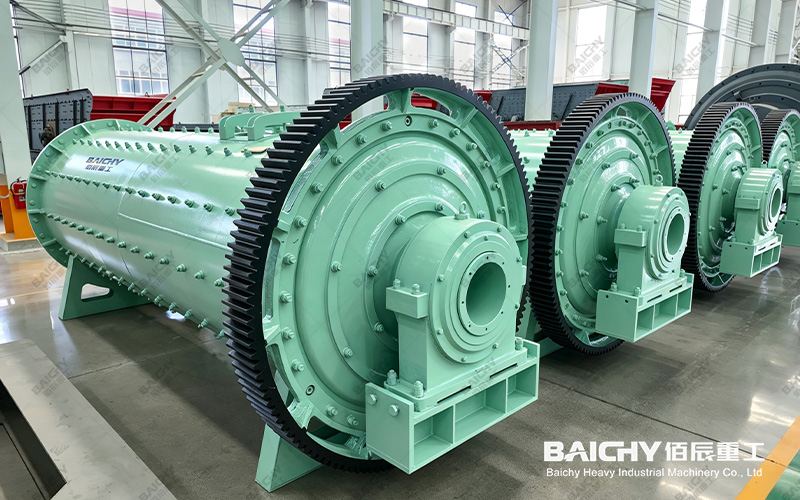
900x4000 Ball Mill for Quartz Stone in Ethiopia
Baichy Heavy Industry — crushing, grinding and mineral processing equipment manufacturer, exporting to 150+ countries.
If you are planning a quartz grinding line in Ethiopia and evaluating a 900x4000 ball mill, this guide gives you the full picture: real technical parameters, capacity correction for quartz hardness, Ethiopian site conditions (voltage, altitude, water, logistics), recommended flow sheets, budget ranges and shipping routes to Djibouti and Addis Ababa.
Why Ethiopia's Quartz Industry Needs Compact, Efficient Ball Mills
Quartz demand is rising across Ethiopia's industrial base
Ethiopia's construction boom, new glass and ceramic factories around Addis Ababa, Oromia and Amhara, and the expansion of cement plants have pushed demand for high-quality quartz powder. Quartz (Mohs hardness 7, SiO₂ 98–99.5%) is used as glass sand, ceramic body and glaze material, foundry sand, paint and rubber filler, metallurgical flux for ferro-silicon and silicon metal, and — critically — as the host rock of most Ethiopian gold deposits, where gold is locked in quartz veins.
For investors, this means one thing: you need a grinding mill that is hard enough for abrasive silica, small enough for a realistic budget, and simple enough to run in remote locations.
Ethiopian site realities you must design around
| Site factor | Ethiopian reality | Design response |
|---|---|---|
| Power supply | Grid 380–400 V / 50 Hz, frequent voltage fluctuation in rural areas | 22 kW motor with overload protection, soft starter or VFD |
| Altitude | Many quarries at 1,800–2,600 m (Addis Ababa ≈2,355 m) | Motor derating and improved cooling / insulation class F |
| Water availability | Dry season scarcity in Afar, Tigray, Somali regions | Dry grinding with baghouse dust collector, or closed water circuit |
| Logistics | Djibouti Port → Modjo dry port → site, 900+ km | Mill sized to fit one 40HQ container; knock-down packing |
| Skill base | Limited local mill maintenance experience | Simple edge-drive design, full training + spare parts kit |
What Is a 900x4000 Ball Mill?
The 900x4000 ball mill (also written Φ900 × 4000 mm) is a small-diameter, long-cylinder horizontal grinding mill: 900 mm shell diameter, 4,000 mm shell length. Its working principle is straightforward — the cylinder rotates at around 38 r/min, lifting steel or ceramic grinding media, which then impact and abrade the quartz by cascading and cataracting action. Material enters at one end through the hollow trunnion and leaves as a fine slurry or dry powder at the other end after 15–25 minutes of residence time.
Because the 900x4000 ball mill is a long, small-diameter unit, the material travels a longer path inside the shell. That translates into finer output and a narrower particle size distribution — exactly what quartz flour (200 mesh / 0.074 mm) and glass sand producers need.
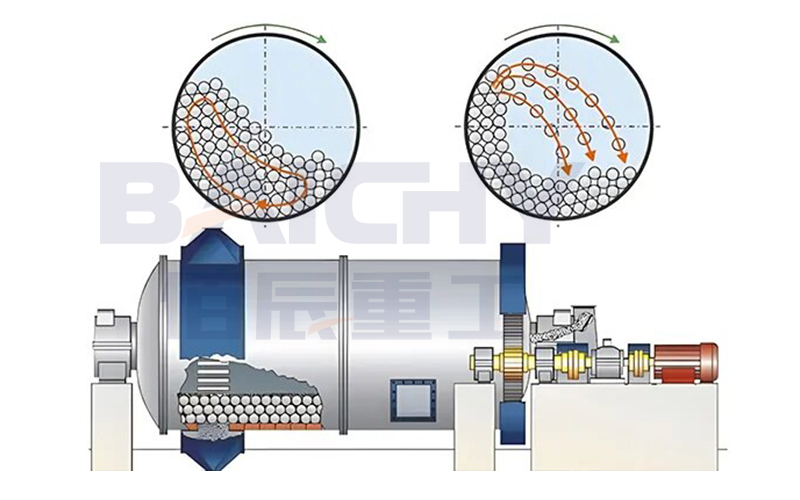
Diagram of the internal structure of a ball mill
Grid type vs. overflow type: which one for quartz?
Grid (grate) type ball mill — forced discharge through a grate plate, coarser product, 15–20% higher throughput, less over-grinding. Best for coarse quartz sand (0.1–0.5 mm) and for gold-quartz ore before gravity concentration or leaching.
Overflow type ball mill — material discharges by gravity over the trunnion, finer product down to 0.074 mm (200 mesh) and beyond, lower throughput. Best for quartz powder, ceramic glaze and filler-grade silica flour.
Most Ethiopian quartz powder projects specify the overflow type 900x4000 ball mill running in closed circuit with a spiral classifier or hydrocyclone.
900x4000 Ball Mill Technical Parameters for Quartz Grinding
Below is the reference specification used by Baichy Heavy Industry for quartz service. All values are configurable to local voltage, liner material and discharge type.
| Parameter | Φ900 × 4000 Ball Mill Specification | Relevance to Quartz Grinding |
|---|---|---|
| Model | 900×4000 (Φ900 × 4000 mm) | Compact mill for 30–70 TPD quartz plants |
| Shell diameter | 900 mm | Small diameter → higher media lift frequency, finer grind |
| Shell length | 4,000 mm | Long residence time → uniform 200 mesh product |
| Effective volume | ≈2.0 m³ | Matches 1.75–2.5 t media charge |
| Rotating speed | 36–38 r/min (30–42 r/min with VFD) | ≈76–80% of critical speed, cascading action |
| Ball loading | 1.75–2.5 t (steel) / 1.4–2.0 t (alumina) | Media graded Φ30/40/60/80 mm |
| Feeding size | ≤20 mm (max 25 mm) | Requires jaw + fine crusher ahead of the mill |
| Discharging size | 0.074–0.89 mm (200–20 mesh) | 0.074 mm = 200 mesh, standard quartz flour |
| Rated capacity | 1.5–3.8 t/h (limestone basis) | — |
| Quartz capacity @ 0.074 mm | 1.0–2.6 t/h | Hardness coefficient ≈0.65–0.70 |
| Quartz capacity @ 0.1–0.3 mm | 2.0–3.2 t/h | Glass sand / ceramic body grade |
| Motor power | 22 kW (380 V / 50 Hz, optional 415 V) | F-class insulation for high-altitude sites |
| Drive type | Edge gear drive, motor + ZD/JS reducer | Simple, field-serviceable in remote areas |
| Liner options | High-manganese steel / rubber / alumina ceramic | Ceramic + alumina balls = iron-free quartz |
| Grinding media | Steel balls, alumina balls, flint pebbles | Pebble/ceramic for high-purity, low-Fe quartz |
| Discharge type | Overflow (standard) or grid type | Selected by target fineness |
| Specific energy | 13–18 kWh/t to 200 mesh (closed circuit) | Lower than jet mill, far lower capex |
| Total weight | ≈5.8–6.2 t | One 40HQ container shipment |
| Application mode | Wet or dry grinding | Dry + bag filter where water is scarce |
How to correct the capacity for your quartz?
Baichy uses a simple empirical formula for preliminary sizing:
• Actual capacity ≈ Nominal capacity × K₁ (hardness) × K₂ (feed size) × K₃ (fineness)
• K₁ — quartz / silica 0.65–0.70 (limestone 1.0, copper ore 0.85, gold ore 0.65)
• K₂ — feed ≤ 20 mm: 1.0; 20–25 mm: 0.85
• K₃ — 0.15–0.4 mm: 1.0; 0.074–0.15 mm: 0.70; finer than 0.074 mm: 0.50–0.60
So a 900x4000 ball mill rated at 3.0 t/h nominal gives roughly 3.0 × 0.68 × 1.0 × 0.70 ≈ 1.4 t/h of 200-mesh quartz powder, or about 30 t/day on a 22-hour operating schedule. Two mills in parallel double that to ~60 TPD without jumping to a much more expensive Φ1200×4500 model.
Recommended Flow Sheet for a 30–70 TPD Quartz Powder Line in Ethiopia
| Stage | Equipment | Output |
|---|---|---|
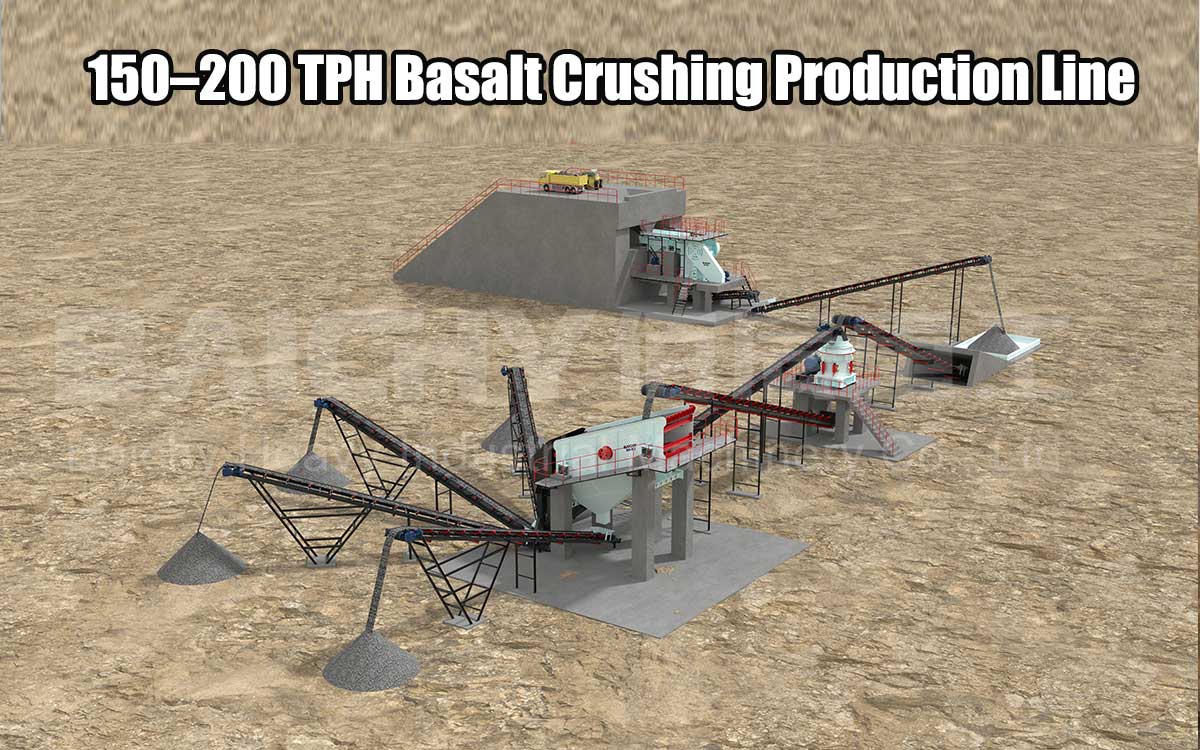
| Primary crushing | Jaw crusher PE 250×400 or PE 400×600 | 0–60 mm |
| Secondary crushing | Fine jaw crusher PEX 150×750 / hammer crusher | ≤20 mm |
| Feeding | Vibrating feeder + belt conveyor | Controlled, steady mill feed |
| Grinding | 900×4000 ball mill (wet or dry) | 0.074–0.3 mm |
| Classification | Spiral classifier FG-750 / hydrocyclone FX100 | Closed circuit, no over-grinding |
| Dewatering / drying | Hydrocyclone + thickener or rotary dryer | Filter cake or dry powder |
| Purification (optional) | Magnetic separator, flotation cell, acid leaching | Low-Fe, high-purity silica |
| Packing | Ton bag / 25 kg valve bag packer | Ship-ready product |
For gold-bearing quartz ore projects in Oromia, Benishangul-Gumuz or Tigray, replace classification with a gravity circuit: the 900x4000 ball mill discharges to a spiral chute, shaking table and centrifugal concentrator — the classic 100 TPD Ethiopian gold flow sheet. For high-purity quartz (glass, solar, electronics), specify an alumina ceramic liner with alumina or silica pebble media to keep iron contamination below 50 ppm.
Ethiopia Delivery, Installation and Service from Baichy
1. Indicative budget
FOB Qingdao / Tianjin price for a complete 900x4000 ball mill with motor, reducer, liner, grate/overflow assembly and standard media is typically USD 9,500–19,000, depending on liner material (manganese steel vs. alumina ceramic), motor brand, VFD and media type. Ceramic-lined, iron-free configurations sit at the upper end. A complete 30 TPD quartz line including crusher, feeder, classifier and conveyors normally lands in the USD 45,000–90,000 range. Request a fixed quotation with your ore sample and target fineness.
2. Shipping to Ethiopia
The 900x4000 ball mill ships as one unit in a 40HQ container (shell, trunnions and drive packed separately with anti-rust coating and steel-frame lashing). Standard routing: Qingdao → Djibouti Port (18–25 days) → rail or truck to Modjo dry port → final delivery to site. Baichy supplies full export documentation: commercial invoice, packing list, certificate of origin, ISO 9001:2015 certificate, CE declaration, HS code 8474.20, and test reports for motor and gearbox.
3. What Baichy provides
Founded in 2003 and operating a 200,000 m² manufacturing base with 500+ staff, Baichy Heavy Industry delivers crushing equipment, sand-making equipment, grinding mills and complete mineral processing plants to over 150 countries. Every export mill includes: flow sheet design, foundation drawing, installation supervision or remote video guidance, operator training, commissioning, a one-year warranty, and a recommended two-year spare parts kit (liners, grate plate, pinion, bearings, V-belts).
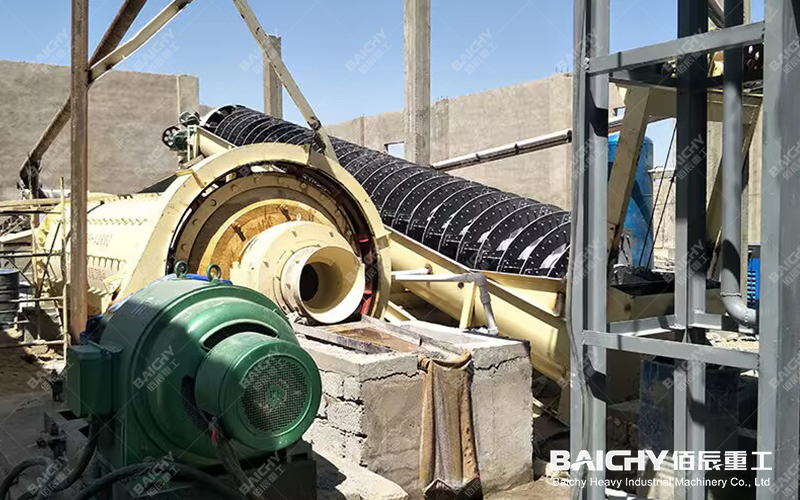
900x4000 Ball Mill for Quartz Stone in Ethiopia
Frequently Asked Questions (FAQ)
1. What capacity can a 900x4000 ball mill reach when grinding Ethiopian quartz?
On quartz (Mohs 7), expect 1.0–2.6 t/h at 200 mesh (0.074 mm) and 2.0–3.2 t/h at 0.1–0.3 mm in closed circuit. That is roughly 25–55 t/day per mill. Actual output depends on feed size, silica purity, slurry density and target fineness.
2. Should I choose wet or dry grinding for quartz in Ethiopia?
Choose wet grinding if water is available and you want finer, dust-free product with higher media efficiency. Choose dry grinding with a pulse-jet baghouse filter in water-scarce regions (Afar, Somali, eastern Oromia) or where the product must be shipped dry. Both modes are available on the 900x4000 ball mill.
3. How do I avoid iron contamination in high-purity quartz powder?
Specify an alumina ceramic or silica liner together with alumina balls or flint pebbles instead of manganese steel. Add a magnetic separator after grinding. This keeps Fe₂O₃ low enough for glass, ceramic glaze and filler-grade silica applications.
4. Can the mill run on Ethiopian power conditions at high altitude?
Yes. Baichy supplies the 22 kW motor at 380 V / 50 Hz (or 415 V on request) with class-F insulation and derating for sites above 2,000 m. A soft starter or VFD is recommended to handle voltage fluctuation and to fine-tune mill speed for different product sizes.
5. How long does delivery and commissioning take to Ethiopia?
Manufacturing takes 15–25 working days; sea freight to Djibouti 18–25 days; inland transport to site 3–7 days. Installation and commissioning with Baichy guidance typically takes 7–12 days, including foundation curing, alignment, no-load and load test runs.
Baichy Heavy Industry
Baichy Heavy Industry is a high-tech mining equipment company integrating R&D, manufacturing, sales, and after-sales service. Focusing on crushing, grinding, and mineral processing equipment, we provide professional solutions to our customers. We are ISO9001:2015 、certified, and our products include mobile crushing palnts, crawler crushing plant, construction waste crushing plants, jaw crushers, sand making machines, cone crushers, fine crushers, grinding mills, ball mills, etc., all with reliable performance to meet diverse project needs.
Baichy Heavy Industry – Your Trusted Partner
To ensure optimal performance of your equipment, Baichy Heavy Industry offers:
- Professional on-site installation guidance
- Comprehensive operator training
- 24/7 technical support & maintenance services
Our complete after-sales service system guarantees long-term, stable operation of your machinery with minimal downtime.
Protect Your Rights – Only Use Official Channels
To avoid scams and ensure authentic support, contact us exclusively through:
• Official Website: www.baichychina.com
• WhatsApp: +8615093222637
• Email: [email protected]
Your satisfaction is our priority – expect prompt, professional service every time.
(Note: Beware of unauthorized third parties claiming to represent Baichy. Always verify through official contacts.)