
www.baichychina.com/Crushing/Jaw_Crusher.html
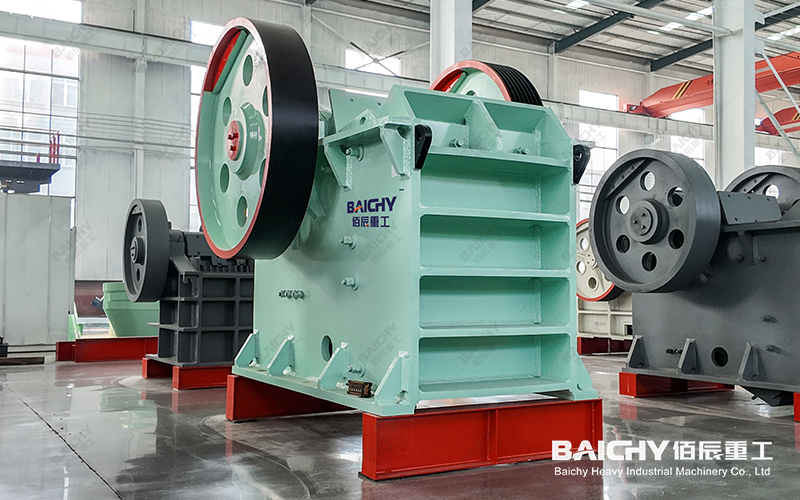
Jaw Crusher
Every ton of rock leaving a jaw crusher has passed between two hardened steel liners — the movable jaw plate (swing jaw plate) and the fixed jaw plate (stationary jaw plate). They are the only parts that touch your ore, and the parts you will replace again and again. Specify the alloy, tooth profile and replacement timing correctly, and you can strip 10–25% off your cost per ton. Get them wrong and you pay in downtime, oversize product and flaky aggregate nobody will buy.
Baichy Heavy Industry casts, heat-treats and machines these liners for our own PE/PEX crushers and ships matched replacement sets to more than 80 countries. Here is how the two plates differ, which manganese grade each rock type needs, and the field rules our service teams use to decide when a liner is finished.

Movable vs Fixed Jaw Plate
What Are the Movable Jaw Plate and Fixed Jaw Plate?
A jaw crusher works by pure compression. The crushing chamber is a V-shaped cavity bounded by two vertical wearing surfaces — one bolted into the frame, one into the swing jaw assembly.
Fixed Jaw Plate: The Stationary Crushing Wall
The fixed jaw plate is bolted to the front wall of the frame and never moves. It is the anvil, the reference surface against which rock is squeezed. Because the load direction is constant, its wear is comparatively even. On single-toggle machines the exception is the bottom third of the chamber, where the gap is narrowest and fine, already-crushed material is forced past the tooth face under high abrasive pressure.
Movable Jaw Plate: The Power Surface
Mounted on the pitman and driven by the eccentric shaft, the movable jaw plate closes on the fixed jaw plate roughly 250–300 times a minute on a mid-size model. It is the active partner — gripping, lifting and fracturing the feed — and it takes the direct impact of fresh rock entering the top of the chamber, which is why its upper zone usually wears fastest.
In practice the swing plate wears 15–30% faster than its stationary partner. That is the reason both should always be specified, rotated and replaced as a matched set.

Moving Jaw And Fixed Jaw - jaw crusher
How the Two Plates Build the Crushing Chamber
Three geometric parameters decide whether a pair performs:
Nip angle (18–22° for hard rock): the angle between the two faces at the point of grip. Too large and rock slips up the stationary plate instead of being bitten — you will see a polished upper face and falling throughput. Too small and you give away capacity.
Closed side setting (CSS): every 10 mm of tooth height lost to wear opens the setting by about the same amount, so product drifts coarser week by week. Re-set the CSS on a measured schedule.
Peak-to-valley alignment: the teeth of the movable jaw plate should face the valleys of the fixed jaw plate. This adds a bending load to the rock, improving breakage and reducing localised wear.
Jaw Plate Material Grades: Mn13Cr2, Mn18Cr2 or Mn22Cr2?
Baichy casts all liners from austenitic manganese steel (Hadfield steel), which work-hardens under impact: the surface transforms into a hard, wear-resistant layer while the core stays ductile and crack-resistant. The right grade depends on how much impact energy your feed delivers — a high-manganese liner crushing soft limestone never fully work-hardens, so the premium buys you nothing.
| Grade | Chemical Composition (Typical) | Hardness: As-Cast → Work-Hardened | Recommended Feed | Relative Cost | Life on Granite |
|---|---|---|---|---|---|
| Mn13Cr2 | C 1.15–1.25%, Mn 11–14%, Si 0.3–0.8%, Cr 1.5–2.5% | 180–220 HB → ~450 HB | Clean limestone, low-abrasion rock, recycling with tramp metal | 1.0× | 300–600 h |
| Mn14Cr2 | C 1.20–1.30%, Mn 13–15%, Cr 1.5–2.5% | 190–230 HB → ~480 HB | General quarrying, river gravel, moderate abrasion | 1.15–1.25× | 500–900 h |
| Mn18Cr2 | C 1.20–1.30%, Mn 17–19%, Cr 1.5–2.5% | 200–240 HB → ~500 HB | Standard for granite, basalt and mixed hard rock | 1.3× | 700–1,000 h |
| Mn22Cr2 | C 1.10–1.40%, Mn 21–23%, Cr 1.5–2.5% | 220–260 HB → ~550 HB | Quartzite, iron ore, taconite, extreme abrasion | 1.4–1.5× | 900–1,200 h |
| Mn22 + TiC insert | Mn22 base with titanium-carbide inserts (~3200 HV) | 220–260 HB base + ceramic inserts | Highly abrasive ore where plain Mn22 still wears fast | 2.0–2.5× | 2–3× standard |
Rotation and Matched-Set Replacement
• One-piece liner: make the first 180° turn when the lower third reaches roughly 30% tooth wear (about 50% wear in the lower area is the practical trigger our crews use); turn a second time once that new lower profile is worn flat, then run out the remaining life.
• Two-piece liner: move the less-worn upper section down into the high-force bottom position and fit a new one on top.
Never replace just one. A fresh liner running against a half-worn partner inherits the wrong chamber profile and wears out prematurely.
Tooth Profile: Buying Shape With Wear Life
• Profile is three numbers — pitch, tooth height and flank angle — and the trade is always life versus product shape:
• Coarse / deep-tooth (60–125 mm pitch): more steel behind the working face and better grip on hard, slabby feed. Typically 15–25% more life on granite, but a flakier product.
• Standard (40–60 mm pitch): the factory default for general quarry work; balanced throughput, shape and wear.
• Fine / shallow-tooth (25–40 mm pitch): better cubic shape and tighter top-size control for secondary crushing, recycled concrete and specification aggregate, at slightly lower throughput.
• Corrugated / wavy: best for soft, friable or damp feed; the grooves stop fines packing in the tooth roots.
Baichy supplies corrugated, straight and tooth-type profiles, and machines to your existing drawing or a worn sample if you run a non-Baichy machine.
When to Replace: Baichy's Field Rules
Replace before the liner wears through to the jaw body or locking wedges. A worn-through plate exposes the frame and swing jaw casting to direct impact, and that repair costs far more than a set of liners.
• Thick-end design (wedges behind the plate): replace at 60–65 mm remaining thickness, or when the teeth are worn flat.
• Thin-end design: replace at 20–25 mm remaining thickness, or once the corrugations have disappeared.
• Production trigger: change the set no later than a 10% drop in throughput at the same CSS.
Inspect cheek plates at every change. They last 2–5× longer than the jaws but, once worn, open the chamber edges and accelerate wear.
Baichy PE Series: Matching Liners to Your Crusher Model
| Model | Feed Opening (mm) | Max Feed (mm) | Discharge (mm) | Capacity (t/h) | Motor (kW) | Recommended Grade |
|---|---|---|---|---|---|---|
| PE-250×400 | 250×400 | 210 | 20–80 | 5–20 | 15 | Mn13Cr2 / Mn14Cr2 |
| PE-400×600 | 400×600 | 340 | 40–100 | 16–65 | 30 | Mn13Cr2 / Mn18Cr2 |
| PE-500×750 | 500×750 | 425 | 50–100 | 45–100 | 55 | Mn18Cr2 |
| PE-600×900 | 600×900 | 500 | 60–160 | 60–180 | 55–75 | Mn18Cr2 (Mn22Cr2 for quartz-rich granite) |
| PE-750×1060 | 750×1060 | 630 | 60–180 | 110–380 | 110 | Mn18Cr2 / Mn22Cr2 |
| PE-900×1200 | 900×1200 | 750 | 95–220 | 220–450 | 132 | Mn22Cr2 |
| PE-1200×1500 | 1200×1500 | 1020 | 150–300 | 400–800 | 220 | Mn22Cr2 / TiC insert option |
Capacity is rated on limestone at ~1.6 t/m³; multiply by about 0.8 for granite and 1.1 for soft limestone.
Conclusion: Specify the Pair, Not the Part
The movable jaw plate and the fixed jaw plate are one matched engineering system. Specify them together — same alloy, same batch, same profile — rotate them on a measured schedule, and size the grade to your rock rather than to your purchase budget. That is how Baichy customers hold downtime below 3% and keep cost per ton predictable.
Send us your crusher model, rock type, max feed size and target t/h, and our engineers will return a liner specification and quotation within 24 hours, with material certificate and dimensional drawing.
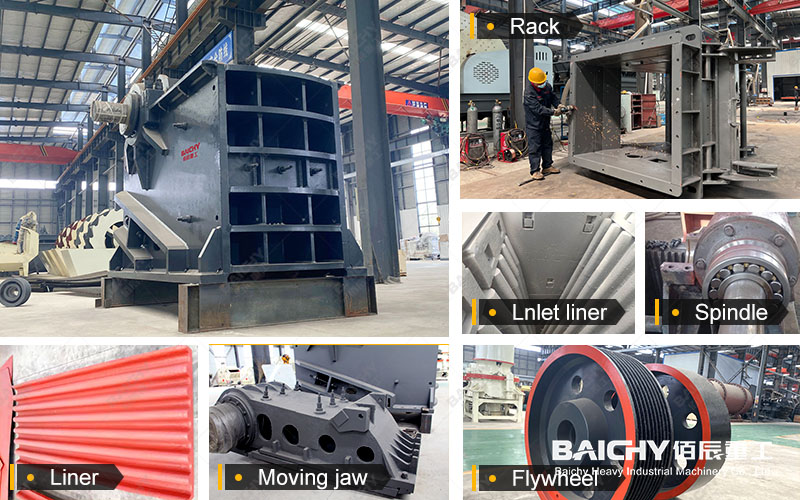
Detailed view of jaw crusher components
Frequently Asked Questions
1. What is the difference between a movable jaw plate and a fixed jaw plate?
The fixed jaw plate is bolted to the stationary frame and acts as the anvil; the movable jaw plate is mounted on the swing jaw and delivers the crushing motion. Because the swing plate takes the impact of fresh feed at the top of the chamber, it usually wears 15–30% faster, while the stationary plate wears fastest at the bottom, where fines abrade the tooth face.
2. Which manganese steel grade should I choose?
Mn13Cr2 for clean limestone and low-abrasion duty; Mn18Cr2 as the standard choice for granite, basalt and mixed hard rock; Mn22Cr2 for quartzite, iron ore and other highly abrasive feeds; Mn22 with TiC inserts where even Mn22 wears out too quickly. Higher grades only pay off above roughly 150 MPa rock strength.
3. How long does a jaw plate last?
On granite, expect 300–600 operating hours from Mn13Cr2, 500–900 hours from Mn18Cr2 and 900–1,200 hours from Mn22Cr2. Feed size, CSS, moisture, feed distribution and whether the crusher is choke-fed all move those numbers considerably.
4. When should I rotate or replace the set?
Rotate a one-piece liner 180° when the lower third has lost about 30% of its tooth height, and replace the matched set when thick-end plates reach 60–65 mm remaining thickness (20–25 mm for thin-end designs), when the teeth are worn flat, or when throughput drops 10% at the same setting.
5. Can Baichy supply jaw plates for crushers it did not build?
Yes. We cast fixed and movable jaw plates, cheek plates and toggle plates to your drawing, model number or a worn sample, and supply matched sets for PE/PEX machines as well as common European and North American models, with hardness and chemical composition certificates for every batch.
Baichy Heavy Industry
Baichy Heavy Industry is a high-tech mining equipment company integrating R&D, manufacturing, sales, and after-sales service. Focusing on crushing, grinding, and mineral processing equipment, we provide professional solutions to our customers. We are ISO9001:2015 、certified, and our products include mobile crushing palnts, crawler crushing plant, construction waste crushing plants, jaw crushers, sand making machines, cone crushers, fine crushers, grinding mills, ball mills, etc., all with reliable performance to meet diverse project needs.
Baichy Heavy Industry – Your Trusted Partner
To ensure optimal performance of your equipment, Baichy Heavy Industry offers:
- Professional on-site installation guidance
- Comprehensive operator training
- 24/7 technical support & maintenance services
Our complete after-sales service system guarantees long-term, stable operation of your machinery with minimal downtime.
Protect Your Rights – Only Use Official Channels
To avoid scams and ensure authentic support, contact us exclusively through:
• Official Website: www.baichychina.com
• WhatsApp: +8615093222637
• Email: [email protected]
Your satisfaction is our priority – expect prompt, professional service every time.
(Note: Beware of unauthorized third parties claiming to represent Baichy. Always verify through official contacts.)