
Tracked Mobile Limestone Crushing Plant 200 t/h
A tracked mobile limestone crushing plant that produces 200 t/h of 0-5 mm, 5-10 mm, 10-20 mm and 20-40 mm aggregate from 600 mm run-of-quarry limestone runs on three self-propelled units: a tracked jaw crusher, a tracked impact crusher and a tracked four-deck screening station. Raw stone is dumped at the face, and four specifications of finished aggregate leave in separate stockpiles.
Which Tracked Configuration Delivers 200 t/h of 0-40 mm Limestone?
Three tracked units cover the duty: a YMC116 tracked jaw crushing station for primary crushing, a YMCI13 tracked impact crushing station for secondary crushing, and a tracked screening station carrying a four-deck 4YK screen for final grading.
| Unit | Process role | Tracked model | Core machine and chassis | Published capacity |
|---|---|---|---|---|
| 1 | Primary crushing | YMC116 | CJ116 jaw with GZD1142 feeder, B1200 × 13 m main discharge belt, B500 × 3.8 m side belt | 200–450 t/h |
| 2 | Secondary crushing | YMCI13 | CI1313 impact with GZD1235 feeder, B1200 × 10 m main discharge belt | 220–500 t/h |
| 3 | Final grading | YMS20 class | YSF2040 feeder on a hydraulic crawler chassis; four-deck 4YK screen | 200–400 t/h (published for the two-deck YMS20T variant) |
The same duty is published as a two-unit configuration on the 180-300 t/h mobile jaw and impact plant, rated at 200-320 t/h and built from a CJ116 jaw on one chassis and a PFW1320 impact with a 3YK2460 screen on the second. The three-unit arrangement above splits grading onto its own chassis so that deck count and cut points can be changed without altering the crushing units.
Two published ranges frame the whole train: a tracked jaw station covers 60-500 t/h with 0-800 mm feed, and a tracked screening station covers 80-800 t/h with 0-800 mm feed.
What Equipment Makes Up the Three Tracked Units?
Tracked Mobile Jaw Crushing Station for Primary Crushing
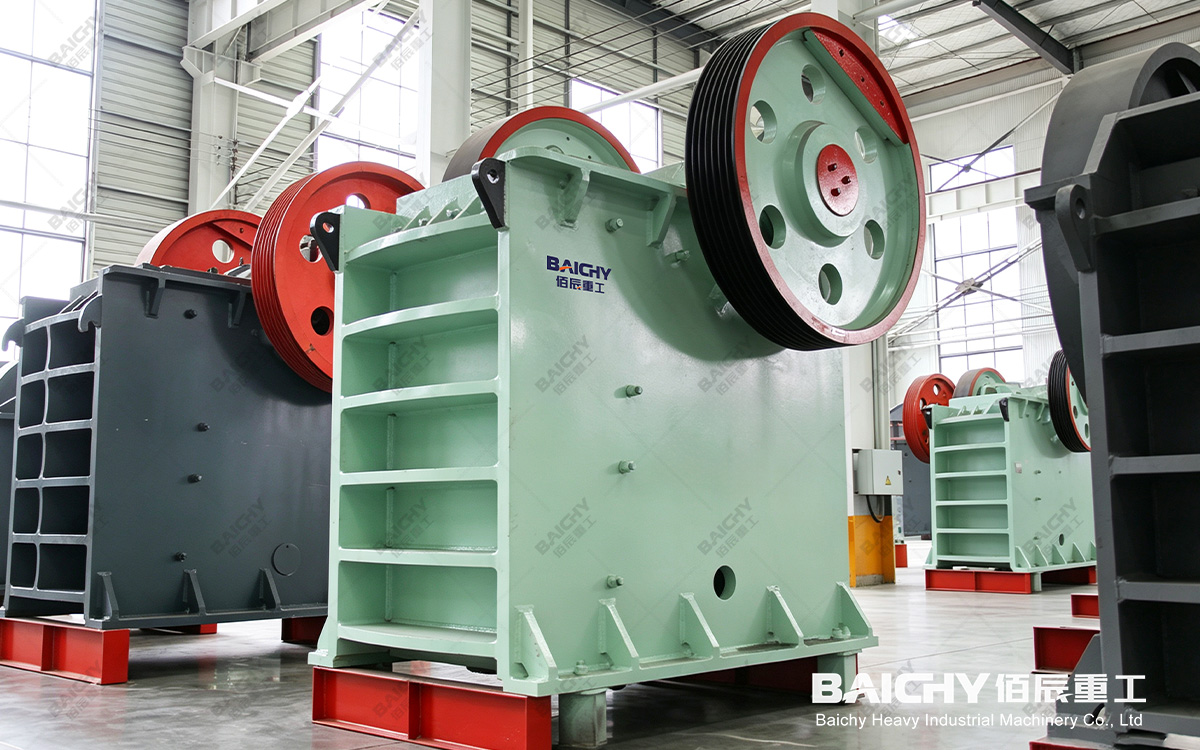
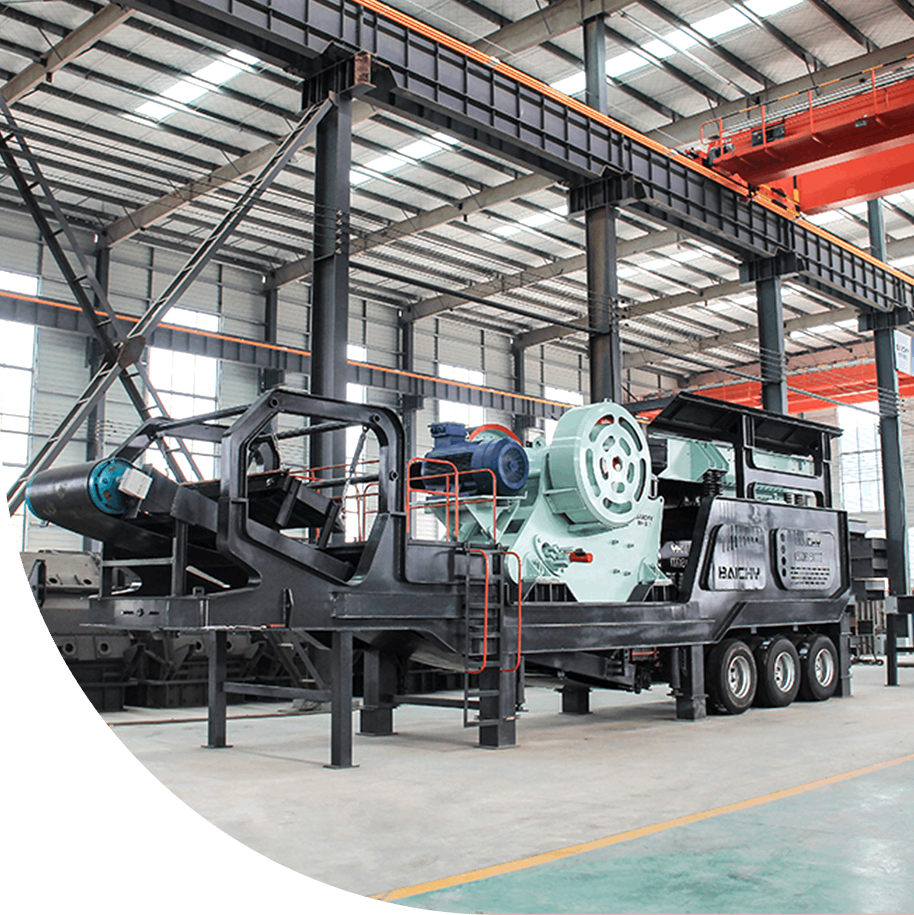
YMC116 tracked jaw crushing station
The YMC116 tracked jaw crushing station carries a CJ116 jaw with a 760×1150 mm feed opening and a published 680 mm maximum feed size, inside a 70-190 mm discharge range. Shaft speed is 260 r/min and motor power is 132 kW, giving 200-400 t/h on a fixed frame and 200-450 t/h on the tracked chassis.
The GZD1142 feeder in front of the jaw pre-screens fines through grizzly bars, so material already below the closed-side setting bypasses the crushing chamber instead of being crushed twice.
Tracked Mobile Impact Crushing Station for Secondary Crushing
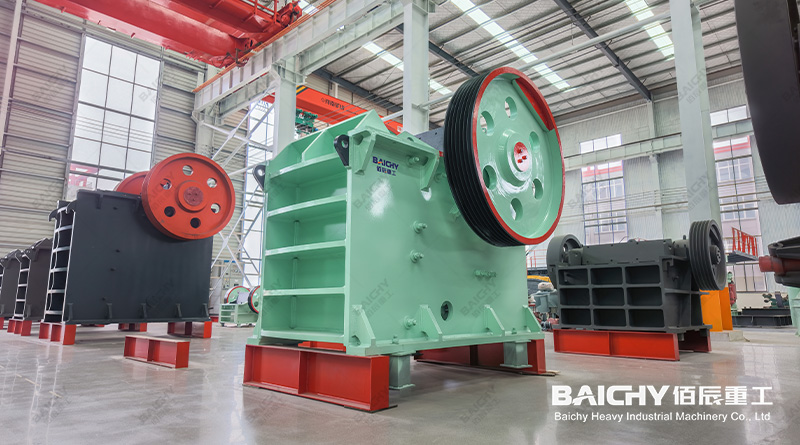
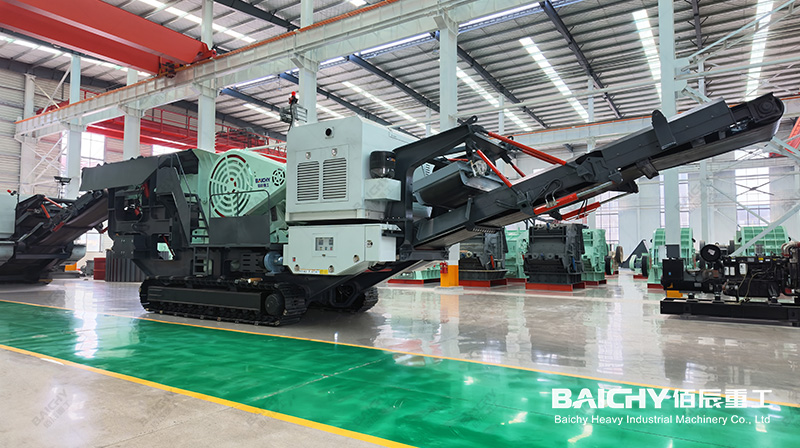
YMCI13 tracked impact crushing station
The YMCI13 tracked impact crushing station carries a CI1313 impact crusher with a GZD1235 feeder and a B1200×10m main discharge belt, published at 220-500 t/h. The output range is adjusted through the gap between the impact plates and the rotor.
PF series impact crushers are rated for material with compressive strength up to 320 MPa, which covers limestone comfortably. The PFW generation adds a hydraulic opening frame, a reinforced heavy rotor and high-chromium blow bars at HRC58-62, published to extend blow bar life by 30%. On the PFW1315, the rotor measures Φ1320×1500 mm and discharge is adjustable down to 0-50 mm.
If closed-circuit crushing is preferred on the same chassis, the YMCI13S variant adds a 2YK1436 inspection screen and a B500×8.6m return belt conveyor, so oversize returns to the crushing chamber without a separate chassis.
Tracked Mobile Four-Deck Screening Station for Final Grading
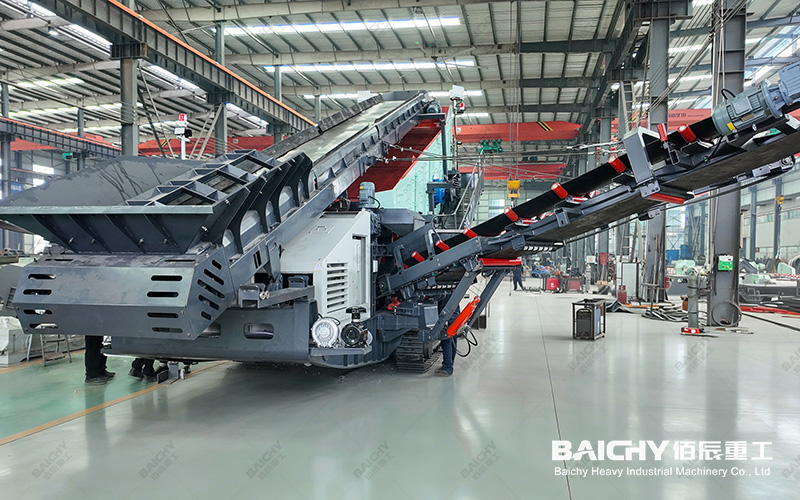
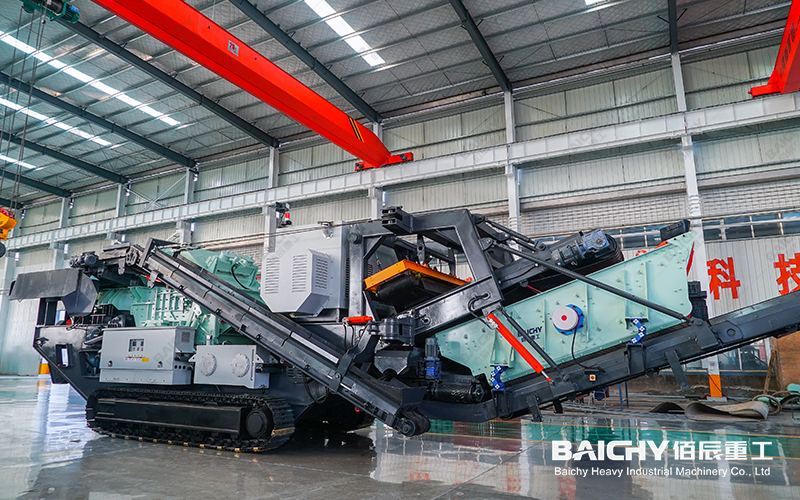
tracked screening station
The tracked screening station integrates a feeder, a vibrating screen and discharge belts on a hydraulic crawler chassis. Independent YK circular vibrating screens cover 30-1400 t/h in 1 to 4 decks, so four decks are a standard configuration rather than a special build.
Four decks cut the stream at 40 mm, 20 mm, 10 mm and 5 mm, which is exactly the number of cut points the four requested fractions need. Screening efficiency is published as 30% higher than a comparable fixed arrangement, optional dust suppression is rated at 95% or better, and the chassis switches to transport mode within 15 minutes.
What Materials Suit a Tracked Jaw and Impact Limestone Line?
Limestone and comparable medium-hard, low-abrasion rock suit a jaw plus impact train. Hard, highly abrasive rock does not, and should move to a cone crusher instead.
Limestone and Comparable Medium-Hard Feed
Limestone is mainly calcium carbonate (CaCO3), which places it well inside the working envelope of both machines in the train.
• The C-series jaw crusher accepts medium-hard to very hard abrasive material up to about 320 MPa, with hard limestone named in the published material list.
• PF series impact crushers handle material up to 320 MPa compressive strength, with limestone, clinker, slag, coke and coal named as typical feeds.
• The ZSW feeder family, used in the equivalent fixed-plant configurations, is published for material below 250 MPa with feed up to 1280 mm across eight models.
A published 200-250 t/h crushing line built around a C100 jaw and two CS160 cone crushers is specified for granite, basalt, river pebble and diabase at 150 MPa and above. Limestone sits below that hardness band, so it needs less crushing energy and less wear protection than that line is designed for.
When Limestone Is Not the Only Feed
A jaw and impact train has a boundary, and it is worth stating before the quotation rather than after commissioning.
If the feed is granite or basalt at Mohs 6-7, the impact crusher's blow bars wear out faster than a laminated-crushing cone. A tracked cone crushing station is published at 100-450 t/h with 50-300 mm feed, and the YMH30S variant carries an HP300 cone at 150-380 t/h.
Jaw crushers are not recommended for sticky clay, wet fines-heavy feed, or material that deforms under pressure.
An impact crusher should not take the primary position on very hard, highly abrasive basalt or river pebble.
For a mixed feed that is mostly limestone with occasional hard lenses, the tracked jaw stays and only the secondary stage changes. That is why the three-unit arrangement keeps grading on a separate chassis.
How Do You Size Each Unit to a 600 mm Feed and a 200 t/h Product?
Feed the jaw with nothing larger than 600 mm, set its closed-side setting at 120-150 mm, and pass everything through the impact crusher before the four-deck screen.
Matching the 600 mm Feed to a Jaw Feed Opening
The working rule is that maximum feed size should stay inside 80% of the feed opening width. The CJ116 feed opening is 760 mm wide, so 80% of it is 608 mm — and 600 mm is 79% of the opening. There is almost no surplus, which means an occasional oversize lump has to be broken at the face rather than dropped into the chamber.
That single rule eliminates the smaller tracked jaw. The CJ106 has a 700×1060 mm feed opening and a published 580 mm maximum feed size, so it cannot accept 600 mm; the CJ116 is the smallest tracked jaw in the published range that can. Where the feed regularly runs above 600 mm, the CJ120 opens the margin with an 870×1200 mm feed opening and a 780 mm maximum feed size.
| Machine | Feed opening (mm) | Max feed size (mm) | Discharge range (mm) | Capacity (t/h) | Motor (kW) |
|---|---|---|---|---|---|
| CJ106 jaw | 700 × 1060 | 580 | 70–180 | 150–300 | 110 |
| CJ116 jaw | 760 × 1150 | 680 | 70–190 | 200–400 | 132 |
| CJ120 jaw | 870 × 1200 | 780 | 70–200 | 400–500 | 160 |
Setting the Closed-Side Setting and the Circulating Load
The CJ116 discharge range is 70-190 mm. A setting of 120-150 mm leaves the impact crusher a feed it can finish in one pass while keeping jaw plate wear moderate.
Grading then decides the rest of the train. On the published mobile jaw and impact line, the screened output splits into 0-5 mm at 30%, 5-10 mm at 25%, 10-20 mm at 20%, 20-40 mm at 15% and oversize above 40 mm at 10%.
The four requested fractions therefore account for 90% of screened output, and 10% returns to the impact crusher. To ship 200 t/h of saleable 0-40 mm product, the train has to screen 200 &pide; 0.90 ≈ 222 t/h — a derived figure, calculated from the published percentages above. The YMCI13 at 220-500 t/h absorbs both the 200 t/h target and that return load.
Matching the Four Cut Points to a Four-Deck Screen
Four cut points need four decks. The published 4YK screens provide them across a wide capacity band.
| Screen model | Screen surface (mm) | Decks | Capacity (t/h) | Power (kW) | Speed (r/min) |
|---|---|---|---|---|---|
| 4YK1860 | 6000 × 1800 | 4 | 65–586 | 30 | 980 |
| 4YK2160 | 6000 × 2100 | 4 | 81–720 | 37 | 980 |
| 4YK2460 | 6000 × 2400 | 4 | 150–850 | 37 | 30 |
Deck 1 cuts at 40 mm, deck 2 at 20 mm, deck 3 at 10 mm and deck 4 at 5 mm. Anything above 40 mm leaves the top deck as the return load. Because the screen is on its own chassis, a change from four fractions to three needs a deck change only, not a new crushing unit.
One limit is worth flagging for the quotation. The published parameter table for the tracked screening station lists two-deck and three-deck variants only, with capacities from 60-150 t/h up to 200-400 t/h, while the same page describes multi-layer screens with 2 to 4 layers as optional. The four-deck tracked configuration is therefore quoted per project rather than selected from a published row.
FAQ: Tracked Mobile Limestone Crushing Plant
1. What maximum feed size can a 200 t/h tracked limestone plant accept?
A: 600 mm fits a YMC116 tracked jaw station, whose CJ116 jaw has a 760×1150 mm feed opening and a published 680 mm maximum feed size, making 600 mm about 79% of the opening width. The smaller CJ106 accepts 580 mm only, so it cannot take 600 mm feed; go to the CJ120 for margin above 600 mm.
2. Can a tracked plant produce 0-5, 5-10, 10-20 and 20-40 mm at 200 t/h?
A: Yes, with a four-deck screen, because four cut points at 40, 20, 10 and 5 mm are a standard YK configuration. Published four-deck models include the 4YK1860 at 65-586 t/h and the 4YK2460 at 150-850 t/h. On the published mobile jaw and impact line the four fractions total 90% of screened output, and the 10% above 40 mm returns to the impact crusher.
3. Why an impact crusher and not a cone crusher for limestone?
A: Limestone is medium-hard and low-abrasion, so an impact crusher produces a more cubical product at a lower cost than a cone. Published PF series impact crushers accept material up to 320 MPa compressive strength, and hard limestone is named in the C-series jaw material list. Move to a tracked cone station, published at 100-450 t/h, if the feed is granite or basalt at Mohs 6-7.
4. How long does it take to move and restart a tracked plant?
A: A tracked plant needs no concrete foundation, and the jaw station is published to start crushing within 30 minutes of reaching the face; the next site is a 15-minute move. The tracked screening station switches to transport mode within 15 minutes. Mobile screening is published to cut material transport costs by more than 50%.
5. What has to be confirmed before a quotation is issued?
A: Confirm the feed gradation, especially the share above 500 mm, the moisture content, and the four exact cut points, then fix the jaw closed-side setting at 120-150 mm and the top deck at 40 mm. Because the published tracked screening table lists two-deck and three-deck rows only, the four-deck tracked configuration is quoted per project.
Baichy Heavy Industry
Baichy Heavy Industry is a high-tech mining equipment company integrating R&D, manufacturing, sales, and after-sales service. Focusing on crushing, grinding, and mineral processing equipment, we provide professional solutions to our customers. We are ISO9001:2015 、certified, and our products include mobile crushing palnts, crawler crushing plant, construction waste crushing plants, jaw crushers, sand making machines, cone crushers, fine crushers, grinding mills, ball mills, etc., all with reliable performance to meet diverse project needs.
Baichy Heavy Industry – Your Trusted Partner
To ensure optimal performance of your equipment, Baichy Heavy Industry offers:
- Professional on-site installation guidance
- Comprehensive operator training
- 24/7 technical support & maintenance services
Our complete after-sales service system guarantees long-term, stable operation of your machinery with minimal downtime.
Protect Your Rights – Only Use Official Channels
To avoid scams and ensure authentic support, contact us exclusively through:
• Official Website: www.baichychina.com
• WhatsApp: +8615093222637
• Email: [email protected]
Your satisfaction is our priority – expect prompt, professional service every time.
(Note: Beware of unauthorized third parties claiming to represent Baichy. Always verify through official contacts.)