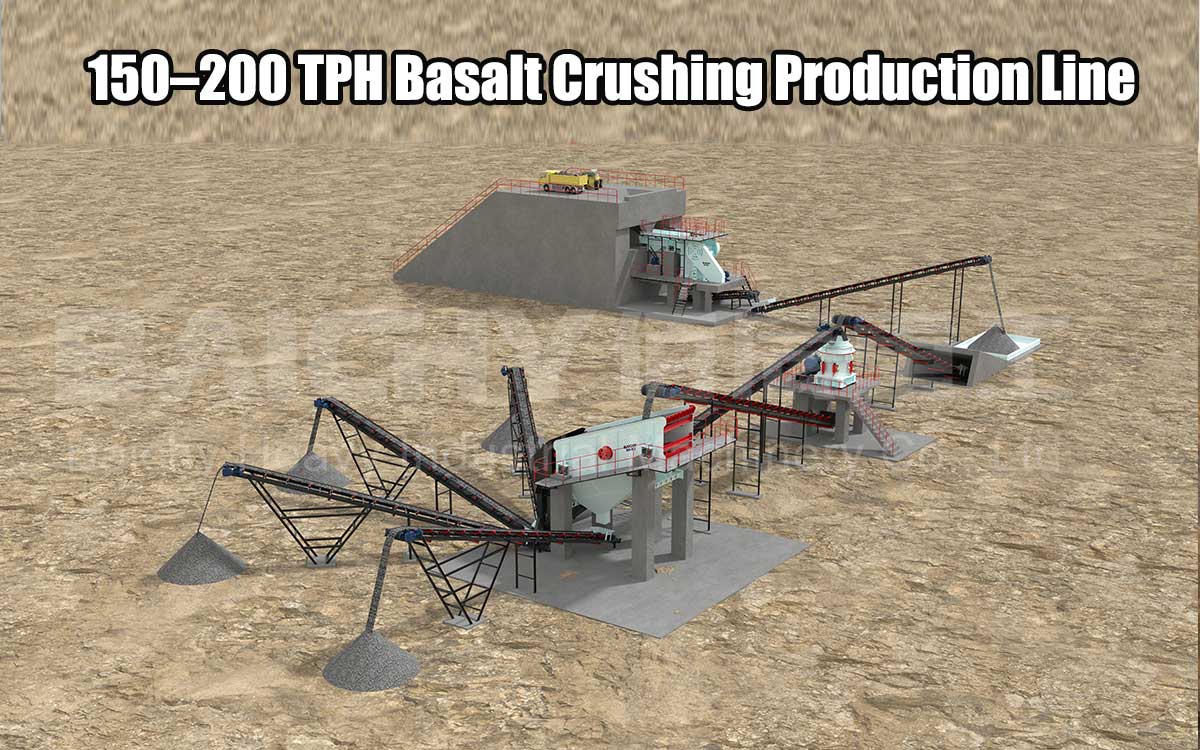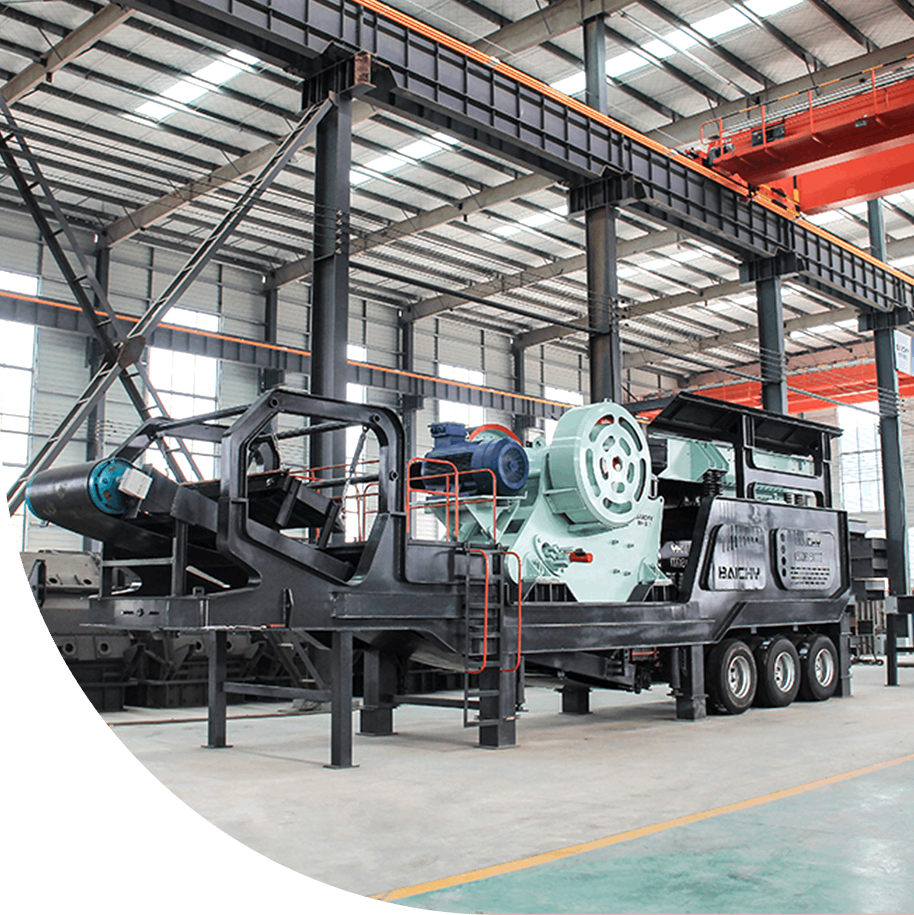

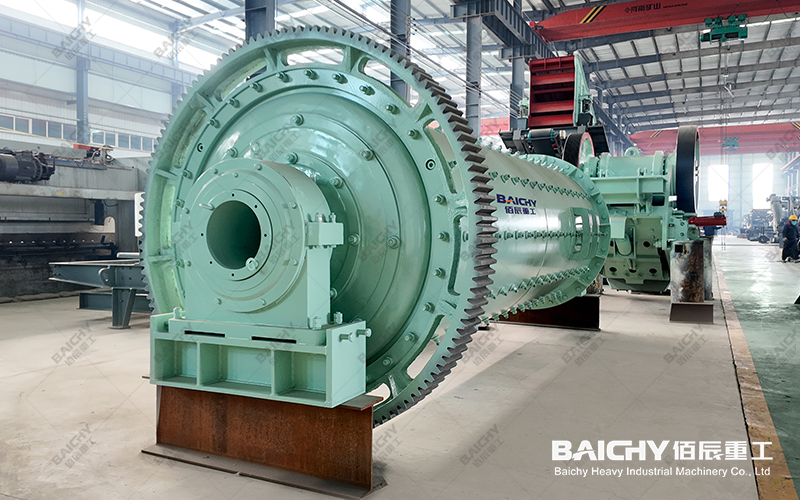
Dry ball mill
In the field of mineral processing, crushing and grinding are key steps in achieving mineral liberation and preparing for subsequent beneficiation operations. While traditional wet grinding is widely used, its high water consumption and tailings slurry production are becoming increasingly prominent problems. In contrast, dry grinding technology is showing great application potential in specific mineral types and water-scarce areas due to its unique advantages. As a crushing and grinding equipment manufacturer with twenty years of industry experience, we will delve into the application of dry grinding technology in modern mining.
I. What is Dry Grinding? — Technology Overview and Analysis
1.1 Core Definition
Dry grinding, as the name suggests, refers to the grinding process where no water or only a very small amount of water is added during the ore grinding process, directly grinding dry or low-moisture ores. Its process flow typically includes: coarse crushing -> medium and fine crushing -> drying (if necessary) -> dry grinding -> dry classification -> product collection.
1.2 Applicable Scenarios Analysis
This technology is not a panacea, but it has significant advantages in the following scenarios:
• Processing minerals with low or no water content: such as limestone, quartz, feldspar, graphite, talc, etc.
• Water-scarce areas: It greatly reduces the dependence on water resources for production, solving the problem of mining development in water-scarce areas.
• Avoiding subsequent drying costs: If the final product requires dry powder, dry grinding can produce it directly, saving the large amount of dehydration and drying equipment and energy consumption associated with wet grinding.
• Areas with stringent environmental requirements: No tailings ponds or wastewater are generated, simplifying environmental management and reducing risks.
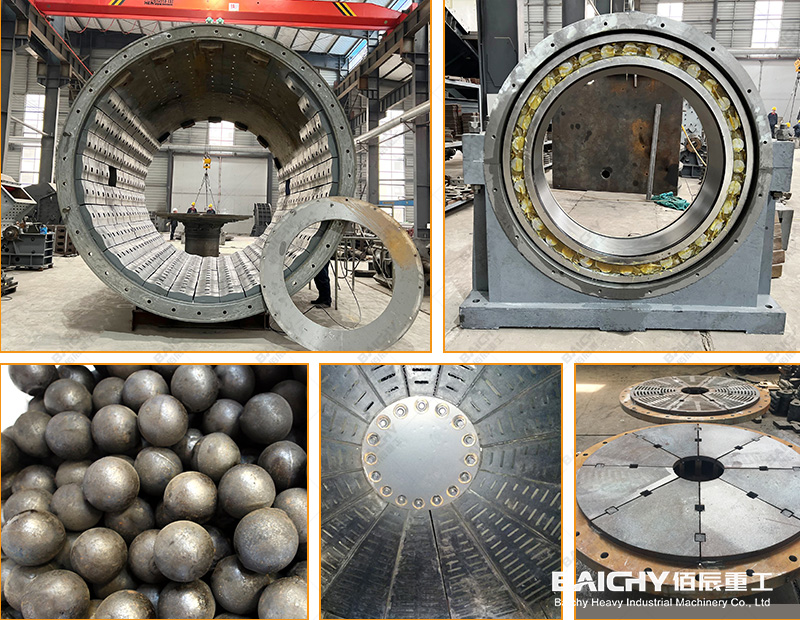
Detailed images of ball mill parts
II. Significant Advantages of Dry Grinding Process
Compared to wet grinding, dry grinding brings multi-dimensional value enhancements to enterprises:
• Superior Environmental Friendliness: Completely eliminates mineral processing wastewater, tailings slurry, and tailings ponds, fundamentally solving heavy metal ion pollution and water resource pollution problems, achieving green mine construction.
• Significant Economic Benefits:
◦ Water and Energy Saving: Significantly reduces water costs, which is of great significance in arid regions; it also eliminates the high-energy-consuming processes of product dehydration and drying.
◦ Reduced Land and Investment: No need to construct concentration, filtration, tailings ponds, and complex water recycling systems, resulting in lower infrastructure and land use costs.
• Increased Product Flexibility: The produced dry powder is easier to transport, store, and further process, and can be sold directly as a commodity.
• Simplified Process Flow: The system is relatively simple, easy to operate and maintain, and has high production stability.
III. Success Story: Limestone Powder Production Line
We designed and built a 300,000-ton-per-year dry ultrafine limestone grinding production line for a large building materials group in North China.
• Core Challenge: The client wanted to utilize local limestone resources to produce 800-mesh ultrafine calcium powder for special mortars and plastic fillers, but local environmental policies strictly prohibited wastewater discharge.
• Our Solution: A closed-loop dry grinding system was implemented using a jaw crusher + cone crusher for pre-crushing, combined with a vertical roller mill (LM series). The feed material is dried before entering the vertical mill for grinding. Real-time particle size classification is achieved through a built-in high-efficiency classifier. Coarse powder is returned for regrinding, while qualified fine powder is collected by a dust collector.
• Achieved Results:
1. Product fineness can be flexibly adjusted between 600-1500 mesh, with a yield rate exceeding 99%.
2. No wastewater discharge throughout the entire process; dust emission concentration is below 10mg/Nm³, far exceeding national standards.
3. Compared to the originally planned wet process, this method saves over 150,000 tons of water per year and reduces overall energy consumption by approximately 35%.
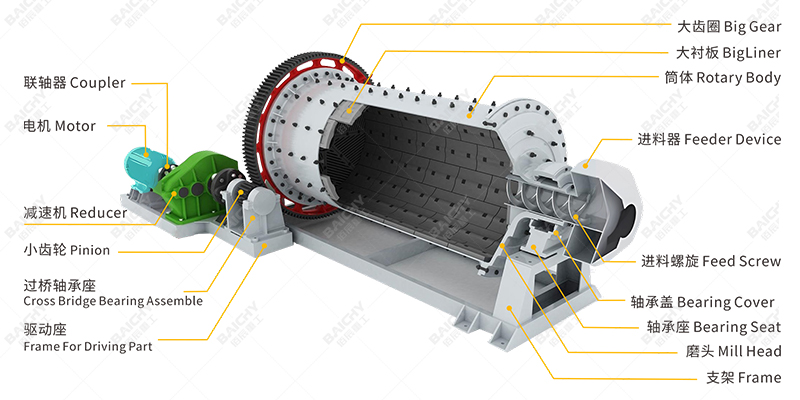
Ball mill structure diagram
IV. Recommended Core Equipment for Dry Grinding Systems
A high-efficiency dry grinding system relies on precise equipment selection and matching:
1. Core Mills:
◦ Vertical Roller Mill: Suitable for large-scale grinding of materials with medium hardness and below (up to hundreds of tons per hour), integrating drying, grinding, and classifying. It has low power consumption and is the first choice for large-scale projects.
◦ European Trapezoidal Mill: Suitable for grinding minerals with a Mohs hardness of 6 or below for small to medium production requirements. It offers a wide range of product particle size adjustment.
◦ Ball Mill (Dry): A mature technology suitable for grinding materials of various hardnesses, but with relatively high energy consumption.
2. Classification Equipment: A high-efficiency eddy current classifier is the "brain" of the closed-circuit dry grinding system. Its classification accuracy and efficiency directly determine the quality of the finished product and the system output.
3. Supporting Equipment: A reliable drying system, airlock feeder, pulse bag dust collector (which combines product collection and environmental protection functions), and automated control system are all crucial.
V. Frequently Asked Questions (FAQ) about Dry Grinding
Q1: Dry grinding or wet grinding?
A1: The choice depends on the ore properties, product requirements, local resources, and environmental policies. Dry grinding is more suitable for ores that are sensitive to water, have low moisture content, require dry powder products, are water-scarce, or are subject to strict environmental regulations. Wet grinding is more advantageous when processing sticky ores, or ores with high mud content, or ores requiring subsequent wet separation (such as flotation). Detailed mineral testing and feasibility studies are recommended.
Q2: How to solve the dust problem in dry grinding? Can it meet standards?
A2: Modern dry grinding systems, through a fully enclosed pipeline design and equipped with high-efficiency pulse bag filters at key dust-generating points (such as mill inlets and outlets, classifiers, and packaging ports), can achieve a virtually dust-free production workshop. The system's outlet dust emission concentration can be stably controlled below 20mg/Nm³ or even 10mg/Nm³, fully meeting the most stringent global environmental standards.
Q3: Can the particle size of dry-ground products reach the fineness of wet-ground products?
A3: Absolutely. By selecting suitable dry mills (such as vertical mills and air jet mills) and combining them with ultra-high precision classifiers, it is entirely possible to produce ultrafine powders of 600 mesh, 800 mesh, and even above 1250 mesh, with adjustable particle size distribution. The fineness already meets the requirements of most industrial fields.