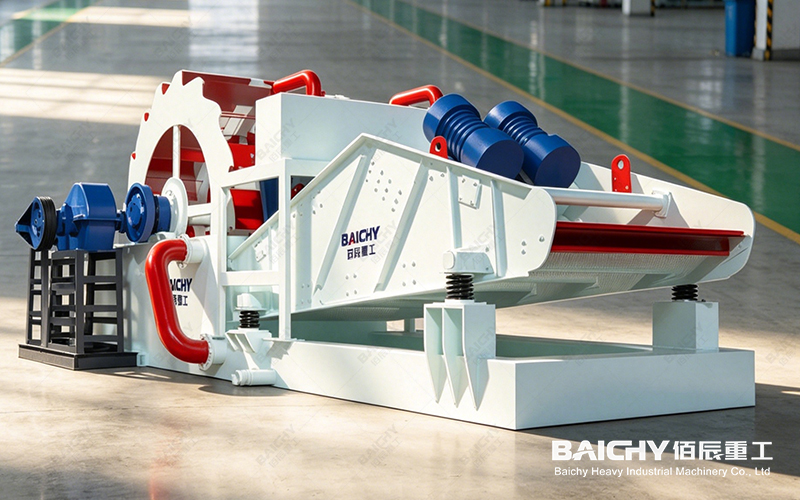
Integrated Mining Washing & Dewatering Equipment
The integrated mining washing and dewatering unit combines washing, dewatering, and fine sand recovery functions to reduce the moisture content of finished sand and gravel products to below 12%–15%. This directly boosts the selling price of aggregates while ensuring compliance with environmental regulations. Traditional sand and gravel yards often face issues such as excessive mud content and high moisture levels in finished products, which frequently lead to price reductions. Through its integrated design, this equipment resolves the industry pain points associated with standalone sand washers—specifically, the inability to clean thoroughly and the problem of excessive residual moisture—making it standard-issue equipment for the development of modern, eco-friendly mines.
1. Core Definition of the Integrated Mining Washing and Dewatering Unit
The integrated mining washing and dewatering machine refers specifically to processing equipment designed for the combined washing, beneficiation, and dewatering of ores, sand, and gravel; it does *not* refer to laundry equipment for miners' workwear. This unit integrates three primary modules: wheel-bucket sand washing, fine sand recovery, and high-frequency dewatering. Its operating principle involves utilizing water flow to strip away mud and impurities from the surface of the sand and gravel, followed by the application of high-frequency vibration to achieve solid-liquid separation, thereby ensuring that the resulting aggregates are ready for immediate loading and transport.
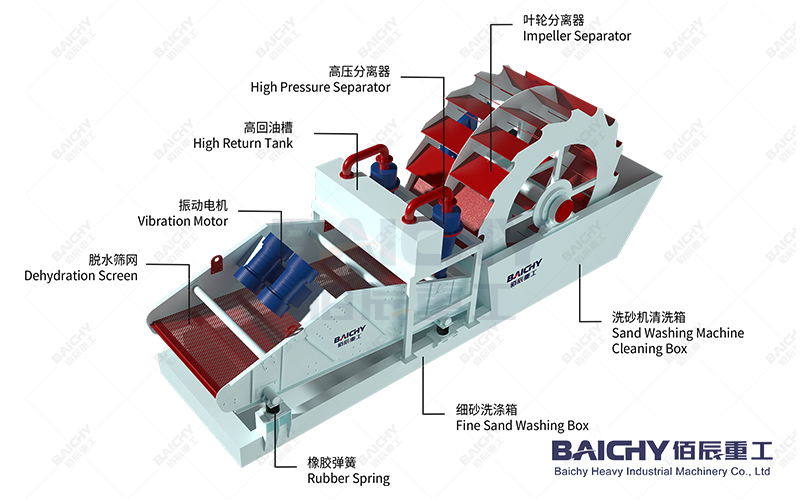
Integrated Mining Washing & Dewatering Equipment Structural Diagram
2. Core Value: Dual Benefits of Environmental Compliance and Price Premiums
Deploying an integrated washing and dewatering unit significantly enhances the market premium potential of finished sand and gravel products while mitigating environmental risks. Untreated wet materials—due to their high moisture and mud content—are frequently subject to weight deductions and price penalties by downstream commercial concrete mixing plants. In contrast, the premium aggregates processed by this equipment command a higher market price—potentially increasing by 5–10 RMB per ton—thanks to their superior grain shape (roundness) and low mud content. Furthermore, the unit's closed-loop water circulation system eliminates the discharge of wastewater, thereby ensuring full compliance with national standards for eco-friendly mine construction.
3. Technical Architecture: A Three-Stage Integrated Design
The equipment employs a three-stage structural design—comprising washing, recovery, and dewatering—to ensure the maximization of resource utilization efficiency. Unlike older, single-function sand washers, this unit leverages structural innovations to execute a comprehensive, end-to-end processing workflow:
| Functional Module | Core Component(s) | Technical Function |
| Washing Module | Wheel Bucket / Spiral Washing Trough | Utilizes hydraulic classification to remove mud and lightweight impurities from the surface of the aggregates. |
| Recovery Module | Hydrocyclone Cluster | Recovers lost fine sand (ranging from 0.16 to 0.5 mm) to prevent resource wastage. |
| Dewatering Module | High-Frequency Dewatering Screen | Utilizes high-frequency vibration at 1450 RPM to forcibly remove surface free water. |
4. Authoritative Standards: Key Technical Parameters and Indicators
Equipment performance must strictly adhere to the national standard GB/T 25706-2010 (*Safety Signs for Mining Machinery*) and the industry standard JB/T 10997-2010. In actual procurement scenarios, the following measured data serve as the critical basis for evaluating equipment quality:
| Assessment Indicator | Industry Qualification Standard | High-Quality Equipment Performance | Testing Basis |
| Moisture Content of Finished Product | ≤ 18% | ≤ 12% | On-site sampling and weighing method |
| Fine Sand Recovery Rate | ≥ 85% | ≥ 95% | Calculation based on hydrocyclone classification efficiency |
| Processing Capacity | 90% of Design Value | ≥ 100% of Design Value | Continuous 8-hour full-load operation |
| Vibration Noise | ≤ 85 dB(A) | ≤ 75 dB(A) | GB/T 25023-2010 |
Case Study: In a granite sand-making project in Xinzhou, Shanxi (2025), the introduction of a 300 T/H integrated washing and dewatering machine reduced the moisture content of the finished sand from 25% to 11%. That same year, the improvement in product quality generated an additional 1.2 million RMB in sales revenue, while simultaneously saving 300,000 RMB in tailings disposal costs.
5. Operational Guidelines: The Four-Step Scientific Selection Method
The correct equipment selection process requires a three-dimensional matching approach based on raw material characteristics, capacity requirements, and site constraints. Blindly pursuing the lowest price often results in equipment being undersized for the workload—akin to a "small horse pulling a heavy cart"—leading to frequent operational failures.
1. Raw Material Analysis: Test the raw material's clay content and particle size distribution. If the clay content exceeds 5%, a dual-screw model with enhanced washing capabilities must be selected.
2. Capacity Verification: The equipment's rated processing capacity should exceed the output volume of the upstream crusher by at least 20% to provide a sufficient margin and prevent material blockages.
3. Material Inspection: Verify that the dewatering screen mesh is made of polyurethane (with a thickness of ≥ 30 mm) and that the main beams of the machine body are constructed from thickened H-beams.
4. Energy Consumption Assessment: Prioritize models equipped with variable-frequency motors, which automatically adjust operating speed based on material flow rates to minimize electricity consumption.
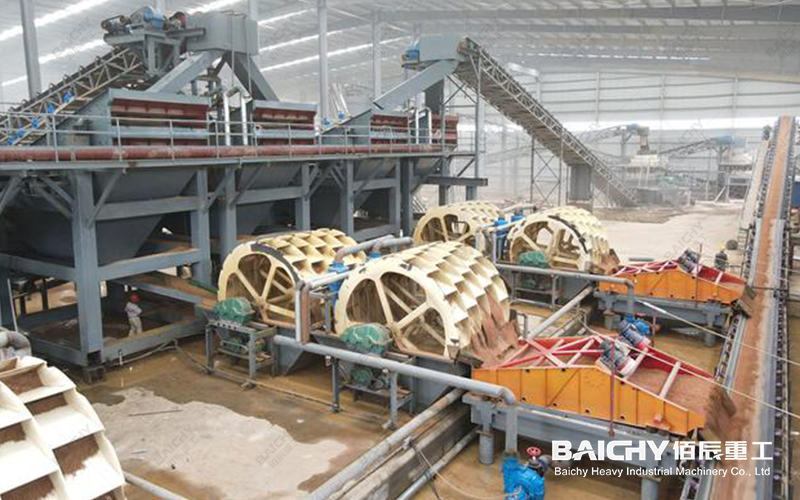
Integrated Mining Washing & Dewatering Equipment Client Site
At the downstream end of large-scale sand-making production lines, the introduction of integrated mining-grade washing and dewatering equipment addresses critical pain points inherent in traditional processes—specifically, high mud content in finished products, excessive moisture levels, and severe loss of fine sand—thereby enabling the large-scale production of premium-quality aggregates. As standards for construction sand (GB/T 14684-2022) become increasingly stringent, relying solely on crushers and screens is no longer sufficient to meet market demand for high-quality manufactured sand. Serving as the final checkpoint before the finished product stage, integrated washing and dewatering equipment fulfills the core functions of "removing impurities, controlling moisture levels, and recovering fine sand," making it a pivotal link in determining the ultimate market premium and value of the final product.
1. Project Background and Pain Point Analysis
In the absence of an efficient washing section, traditional large-scale sand-making lines face significant risks regarding product marketability and environmental compliance. Production lines not equipped with integrated washing and dewatering systems typically suffer from the following issues:
• Quality Deficiencies: The powder and mud content in the finished sand fluctuates significantly; furthermore, coarse and fine sands often remain intermixed, making it difficult to meet the strict aggregate specifications required for high-grade concrete mixes at commercial concrete batching plants.
• Resource Waste: Traditional sand-washing methods result in the loss of substantial quantities of fine sand (ranging from 0.16 mm to 0.5 mm) carried away by the wash water. This not only reduces overall yield but also places increased pressure on the management and disposal capacity of tailings ponds.
• Transport Limitations: The moisture content of the finished product frequently exceeds 20%. This high moisture level renders the material susceptible to freezing in winter and segregation during transport in summer, thereby severely restricting the feasible transport radius and limiting the operational sales season.
Core Solution: Integrated Washing and Dewatering Process
Adopting an integrated process—combining "wheel-bucket washing + cyclone recovery + high-frequency dewatering"—to replace the traditional, multi-stage serial processing configuration. This solution positions the integrated washing and dewatering unit between the secondary crushing stage and the finished product stockpile, thereby establishing a closed-loop operational system:
| Process Stage | Equipment Action | Expected Output |
| Feeding & Washing | The mixture produced by the sand-making machine enters the wheel-bucket washing zone | Soil impurities mix with water and are discharged; stone surfaces are thoroughly cleaned. |
| Fine Sand Recovery | Overflow wastewater enters a hydrocyclone for concentration and classification | Lost fine sand is recaptured and returned to the dewatering screen. |
| Finished Product Dewatering | Clean sand and gravel enter a high-frequency dewatering screen (1,450 strokes/min) | Surface free water is removed, stabilizing the moisture content at below 12%. |
3. Implementation Benefits and Expected Outcomes
This configuration is projected to boost the finished product qualification rate to over 95% and significantly reduce the production cost per ton of sand. Specific benefits include:
• Economic Benefits: Premium sand processed by the integrated washing and dewatering unit commands a market price that is 5–10 RMB/ton higher than that of ordinary wet sand. Based on a production capacity of 500 tons per hour, the daily gross profit sees a substantial increase.
• Environmental Compliance: Achieves zero wastewater discharge and zero loss of fine sand, thereby completely eliminating environmental inspection risks associated with the accumulation of washing sludge.
• Land Efficiency: The integrated design occupies approximately 40% less land area than the traditional combination of "sand washer + dewatering screen + settling pond," making it ideal for large-scale mining operations with limited land availability.
In large-scale sand-making and washing production lines, the integrated washing and dewatering equipment serves as the critical node for guaranteeing the quality of the final product. This solution not only effectively removes harmful impurities—such as mica and soil—but also ensures the stability of sand and gravel aggregates during long-distance transport through precise moisture content control; it is the standard configuration for building green, efficient, and intelligent mining operations.
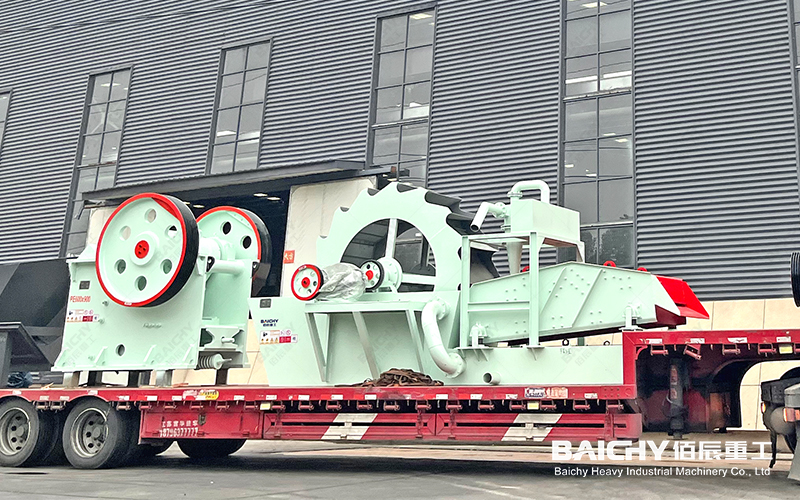
Integrated Mining Washing & Dewatering Equipment Shipping
Frequently Asked Questions (FAQ)
Q1: What is the difference between an integrated mining washing-dewatering unit and a standard sand washer?
A1: A standard sand washer is responsible solely for washing; the resulting sand retains a high moisture content and a significant amount of residual silt. The integrated washing-dewatering unit, however, incorporates a dewatering screen and a fine sand recovery system, allowing the washed sand to be loaded directly onto trucks without the issue of "muddy residue."
Q2: Can this equipment effectively remove yellow rust from the surface of stones?
A2: For lightly adhering weathered layers or surface rust, effective removal can be achieved by adding specialized cleaning agents and utilizing high-frequency vibration. However, for deep-seated oxide scale, it is recommended to use this equipment in conjunction with a rotary stone washer.
Q3: Approximately how much water is consumed to wash one ton of stone?
A3: Under a standard circulating water system, the consumption of fresh water is approximately 0.5 to 1 ton per ton of washed sand and gravel. If a fully closed-loop circulation system is employed, actual water loss is primarily attributed to evaporation and the moisture retained within the finished product.
Q4: Is the equipment noisy during operation? Will it cause a nuisance to the surrounding community?
A4: The primary source of noise originates from the dewatering screen motor, typically ranging between 75 and 85 decibels. It is recommended to construct soundproof walls within the plant premises and to avoid high-load operations during nighttime hours whenever possible.
Q5: Are maintenance costs high? What are the primary wear parts?
A5: Maintenance costs are primarily concentrated on the screen mesh and the underflow nozzles of the hydrocyclones. Polyurethane screen meshes typically have a service life of 3 to 6 months; it is advisable to keep a spare set on hand, as a complete replacement takes only two hours.
Q6: Are the equipment selection parameters the same for processing granite versus limestone?
A6: No, they are not. Granite is characterized by high hardness and density, requiring a dewatering screen capable of generating greater excitation force. Limestone, conversely, is more brittle and contains a higher proportion of fines, necessitating stronger water spray pressure and a more robust fine sand recovery system.
Q7: How thick must the concrete foundation be for this equipment?
A7: Thanks to its fully suspended shock-absorption design, a reinforced concrete foundation typically just 300–500 mm thick is sufficient; unlike older equipment models, there is no need to drive deep piles exceeding 1 meter in depth.
Q8: Can this equipment be directly integrated into an existing crushing production line?
A8: Yes. The equipment's inlet and outlet ports feature a standardized flange design, allowing for seamless integration with the downstream end of jaw crushers, cone crushers, or impact crushers simply by adjusting the conveyor height.