
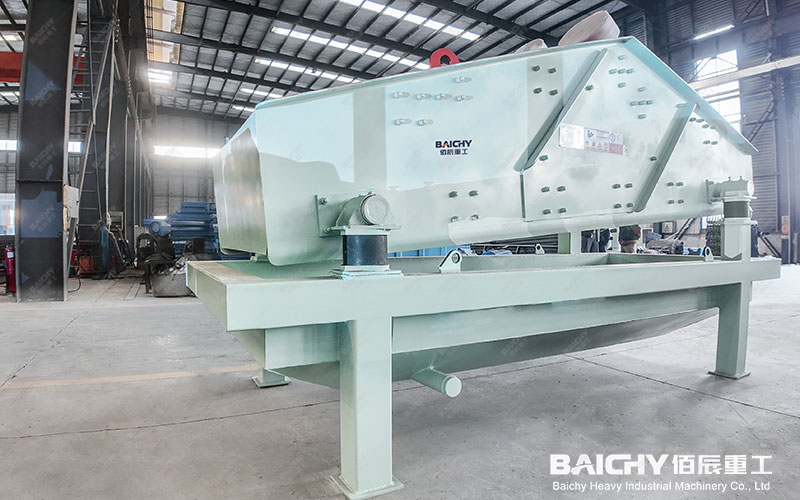
Sand and Gravel Dewatering Screen: How to Choose
A sand and gravel dewatering screen is sized from four numbers: line throughput, feed size, feed moisture and target moisture. Baichy ZSD models are published for 30-250 t/h, take feed up to 10 mm, and cut the 20%-30% moisture of washer discharge to 5%-8%.
What Data Do You Need Before Choosing a Dewatering Screen?
Seven site values drive the choice: a published capacity figure is valid only for the material it was measured on.
Line throughput — design output of finished sand in t/h.
• Feed size — largest particle reaching the deck; ZSD models publish ≤10 mm.
• Feed moisture — washer discharge, typically 20%-30%.
• Target moisture — 5%-8% for sand that must load without dripping.
• Silt and clay — heavy fines force a capacity derate.
• Duty — sand, tailings or concentrate dewatering.
• Power supply — site voltage and frequency for the motor winding.
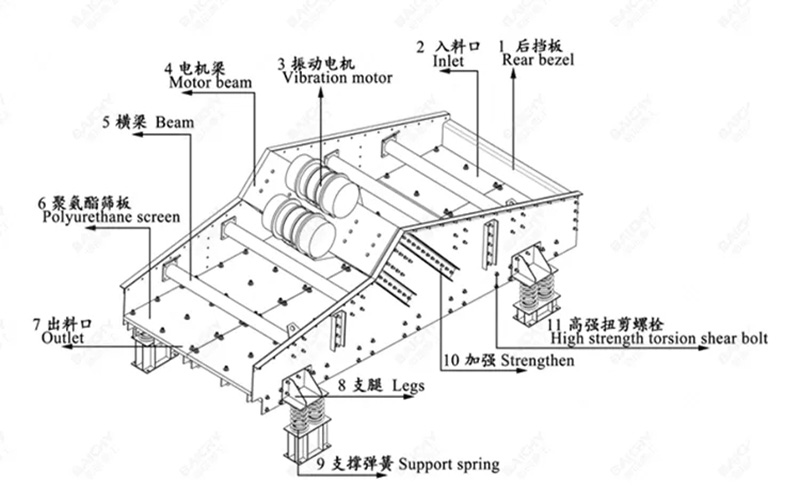
Structural diagram of the dewatering screen
Step 1: Size the Screen to Line Throughput
Set screen capacity at line throughput in t/h multiplied by 1.2, and derate it when silt and clay are heavy. The factor absorbs peak feed and the throughput lost as the deck wears.
Worked example: a 100 t/h sand making line needs 100 × 1.2 = 120 t/h of screen capacity, the 80-120 t/h band published for the ZSD1530 and ZSD1536.
Step 2: Match the Model to Deck Area and Motor Power
Dewatering screen selection starts with deck area rather than motor power, because deck area decides how much water the deck can drain at a given capacity. All ten ZSD models take feed up to 10 mm.
| Model | Motor Power (kW) | Capacity (t/h) | Feeder Size (mm) | Sieve plate Size (mm) | Area (㎡) | Overall Dimension (mm) |
|---|---|---|---|---|---|---|
| ZSD1230 | 1.9 | 30–80 | ≤10 | 1200×3000 | 3.6 | 3085×1590×1439 |
| ZSD1236 | 2.2 | 30–80 | ≤10 | 1200×3600 | 4.32 | 3677×1590×1600 |
| ZSD1530 | 2.2 | 80–120 | ≤10 | 1500×3000 | 4.5 | 3075×2491×1601 |
| ZSD1536 | 3 | 80–120 | ≤10 | 1500×3600 | 5.4 | 3200×2491×1802 |
| ZSD1836 | 7.5 | 100–140 | ≤10 | 1800×3600 | 6.48 | 3758×3075×1988 |
| ZSD1842 | 7.5 | 100–140 | ≤10 | 1800×4200 | 7.56 | 4368×3075×2000 |
| ZSD1848 | 7.5 | 100–140 | ≤10 | 1800×4800 | 8.64 | 4791×3065×1959 |
| ZSD2442 | 11 | 140–180 | ≤10 | 2400×4200 | 10.1 | 4403×3737×1931 |
| ZSD2448 | 11 | 140–180 | ≤10 | 2400×4800 | 11.52 | 5008×3737×1977 |
| ZSD3048 | 15 | 200–250 | ≤10 | 3000×4800 | 14.4 | 4959×4518×2218 |
The output will vary according to different materials, feed particle size and other factors.
Inside a band, deck area decides the rest: the ZSD1836, ZSD1842 and ZSD1848 share the 100-140 t/h band and the same 7.5 kW motor, yet their sieve plate areas run from 6.48 ㎡ to 8.64 ㎡. Wetter or finer feed takes the larger deck, and a sand dewatering screen on coarse, drained feed takes the smaller one.
Step 3: Set the Screen Aperture to the Duty
Screen aperture follows the product: 0.3-1.0 mm for tailings dry stacking and 0.15-0.5 mm for concentrate dewatering. A high frequency dewatering screen on sand duty runs a coarser aperture and aims at the moisture figure instead.
Tailings duty also accepts wetter cake, 15%-20% instead of 5%-8%, from a slurry arriving at 60%-80% moisture with solids below 5 mm. That load blinds a deck, so polyurethane decks with self-cleaning behaviour are specified.
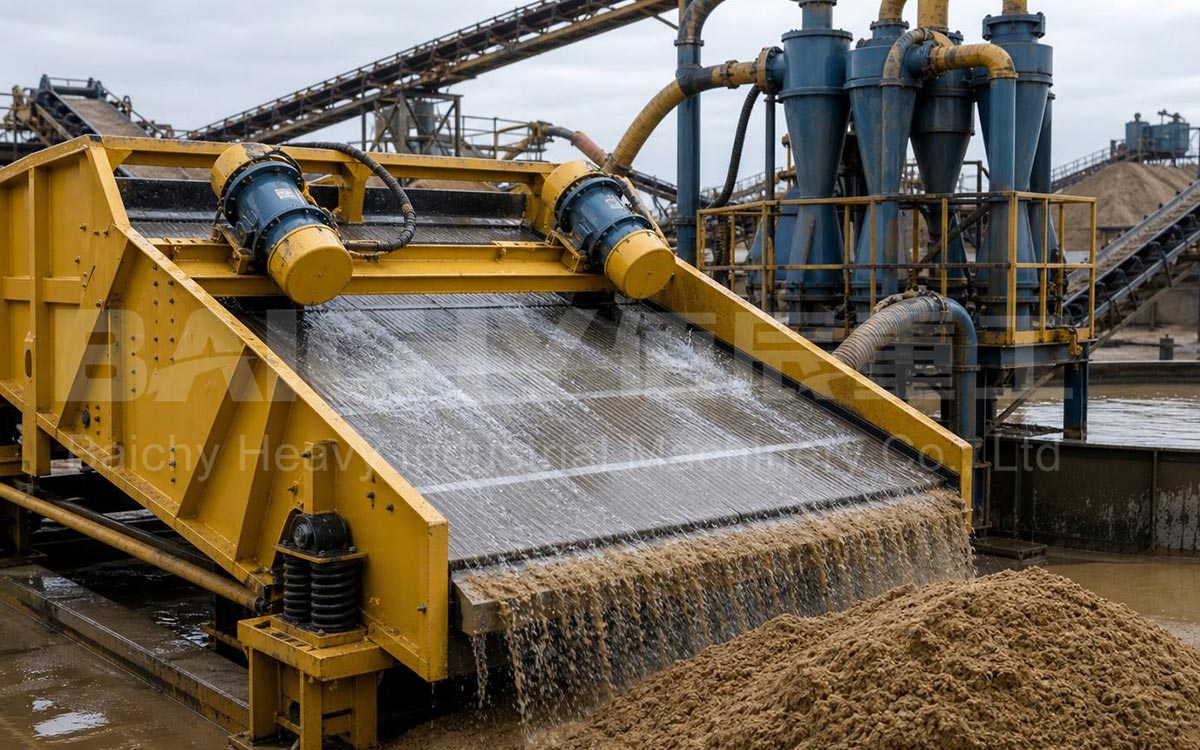
sand and gravel dewatering screen
Step 4: Add Recovery Only Where the Fines Pay for It
Washer overflow carries 0.075-2 mm fine sand that a settling pond writes off. Where that loss is real, a cyclone and slurry pump feeding a dewatering vibrating screen recover over 95% of the particles in the 0.075-2 mm range.
The closed loop returns 10%-15% of lost yield and is published as paid back within 1-2 months. Desilting drops from monthly to quarterly, and a standalone fine sand recovery machine covers the same duty where a cyclone station will not fit.
Standalone Screen or an Integrated Washing and Dewatering Unit
Where the layout will not take a washer, cyclone and screen as separate machines, the sand washing and dewatering integrated equipment combines washing, recovery and dewatering in one frame. Two models are published: 2610+1225 at 30-80 t/h and 26.9 kW, 2915+1530 at 60-120 t/h and 35.5 kW.
A wheel sand washing machine or a spiral sand washer with a separate screen suits a line that already has a washer.
Five Selection Mistakes That Cost Capacity
Most lost capacity traces back to five decisions taken before the order.
1. Quoting line throughput as screen capacity. A 100 t/h line needs 120 t/h of screen capacity.
2. Reading the capacity band as a guarantee. Heavy silt or clay needs a derate, because published output varies with the material.
3. Using one screen for two duties. Sand dewatering targets 5%-8% moisture; tailings dry stacking accepts 15%-20% cake at a 0.3-1.0 mm aperture.
4. Specifying a woven deck for fine tailings. Fine tailings blind the deck; polyurethane with self-cleaning behaviour is specified.
5. Buying on capacity band and ignoring deck area. The ZSD1836, ZSD1842 and ZSD1848 all cover 100-140 t/h at 7.5 kW, yet their sieve plates run from 6.48 ㎡ to 8.64 ㎡.
FAQ: Choosing the Right Dewatering Screen
1. What size sand and gravel dewatering screen does a 100 t/h line need?
A 100 t/h sand making line needs 120 t/h of screen capacity, calculated as 100 × 1.2. That is the 80-120 t/h band published for the ZSD1530, with a 4.5 ㎡ sieve plate, and the ZSD1536, with 5.4 ㎡.
2. What is the maximum feed size of a ZSD dewatering screen?
ZSD models are published with a 10 mm feeder size, so 10 mm is the maximum. Coarser material is removed upstream: it accelerates deck wear and blocks the draining apertures.
3. How much moisture does a dewatering screen remove?
Washer discharge at 20%-30% moisture leaves the deck at 5%-8%, dry enough to stockpile without dripping. Tailings duty publishes 15%-20% filter cake instead.
4. Do you need a cyclone with the dewatering screen?
The screen works without a cyclone, but only a cyclone loop recovers the fines. With one, recovery exceeds 95% of particles in the 0.075-2 mm range, and payback is published at 1-2 months.
Baichy Heavy Industry
Baichy Heavy Industry is a high-tech mining equipment company integrating R&D, manufacturing, sales, and after-sales service. Focusing on crushing, grinding, and mineral processing equipment, we provide professional solutions to our customers. We are ISO9001:2015 、certified, and our products include mobile crushing palnts, crawler crushing plant, construction waste crushing plants, jaw crushers, sand making machines, cone crushers, fine crushers, grinding mills, ball mills, etc., all with reliable performance to meet diverse project needs.
Baichy Heavy Industry – Your Trusted Partner
To ensure optimal performance of your equipment, Baichy Heavy Industry offers:
- Professional on-site installation guidance
- Comprehensive operator training
- 24/7 technical support & maintenance services
Our complete after-sales service system guarantees long-term, stable operation of your machinery with minimal downtime.
Protect Your Rights – Only Use Official Channels
To avoid scams and ensure authentic support, contact us exclusively through:
• Official Website: www.baichychina.com
• WhatsApp: +8615093222637
• Email: [email protected]
Your satisfaction is our priority – expect prompt, professional service every time.
(Note: Beware of unauthorized third parties claiming to represent Baichy. Always verify through official contacts.)