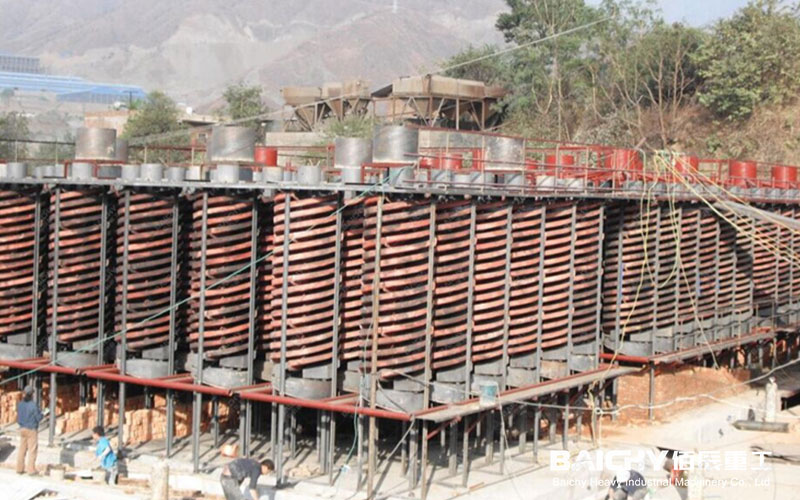
Spiral Chutes
The spiral chute is a critical gravity separation device within mineral processing production lines, responsible for the "roughing and scavenging" stages. It consumes no external power, relying primarily on differences in material density and centrifugal force to physically separate heavy minerals (concentrates) from light minerals (tailings) as the mineral slurry flows through the device.
I. Specific Role in the Production Line
Spiral chutes are typically positioned downstream of the grinding stage, playing a pivotal role in bridging the gap between upstream and downstream processes:
1. Roughing and Pre-enrichment: Processing the mineral slurry after grinding to preliminarily discard large quantities of low-grade tailings, thereby reducing the processing load on subsequent fine-separation equipment.
2. Scavenging and Recovery: Reprocessing tailings generated by shaking tables or flotation cells to recover lost valuable minerals and minimize metal losses.
3. Classification Pre-treatment: Separating out easily separable coarse-grained materials via the spiral chute before the stream enters equipment designed for fine particles (such as flotation machines).
II. Applicable Scenarios and Target Minerals
Spiral chutes are particularly effective for weakly magnetic minerals in the micro-fine particle size range (0.03–0.3 mm) and represent a preferred solution for low-cost mineral processing.
| Applicable Mineral Types | Typical Application Cases |
| Iron Ores | Hematite, Limonite, Ilmenite |
| Non-ferrous/Rare Metals | Cassiterite, Tungsten Ores, Tantalum-Niobium Ores |
| Non-metallic Minerals | Quartz Sand (impurity removal/purification), Beach Placer Deposits |
| Others | Coal Gangue Desulfurization, Tailings Reprocessing |
III. Core Advantages and Limitations
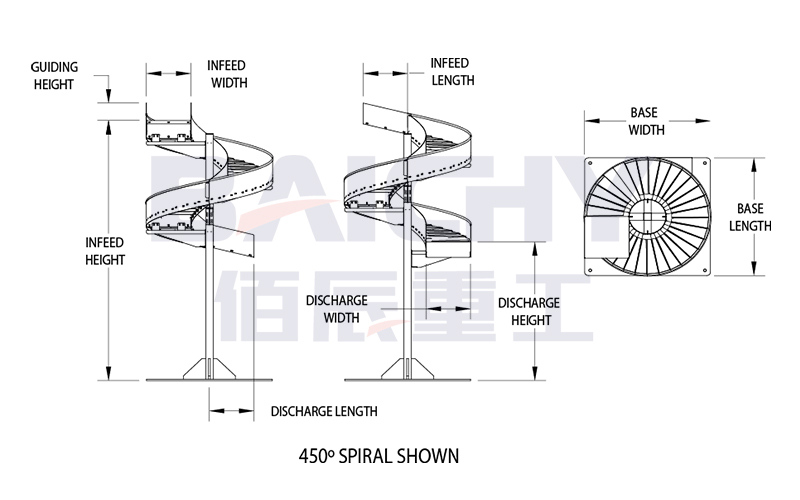
Spiral Chute Structure Display
• Advantages: Zero energy consumption (relies on gravity-driven flow), no moving parts (extremely low failure rate), high processing capacity, simple operation and maintenance, and low capital investment costs.
• Limitations: Separation precision is lower than that of shaking tables; separation efficiency is poor for extremely fine slimes (<0.03 mm) and for minerals with very similar densities; consequently, spiral chutes are typically used in conjunction with shaking tables or flotation processes.
IV. Typical Process Combinations
Within a complete mineral processing flowsheet, spiral chutes are frequently used in conjunction with the following equipment:
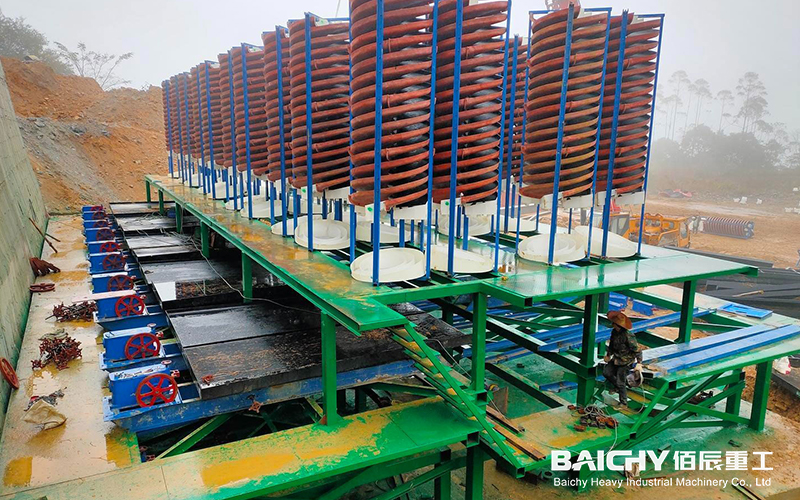
Spiral Chute + Shaking Table
• Spiral Chute + Shaking Table: Chutes for roughing (pre-concentration), tables for cleaning (a classic flowsheet for tungsten and tin ores).
• Spiral Chute + Flotation: Chutes for recovering heavy minerals, flotation for processing fine slimes or complex associated ores.
• Spiral Chute + Magnetic Separation: Used in combined beneficiation flowsheets for iron ores.
If you have a specific type of ore (such as iron ore or a tailings recovery project), I can provide you with more tailored configuration recommendations.
In industrial settings, spiral chutes are almost invariably used in groups. A single spiral chute is utilized only for very small-scale laboratory experiments or temporary operations with extremely low throughput; a formal production line must rely on "teamwork"—operating in groups.
V. Industrial Practice: Must Be Grouped (Parallel + Series)
To meet requirements regarding throughput, recovery rate, and operational stability, on-site installations typically follow this logic: "Parallel arrangement horizontally to expand capacity; series arrangement vertically to ensure recovery."
1. Parallel Arrangement (The Most Common Configuration)
◦ Purpose: To expand processing capacity. Since the throughput of a single unit is limited, the mineral slurry—after exiting the grinding mill—is uniformly distributed via a distributor to dozens or even hundreds of spiral chutes.
* Scenario: The roughing section of large-scale beneficiation plants, where one typically sees arrays of chutes arranged in rows stretching into the distance.
2. Series Arrangement (Cascading Configuration)
* Purpose: To enhance the recovery rate. The tailings (or middlings) from the first stage of chutes serve as the feed for the second stage, undergoing a "scavenging" process to prevent the loss of valuable minerals.
* Scenario: Processing flowsheets for tungsten and tin ores—or for tailings reprocessing—where extremely high recovery rates are required.
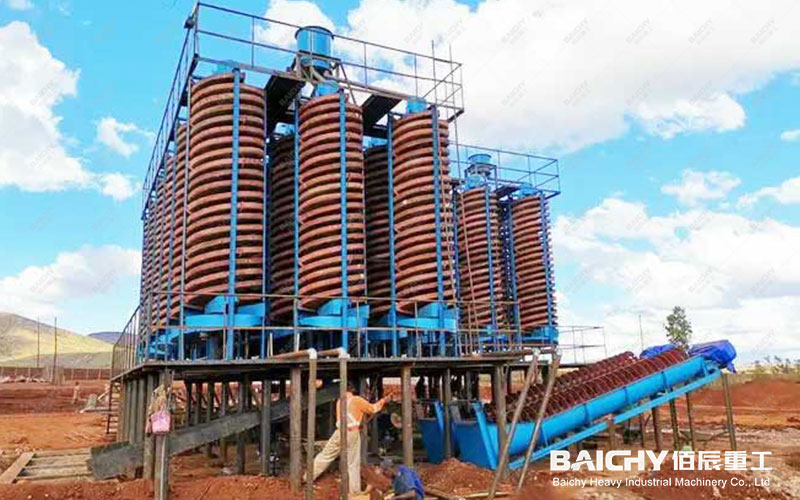
Spiral Chute + Spiral Classifier
VI. Single-Unit Usage: Limited to Laboratories or Highly Specific Scenarios
The scope for using a single spiral chute is extremely limited:
• Laboratory Use: Conducting beneficiation amenability tests to determine parameters such as feed density, particle size distribution, etc.
* Micro-scale Processing Sites: Manual operations involving extremely low throughputs.
• Temporary Sampling: Temporarily installing a single unit at a specific point in a production line for diagnostic testing or sampling purposes.
VII. Selection and Configuration Reference
Based on your specific processing requirements, you may refer to the following configuration logic:
| Your Requirement | Recommended Configuration | Description |
| Small-scale Processing Plant / High-grade Ore | 4–10 units in parallel | Single-stage configuration; balances both cost-effectiveness and processing efficiency. |
| Large-scale Processing Plant / Low-grade Ore | 20–100+ units | Series scavenging stage; must be equipped with an automatic ore splitter, and consideration should be given to tailings re-processing. |
| Experimental / Research Use | 1 unit (Single-head) | Used for exploring and optimizing process parameters. |
VIII. Key Engineering Details
When used in groups, there are two critical factors that directly impact mineral processing performance metrics:
1. Feed Uniformity: An ore splitter *must* be used to ensure that the feed rate and slurry density delivered to each inpidual spiral chute are consistent; otherwise, the overall efficiency of the entire equipment group will be significantly compromised.
2. Selection of "Heads" (Spirals): Industrial spiral chutes themselves often feature a "multi-head" design (e.g., 4-head, 6-head), meaning a single physical unit contains multiple spiral flumes. This constitutes an internal grouping within the equipment itself, designed to maximize the processing throughput of a single machine within a limited footprint.
If you can provide specific details regarding your daily processing tonnage or the type of ore being processed (e.g., iron ore, tailings), I can assist you in estimating the optimal number of units (or "heads") to configure for the most economically rational solution.
Frequently Asked Questions (FAQ)
1. Should spiral chutes be used inpidually or in groups?
In industrial production settings, spiral chutes are almost invariably used in groups (in parallel). A single unit is typically reserved only for laboratory experiments or extremely small-scale processing operations; it cannot meet the continuous, high-volume processing demands of a commercial mineral processing plant. On-site installations typically involve connecting dozens of units in parallel, utilizing ore splitters to evenly distribute the mineral slurry and facilitate large-scale production.
2. Why are so many spiral chutes connected in parallel?
The primary objective is to increase processing throughput. A single spiral chute has a limited processing capacity, whereas the volume of mineral slurry generated after grinding is typically immense. By connecting units in parallel, the slurry can be evenly distributed across dozens of chutes for simultaneous separation—a necessary measure to meet the overall processing capacity requirements of a plant (e.g., handling thousands or tens of thousands of tons per day).
3. Can spiral chutes be connected in series?
Yes, they can. This configuration is typically employed to enhance mineral recovery rates. A "roughing-scavenging" series configuration is frequently employed: the tailings or middlings from the first stage (roughing) are fed into the second-stage (scavenging) sluice for reprocessing. This approach aims to maximize the recovery of valuable minerals and minimize metal losses, and it is commonly applied to minerals for which high recovery rates are required (such as tungsten and tin).