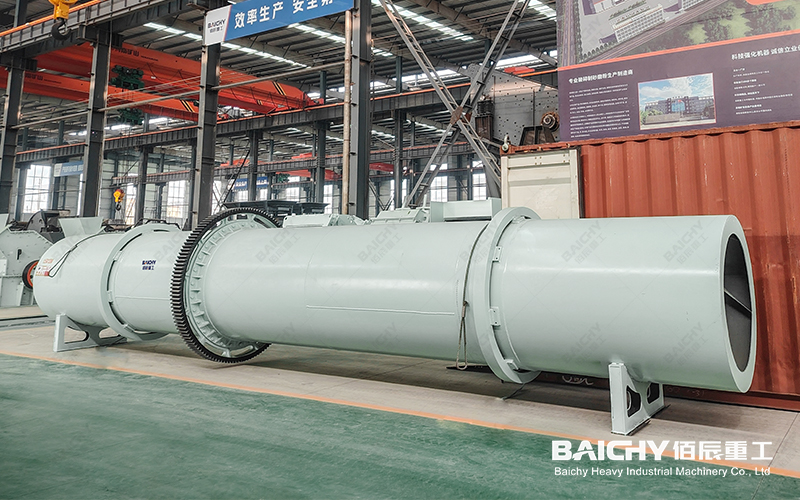
Industrial Sludge Dryer
Industrial sludge drying constitutes a critical stage in the processes of sludge volume reduction and resource recovery (including incineration, brick manufacturing, and landfilling). Given the complex characteristics of industrial sludge—such as high viscosity, corrosiveness, and thermal sensitivity—selecting the appropriate dryer model directly determines a project's operational costs and stability. This guide systematically deconstructs the logic behind dryer selection and outlines the prevailing technological approaches in the field.
I. Dryer Selection: 5 Core Decision Factors
Before comparing specific equipment options, it is essential to first define your process boundary conditions; these serve as the foundational basis for equipment selection:
| Decision Dimension | Key Questions & Metrics |
| Sludge Characteristics | Initial moisture content (typically 80% → target: 10–40%), organic/oil content, pH value, corrosiveness, particle size, viscosity (propensity for agglomeration/caking) |
| Processing Scale | Continuous throughput (t/d or kg/h); equipment investment costs differ significantly between small-scale projects (<50 t/d) and large-scale projects (>100 t/d) |
| Heat Source & Energy Consumption | Available heat sources (steam, natural gas, electric heat pumps, process waste heat), energy consumption budget per unit of evaporated water (kcal/kg H₂O) |
| Subsequent Disposal | Incineration (requires partial drying), utilization in building materials (requires deep drying and strict control of chloride content), Landfilling (requires meeting site acceptance criteria) |
| Safety & Environmental Protection | Presence of solvents/VOCs (requires enclosed/vacuum systems), odor control requirements, dust explosion protection rating |
II. Comparison of Mainstream Industrial Sludge Dryers
Based on the method of heat transfer (direct/indirect) and structural design, the technical characteristics and applicable scenarios for mainstream equipment types are compared below:
1. Rotary Drum Dryer
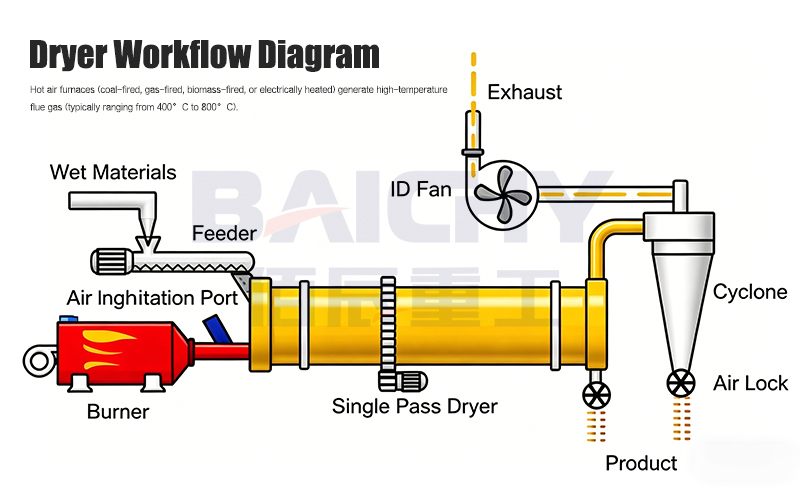
Dryer Workflow Diagram
• Working Principle: Inside a rotating drum, the sludge is continuously lifted and tumbled by lifting flights, facilitating heat exchange with the hot air (or thermal medium within the drum walls) present inside the drum.
• Advantages: Relatively simple structure, high processing capacity, strong adaptability to fluctuations in moisture content, and suitable for large-scale municipal and general industrial sludge applications.
• Limitations: Moderate thermal efficiency; prone to wall adhesion (sticking) when processing highly viscous materials; direct-heating models generate exhaust gas with relatively high dust content. • Variant: The triple-pass rotary dryer features a multi-shell cylinder design, offering higher thermal efficiency and a smaller footprint.
2. Paddle / Rake Dryer
• Working Principle: Relies on an agitator shaft equipped with hollow paddles rotating slowly within a trough; heat is transferred via conduction through the paddle surfaces while simultaneously conveying the sludge forward.
• Advantages: Extremely high heat transfer efficiency (thermal utilization rate > 90%); features a self-cleaning design suitable for high-viscosity, easily agglomerating paste-like sludge; can be configured with a vacuum system for low-temperature drying.
• Limitations: Relatively complex mechanical structure and high capital cost; typically suited for small-to-medium processing capacities or applications involving temperature-sensitive materials.
3. Belt Dryer
• Working Principle: Sludge is spread evenly onto a conveyor belt and moves through a drying chamber, passing sequentially through zones with varying temperatures and humidity levels.
• Advantages: Gentle drying process with uniform heating of materials; suitable for heat-sensitive substances (such as certain chemical sludges); features a high degree of automation.
• Limitations: The conveyor belt is prone to wear and requires maintenance; not suitable for sludge containing large particles or exhibiting extreme viscosity; requires a relatively large equipment footprint.
4. Fluidized Bed / Flash Dryer
• Working Principle: Utilizes a high-velocity stream of hot gas to maintain sludge particles in a fluidized state or to induce the instantaneous evaporation of moisture.
• Advantages: Extremely rapid drying speed and high thermal efficiency; suitable for granular or powdery materials with good flowability.
• Limitations: Imposes strict requirements on the feed material's physical form (often requiring pre-granulation); involves high energy consumption and capital investment; not recommended for the direct processing of raw, high-viscosity slurries.
5. Low-Temperature Heat Pump Dryer
• Working Principle: Employs a heat pump system to recover latent heat from the exhaust air, facilitating a low-temperature (40–80°C) closed-loop drying process.
• Advantages: High energy efficiency ratio; prevents the emission of odors; suitable for temperature-sensitive materials or regions with strict environmental regulations.
• Limitations: High initial capital investment; relatively long drying cycle; processing capacity is susceptible to fluctuations in ambient temperature and humidity.
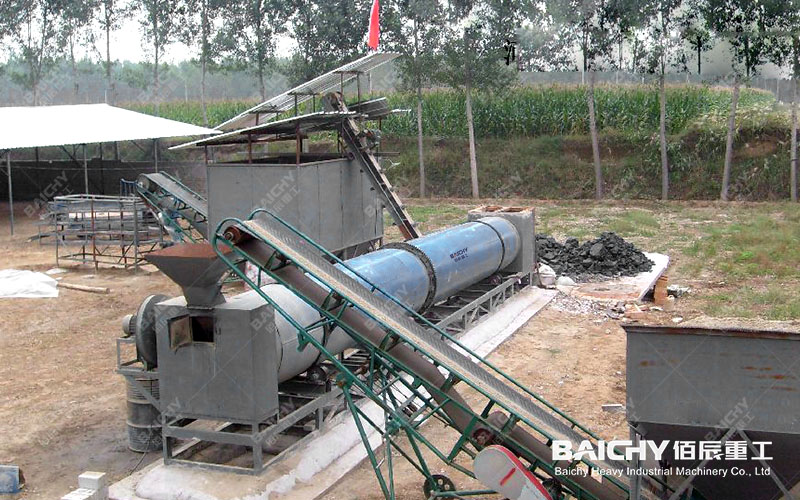
Dryer Customer Site
III. Scenario-Based Selection Recommendations
| Your Application Scenario | Recommended Primary Model | Rationale and Considerations |
| Large-scale Municipal / General Industrial (>50 t/d) | Rotary Drum Dryer | High cost-effectiveness and stable operation; for higher thermal efficiency, a triple-pass structure is recommended. |
| High-Viscosity, Paste-like Chemical Sludge | Paddle (Rake) Dryer | Powerful agitation and self-cleaning capabilities resolve issues with material sticking to walls; vacuum models are suitable for processing solvent-containing sludge. |
| Heat-Sensitive Materials (Requiring Activity Preservation) | Belt Dryer *or* Low-Temperature Heat Pump Dryer | Belt dryers are suitable for continuous, gentle drying; heat pump dryers are ideal for small-scale operations with extremely strict requirements for odor control. |
| Pursuit of Ultimate Energy Efficiency / Waste Heat Utilization | Paddle Dryer *or* Triple-Pass Rotary Drum Dryer | Paddle dryers minimize conductive heat loss, while triple-pass rotary drums offer excellent thermal insulation; both are suitable for use with steam or thermal oil heat sources. |
| VOC-Containing / Flammable & Explosive Sludge | Vacuum Paddle Dryer | Operates in a sealed, low-oxygen environment for maximum safety; allows for simultaneous solvent recovery. |
IV. Key Operational and Maintenance Recommendations
1. Anti-Sticking and Anti-Caking: Industrial sludge typically exhibits high viscosity; equipment must be fitted with mechanical breaking mechanisms (e.g., rotating rakes, scrapers) or back-mixing devices (re-incorporating dried sludge) to prevent clogging and subsequent equipment downtime.
2. Corrosion Protection: For acidic or alkaline sludge—such as that from electroplating or chemical industries—materials in contact with the sludge must be upgraded to stainless steel (304/316L) or higher-grade corrosion-resistant alloys.
3. Tail Gas Treatment: The drying process generates large volumes of dust-laden and odorous exhaust gas; a comprehensive treatment system—combining dust removal (e.g., bag filters, wet electrostatic precipitators) with odor control (e.g., biofilters, chemical scrubbers)—is mandatory to ensure compliance with emission standards.
4. Energy Consumption Control: Whenever possible, utilize existing process waste heat within the facility (e.g., boiler flue gas, steam condensate) or employ heat pump technology to reduce the cost per unit of water evaporated.
Final Recommendation: Given the complex composition of industrial sludge, it is strongly recommended to conduct small-scale or pilot-scale trials prior to making a final equipment selection. By conducting practical material tests to evaluate wall adhesion, evaporation efficiency, and final moisture content, potential project failures resulting from deviations in theoretical calculations can be avoided.
Three Common Questions Regarding Industrial Sludge Dryers
1. How dry should industrial sludge be dried to be considered appropriate?
This "endpoint" depends entirely on the subsequent method of disposal or utilization:
• For Incineration: Reducing the moisture content to 50%–60% is sufficient. At this level, the calorific value of the sludge increases significantly, allowing for stable, self-sustaining combustion while substantially reducing fuel consumption; this represents the optimal balance between energy efficiency and cost.
• For Building Materials (Bricks/Ceramsite): Deep drying to a moisture content of 10%–20% is typically required to ensure the structural strength of the finished products. Additionally, the content of impurities—such as chlorine and sulfur—must be controlled to prevent the generation of corrosive gases during the sintering process.
• For Landfilling: It is sufficient to simply meet the admission standards of the local landfill facility (typically ranging from 40% to 60% moisture content). The primary objective here is significant volume reduction, thereby saving landfill space and costs.
2. Which type of dryer is most reliable for processing high-viscosity, prone-to-caking chemical sludge?
The paddle (or rake) dryer is the preferred choice. Its core advantages include:
• Self-Cleaning and Agitation: While providing conductive heating, the hollow paddles continuously shear and agitate the sludge; this effectively breaks up large clumps of sludge and prevents them from adhering to and solidifying on the dryer walls or paddles.
• High Adaptability: It can be designed as a vacuum-type system, allowing for drying in a low-temperature, enclosed environment. This makes it particularly suitable—and highly safe—for processing chemical sludge that contains solvents, emits odors, or is heat-sensitive.
• High Heat Transfer Efficiency: Heat is transferred directly to the sludge through the metal walls, resulting in minimal heat loss and a thermal efficiency that typically exceeds 90%.
3. What are the main components of the operating costs for industrial sludge drying? How can these costs be reduced?
Operating costs primarily consist of three components: energy consumption, maintenance, and exhaust gas treatment. Among these, energy consumption accounts for the largest share (potentially reaching up to 70%).
Key Components:
• Energy Costs: The cost of the heat source (steam, natural gas, or electricity) constitutes the largest single expense, while the cost per unit of evaporated water serves as the core performance metric. • Maintenance Costs: Expenses associated with replacing wear parts (such as paddles, bearings, and seals), as well as repairing components damaged by corrosion or abrasion.
• Environmental Compliance Costs: Costs incurred to treat dryer exhaust gases (containing dust, odors, and VOCs) in order to meet regulatory emission standards.
Key Strategies for Cost Reduction:
• Waste Heat Utilization: Maximizing the use of the plant's process waste heat—such as boiler flue gas, steam condensate, and process off-gases—as the heat source for drying represents the most cost-effective solution.
• Precise Equipment Selection: Selecting equipment specifically matched to the characteristics of the sludge (e.g., using a paddle dryer for viscous sludge) helps prevent costly downtime and high maintenance expenses caused by frequent clogging and fouling.
• Exhaust Gas Optimization: Employing a combined condensation and heat recovery process to treat exhaust gases allows for the reclamation of a portion of the moisture and thermal energy, thereby reducing overall energy consumption.