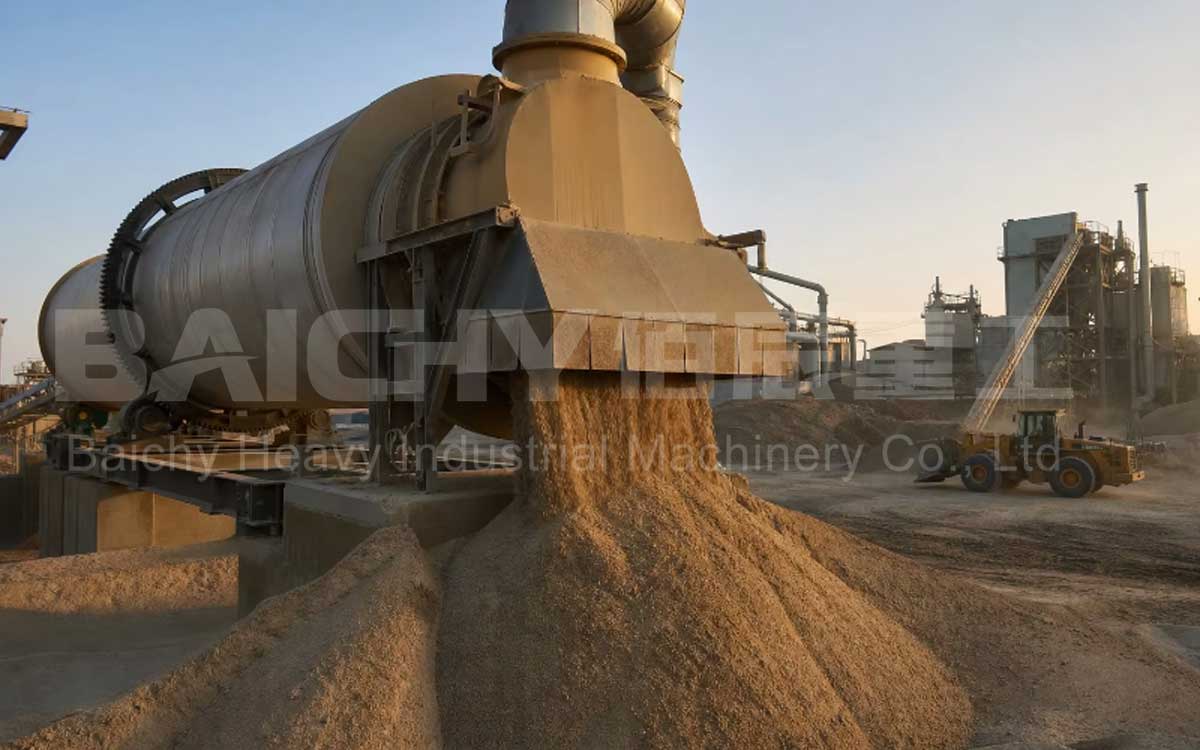
Sand drying production line
A sand drying production line is not merely a sale of a dryer; it represents a system capability that ensures a stable output moisture content of ≤0.5%. Washed sand and manufactured sand typically leave the plant with moisture levels between 8% and 20%; while open-air drying can reduce this to 5%–8%, the process is at the mercy of the weather. In contrast, procurement contracts for dry-mixed mortar, asphalt mixing, and sand for casting or glass manufacturing strictly cap moisture content at 0.5% or lower. Consequently, the purpose of drying has evolved from simply "reducing weight to save on shipping costs" to serving as an "entry ticket" for quality-based transactions. For sand and gravel enterprises with a daily output exceeding 50 tons, a properly configured sand drying production line is a strategic investment that shifts the product from competing on tonnage to commanding a quality premium.
I. Why a "Production Line" Instead of Just a "Dryer"?
Purchasing a standalone dryer addresses the "drying" process, whereas a sand drying production line addresses the need for "stability." The interfaces between pieces of equipment are often the primary sources of malfunction:
• Matching the hot blast stove with the main unit: Insufficient heat reduces output, while excessive heat causes exhaust temperatures to spike and burns out dust collector bags.
• Balancing dust extraction airflow with induced draft: Insufficient airflow leads to inadequate negative pressure inside the drum and dust leakage, while excessive airflow draws fine sand into the dust collector.
• Discharge cooling and conveying seals: Hot sand entering the storage bin directly can reabsorb moisture and clump, while air leaks in the conveying section allow cold, humid air to enter the system.
• Interlocking moisture, temperature, and feed rates: Manual monitoring cannot guarantee stable output moisture when the input material's moisture content fluctuates.
Demand-side requirements are also driving the necessity for such production lines. Data from the China Sand and Gravel Association's Big Data Center indicates that national sand and gravel production in 2024 reached approximately 15.3 billion tons. Tightening supplies of natural sand have driven a continuous rise in the proportion of manufactured sand, while wet sand-washing processes have generally increased the moisture content of the finished product. Meanwhile, the international research firm Mordor Intelligence forecasts that global dry-mixed mortar production will grow to approximately 458 million tons by 2031. The rising demand for dry sand is structural in nature, and drying is shifting from a "niche process" to a "standard feature" for manufactured sand plants.
Demand is tiered, and production lines must be tiered accordingly. For construction sand (river sand or manufactured sand), drying moisture content to 1%–2% addresses issues related to weight reduction and storage; conversely, orders for dry-mixed mortar plants, asphalt mixing, casting, and glass-grade sand require moisture levels of 0.5% or lower—here, the product is sold based on grade. One must first determine the target market for the sand before deciding on the specifications of the drying line; this choice dictates whether the main unit is a triple-pass or single-pass dryer, whether the dust collection system requires anti-condensation features, and whether the control system needs an online closed-loop moisture monitoring function.
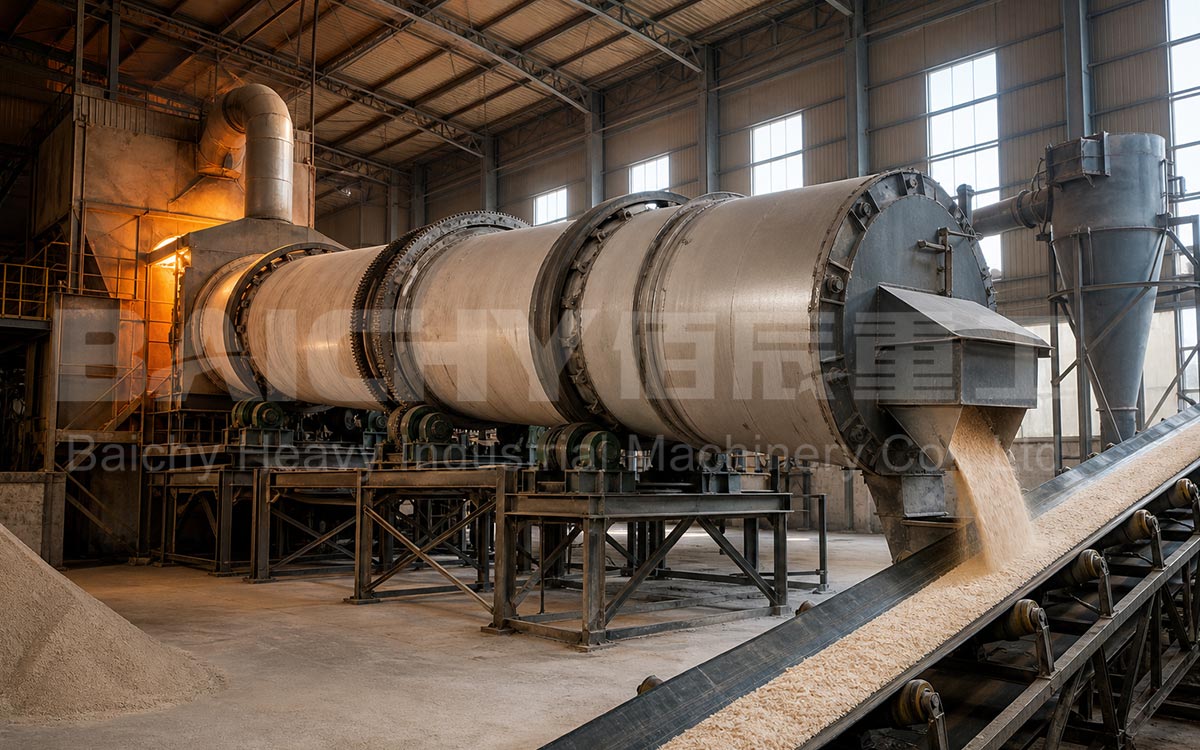
sand drying equipment
II. The Complete Process of a Standard Sand Drying Line
Standard workflow: Wet sand stockpile → Feed hopper (with grizzly screen for impurity removal) → Belt conveyor → Hot blast stove → Main drying unit (triple-pass dryer or single-pass rotary dryer) → Discharge conveyor → Single-pass cooler → Bucket elevator → Finished product silo/loading station. Exhaust gas is discharged after undergoing a two-stage dust removal process: primary separation via cyclone and fine collection via bag filter.
2.1 Main Unit Section: Where Evaporation Occurs
The triple-pass structure facilitates three stages of heat exchange between hot air and material within a self-insulating drum, achieving a thermal efficiency of approximately 45% (compared to about 35% for single-pass rotary dryers). For the same production capacity, the total length of the unit is about 60% shorter than that of a single-pass dryer, making it the mainstream choice for sand drying lines. However, for materials with extremely high moisture content or high clay/stickiness, a single-pass rotary dryer equipped with a breaking mechanism to prevent wall adhesion is selected.
2.2 Auxiliary Section: The Critical Factor for Cost Variance
The heat source (natural gas, coal, biomass, or waste heat) dictates the cost-per-ton curve. Dust collection and piping systems require thermal insulation and dew-point control in northern winters or high-humidity regions; otherwise, condensation causes "bag blinding" (clogging), leading to immediate system shutdown. When comparing prices, the hot-blast stove, dust collection system, and conveying equipment must be included in the total cost, rather than comparing only the price of the main unit.
2.3 Control Section: The Engineering Prerequisite for Consistent Output
An airlock valve at the discharge end prevents the finished product from reabsorbing moisture. An online moisture analyzer links the variable-frequency feeder and hot-air temperature, replacing "operator intuition" with "instrument-based closed-loop control"—this is the key to maintaining a long-term moisture content of ≤0.5% in the sand drying line. The design logic follows a "reverse-engineering from final moisture content" approach: first, establish the target discharge moisture and production capacity; next, calculate the hourly evaporation rate; then, determine the hot-air temperature, residence time inside the drum, and required airflow. All equipment selection centers on this evaporation figure, rather than selecting machines first and then cobbling together a process.
III. Reference Table for Complete Line Configuration by Capacity
A complete production line is not merely a scaled-up version of the main unit; as capacity increases, the heat source and dust collection systems account for a larger proportion of the total system. The following table provides configuration references for sand drying lines across three capacity tiers.
| Configuration Item | 10–15 t/h | 20–30 t/h | 50–80 t/h |
|---|---|---|---|
| Capacity Configuration | 10–15 t/h | 20–30 t/h | 50–80 t/h |
| Recommended Main Unit | Φ2.0×4m Triple-drum | Φ2.5×6m Triple-drum | Φ3.6×8m Triple-drum |
| Hot Air Furnace | Gas/Coal dual-fuel furnace | Customized based on local energy sources | Large hot air furnace + economizer |
| Dust Removal System | Cyclone + bag filter | Cyclone + bag filter (anti-condensation) | Multi-tube cyclone + pulse-jet bag filter |
| Discharge Moisture Content | ≤0.5% | ≤0.5% | ≤0.5% |
| Installed Power | Approx. 45–60 kW | Approx. 80–110 kW | Approx. 200–280 kW |
| Reference Footprint | Approx. 200–300 m² | Approx. 350–500 m² | Approx. 700–1000 m² |
| Typical Downstream Applications | Dry-mixed mortar plant, small sand washing plant | Mortar plant + asphalt mixing plant | Large sand-making plant, sand and gravel distribution center |
* Reference configuration for a standard sand drying production line (feed moisture ~8–20%, discharge ≤0.5%). Capacity is on a dry-product basis; final scope confirmed by process calculation. | Baichy Heavy Industry
Production capacity varies based on feed moisture content, particle size, and sand type; the figures above are estimates, and final specifications are subject to calculation based on actual operating conditions.
IV. Core Main Unit Specifications: Bacihy Triple-Drum Dryer (Sand Drying Series)
| Model | Outer Diameter × Length (m) | Drum Volume (m³) | Rotation Speed (r/min) | Max. Inlet Air Temp. (°C) | Capacity (t/h) | Main Unit Power (kW) |
|---|---|---|---|---|---|---|
| Φ2.0×4m | 2.0×4 | 12.56 | 4–10 | 700–750 | 8–15 | 5.5×2 |
| Φ2.2×5m | 2.2×5 | 18.99 | 4–10 | 700–750 | 12–20 | 5.5×2 |
| Φ2.5×6m | 2.5×6 | 29.43 | 4–10 | 700–750 | 18–28 | 7.5×2 |
| Φ2.8×6m | 2.8×6 | 36.92 | 4–10 | 700–750 | 25–35 | 11×2 |
| Φ3.0×6m | 3.0×6 | 42.39 | 4–10 | 700–750 | 30–40 | 7.5×4 |
| Φ3.2×7m | 3.2×7 | 56.27 | 4–10 | 700–750 | 35–55 | 11×4 |
| Φ3.6×8m | 3.6×8 | 81.39 | 4–10 | 700–750 | 55–75 | 18.5×4 |
| Φ4.0×10m | 4.0×10 | 125.60 | 4–10 | 700–750 | 70–100 | 22×4 |
* Capacity rated under typical washed-sand conditions (feed moisture ~8–20%, discharge ≤0.5%). High-moisture or sticky feed reduces actual throughput by 20–30% — select one size up if in doubt. | Baichy Heavy Industry
V. Three Key Selection Criteria Determining the Success of the Entire Line
• Specify the evaporation capacity, not just the production output: The supplier's "t/h" rating—whether based on wet or dry material throughput and the assumed input moisture content—must be explicitly stated in the contract's technical annex. Example calculation: For a 20 t/h dry sand line with 10% input moisture and a target output moisture of ≤0.5%, the evaporation requirement (E) is 20 × (0.10 − 0.005) / (1 − 0.005) ≈ 1.9 t/h. This means nearly 2 tons of water must be evaporated per hour—this is the true benchmark for budgeting heat sources and fuel.
• Sea sand requires "salt washing before drying": Failure to remove chloride ions leads to corrosion of the equipment and downstream concrete or mortar products; the sand must undergo a washing and desalination process prior to drying.
• Increase airflow specifications for high-altitude locations: Air is thinner at high altitudes, requiring higher airflow rates for induced draft fans and burner combustion air; always specify the site altitude and grid voltage/frequency (customization is available for 380V/50Hz, 400V/50Hz, 440V/60Hz, etc.) during inquiries. Neglecting any of these three points will result in compounded issues during commissioning—such as material clogging, failure to meet standards, or reduced output. Providing complete operational details allows the supplier to offer performance guarantees that can be formally included in the contract.
VI. Economic Analysis of the Line: Drying is a Business with Quantifiable Costs
Based on calculations assuming 12% input moisture and ≤0.5% output moisture, approximately 110–120 kg of water must be evaporated per ton of wet material. For a triple-drum drying line, the comprehensive heat consumption per ton of dry sand is approximately 130,000–160,000 kcal (equivalent to 18–22 kg of standard coal or 15–18 Nm³ of natural gas), while electricity consumption for fans, dust removal, and conveying systems is approximately 4–7 kWh per ton. To determine if the investment is worthwhile, do not simply compare equipment prices; instead, compare the "processing cost per ton" against the "price difference between dry and wet sand." The profit margin generated by the sand drying line is the price difference minus the processing cost per ton. When production capacity is sufficient, the equipment investment can typically be recouped within one or two peak seasons. The exact timeframe depends on local energy prices and regional sand price differentials; be sure to recalculate based on actual prices before placing an order.
Here is a verifiable example: If the local price difference between dried sand and wet-washed sand is 40 RMB/ton and the processing cost is approximately 20 RMB/ton, the gross profit is about 20 RMB/ton. For a sand drying line with a capacity of 20 t/h and a daily output of 400 tons, the daily gross profit is approximately 8,000 RMB; 6,000 hours of annual operation is sufficient to cover most of the equipment investment. Since price differentials fluctuate by region and season, please recalculate using actual local prices before signing a contract—we provide a cost-per-ton calculation template along with our proposal.
VII. Baichy’s Turnkey Line Delivery: An Integrated Solution for Crushing, Sand Making, Washing, and Drying
Baichy Heavy Industry is a full-chain manufacturer of equipment for mining crushing, sand making and washing, grinding, and mineral processing, as well as a system integrator for complete sand drying line solutions. The sand drying line can be planned and delivered by a single provider alongside upstream crushing and sand-making lines and sand washing/dewatering equipment. We provide a seamless connection from the feeder to the finished product silo interface, eliminating coordination issues between multiple suppliers. Equipment is customized to local electrical standards, backed by a service commitment that includes a 60-second response time, technical answers within 30 minutes, and design proposals delivered within 24 hours.
When requesting a configuration proposal, please provide the following details: sand type and source (river sand, manufactured sand, or sea sand), feed moisture content, target moisture content, target capacity, available heat sources, and site altitude, voltage, and frequency. Once we receive these operational parameters, we will directly provide an equipment list, a general layout plan, and a cost-per-ton calculation.
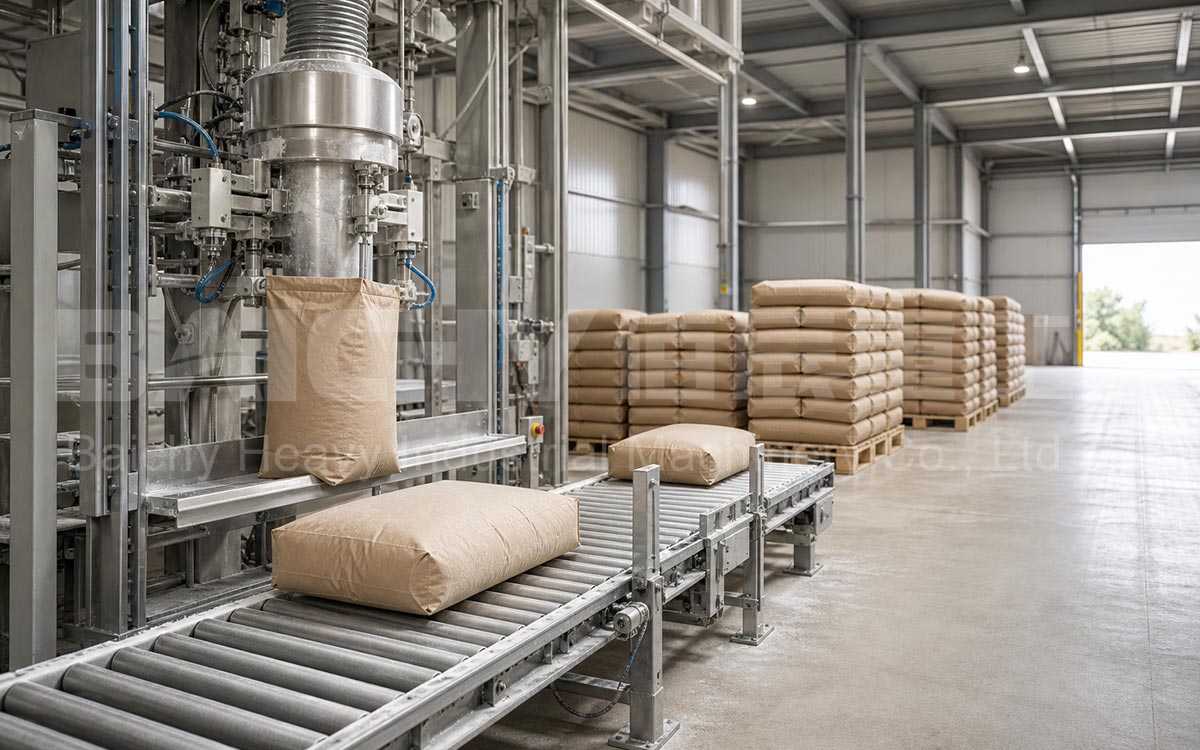
Packaging of finished products
FAQ: Common Questions About Sand Drying Lines
1. What equipment is included in a sand drying line? What does the quote cover?
The standard configuration includes a feed hopper, belt conveyor, hot air furnace, main drying unit (triple-pass or single-pass rotary drum), discharge cooling and lifting system, cyclone and baghouse dust collectors, an induced draft fan, and an electrical control system. When requesting a quote, be sure to clarify whether the hot air furnace, dust collection system, and conveyors are included; these three components often account for a significant portion of the budget, so comparing only the price of the main unit is meaningless. A complete line delivery should also include installation guidance, commissioning, and operational training. Contract terms must clearly define interface responsibilities to prevent finger-pointing among different suppliers if the main unit, hot air furnace, and dust collection system are sourced from separate vendors.
2. What is the production line's footprint? Can it be installed outdoors?
Depending on the production capacity (10–100 t/h), the footprint ranges from approximately 200 to 1,000 m² (the triple-pass design reduces the footprint by about 60% compared to the single-pass design, making it suitable for smaller sites). While the main unit can be installed outdoors, it is recommended to house the electrical control cabinet indoors. In northern regions during winter or in high-humidity areas, the dust collector, ductwork, and storage silos require thermal insulation to prevent condensation, while the cooling section needs protection against rain and moisture re-absorption.
3. Which heat source is the most cost-effective? Can waste heat be utilized?
Compare the costs of natural gas, coal, biomass, and diesel based on local unit heat prices; long-term cost differences can exceed 20%. Factories with waste heat sources (such as kiln exhaust or generator flue gas) should prioritize waste heat utilization schemes, as fuel costs can be reduced to near zero. The equipment offers fuel flexibility, avoiding reliance on a single energy market; when selecting a model, simply plug local gas and coal prices into the cost-per-ton formula to calculate the total cost over a three-year period.
Baichy Heavy Industry
Baichy Heavy Industry is a high-tech mining equipment company integrating R&D, manufacturing, sales, and after-sales service. Focusing on crushing, grinding, and mineral processing equipment, we provide professional solutions to our customers. We are ISO9001:2015 、certified, and our products include mobile crushing palnts, crawler crushing plant, construction waste crushing plants, jaw crushers, sand making machines, cone crushers, fine crushers, grinding mills, ball mills, etc., all with reliable performance to meet diverse project needs.
Baichy Heavy Industry – Your Trusted Partner
To ensure optimal performance of your equipment, Baichy Heavy Industry offers:
- Professional on-site installation guidance
- Comprehensive operator training
- 24/7 technical support & maintenance services
Our complete after-sales service system guarantees long-term, stable operation of your machinery with minimal downtime.
Protect Your Rights – Only Use Official Channels
To avoid scams and ensure authentic support, contact us exclusively through:
• Official Website: www.baichychina.com
• WhatsApp: +8615093222637
• Email: [email protected]
Your satisfaction is our priority – expect prompt, professional service every time.
(Note: Beware of unauthorized third parties claiming to represent Baichy. Always verify through official contacts.)