
Manganese Ore Crushing Equipment and Processing Flow
The core challenge in manganese ore processing lies in balancing "grade upgrading" against "controlling over-pulverization": lump ore must be sized via crushing and screening for furnace feed, while fine, low-grade ore requires enrichment through washing and high-intensity magnetic separation. The established processing route involves "jaw crushing (primary) → cone/impact crushing (secondary) → washing and desliming → high-intensity magnetic separation → ball milling (fine grinding)." Selecting the right equipment models and parameters can reduce electricity consumption per ton of ore processed by 15%–20%. This article outlines comprehensive manganese ore processing workflows and equipment selection strategies, covering four dimensions: process, application scenario, parameters, and case studies.
I. Overview of Manganese Ore Characteristics and Processing Workflows
1.1 Ore Type Determines the Processing Route
Manganese ores are categorized into three main types based on mineral form; differences in hardness and beneficiation characteristics dictate the choice of crushing equipment and processing methods:
| Ore Type | Primary Minerals | Mohs Hardness | Major Producing Regions | Typical Process |
| Manganese Oxide Ore | Pyrolusite, Psilomelane | 2-6 | South Africa, Gabon, Australia, Ghana | Crushing + Washing + High-Intensity Magnetic Separation/Gravity Separation |
| Manganese Carbonate Ore | Rhodochrosite | 3.5–4.5 | China, Ukraine, India | Crushing + Flotation/Roasting & Magnetic Separation |
| Composite Manganese Ore | Braunite, Manganite, etc. | 4-6 | Brazil, Côte d'Ivoire | Crushing + Combined Beneficiation Process |
Global manganese ore resources are highly concentrated: South Africa ranks first in both reserves and production, while Gabon is the second-largest producer (accounting for 63% of US manganese ore imports in 2024). Together, three countries—South Africa, Gabon, and Australia—contribute approximately 74% of global manganese ore production (USGS, 2023). Metallurgical-grade manganese ore generally requires a grade of ≥30% Mn, whereas battery-grade feedstock typically requires ≥40% Mn with strictly controlled impurities; the higher the grade threshold, the more rigorous the requirements for precision in the crushing and beneficiation stages.
1.2 Overview of Manganese Ore Processing Flow
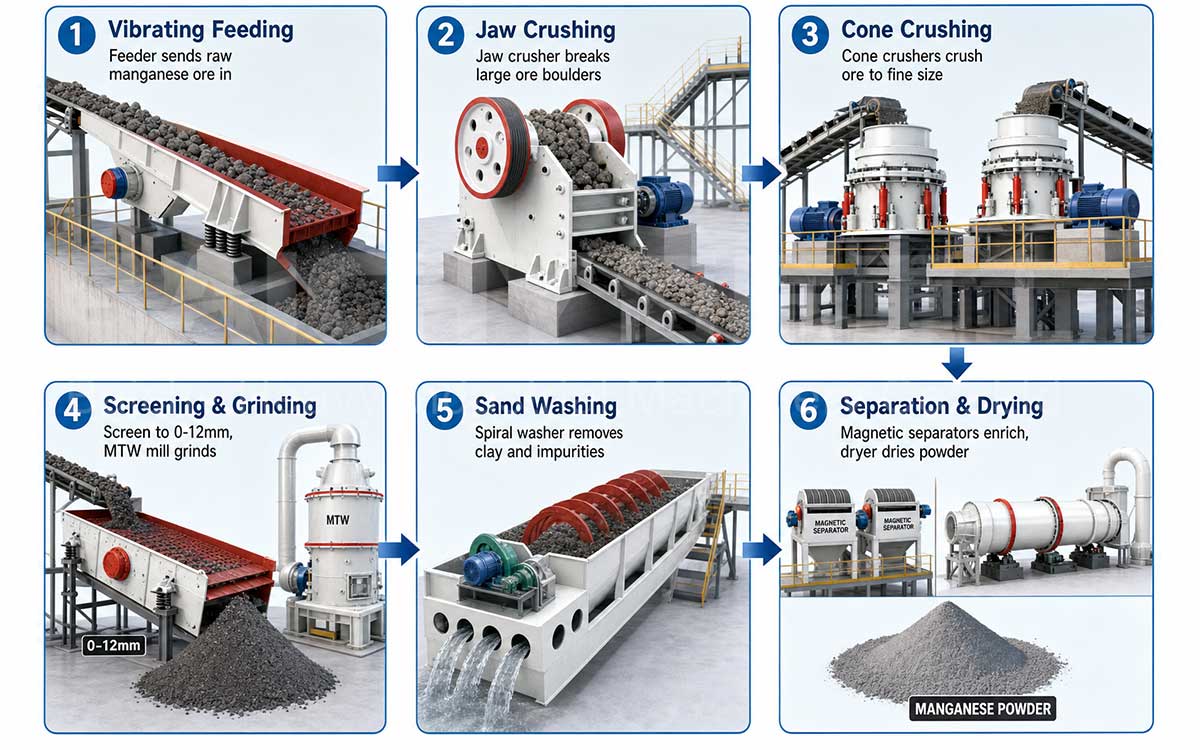
A typical manganese ore processing flow consists of: mining → primary crushing → secondary crushing → washing and desliming → screening and classification → beneficiation (via high-intensity magnetic separation, gravity separation, or flotation) → concentrate grinding → drying and packaging. Crushing and screening constitute the "particle size preparation stage," which determines subsequent beneficiation efficiency: the more uniform the feed size, the higher the separation precision of high-intensity magnetic separation and jigging, and the more stable the concentrate grade and recovery rate. The lump ore route (metallurgical grade) typically involves crushing to ≤40 mm followed by direct classification and furnace charging; the fine-particle route (battery grade) requires further grinding until more than 85% of the material passes through a 0.074 mm sieve.
II. Application Scenarios for Manganese Ore Crushing Equipment
2.1 Metallurgical-Grade Manganese Ore Processing Plants (Feedstock Preparation for FeMn/SiMn)
Supporting ferromanganese or silicomanganese alloy production lines (using blast furnaces or electric arc furnaces), this process crushes run-of-mine ore to the required lump size and classifies it. This scenario demands high hourly throughput, low failure rates, and continuous operation from the crushing equipment; the yield of lump ore directly impacts the furnace feed grade and the specific power consumption of alloy production.
2.2 Battery-Grade/Chemical-Grade Manganese Ore Processing Lines
For production lines manufacturing electrolytic manganese metal (EMM), electrolytic manganese dioxide (EMD), and manganese sulfate, ore must first be crushed to ≤20–25 mm for mill feeding and subsequently ground to a fine powder for leaching reactions. This route places extremely high demands on particle size uniformity; closed-circuit crushing using cone crushers is the key step in controlling over-grinding.
2.3 Washing and Beneficiation of High-Clay Oxidized Manganese Ore
Oxidized manganese ores in tropical and subtropical regions often coexist with clay. Consequently, a washing and desliming stage (utilizing spiral or wheel-bucket sand washers combined with dewatering screens) must be added after crushing; otherwise, the clay content dilutes the grade and clogs downstream magnetic separation equipment. A combination of washing and high-intensity magnetic separation constitutes the standard processing flow for this type of ore. 2.4 Pre-treatment of Manganese Carbonate Ore: Flotation/Roasting
Rhodochrosite typically exhibits fine-grained dissemination; the ore must be crushed to ≤10 mm before proceeding to the grinding-flotation circuit, or alternatively, roasted to convert it into MnO prior to magnetic separation. Strict control of particle size during the crushing stage is a prerequisite for achieving uniform roasting and optimal flotation performance.
III. Core Parameter Configuration Table for Manganese Ore Crushing Equipment
The following outlines the equipment configuration for a typical 100 tph manganese ore crushing, screening, and grinding production line (reference values based on design operating conditions):
| Process | Equipment Model | Feed Size | Discharge Size | Capacity | Motor Power |
| Feeding | ZSW-380×96 Vibrating Feeder | ≤500 mm | - | 96–160 t/h | 11 kW |
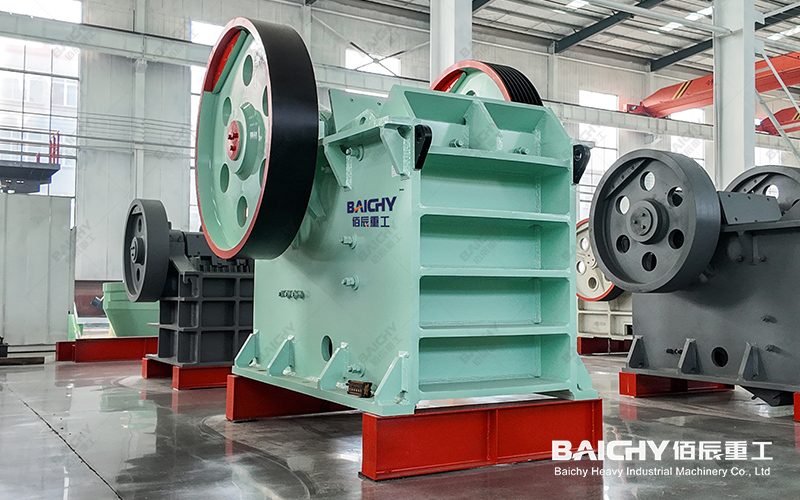
| Primary Crushing | PE-600×900 Jaw Crusher | ≤500 mm | 65–160 mm | 96–160 t/h | 75 kW |
| Secondary Crushing | CS-160 Cone Crusher (hard ore) / PF-1214 Impact Crusher (soft ore) | ≤350 mm | ≤40 mm | 100–150 t/h | 160 kW |
| Screening | 3YK-1860 Circular Vibrating Screen | ≤40 mm | 0–10 / 10–40 mm | -- | 15 kW |
| Washing & Desliming | 2XL-915 Spiral Sand Washer + Dewatering Screen | ≤40 mm | Washed ore | 100–120 t/h | 15 kW × 2 |
| Fine Grinding (Battery-grade route) | φ2.4×8 m Ball Mill | ≤25 mm | -0.074 mm ≥85% | 20–25 t/h | 245 kW |
Capacity Conversion Note: Equipment nameplate capacities are typically rated based on limestone (loose bulk density approx. 1.6 t/m³). Manganese ore has a loose bulk density of approx. 1.9–2.2 t/m³; therefore, capacity by weight may increase by 10%–25%. However, if clay or moisture content is high, the risk of clogging by wet material must be considered, and a capacity margin of at least 15% should be allowed for the washing and screening stages.
IV. Core Advantages of Manganese Ore Crushing Equipment
4.1 Low energy consumption and high yield for brittle, low-to-medium hardness ores
Minerals such as pyrolusite and psilomelane are typically brittle, with compressive strengths far lower than that of granite. A combination of jaw and cone crushers offers a high reduction ratio, uniform product sizing, and a low over-crushing rate. This not only reduces electricity consumption during the crushing stage but, more importantly, minimizes interference from fine ore dust on subsequent high-intensity magnetic separation performance.
4.2 Inter-particle crushing preserves particle size, enhancing magnetic separation efficiency
Manganese minerals are weakly magnetic; high-gradient, high-intensity magnetic separation is the primary method for concentrating fine particles, yet this process is sensitive to feed particle size distribution. Cone crushers utilize inter-particle (choke-fed) crushing to produce regular particle shapes and control fine-particle content. This significantly improves the separation precision and concentrate grade of high-intensity magnetic separators, effectively trading superior crushing quality for higher mineral recovery rates.
4.3 Integrated ore washing and desliming stabilize the grade baseline
If clay-bearing manganese ore is not deslimed, the clay content dilutes the grade and coats the manganese mineral particles. Baichen’s closed-loop configuration—comprising a spiral sand washer, dewatering screen, and fine sand recovery unit—keeps ore washing losses below 3%, ensuring a stable feed for subsequent grinding and high-intensity magnetic separation.
4.4 Superior Total Cost of Ownership (TCO)
Equipment selection for the secondary crushing stage is based on ore hardness: impact crushers are used for soft manganese oxide ores (offering low investment and easy maintenance), while cone crushers are used for hard ores or when particle shape preservation is critical (offering long wear-part life and low per-ton consumption). Overall, properly selected manganese crushing equipment can reduce the total cost per ton of ore by 15%–20% over a 3-to-5-year period.
4.5 Project Case Reference (Typical Configuration)
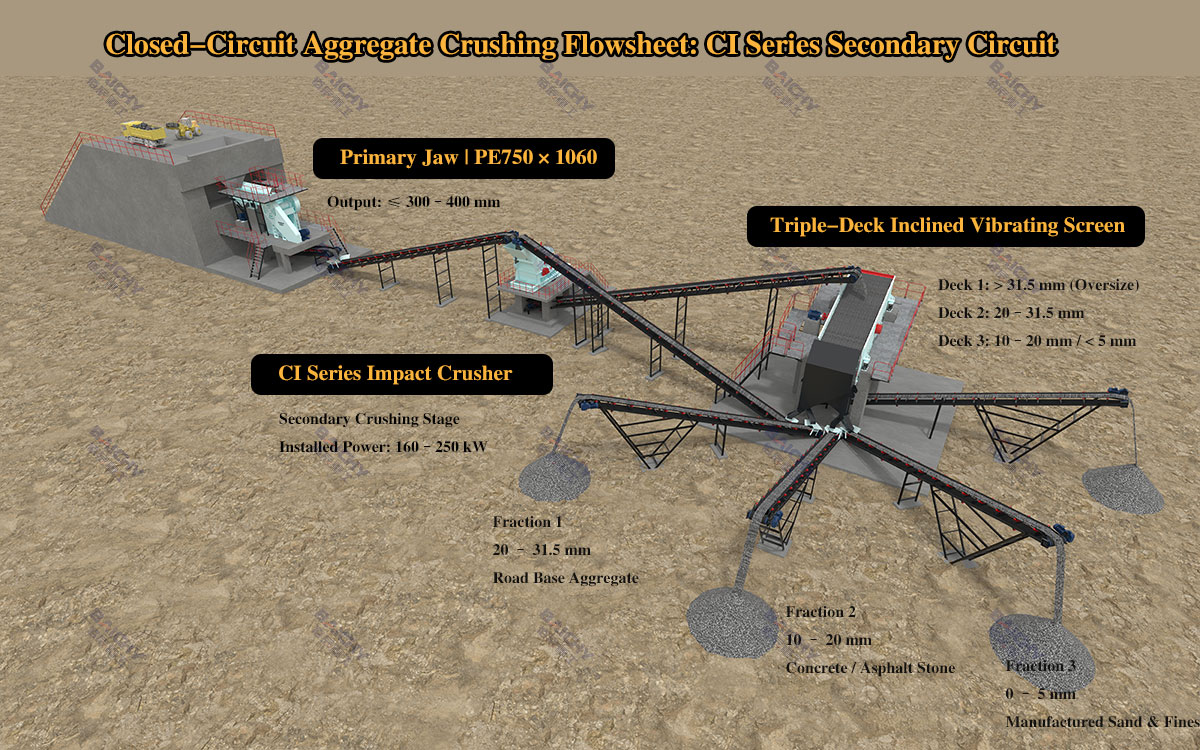
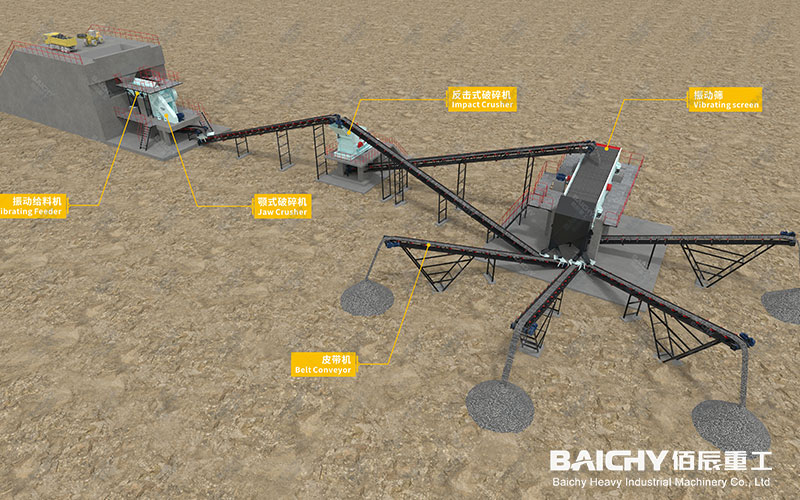
Crushing workshop for a manganese ore processing plant in Southwest China (typical configuration): Utilizes a two-stage, one-closed-circuit process comprising a ZSW feeder, PE-600×900 jaw crusher, CS-160 cone crusher, and 3YK-1860 vibrating screen. Design specifications include a mill feed size of ≤25mm, a P80 passing rate exceeding 90%, and crushing energy consumption of approximately 1 kWh per tonne of ore, with over 7,000 hours of continuous annual operation. A spiral sand washer and dewatering screen are added when the raw ore has high clay content. Specific data depends on actual site materials and operating conditions; Baichen offers free process design services.
V. Recommended Equipment
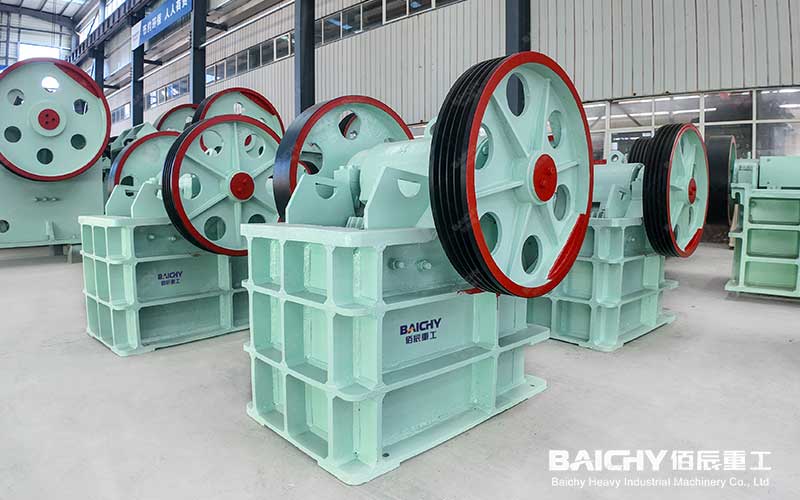
Primary Crushing: PE series jaw crushers (PE400×600 to PE900×1200); capable of reducing the size of large raw manganese ore blocks.
Secondary/Fine Crushing: CS/HP series cone crushers (for hard manganese ore and strict product size requirements); PF series impact crushers (for soft manganese oxide ore).
Ore Washing & Desliming: Spiral sand washers, XSD wheel-bucket sand washers, dewatering screens, and fine sand recovery machines.
Beneficiation/Enrichment: Wet high-intensity magnetic separators (for fine-grained manganese oxide ore); SF series flotation machines (for manganese carbonate ore); jigs/spiral chutes (for coarse-grained gravity separation).
Fine Grinding: Ball mills (grate-discharge or overflow types; ceramic lining available to minimize iron contamination), operated in a closed circuit with classifiers.
Auxiliary Equipment: ZSW vibrating feeders, YK circular vibrating screens, belt conveyors, and rotary dryers (for concentrate drying).
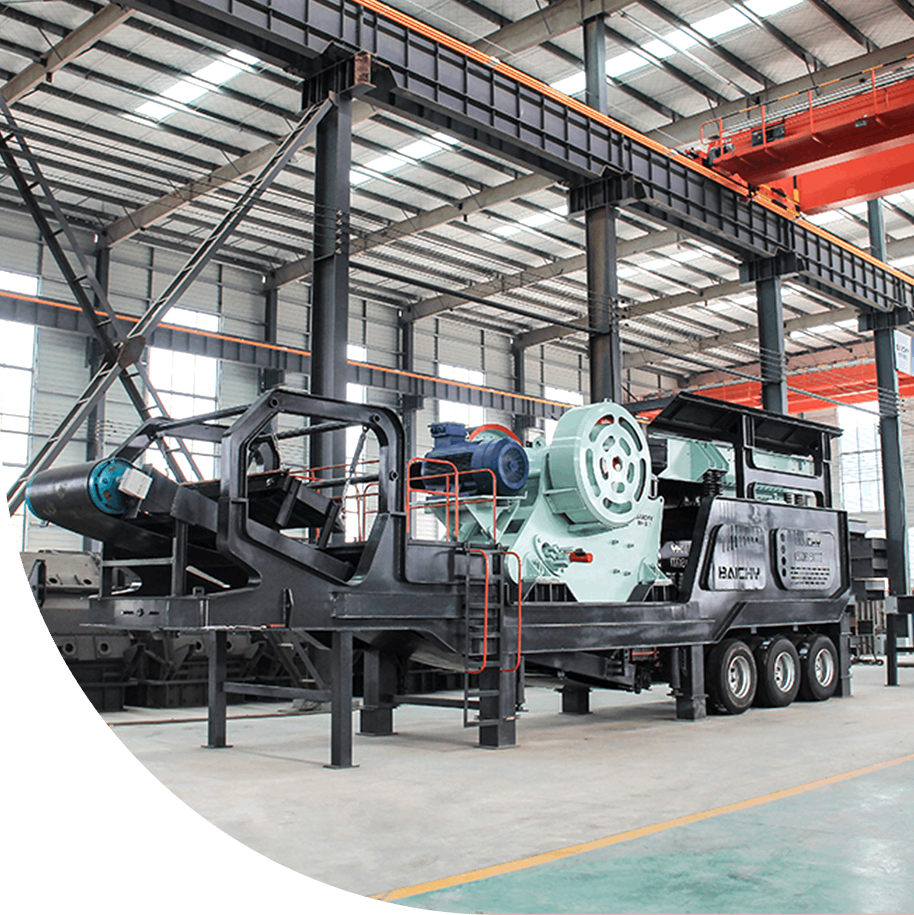
Mobile Solutions: YDPZ mobile crushing stations; suitable for on-site crushing in dispersed mining areas to reduce material transfer costs.
VI. FAQ
Q1: Should I choose an impact crusher or a cone crusher for manganese ore?
It depends on the ore hardness and the intended application. For pyrolusite (hardness 2–3), which is highly brittle, impact crushers offer high product yield and low investment costs. However, for psilomelane and braunite (hardness 4–6)—or for battery-grade production requiring high particle size uniformity—cone crushers utilizing inter-particle (layer) crushing are essential; impact crushers suffer from rapid hammer wear and excessive fines generation in these applications. Jaw crushers are universally adopted for the primary crushing stage.
Q2: Which is more critical in the manganese ore processing flow: ore washing or high-intensity magnetic separation?
It depends on the ore type. For high-clay oxidized manganese ore, "washing first" is mandatory; failure to remove clay dilutes the grade and clogs equipment, making washing the baseline for the entire process's grade quality. Conversely, for oxidized manganese ore with fine-grained dissemination, high-intensity magnetic separation serves as the core beneficiation method. Manganese carbonate ores typically follow a flotation or roasting-magnetic separation route. It is recommended to conduct ore beneficiability tests before finalizing the process flow.
Q3: What are the particle size requirements for crushing battery-grade manganese ore?
Standard practice requires crushing to ≤20–25 mm before grinding, followed by grinding to a product where over 85% passes through a 0.074 mm sieve (specifics depend on the leaching process). The crushing stage requires cone crushers in a closed-circuit configuration to ensure particle size uniformity and minimize over-crushing; excessive fines increase energy waste during grinding, while coarse particles hinder leaching reaction rates and recovery rates.
Conclusion
Opportunities for cost reduction in manganese ore processing largely lie in the interface between the crushing/grinding stages and the washing/beneficiation stages. By properly matching equipment types and parameters for primary crushing, secondary crushing, washing, and magnetic separation, both metallurgical-grade and battery-grade projects can benefit from lower electricity consumption per ton, as well as higher concentrate grades and recovery rates. Baichy Heavy Industry offers a full range of equipment—including jaw crushers, cone crushers, impact crushers, high-intensity magnetic separators, ball mills, and mobile crushing stations—along with free process design services. You are welcome to submit your manganese ore samples and capacity requirements to receive a customized solution.
Baichy Heavy Industry
Baichy Heavy Industry is a high-tech mining equipment company integrating R&D, manufacturing, sales, and after-sales service. Focusing on crushing, grinding, and mineral processing equipment, we provide professional solutions to our customers. We are ISO9001:2015 、certified, and our products include mobile crushing palnts, crawler crushing plant, construction waste crushing plants, jaw crushers, sand making machines, cone crushers, fine crushers, grinding mills, ball mills, etc., all with reliable performance to meet diverse project needs.
Baichy Heavy Industry – Your Trusted Partner
To ensure optimal performance of your equipment, Baichy Heavy Industry offers:
- Professional on-site installation guidance
- Comprehensive operator training
- 24/7 technical support & maintenance services
Our complete after-sales service system guarantees long-term, stable operation of your machinery with minimal downtime.
Protect Your Rights – Only Use Official Channels
To avoid scams and ensure authentic support, contact us exclusively through:
• Official Website: www.baichychina.com
• WhatsApp: +8615093222637
• Email: [email protected]
Your satisfaction is our priority – expect prompt, professional service every time.
(Note: Beware of unauthorized third parties claiming to represent Baichy. Always verify through official contacts.)