
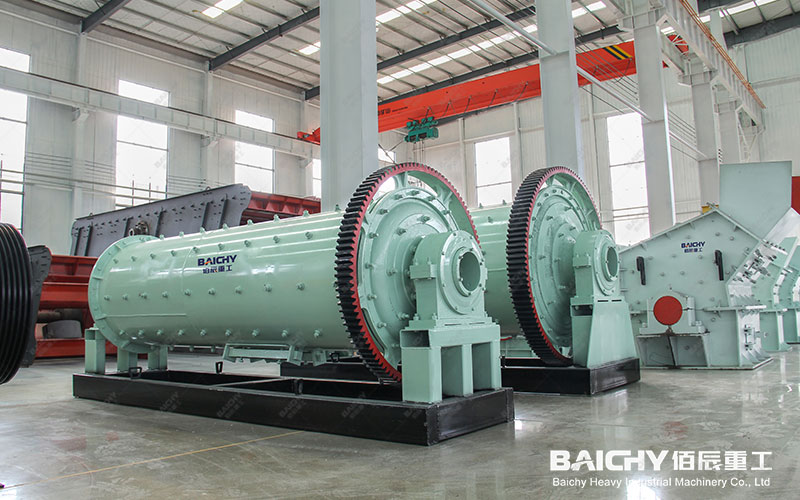
Mineral processing ball mill
In the long and transformative journey of mineral processing, from the rough raw ore extracted through blasting to the fine powder that meets the requirements of downstream smelting or applications, a crucial transformation must take place – grinding. And in this transformation, the ball mill undoubtedly plays the role of the core engine. As a mining equipment provider with twenty years of research and development and manufacturing experience, we will take you deep into the world of ball mills, analyzing their working principles, key types, and how to select efficient and energy-saving equipment to help your project achieve cost reduction and efficiency improvement.
| Product Model | Ball Mill |
|---|---|
| Feed Size | 0-25mm |
| Motor Power | 18.5-800kw |
| Capacity | 0.65-90 t/h |
| Core advantage | Steel ball grinding |
| Brand | Baichy Heavy Industry |
| Please note: The above table data is for reference only. For specific information, please contact us. | |
I. Ball Mills: Why are they the backbone of mineral processing?
A ball mill is a classic piece of equipment that uses the rotation of a cylinder to drive internal grinding media (such as steel balls, ceramic balls, etc.) to impact and grind materials. Its core value lies in further grinding crushed materials (usually with a particle size of less than 25mm) to a finer particle size (usually 0.074mm (200 mesh) or finer), fully separating useful minerals from gangue, and creating the necessary conditions for subsequent beneficiation operations (such as flotation and magnetic separation).
Its irreplaceable advantages mainly include:
• Strong adaptability: It can process ores of various hardnesses and properties, both wet and dry methods are possible.
• High crushing ratio: It can grind materials to extremely fine particle sizes, and the product fineness is easy to adjust.
• Reliable operation: The structure is relatively simple, the process is mature, and it can meet large-scale continuous production.
• High stability: Stable production capacity and product quality, making it a standard configuration for modern mineral processing plants.
II. Core Structure, Working Principle, and Main Types of Ball Mills
A typical ball mill mainly consists of a drive system (motor, reducer), a rotating part (cylinder, liner), a feeding/discharging part, and grinding media.
The working principle is simple and efficient: the cylinder rotates at a certain speed under the drive, and the internal grinding media are lifted to a certain height under the action of friction and centrifugal force, and then fall in a cascading or tumbling manner, generating strong impact and grinding effects on the materials inside the cylinder, thus achieving the gradual grinding of the materials. Based on process requirements, ball mills are mainly pided into the following categories:
1. By discharge method:
* Grate-type ball mill: Equipped with a grate plate at the discharge end for forced discharge, resulting in faster speed and less over-grinding, suitable for coarse grinding or single-stage grinding.
* Overflow-type ball mill: Discharges through the self-flowing overflow of the slurry, resulting in longer grinding time and finer product fineness, commonly used for secondary grinding or fine grinding.
2. By transmission method: Edge drive, central drive.
3. By process method: Wet ball mill (most widely used), dry ball mill.
III. Twenty Years of Experience: How to Select and Optimize Ball Mills?
Selecting a suitable ball mill is a systematic project that requires comprehensive consideration of many factors. Based on our twenty years of industry service experience, we recommend that you focus on the following points:
• Material properties are fundamental: The hardness, particle size, density, and grindability of the ore are the primary basis for determining the ball mill model, cylinder size, and liner type.
• Process requirements determine the direction: The target product fineness and processing capacity determine whether to choose a grate-type or overflow-type mill, as well as the mill's working process (open circuit or closed circuit).
• Grinding media and liners: Scientifically proportioning steel balls of different sizes is key to improving grinding efficiency and reducing energy consumption. The material of the wear-resistant liner (such as high-manganese steel, rubber, magnetic liner) directly affects equipment life and maintenance costs.
• Drive and energy efficiency: High-efficiency and energy-saving motors and transmission systems, as well as considering the addition of variable frequency control, are key to reducing long-term operating costs.
• Manufacturer's experience and support: A manufacturer with extensive experience can not only provide reliable equipment but also provide process optimization suggestions, installation guidance, and comprehensive after-sales maintenance services from the perspective of the entire production line, ensuring maximum return on investment.
IV. Future Trends: Smarter, More Energy-Efficient, and More Durable
Ball mill manufacturing technology is also constantly evolving.
Future development trends focus on:
• Large-scale and intelligent: Larger equipment to meet economies of scale, integrated sensors and automated control systems to achieve real-time monitoring, optimized filling rate, and rotation speed. • Material Innovation: Developing new liner plates and grinding media that are more wear-resistant and lightweight to reduce energy consumption and replacement frequency.
• Energy Saving and Consumption Reduction: Achieving lower energy consumption per ton of ore through optimized drive design and improved internal structure (such as using high-efficiency classification liners).
As the heart of mineral processing equipment, the selection and operating status of ball mills directly impact the economic efficiency of the entire processing plant. It is not merely a combination of steel and motors, but a crystallization of process knowledge and engineering experience. Choosing a partner who understands your process needs and can provide long-term value support is crucial. With twenty years of dedication and accumulated expertise, we are committed to providing reliable solutions to global customers, from single machines to complete lines, from design to service, ensuring that the value of every piece of ore is efficiently realized.
Further reading:
How To Reduce The Energy Consumption Of Ball Mill? 5 Practical Energy-Saving Tips
Iron Ore Beneficiation Process: Magnetic Separation/Flotation/Gravity Separation