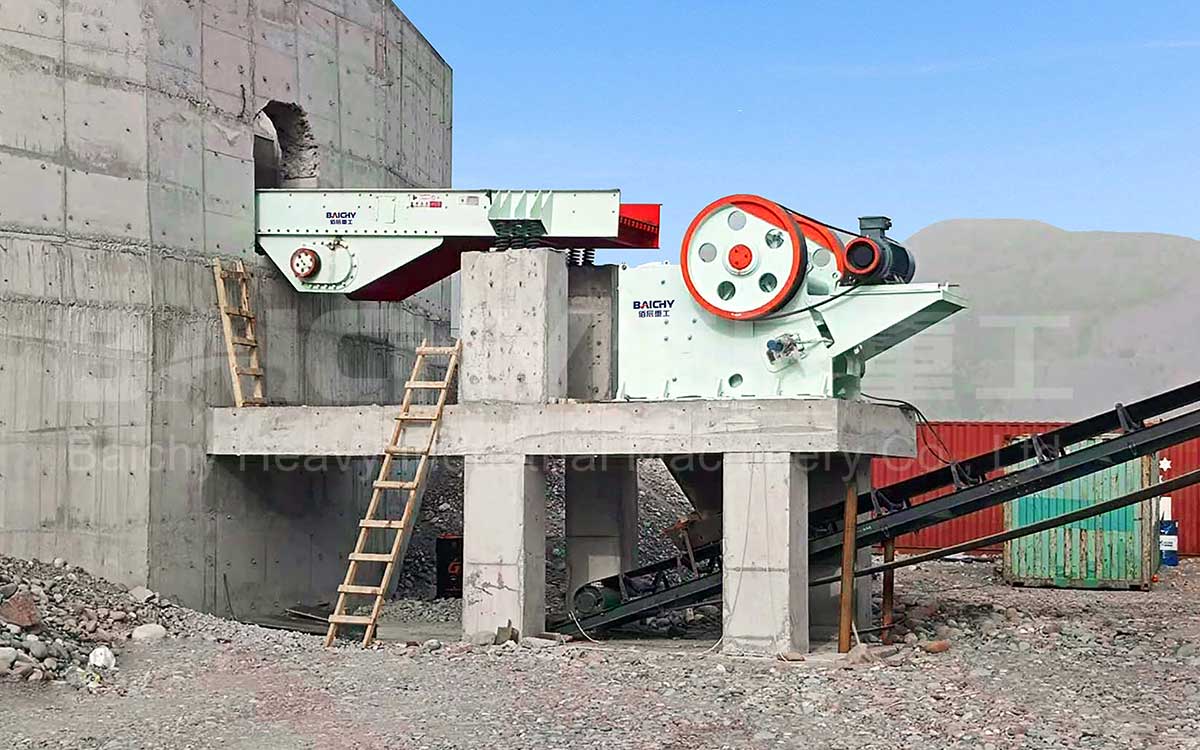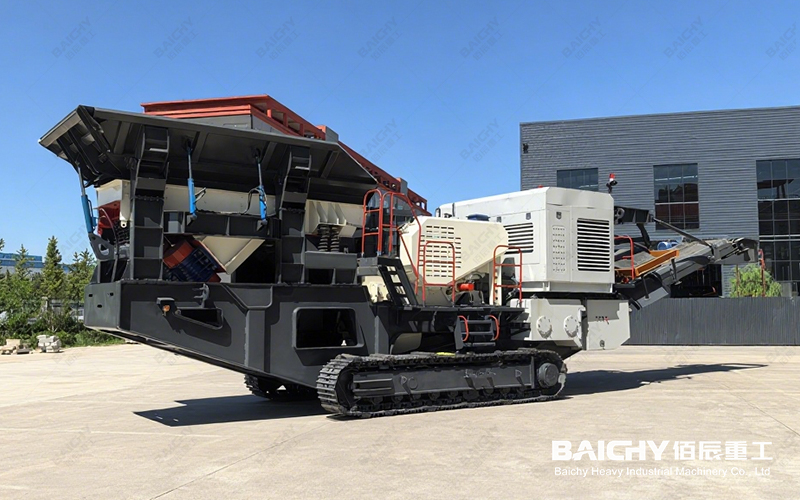
tracked mobile jaw crushing station
The tracked mobile jaw crushing station does more than just "bite" through concrete; its compression-based crushing principle is actually more efficient when processing concrete—a typically brittle material characterized by high compressive strength but low tensile strength—than when crushing hard rock. Demolished concrete typically has a compressive strength in the C20–C60 (20–60 MPa) range, far lower than that of granite (150–250 MPa) or basalt. This means that when processing concrete, the machine's production capacity actually increases rather than decreases, and the service life of the jaw plates is extended. This article provides a comprehensive answer to the questions "Can tracked jaw crushers be used for concrete crushing?" and "How can they be used most effectively?" by examining six key aspects: working principles, application scenarios, core advantages, parameter configurations, case study calculations, and pitfalls to avoid during equipment selection.
I. Why the question "Can tracked jaw crushers crush concrete?" deserves a serious answer
This is a valid question, not a trivial one. Concrete differs fundamentally from natural rock and ore: it is a composite material made of cement mortar, coarse and fine aggregates, and a steel reinforcement framework. It has a high iron content, contains impurities (slag), and comes in irregular shapes. These characteristics lead many users in the mining industry to instinctively question whether a jaw crusher—typically viewed as "hard-rock equipment"—is suitable for tackling concrete.
Market data provides the answer:
China: According to the Ministry of Housing and Urban-Rural Development, my country generates over 2 billion tons of urban construction waste annually. This accounts for approximately 40% of total urban solid waste, making it the single largest category of urban solid waste by volume. Meanwhile, estimates by the China Association of Urban Environmental Sanitation indicate that the resource utilization rate for construction waste is currently less than 5%. This means that over a billion tons of recyclable concrete material are sent to landfills or stockpiles each year.
European Union: The average recycling rate for construction waste is approaching 89%, though there are vast disparities among member states (ranging from under 10% to over 90%). Construction waste accounts for more than 38% of the EU's total waste volume (Eurostat, 2022 data). This gap represents a significant market opportunity.
The logic from the demand side is clear: whoever can transform concrete into recycled aggregate at a low cost right at the demolition site stands to profit from two revenue streams simultaneously—disposal fees and aggregate sales. The first step in transforming concrete into recycled aggregate is primary crushing—and the mobile jaw crusher is equipment purpose-built for this "crush-on-site" scenario.
II. Crushing Concrete with Track-Mounted Jaw Crushers: Principles and Material Suitability
2.1 Mechanical Logic: Why Compression Crushing is Highly Efficient for Concrete
The failure mechanism of concrete makes the jaw crusher its ideal match: while concrete possesses high compressive strength, its tensile and flexural strengths are only about one-tenth of that value. The jaw crusher’s compression-based crushing principle generates tensile stress cracks within the material, effectively targeting concrete's "Achilles' heel" and resulting in crushing efficiency far superior to that achieved with homogeneous hard rock.
Furthermore, concrete has a bulk density of approximately 2.2–2.4 t/m³—lower than most hard rocks—allowing for higher throughput within the same crushing chamber. Additionally, the bond strength at the interface between cement mortar and aggregate is far weaker than the bonding between mineral crystals; this facilitates easier crack propagation and yields a final product with a shape closer to a cube.
2.2 The Rebar Issue: "Squeezing Out" Rather Than Cutting
Demolished concrete typically contains 1%–2% rebar by weight. Jaw crushers operate via a combination of compression and bending; they process rebar by bending and squeezing it out rather than shearing it, so under normal operating conditions, the jaw plates do not jam or sustain damage. The real risk arises in the subsequent processing stage: if long pieces of rebar enter impact crushers, cone crushers, or screening equipment, they can cause severe damage. Therefore, a standard configuration for track-mounted jaw crushers processing concrete must include a magnetic separation stage to remove iron.
2.3 pision of labor with impact crushers and cone crushers
| Equipment | Role in concrete crushing line | Tolerance for rebar | Finished product shape |
| Tracked Jaw Crusher | Primary crushing (0–150 mm) | High; can "squeeze out" rebar | Average |
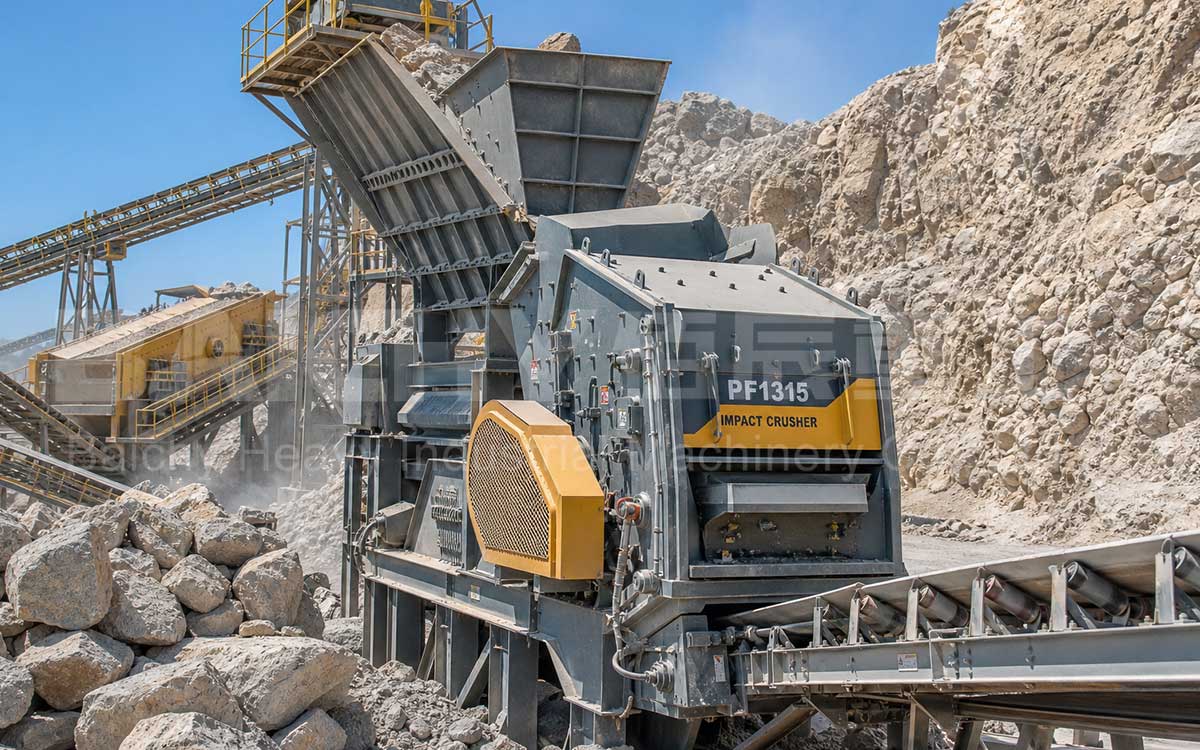
| Tracked Impact Crusher | Secondary crushing + shaping (0–40 mm) | Low; iron removal required before feeding | Good; cubic shape |
| Cone Crusher | Not recommended for concrete containing iron | Poor; high risk of damage from metal debris | Good but unsuitable |
Typical process chain: Jaw crusher (primary crushing) → Iron remover (separates rebar) → Tracked impact crusher (secondary crushing & shaping) → Mobile screening station (grading) → 0–5/5–10/10–31.5 mm recycled aggregates.
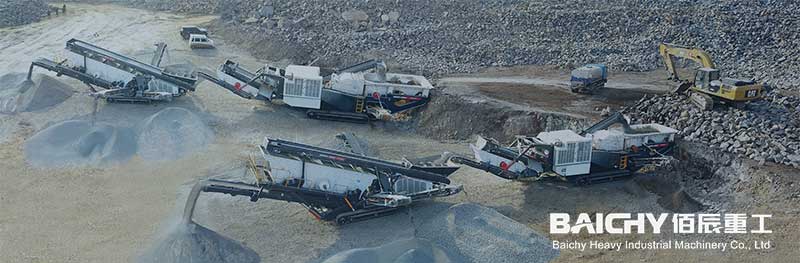
crawler crushing plant
III. Six core advantages of tracked jaw crushers for concrete crushing
3.1 Immediate production upon arrival: No foundations, civil works, or approval waiting periods
Stationary crushing lines require laying foundations, building storage bins, and running power cables, often taking 3–6 months from contract signing to commissioning; in contrast, this equipment can be positioned and started up as soon as it arrives on-site. For demolition projects with schedules measured in weeks, this factor is decisive.
3.2 Flexible relocation: Crush right where the demolition happens
Demolition work sites are dynamic. Equipped with its own travel system, the machine can move around the site independently to keep pace with demolition progress; once a project is finished, it can simply be hauled away, avoiding issues with stranded assets.
3.3 Resistance to rebar impact: Rugged and durable with low failure rates
Compression-based crushing offers high tolerance for metal debris such as rebar, wire, and expansion bolts. Its failure rate is far lower than that of impact or cone crushers when handling similar materials, making it irreplaceable as the "first line of defense."
3.4 Increased Capacity When Processing Concrete
Using the same primary crusher unit (e.g., PE750×1060), the actual throughput for crushing concrete can reach 1.2–1.5 times that of granite processing. Wear on the jaw plates is also reduced, extending the replacement cycle by 20%–40%. For the buyer, this translates directly to lower crushing costs per ton and a faster return on investment.
3.5 Adjustable Output Size: Ready for Recycled Aggregate Sales
The machine features a hydraulic discharge opening adjustment, allowing the output size to be flexibly set within the 0–150 mm range. When paired with a screening station after primary crushing, it can consistently produce 0–31.5 mm graded aggregate, suitable for immediate use in municipal road base layers, backfilling, and masonry mortar.
3.6 Environmental Compliance: Suitable for Urban Operations
Equipped with a standard dust-suppression water spray system, the machine keeps operating noise and dust emissions within urban construction standards. Compared to blasting or impact crushing, mobile jaw crushing offers a compliant method for processing demolition waste and serves as core equipment for obtaining construction waste recycling certification.
IV. Typical Application Scenarios
4.1 Urban Construction Waste Disposal Sites / Recycling Centers
These facilities centrally receive demolition waste from across the city. The mobile jaw crusher acts as the core primary crusher, working alongside fixed or mobile secondary crushers and screening units to form a stable production line for recycled materials. This scenario currently benefits from the clearest policy subsidies and the most mature business models.
4.2 On-Site Processing for Urban Renewal and Demolition Sites
Concrete from floor slabs, beams, columns, and foundations is crushed on-site for immediate backfilling or external sale. This eliminates the dual costs of transporting debris (which can reach 20–40 RMB/ton for transport and disposal fees in some regions) and purchasing backfill materials.
4.3 On-Site Recycling for Road and Bridge Renovation
Removed concrete pavement and asphalt blocks are crushed on-site into 0–50 mm graded material for direct use as road base fill. This is a mature process that has been used in Europe and the US for over 20 years (the EU's overall recycling rate of nearly 89% relies primarily on this method).
4.4 Large-scale infrastructure sites (airports, ports, etc.)
Demolition projects involving runways, storage yards, and aprons generate concrete waste volumes in the range of hundreds of thousands of cubic meters. Mobile jaw crushers can be relocated in sync with project milestones, preventing equipment downtime and spreading depreciation costs across a larger tonnage.
4.5 Post-disaster reconstruction and emergency response
Construction debris resulting from earthquakes or typhoons requires rapid cleanup and resource recovery. Crawler-mounted jaw crushers do not rely on grid power infrastructure (diesel drive is an option), allowing them to begin operations immediately at sites lacking electricity or water supplies.
5. Core Specifications: Typical Configuration of Baichy Crawler Jaw Crushers
The following details the typical configuration specifications for Baichy crawler-mounted mobile jaw crushing stations (YDPZ Series, featuring a PE jaw crusher unit and a crawler chassis):
| Crawler Jaw Crusher Configuration | Main Jaw Crusher Unit | Feed Opening (mm) | Max. Feed Size (mm) | Concrete Processing Capacity (t/h)* | Main Motor (kW) | Typical Applications |
| YDPZ Series (Medium) | PE600×900 | 600×900 | 500 | 70–180 | 75 | Medium-sized demolition sites; 100 t/h class resource recovery lines |
| YDPZ Series (Large) | PE750×1060 | 750×1060 | 630 | 120–280 | 110 | Large-scale urban renewal; centralized disposal/processing sites; road recycling |
| YDPZ Series (Extra-Large) | PE900×1200 | 900×1200 | 750 | 220–450 | 132 | Airport/port-scale projects; massive demolition operations |
*Note: Based on demolition concrete with a compressive strength of 30–45 MPa and a low rebar content. Actual processing capacity for concrete applications is typically 1.2–1.5 times the rated capacity for hard rock, fluctuating based on discharge opening settings, feed particle size, moisture content, and debris/soil content; final technical specifications are subject to the Baichy factory configuration sheet. Optional configurations: dual diesel/electric drive, iron remover, water spray system, and remote-controlled mobility.
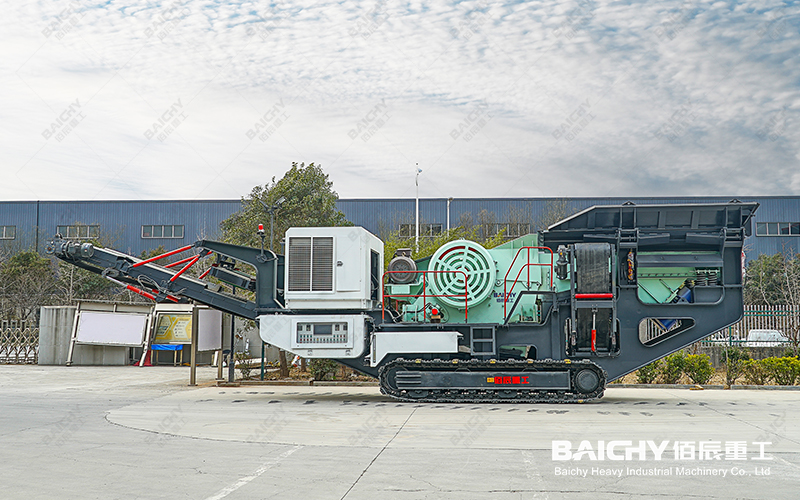
Crawler jaw crusher
VI. Site Case Study and Cost-Benefit Analysis
Note: The following is a calculation example based on typical industry standards, intended to illustrate the economic model of concrete crushing using a tracked jaw crusher; it does not represent data from a specific client. Actual figures will vary depending on regional electricity prices, labor costs, and aggregate market prices.
6.1 Case Study: 150 t/h Recycled Aggregate Line at an Urban Waste Disposal Site
Configuration: YDPZ series large-scale tracked jaw crusher (PE750×1060) + self-discharging iron remover + tracked impact crusher + mobile screening station.
Calculation Assumptions (based on typical standards for a Tier 2 city in China): Design capacity of 150 t/h; two shifts (16 hours/day), 300 operating days per year; overall equipment utilization rate of 85%; recycled aggregate yield (after deducting soil/debris, rebar, and impurities) of approximately 85%.
| Indicator | Numerical value |
| Annual concrete processing volume | Approx. 510,000 tons (150 t/h × 16 h × 300 d × 85%) |
| Annual recycled aggregate production | Approx. 430,000 tons |
| Savings on spoil removal and disposal fees (at 25 RMB/t) | Approx. 12.8 million RMB/year |
| Revenue from recycled aggregate sales (at 40 RMB/t) | Approx. 17.2 million RMB/year |
| Equipment and ancillary investment (estimated) | Approx. 9–13 million RMB |
| Static payback period | Approx. 1.5–2 years |
Conclusion: In markets where revenue is generated from both disposal fees and aggregate sales, resource recovery lines centered on mobile jaw crushers typically achieve a payback period of under two years; even if only "saved disposal fees" are considered, this represents a guaranteed cash inflow.
6.2 Scenario Review: On-site Recycling of Road Concrete
In a municipal road renovation project, approximately 80,000 m³ of old road surface concrete was demolished. A medium-sized mobile jaw crusher was used to crush the material on-site into 0–50 mm graded aggregate, which was then used directly for the roadbed base layer.
• Savings: Spoil transport and disposal fees, plus the cost of purchasing graded crushed stone; combined, these represent a raw material cost saving of approximately 30–50 RMB/m³.
• Earnings: Revenue from the sale of surplus aggregate.
• Time efficiency: No queuing at disposal sites and no round-trip transport required; project duration reduced by approximately 30%–40%.
6.3 Calculation Basis
The figures above are based on open market ranges; fluctuations in any single indicator (disposal fees, aggregate prices, production capacity utilization) will affect the results. It is recommended to use actual local prices for calculations during the equipment selection phase; Baichy can provide free capacity and economic analysis spreadsheets.
VII. Equipment Selection Recommendations and Pitfall Avoidance
7.1 Crawler-mounted Jaw Crusher or Stationary Jaw Crusher?
| Decision Criteria | Choose Track-Mounted Jaw Crusher | Choose Stationary Jaw Crusher |
| Project Duration | Short-term; frequent site transfers | Long-term operation (3+ years) |
| Site Conditions | No civil works; mobile operations | Established facility; existing foundations |
| Power Supply | No grid access or temporary power (diesel-driven) | Low electricity costs; stable supply |
| Initial Investment | Lower (saves on civil works) | Lower (lower unit equipment cost) |
Decision Summary: For demolition sites, waste disposal yards, or rotating multi-project operations—choose the track-mounted jaw crusher; for fixed, high-capacity facilities with low electricity costs—consider the stationary type.
7.2 Five Common Pitfalls
• Crushing without iron removal: Rebar entering impact crushers or screening equipment causes damage; repair costs far exceed the price of an iron remover.
• Oversized feed: Large chunks of floor slabs or pile caps exceeding 80% of the feed opening size can clog the crushing chamber or even damage jaw plates.
• Excessive soil/sludge content: Materials with high clay or silt content require pre-screening via grizzly bars; otherwise, throughput will be choked off by clogging.
• Crushing without screening: Mixed-grade material fetches a low price; only graded aggregates (e.g., 0–31.5 mm) command a market premium.
• Power supply mismatch: For export or remote projects, always verify frequency (50 Hz/60 Hz), voltage (380 V/440 V), and dual-power (diesel/electric) options to avoid startup failure upon arrival.
VIII. Recommended Related Equipment
The mobile jaw crusher serves as the "entry point" for a concrete crushing line; a complete concrete recycling line also requires the following auxiliary equipment (all available as a complete package from Baichy):
• Crawler-type impact crushing station: Receives output from the jaw crusher for secondary crushing and shaping, consistently producing high-quality 0–40 mm aggregates;
• Crawler-type screening station / Mobile circular vibrating screen: Performs multi-stage screening (0–5, 5–10, 10–31.5 mm) for direct truck loading and sales;
• Self-discharging / Permanent magnet iron remover: Separates rebar and iron wire to protect secondary crushing and screening equipment; essential for concrete processing applications;
• Combined mobile crushing station (integrated jaw & impact crusher): A complete line in a single unit; ideal for rapid deployment at small-to-medium volume or single-site projects;
• Vibrating feeder (with grizzly bars): Pre-screens to remove fines and debris, enhancing downstream crushing efficiency;
• Fine sand recovery machine: Recovers fine particles during the sand washing process, improving aggregate gradation and market value.
IX. FAQ
Q1: Will a crawler jaw crusher be damaged when crushing concrete containing rebar?
No. Jaw crushers utilize a compression crushing method; they bend and squeeze out rebar rather than cutting it, so under normal operating conditions, the jaw plates or drive system remain undamaged. The real risk lies in the secondary crushing stage—long rebar entering an impact or cone crusher can cause severe damage. Therefore, installing a magnetic iron remover after the jaw crusher is recommended; this is a standard configuration that distinguishes concrete crushing lines from mining lines.
Q2: How do I choose between a crawler jaw crusher and a stationary jaw crusher for concrete crushing?
Consider four variables: project duration, frequency of relocation, and site/power conditions. For demolition sites, startup operations at disposal facilities, or scenarios requiring rotation between multiple projects, choose a crawler jaw crusher (no foundation required, immediate operation, flexible relocation). For facilities with a fixed operational plan of over three years and access to low-cost, stable electricity, a stationary unit may be considered to lower the initial equipment cost. However, for the startup phase of most construction waste recycling projects, the crawler jaw crusher offers a better overall return on investment.
Q3: What are the production capacity and output particle size for crushing concrete with a tracked jaw crusher?
Taking the PE750×1060 main unit as an example, the processing capacity for concrete is approximately 120–280 t/h (1.2–1.5 times the rated capacity for hard rock); the discharge opening is hydraulically adjustable, allowing for an output size range of 0–150 mm. If graded aggregate (0–31.5 mm) is required, a secondary impact crusher and a screening station must be added downstream for secondary crushing and shaping. Actual capacity varies depending on feed size, moisture content, and the proportion of soil/debris; it is recommended to provide material specifications so the manufacturer can propose a suitable equipment configuration.