
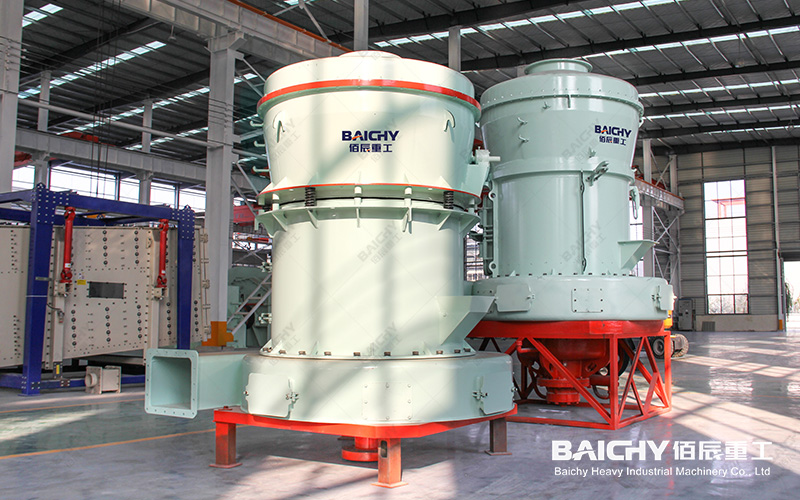
Raymond mill
Grinding 250–500 μm powder down to 90–150 μm involves a compression ratio of approximately 1.7:1 to 5.6:1 (with a median of around 3:1), characterizing a typical low-compression-ratio regrinding scenario. The grinding assembly (rollers and rings) of the Raymond mill is hardly the bottleneck; instead, the challenges lie elsewhere: whether the classifier can consistently maintain the cut point near 150 μm (100 mesh) and whether a stable material bed can be maintained given the powdery feed. Conclusion: The 90–150 μm range (roughly 100–170 mesh) falls into the coarser end of the Raymond mill's standard output range, meaning the machine operates at the upper end of its rated capacity; the 4R3016 model suits small-batch production, the 5R4119/YGM130 are mainstream choices, and the YGM160 targets high-output, single-unit solutions. The most common "trap" in a quotation is stating an "hourly output of X tons" without specifying the corresponding fineness.
I. Clarifying the task: This is regrinding, not primary crushing
1.1 Low compression ratio results in low wear and low circulating load
While the standard maximum feed size for Raymond mills is 15–35 mm (depending on the model), the feed here is only 0.25–0.5 mm—roughly 1.5 to 2 orders of magnitude smaller. There is no need to build a thick material bed for coarse crushing within the grinding chamber; the grinding assembly handles surface grinding between fine particles, resulting in lower roller and ring wear per unit of throughput. Furthermore, with a product threshold as high as 150 μm, material recirculation is minimal, keeping the system's circulating load light. The finer the feed and the coarser the target product, the closer the actual capacity comes to the upper limit of the rated range—contrary to the conservative estimates (often based on the lower-middle range) typically used in calculations.
1.2 90–150 μm (100–170 mesh) falls within the coarser end of the discharge range.
The standard product fineness for Raymond mills ranges from 0.613 to 0.044 mm (approx. 30–325 mesh), with the YGM series capable of reaching 0.033 mm (425 mesh). The target range for this project—0.15–0.09 mm—falls within the coarser segment of this spectrum. The advantage is ample production capacity headroom; the trade-off is that the classifier must operate at lower speeds, making classification efficiency more sensitive to speed fluctuations and leading to a broader particle size distribution—which is precisely why the fineness specifications must be explicitly defined in the technical agreement.
1.3 The bottleneck lies not in the main unit's power, but in classification precision and material bed stability.
Classification: The classifier speed determines the cut point; at lower speeds, the probability of coarse particles bypassing the separation process increases, causing the D97 value to drift above 150 μm and resulting in "coarse carry-over" in the final product.
Material bed: Since the feed material is already in powder form, the scraper blades struggle to form a stable material bed; fine particles are easily "short-circuited" and carried away by the rising airflow, leading to fluctuations in fineness.
II. Key Parameter Table
2.1 Mesh Size vs. Micron Conversion (Target Range for This Task)
Mesh Size vs Particle Size
Target 90–150 μm · 100–170 Mesh| Mesh Size | Corresponding Particle Size | Target Range for This Task |
|---|---|---|
| 100 mesh | ≈150 μm | Finished product upper limit (D97 primary control point) |
| 140 mesh | ≈106 μm | Finished product median range |
| 170 mesh | ≈90 μm | Finished product lower limit |
| 200 mesh | ≈75 μm | Finer grade (outside scope of this task) |
| 325 mesh | ≈45 μm | Standard fine powder grade |
2.2 Raymond Mill Model and Capacity Specifications (Baichy R-Series / YGM-Series)
Raymond Mill & YGM High-Pressure Mill — Model Specifications
Target 90–150 μm · 100–170 Mesh| Model | No. of Grinding Rollers | Roller Dimensions (mm) | Max. Feed Size (mm) | Product Fineness (mm / mesh) | Capacity (t/h) | Main Motor Power (kW) |
|---|---|---|---|---|---|---|
| 3R2115R series | 3 | 210×150 | ≤15 | 0.613–0.044 / 30–325 | 0.4–1 | 15 |
| 4R3016R series | 4 | 300×160 | ≤25 | 0.613–0.044 / 30–325 | 1–4 | 30 |
| 5R4119R series | 5 | 410×190 | ≤30 | 0.613–0.044 / 30–325 | 2.5–9.5 | 75 |
| YGM95YGM series | 4 | 310×190 | ≤25 | 0.613–0.033 / 30–425 | 2.1–5.6 | 45 |
| YGM130YGM series | 5 | 410×230 | ≤30 | 0.613–0.033 / 30–425 | 2.5–9.5 | 90 |
| YGM160YGM series | 6 | 450×300 | ≤35 | 0.613–0.033 / 30–425 | 8–16 | 132 |
Task fit: All six models cover the 90–150 μm target window — product fineness of 0.613–0.044 mm and 0.613–0.033 mm both include 0.15–0.09 mm, i.e. 100–170 mesh (US standard sieve). For this task the selection driver is therefore hourly capacity, not achievable fineness: 4R3016 (1–4 t/h) suits small-batch output; 5R4119 and YGM130 (2.5–9.5 t/h) are the mainstream choice; YGM160 (8–16 t/h) covers single-unit high output. Rows are ordered by product series, not by ascending capacity — YGM95 (2.1–5.6 t/h) is rated below 5R4119 (2.5–9.5 t/h).
Conversion basis: Fineness values follow Baichy's catalogue convention, which rounds coarser openings relative to ASTM E11: 0.044 mm ≈ 45 μm (US No.325); 0.613 mm corresponds to US No.30 (0.600 mm, about +2%); 0.033 mm ≈ 33 μm sits between US No.400 (38 μm) and No.500 (25 μm), so the "425 mesh" ceiling is a catalogue designation rather than a US standard sieve number.
Capacity basis: Capacity figures are quoted on Baichy's rating basis — medium-hardness material at roughly 200 mesh — and will fall for finer targets, harder minerals, or higher feed moisture. Confirm actual output by material grinding test before signing a technical agreement.
III. Production Line Configuration: Four-Stage Series Setup with Two Adjustable Points
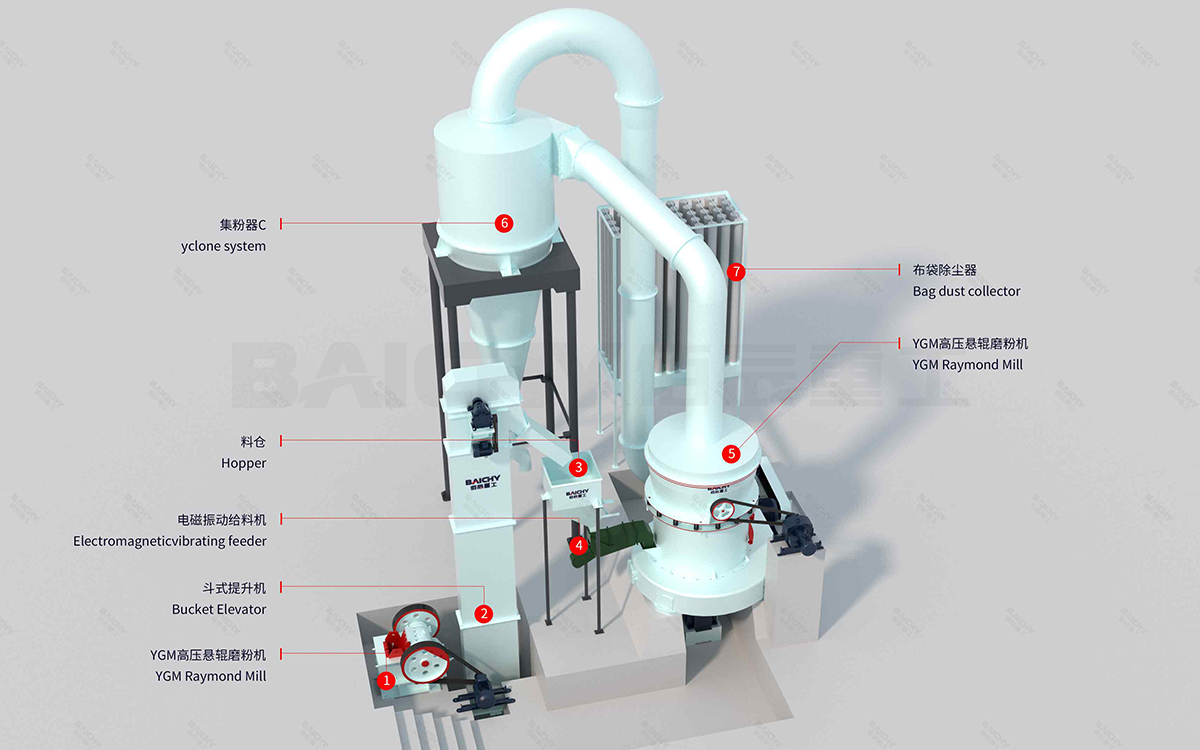
Schematic diagram of the Raymond mill grinding production line process
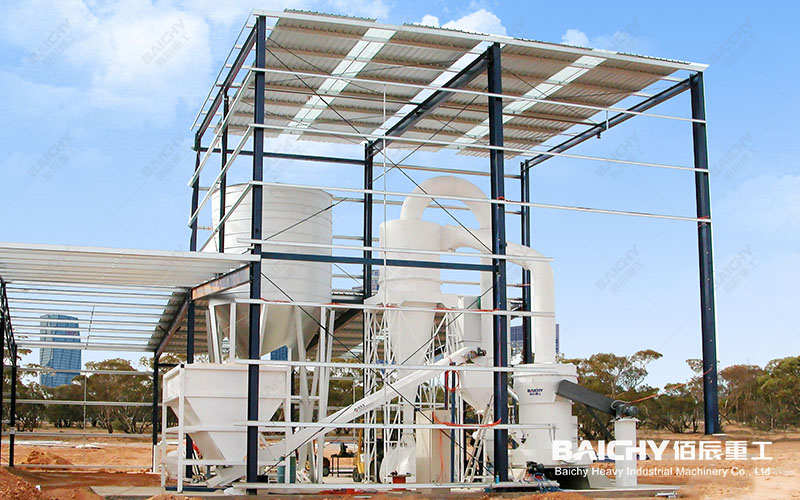
The Raymond mill production line for this project is configured as follows: Raw Material Silo → Variable-Frequency Quantitative Feeder → Raymond Mill Main Unit → Classifier (Variable-Frequency Grading) → Cyclone Collector → Pulse Dust Collector → Screw Conveyor → Finished Product Silo. The two adjustable points directly address the bottlenecks mentioned earlier: the variable-frequency feeder maintains stable grinding chamber current, preventing overfeeding caused by the material's high flowability; the variable-frequency classifier allows for the direct setting of a 150 μm cut point, enabling switching between 90 μm and 150 μm simply by adjusting rotational speed, without the need to replace components.
There is an additional structural advantage: the cyclone collector captures the primary product, while the pulse dust collector captures a finer fraction; this "two-stage collection" process effectively acts as a preliminary classification step. If downstream requirements regarding particle size distribution width are stringent, the fine powder from the dust collector can be metered separately and either blended back as needed or processed as a distinct product stream. Utilizing the system's built-in structure in this way—rather than employing post-grinding screening—represents the most cost-effective method for particle shape and size control.
IV. Key Control Points and Pitfall Avoidance Checklist
• Feed moisture content below 6%: Powdered feed is more prone than lump material to sticking to roller rings and piping due to moisture; raw materials during the rainy season require air-drying or a pre-drying process.
• Mandatory iron removal at the feed inlet: Metal shavings or high-hardness impurities (like quartz) mixed in can cause rapid, groove-like wear on the roller ring surfaces.
• Quote based on fineness specifications: Ensure the agreement specifies "guaranteed production capacity for a target range of 90–150 μm" and includes D97 values and laser particle size analysis reports as the basis for acceptance.
• Verify power grid standards beforehand: Customize motors and control cabinets according to local voltage (380V/400V/440V) and frequency (50Hz/60Hz). Send 2–5 kg of raw material for free grinding tests before signing the contract; this is the only way to transform estimates into guaranteed performance figures.
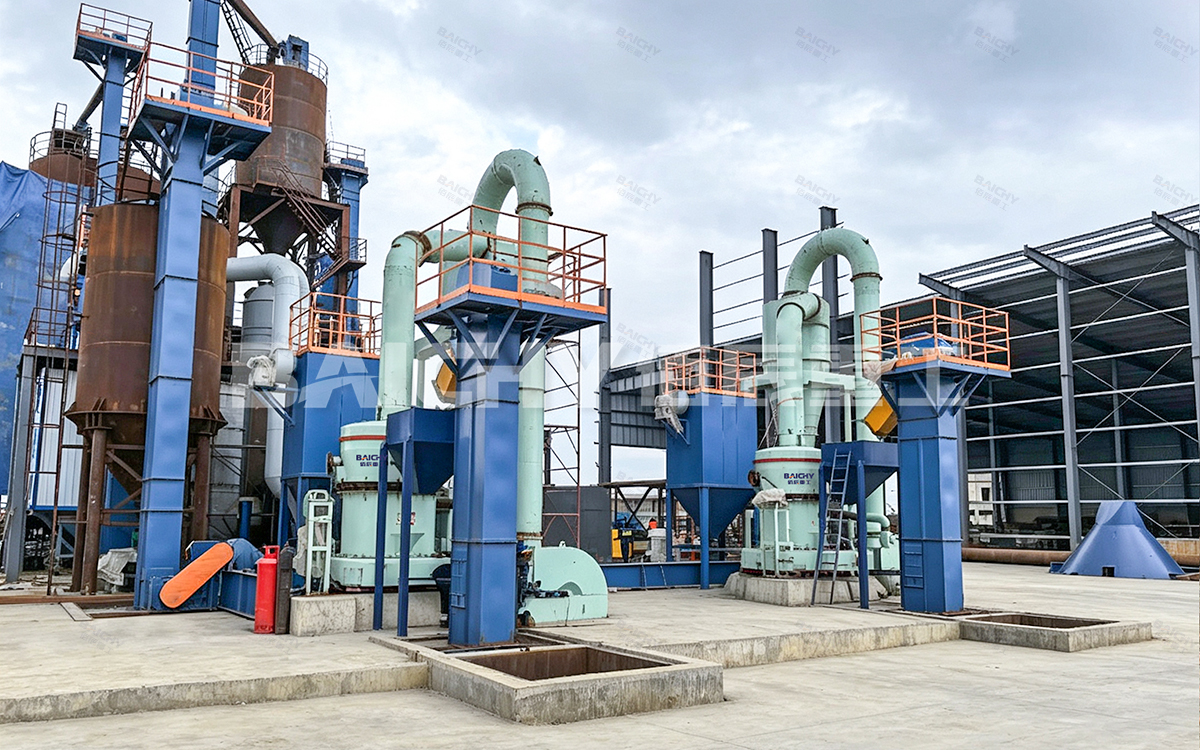
Raymond Mill Customer Site
V. FAQ
FAQ 1: Can a Raymond mill directly process powdered material in the 250–500 μm range?
Yes. The standard maximum feed size for a Raymond mill is 15–35 mm (depending on the model); the 0.25–0.5 mm range is well below this limit, allowing for direct feeding without preliminary crushing. However, two conditions must be met: the feed rate must be controlled (using a variable-frequency electromagnetic vibrating feeder) to ensure consistent flow; and moisture content must be below 6% to prevent fine powder from sticking to roller rings and clogging the classification channels.
FAQ 2: Can a single machine handle grinding to 90–150 μm? What is the approximate capacity?
Yes, a single machine can handle this. The 90–150 μm range (approximately 100–170 mesh) falls within the coarser end of the Raymond mill's standard output range, meaning capacity will be at the higher end of the nominal specifications. Capacity tiers include: 4R3016 (1–4 t/h) for small batches; 5R4119 and YGM130 (2.5–9.5 t/h) as mainstream choices; and YGM160 (8–16 t/h) for high-output, single-unit solutions. The capacity figures in the table are based on materials of medium hardness; ratings are subject to downward adjustment if the material has high quartz content or high moisture levels. Final capacity is determined by actual material grinding tests.
FAQ 3: The finished product particle size distribution is too broad; how can it be stabilized within the 90–150 μm range?
An overly broad distribution usually stems from a low classifier rotor speed or a mismatch in system airflow. Three approaches can be taken: first, increase the classifier speed to shift the cut point from the coarse end to within the 150 μm limit; second, verify the fan airflow and duct sealing—excessive airflow carries over coarse particles, while air leakage reduces overall classification efficiency; third, utilize a two-stage collection setup—combining a cyclone collector and a pulse-jet dust collector—to process fractions separately. If an even narrower distribution is required, a flat rotary screen or an air classifier can be installed downstream for final product refinement.

Baichy Heavy Industry
Baichy Heavy Industry is a high-tech mining equipment company integrating R&D, manufacturing, sales, and after-sales service. Focusing on crushing, grinding, and mineral processing equipment, we provide professional solutions to our customers. We are ISO9001:2015 、certified, and our products include mobile crushing palnts, crawler crushing plant, construction waste crushing plants, jaw crushers, sand making machines, cone crushers, fine crushers, grinding mills, ball mills, etc., all with reliable performance to meet diverse project needs.
Baichy Heavy Industry – Your Trusted Partner
To ensure optimal performance of your equipment, Baichy Heavy Industry offers:
- Professional on-site installation guidance
- Comprehensive operator training
- 24/7 technical support & maintenance services
Our complete after-sales service system guarantees long-term, stable operation of your machinery with minimal downtime.
Protect Your Rights – Only Use Official Channels
To avoid scams and ensure authentic support, contact us exclusively through:
• Official Website: www.baichychina.com
• WhatsApp: +8615093222637
• Email: [email protected]
Your satisfaction is our priority – expect prompt, professional service every time.
(Note: Beware of unauthorized third parties claiming to represent Baichy. Always verify through official contacts.)