
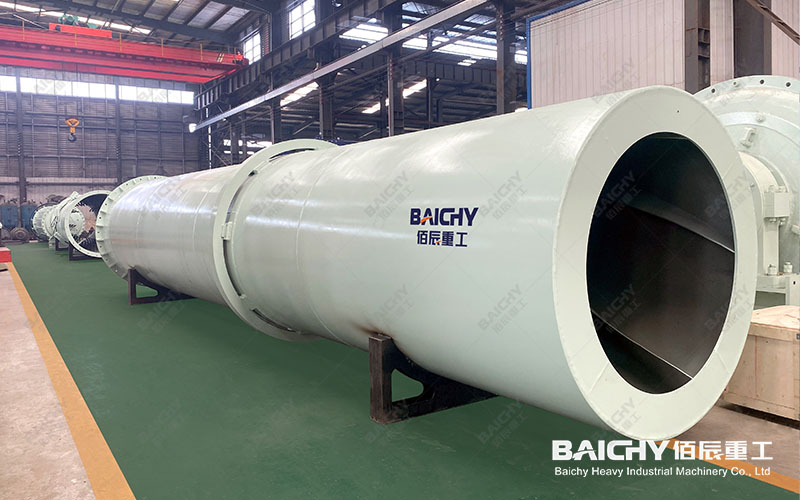
Wood Chip Rotary Dryer
I. Project Overview
Primary selection principle: Single-drum dryer capacity is rated based on the rate of water evaporation, not the tonnage of wet raw material.
Drying 2 t/h of wet sawdust from 40% moisture content down to 10% requires evaporating approximately 0.67 t/h of water, yielding about 1.33 t/h of dry material. The appropriate equipment is a rotary sawdust dryer in the φ1.5 × 12 m class (Baichy HG-1500×12000). This model has a rated evaporation capacity of 0.78–1.0 t/h; the required evaporation rate for the 2 t/h operating condition falls below the model's minimum rated capacity (even with a ~15% safety margin), placing it at the low end of the machine's load range. The required thermal input is approximately 2.6–3.1 GJ/h (effective heat: 1.80–2.20 GJ/h), consuming about 170–210 kg/h of biomass fuel with 15% moisture content.
II. Why must sawdust with 40% moisture still be dried?
While 40% moisture is considered "good quality" compared to the typical 45%–55% found in wet sawdust, for rotary sawdust dryers, this level represents a critical threshold for downstream processing.
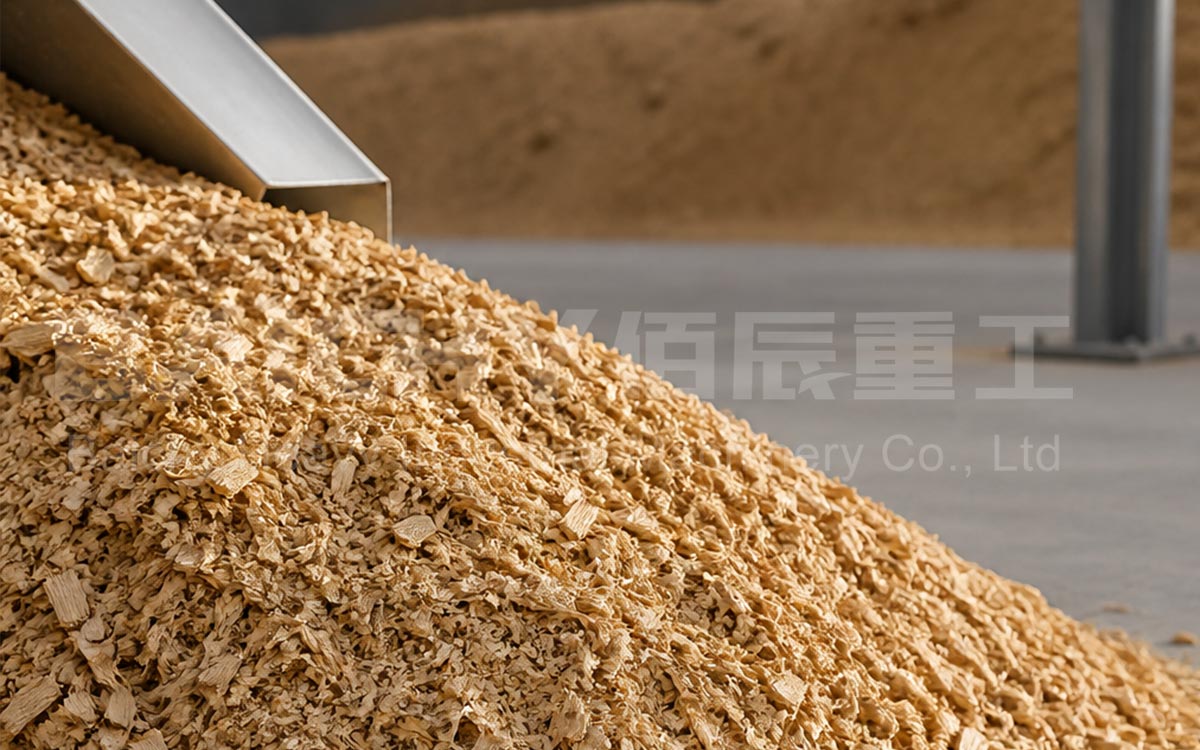
Wood Chip Rotary Dryer
III. Three Key Considerations: Calorific Value, Standards, and Storage
• Calorific Value: The net calorific value (dry basis) of wood is approximately 18–19 MJ/kg, but this drops to about 10–11 MJ/kg at 40% moisture, as nearly 40% of the energy is consumed just to evaporate the material's own water content. Since fuel is priced based on calorific value, high moisture content results in a price discount.
• Standards: Export-grade pellet fuel must comply with EN ISO 17225-2 (ENplus A1) standards, which mandate a maximum moisture content of 10%. Sawdust with moisture levels exceeding 15% cannot be successfully pelletized; the resulting pellets tend to be loose and prone to cracking.
• Storage: Wet sawdust piles begin to ferment and generate heat after just 2–3 weeks of storage; this degradation in quality is accompanied by a risk of spontaneous combustion. Once dried to a moisture content of 10%–12%, the material is safe for stockpiling and long-distance transport.
• Quantitative benchmark: Drying 1 tonne of wet sawdust (40% moisture) down to 10% involves evaporating approximately 0.33 tonnes of water, yielding about 0.67 tonnes of dry material. All calculations are based on the "amount of evaporated water."
III. Working Principle: Why a Rotary Sawdust Dryer is the Preferred Choice for 2 t/h Operations
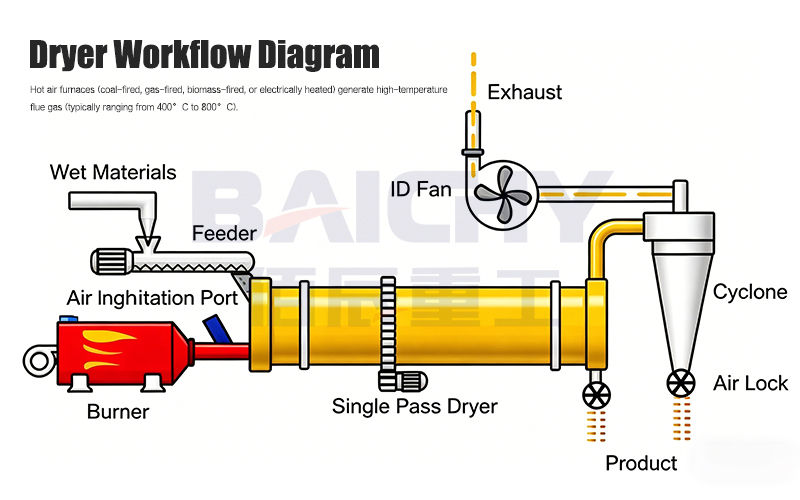
Working Principle of the Single-Drum Dryer
The rotary sawdust dryer consists of a slightly inclined, slow-rotating drum, internal lifting flights, a roller drive system, inlet/outlet seals, and a hot air system. Wet sawdust enters the drum via a screw feeder; internal flights continuously lift and shower the material, creating a "curtain" that contacts the high-temperature flue gas in a co-current flow. Moisture evaporates as the material tumbles, and the dried product discharges from the lower end.
Thermodynamic Advantages of Co-current Flow
Co-current flow ensures that wet material first contacts the hottest flue gas. Since the sawdust temperature remains lower than that of the gas, the risk of overheating and ignition is naturally reduced. For sawdust—which has an ignition point of only around 260°C—this temperature gradient provides a crucial safety margin.
Single-Drum or Triple-Pass?
While triple-pass designs offer thermal efficiencies exceeding 80% and a ~40% smaller footprint—making them ideal for continuous, high-moisture processing—a 2 t/h capacity falls into the small-to-medium range. In this context, the single-drum rotary dryer is the more practical configuration, offering fewer potential failure points, lower maintenance requirements, and easier clearing of blockages.
IV. Core Specifications Table: Selection based on 2 t/h throughput and 40% → 10% moisture reduction
The selection of a rotary sawdust dryer is based on the water evaporation rate rather than the tonnage of wet material. The table below outlines specifications for operating conditions involving a 2 t/h throughput, with initial moisture at 40% and final moisture at 10%:
| Model | Drum Dimensions (φ×L) | Drum Volume | Evaporation Capacity (t/h) | Wet Material Handling Capacity (t/h, 40% initial moisture) | Dry Material Output (t/h, 10% final moisture) | Inlet Air Temperature | Main Motor Power |
|---|---|---|---|---|---|---|---|
| HG-1200×8000 | φ1.2×8 m | 9.0 m³ | 0.47–0.58 | 1.4–1.7 | 0.9–1.1 | 300–400 °C | 11 kW |
| HG-1500×12000 (Recommended) | φ1.5×12 m | 21.2 m³ | 0.78–1.0 | 2.3–3.0 | 1.5–2.0 | 300–400 °C | 15 kW |
| HG-1800×14000 | φ1.8×14 m | 35.6 m³ | 1.4–1.8 | 4.2–5.4 | 2.8–3.6 | 300–400 °C | 22 kW |
| HG-2200×16000 | φ2.2×16 m | 60.8 m³ | 2.3–3.1 | 6.9–9.3 | 4.6–6.2 | 300–400 °C | 30–37 kW |
Note: Values are typical reference figures based on wood chips bulk density of 150–250 kg/m³, 40% initial moisture and 10% final moisture. Wood chips are extremely light, so capacity per unit of drum volume is far lower than for sand and aggregate materials — do not apply wet-tonnage figures from tables specified for other materials. Final moisture target can be adjusted within 8%–15% depending on the downstream process (pellets, charcoal briquettes, direct combustion, panel board), and the final drum size must be confirmed by a material drying test.
V. Heat Balance Calculation for the Sawdust Rotary Dryer: Derivation of the 0.67 t/h Evaporation Rate
Step 1: Moisture Balance (Determines equipment size)
Bone-dry material = 1 × (1 − 40%) = 0.60 t; Total weight at 10% final moisture = 0.60 &pide; 0.90 = 0.667 t; Water evaporated = 0.333 t per tonne of wet material. Scaling up to a 2 t/h sawdust rotary dryer operation: evaporation rate of 0.667 t/h and dry material output of 1.333 t/h.
Step 2: Heat Consumption and Specific Fuel Consumption (Determines operating costs)
Effective heat required per kg of evaporated water is approximately 2.7–3.3 MJ (consistent with existing drying documentation).
Conversions are shown in the table below:
| Calculation Item | Unit | Value |
|---|---|---|
| Water evaporation rate | t/h | 0.67 |
| Dry material output | t/h | 1.33 |
| Effective heat demand | GJ/h | 1.80–2.20 |
| Effective heat equivalent power | kWh (thermal) | Approx. 500–610 |
| Fuel heat input (70% thermal efficiency) | GJ/h | 2.57–3.14 |
| Fuel heat input equivalent power | kWh (thermal) | Approx. 715–875 |
| Biomass fuel consumption (LHV ≈ 15 MJ/kg) | kg/h | 170–210 |
| Specific fuel consumption per tonne of wet material | kg/t | 85–105 |
Note: Derived from an effective heat requirement of 2.7–3.3 MJ per kg of water evaporated, a system thermal efficiency of 70%, and a biomass fuel lower heating value of approx. 15 MJ/kg (at 15% moisture). Fuel is typically the largest single operating cost of a drying system, accounting for roughly 70% of the cost per tonne dried. Substitute your local delivered fuel price to obtain the actual cost per tonne, and multiply by annual throughput for the 5-year TCO comparison.
VI. Minimum Complete Configuration and Safety Essentials for a Sawdust Rotary Dryer
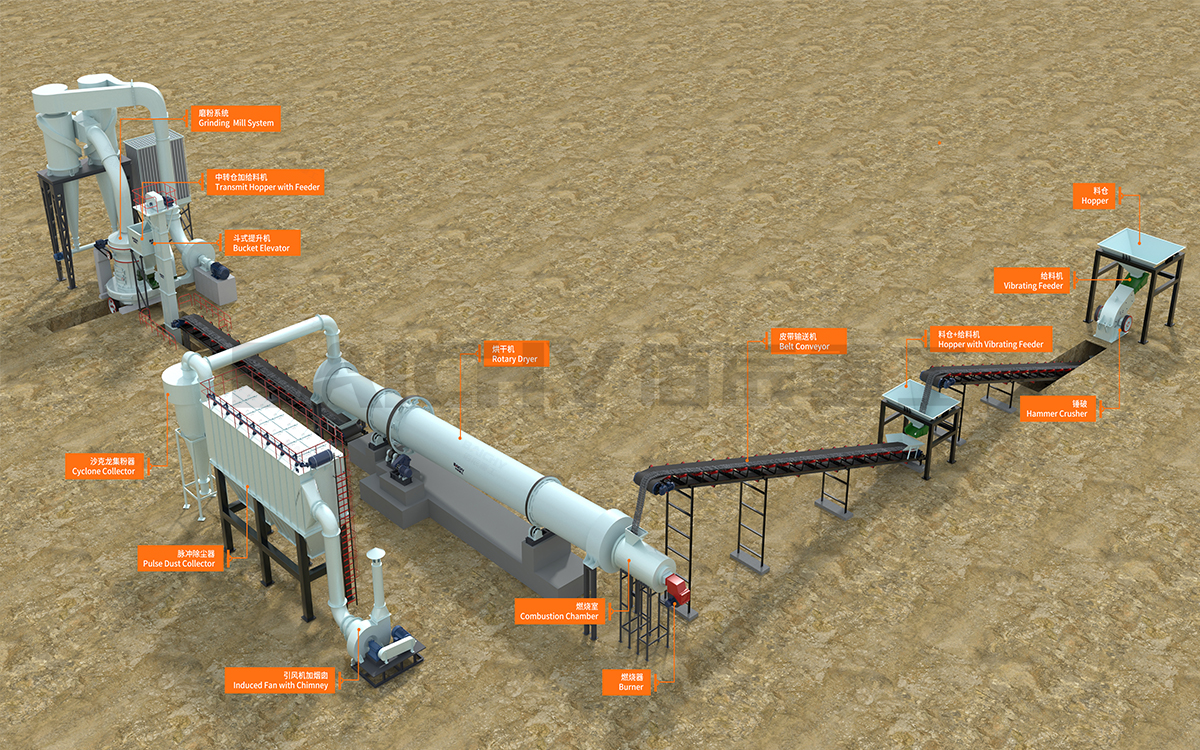
Schematic diagram of the single-drum dryer process
A stable, 2 t/h sawdust rotary dryer setup comprises: a feed screw conveyor → dryer main unit → biomass hot-air furnace → cyclone separator → baghouse dust collector → induced draft fan → discharge airlock valve. Pre-processing material to a size under 10 mm before feeding is recommended to significantly improve drying uniformity and effective throughput.
Fire and Explosion Prevention: A Necessity, Not an Option
Sawdust is a typical combustible dust, and the drying system represents one of the highest fire-risk areas in the plant:
• Inlet air temperature interlock: Automatically cuts off the heat source and triggers an alarm if flue gas exceeds temperature limits, preventing ignition caused by localized overheating;
• Spark detection and automatic suppression: Detectors installed at the feed inlet and upstream of the dust collector trigger an immediate water-mist spray upon detecting sparks;
• Dust collection system explosion venting: Cyclone and baghouse collectors must feature explosion vents, anti-static filter bags, and reliable grounding; explosion-proof electrical components (compliant with ATEX/GB standards) should be selected where necessary;
• Discharge temperature and CO monitoring: Prevents smoldering of high-temperature material after it exits the drum;
• Final moisture content ≥ 8%: Over-drying actually increases the risk of spontaneous combustion during storage—the idea that "drier is safer" is a common misconception.
VII. Avoiding Pitfalls in Selecting Rotary Sawdust Dryers: Four Common Mistakes
• Selecting based on wet tonnage: The capacity of a rotary sawdust dryer is not equivalent to the tonnage of wet material; one must first calculate the water evaporation requirement.
• Ignoring bulk density: The bulk density of sawdust is only about one-tenth that of sand or gravel; insufficient airflow or inadequate lifter (flight) design will severely compromise production capacity.
• Comparing only the main unit price: Ancillary systems—such as the heat source, dust collection, explosion protection, and installation infrastructure—often account for over 40% of the total investment.
• Skimping on safety features: Omitting spark detection and explosion venting systems is risky; the financial loss from a single accident far exceeds the cost difference of the entire equipment package.
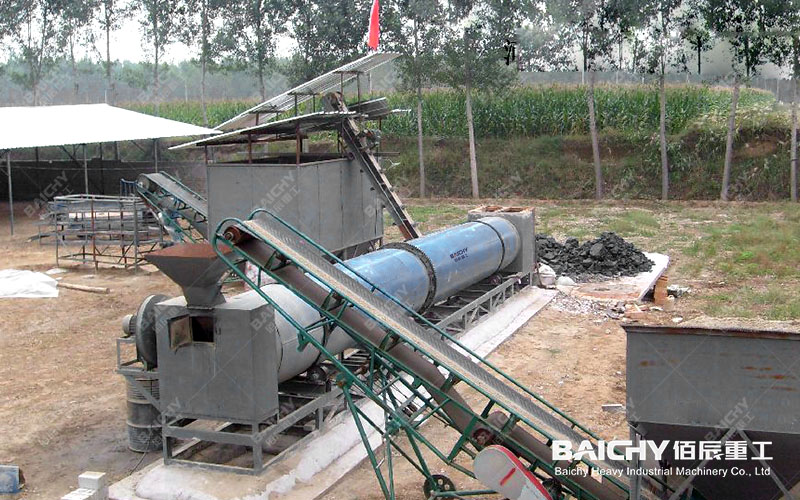
Customer site featuring the single-drum dryer
VIII. FAQ (Frequently Asked Questions)
The following three questions are the most common inquiries regarding rotary sawdust dryers.
Q1: What size rotary sawdust dryer is needed to dry 2 t/h of wet sawdust from 40% moisture content down to 10%?
Drying one tonne of wet material requires evaporating approximately 0.333 tonnes of water; a 2 t/h throughput implies an evaporation demand of 0.67 t/h. A model with specifications of φ1.5×12 m (HG-1500×12000) or larger should be selected, as its evaporation capacity of 0.78–1.0 t/h provides a safety margin of about 15%. A more reliable approach is to conduct a drying test using the specific initial moisture, final moisture, bulk density, and particle size, and then calibrate the capacity based on the measured data.
Q2: What are the fuel consumption and drying cost per tonne for a rotary sawdust dryer?
Using biomass fuel (LHV approx. 15 MJ/kg) as an example, the fuel consumption is approximately 85–105 kg per tonne of wet sawdust; for a 2 t/h operation, this equates to roughly 170–210 kg/h. Cost per tonne = (Fuel consumption per tonne × Local fuel price) + Electricity consumption (approx. 20–25 kWh/t) + Labor costs. If waste material generated by the production line is used as fuel, the cash expenditure for fuel can approach zero.
Q3: Is there a risk of fire or dust explosion when drying sawdust with a 40% moisture content?
The risk is real but entirely manageable. The lower explosive limit (LEL) for sawdust dust is approximately 40–60 g/m³, with the highest risk areas being the exhaust gas ducts and the interior of the cyclone separator. A reliable safety system includes: a co-current drying configuration; an inlet air temperature interlock (to prevent overheating); spark detection and automatic suppression; explosion venting and anti-static design for the dust collection system; online monitoring of discharge temperature and CO levels; and remote interlock shutdown for abnormal conditions. When purchasing, you should require the manufacturer to provide a comprehensive list of safety features.

Baichy Heavy Industry
Baichy Heavy Industry is a high-tech mining equipment company integrating R&D, manufacturing, sales, and after-sales service. Focusing on crushing, grinding, and mineral processing equipment, we provide professional solutions to our customers. We are ISO9001:2015 、certified, and our products include mobile crushing palnts, crawler crushing plant, construction waste crushing plants, jaw crushers, sand making machines, cone crushers, fine crushers, grinding mills, ball mills, etc., all with reliable performance to meet diverse project needs.
Baichy Heavy Industry – Your Trusted Partner
To ensure optimal performance of your equipment, Baichy Heavy Industry offers:
- Professional on-site installation guidance
- Comprehensive operator training
- 24/7 technical support & maintenance services
Our complete after-sales service system guarantees long-term, stable operation of your machinery with minimal downtime.
Protect Your Rights – Only Use Official Channels
To avoid scams and ensure authentic support, contact us exclusively through:
• Official Website: www.baichychina.com
• WhatsApp: +8615093222637
• Email: [email protected]
Your satisfaction is our priority – expect prompt, professional service every time.
(Note: Beware of unauthorized third parties claiming to represent Baichy. Always verify through official contacts.)