
 \
\
3-Ton/Hour Single-Drum Rotary Dryer | Models and Specifications
The model designation for a single-drum rotary dryer is typically expressed as "drum diameter × drum length". According to industry standards, common models—ranging from laboratory-scale to large-scale industrial units—are categorized as follows:
1. Parameter Table for Standard Models
The following lists the standard specifications and reference parameters commonly found within the industry (inpidual manufacturers may apply minor adjustments of ±10%):
| Model Specifications (Diameter × Length, m) | Drum Volume ($m^3$) | Processing Capacity (t/h) | Motor Power (kW) | Total Equipment Weight (t) |
| Φ0.6 × 6.0 | 1.7 | 0.5 - 1.5 | 3.0 | 2.5 |
| Φ0.8 × 8.0 | 4.0 | 1.0 - 2.5 | 4.0 | 3.5 |
| Φ1.0 × 10.0 | 7.8 | 2.0 - 4.0 | 5.5 | 5.5 |
| Φ1.2 × 12.0 | 13.5 | 3.0 - 6.0 | 7.5 | 9.5 |
| Φ1.5 × 12.0 | 21.2 | 5.0 - 10.0 | 11.0 | 14.5 |
| Φ1.5 × 15.0 | 26.5 | 6.0 - 12.0 | 15.0 | 17.0 |
| Φ1.8 × 18.0 | 45.8 | 10.0 - 18.0 | 18.5 | 24..5 |
| Φ2.2 × 20.0 | 76.0 | 15.0 - 25.0 | 30.0 | 35.0 |
| Φ2.4 × 24.0 | 108.5 | 20.0 - 35.0 | 45.0 | 52.0 |
| Φ3.0 × 25.0 | 176.6 | 30.0 - 50.0 | 75.0 | 78.0 |
2. Single-Drum Dryer Model Selection for 3 t/h Capacity
Based on your requirement for a processing capacity of 3 tons per hour (t/h), the most suitable standard models are:
Φ1.2 × 12.0 meters: This is the safest and most reliable choice, capable of handling situations involving significant fluctuations in moisture content.
Φ1.0 × 10.0 meters: If the material's initial moisture content is relatively low (e.g., less than 10%) and the material exhibits excellent flowability, this smaller model can also achieve a throughput of 3 tons per hour.
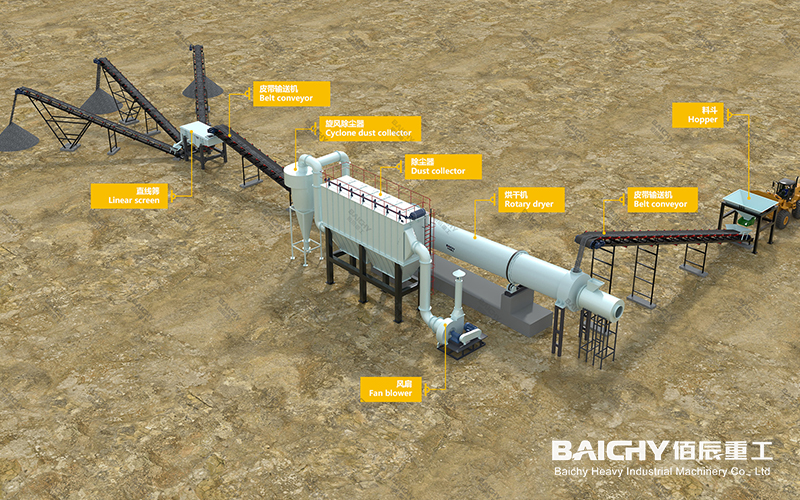
Single-Drum Dryer Process Flow Diagram
3. Key Configuration Details
When selecting these models, in addition to the physical dimensions, it is necessary to confirm the following three configuration aspects:
1. Drive Mechanism:
Gear Drive: Offers high torque and is suitable for larger machines (with diameters of Φ1.5 meters or greater).
Friction Drive (Support Roller Drive): Provides smoother operation, lower noise levels, and simpler maintenance; commonly found in smaller models (with diameters of Φ1.2 meters or less).
2. Internal Lifter/Flight Design:
Lifting Type: A universal design suitable for various granular materials.
Spiral / Self-Cleaning Type: Suitable for sticky or cohesive materials (e.g., sludge).
3. Rotational Speed Control:
It is recommended to equip the unit with a Variable Frequency Drive (VFD) system. This allows for flexible adjustment of the material's residence time within the drum, based on the specific moisture content of the material being processed.
4. Auxiliary Support Equipment
A complete system based on these standard dryer models typically includes the following auxiliary components:
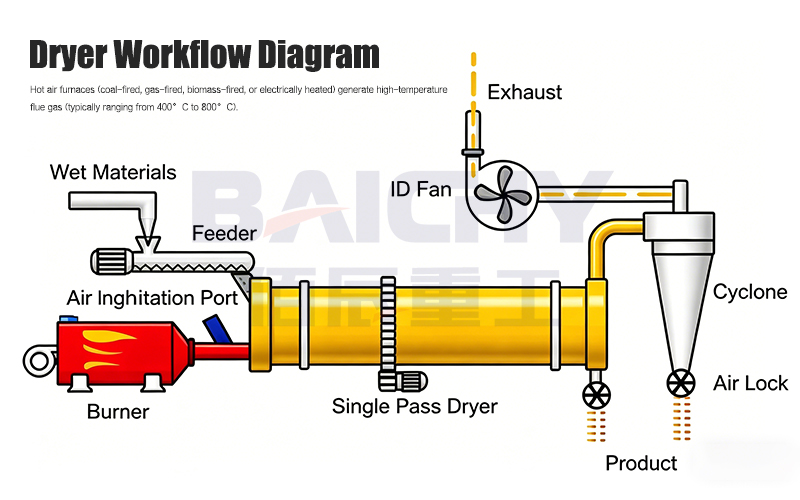
Schematic Diagram of the Working Principle of a Single-Drum Dryer
• Heat Source: A hot air furnace (fueled by natural gas, biomass, or coal) or a steam heat exchanger.
• Feeding & Discharging System: A belt conveyor or a screw feeder.
• Dust Removal System: Cyclone separator (for coarse particles) + Baghouse filter or Wet scrubber (for fine dust).
The Single-drum Rotary Dryer is widely utilized across numerous industrial sectors due to its characteristics of high processing capacity, robust durability, simple operation, and broad adaptability to various materials.
Its primary application scenarios can be summarized into the following five major categories:
1. Mining & Construction Materials (The Most Classic Application)
This is the sector where rotary dryers are most frequently employed, primarily for processing large-volume bulk materials:
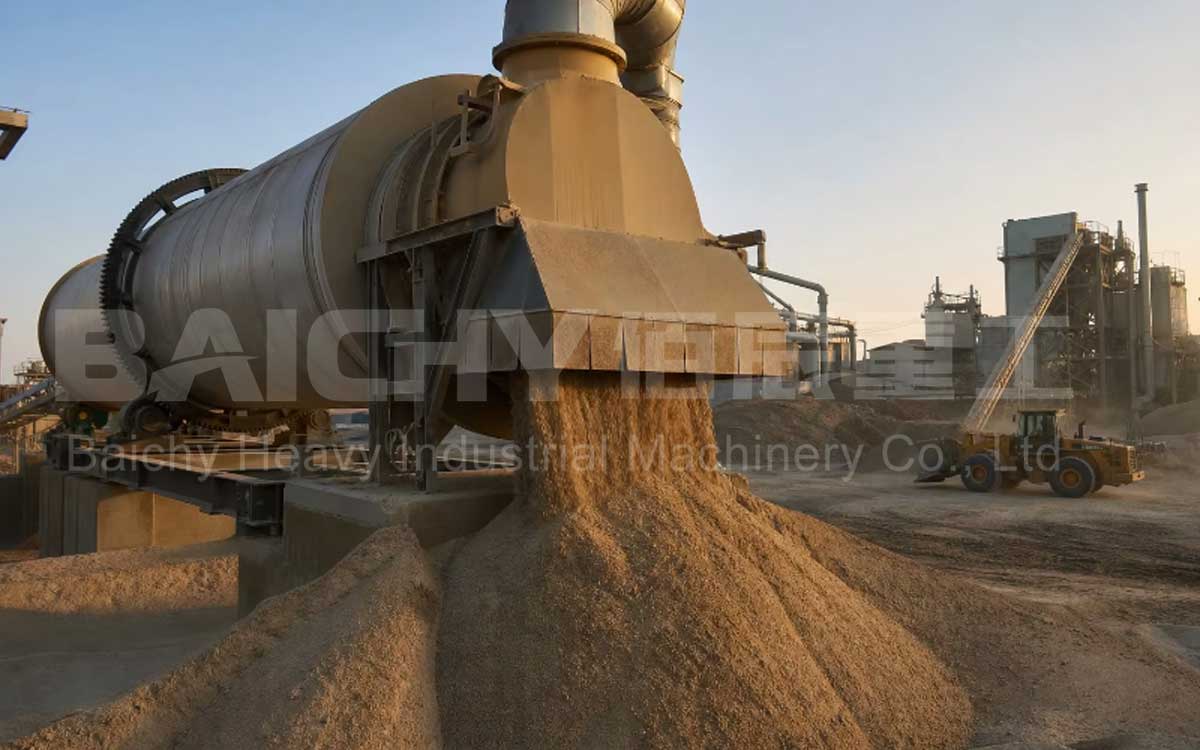
• Sand & Aggregates: River sand, sea sand, quartz sand, and foundry sand. These are the most common materials processed at a scale of 3 tons per hour.
• Ores & Slags: Iron ore powder, manganese ore powder, copper concentrate, blast furnace slag, and calcium carbide residue.
• Clay & Limestone: Used in cement plants to dry raw materials, facilitating subsequent grinding and calcination processes.
2. Energy & Coal Industry
Primarily used to enhance calorific value or to meet specific processing requirements:
• Coal-related Materials: Raw coal, coal slime, lignite, and washed coal.
• Fly Ash: Fly ash recovered from thermal power plants; once dried, it serves as an additive in cement production.
3. Environmental Protection & Waste Treatment
As environmental regulations become stricter, rotary dryers are frequently utilized for waste volume reduction:
• Sludge Drying: Municipal sewage sludge and industrial sludge (e.g., from papermaking or electroplating). Drying significantly reduces volume, facilitating subsequent landfill disposal or incineration.
• Desulfurization Gypsum: A byproduct generated during the flue gas desulfurization process at power plants; once dried, it can be manufactured into gypsum boards.
4. Agriculture, Biomass & Food Industry
Often used to process organic materials intended for recycling or reuse (care must be taken to control drying temperatures to prevent spoilage):
• Biomass Fuels: Wood chips, sawdust, and wood shavings (used for moisture control prior to pelletizing for fuel production). Agro-industrial Byproducts: Distiller's grains, vinegar residue, beet pulp, bagasse.
• Animal Manure: Chicken manure, cattle manure (processed into organic fertilizer granules after drying).
5. Chemical and Metallurgical Industries
Processing powders and granules that are not highly corrosive (or utilizing drums constructed from specialized materials):
• Chemical Raw Materials: Ammonium sulfate, calcium carbonate, certain fertilizer granules.
• Metal Powders: Magnetic powder, recycled metal scraps.
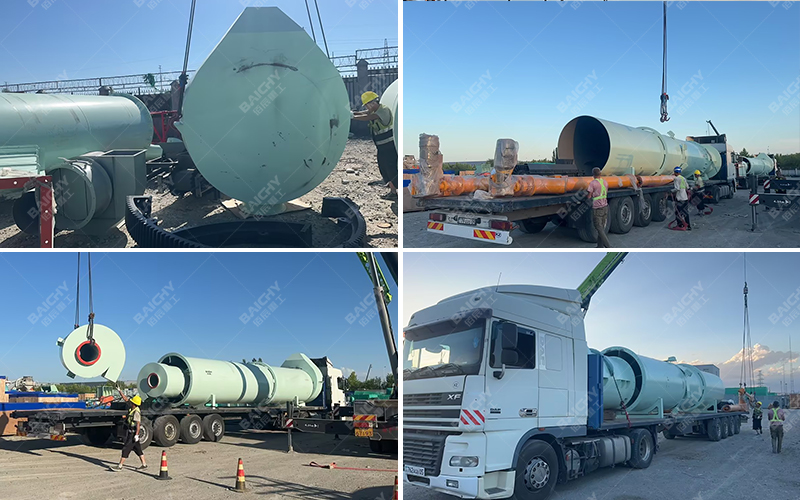
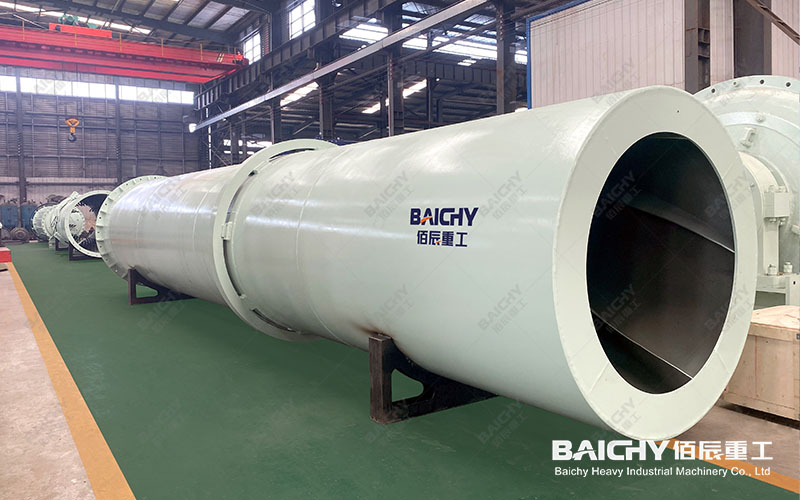
Shipping Photos of the Single-Drum Dryer
Why Choose a "Single-Drum" Dryer? (Compared to Other Dryer Types)
Compared to Triple-Drum Dryers: The single-drum features a simple internal structure that prevents clogging; it is ideal for processing materials with larger diameters, irregular shapes, or slight stickiness. While triple-drum dryers are energy-efficient, their narrow internal clearances make them highly susceptible to clogging.
Compared to Air-Stream Dryers: Rotary drum dryers possess robust processing power, capable of handling mixtures with a wide range of particle sizes—from fine powders to lumps measuring several centimeters.
Compared to Fluidized Bed Dryers: Rotary drum dryers operate with exceptional stability; even when the moisture content of the incoming feed fluctuates significantly, the machine can maintain a consistent moisture level in the output by adjusting its rotation speed and drum inclination.
Summary Recommendation:
If your material consists of sand, slag, or coal slime—i.e., high-temperature-resistant and highly abrasive granules—the single-drum rotary dryer represents the most cost-effective and rugged choice available.
Frequently Asked Questions (FAQ)
Q1: What factors influence the actual output of a 3-ton/hour single-drum dryer?
A: The "3 t/h" figure typically refers to the finished product output. Actual throughput is governed by two primary factors: First, the initial moisture content (e.g., reducing moisture from 30% to 1% is significantly more challenging than starting from 10%); and second, the material particle size. For high-density materials like sand, this dryer model operates with great stability; however, for lightweight biomass materials, the internal lifting flight structure may need to be adjusted to prevent the material from passing through the drum too rapidly.
Q2: Approximately how much does the energy consumption cost per hour to operate a 3 t/h drying system?
A: Energy consumption costs depend primarily on the specific heat source utilized. Taking the drying of sand as an example: when using natural gas, the fuel cost per ton of finished product is approximately 15–25 RMB (depending on gas prices); if biomass pellets are used instead, costs can be reduced by about 30%. Furthermore, the system's total installed power capacity is approximately 15–22 kW (including the induced draft fan), with an electricity consumption of about 12–18 kWh per hour.
Q3: Why is a single-drum dryer recommended over a triple-drum dryer for 3-ton-scale projects?
A: Although triple-drum dryers offer higher thermal efficiency, single-drum dryers possess three distinct advantages for small-to-medium-scale operations—such as a 3-ton-per-hour capacity: 1. They are clog-resistant, making them suitable for processing materials with uneven particle sizes or those that are sticky in nature; 2. They feature a simple structure, making the subsequent replacement of lifting flights or general maintenance extremely easy to perform; and 3. They entail lower manufacturing costs, resulting in a shorter return-on-investment period.