
C Series Jaw Crusher vs PE Series Jaw Crusher
Why the C Series vs PE Series Decision Shapes Your Whole Plant
Every aggregate or mineral processing line lives or dies at the primary crushing stage. Choose the wrong jaw crusher and you pay for it twice — once in lost throughput, and again in downtime and wear parts. For international buyers sourcing from China, the two most compared options are the C series jaw crusher (European-type, modular non-welded design) and the PE series jaw crusher (classic Chinese standard, welded heavy frame).
Before you compare a C series jaw crusher with a PE series jaw crusher, fix three variables first: rock hardness, target t/h, and operating hours per year. Those three numbers decide the answer far more reliably than brand or price.
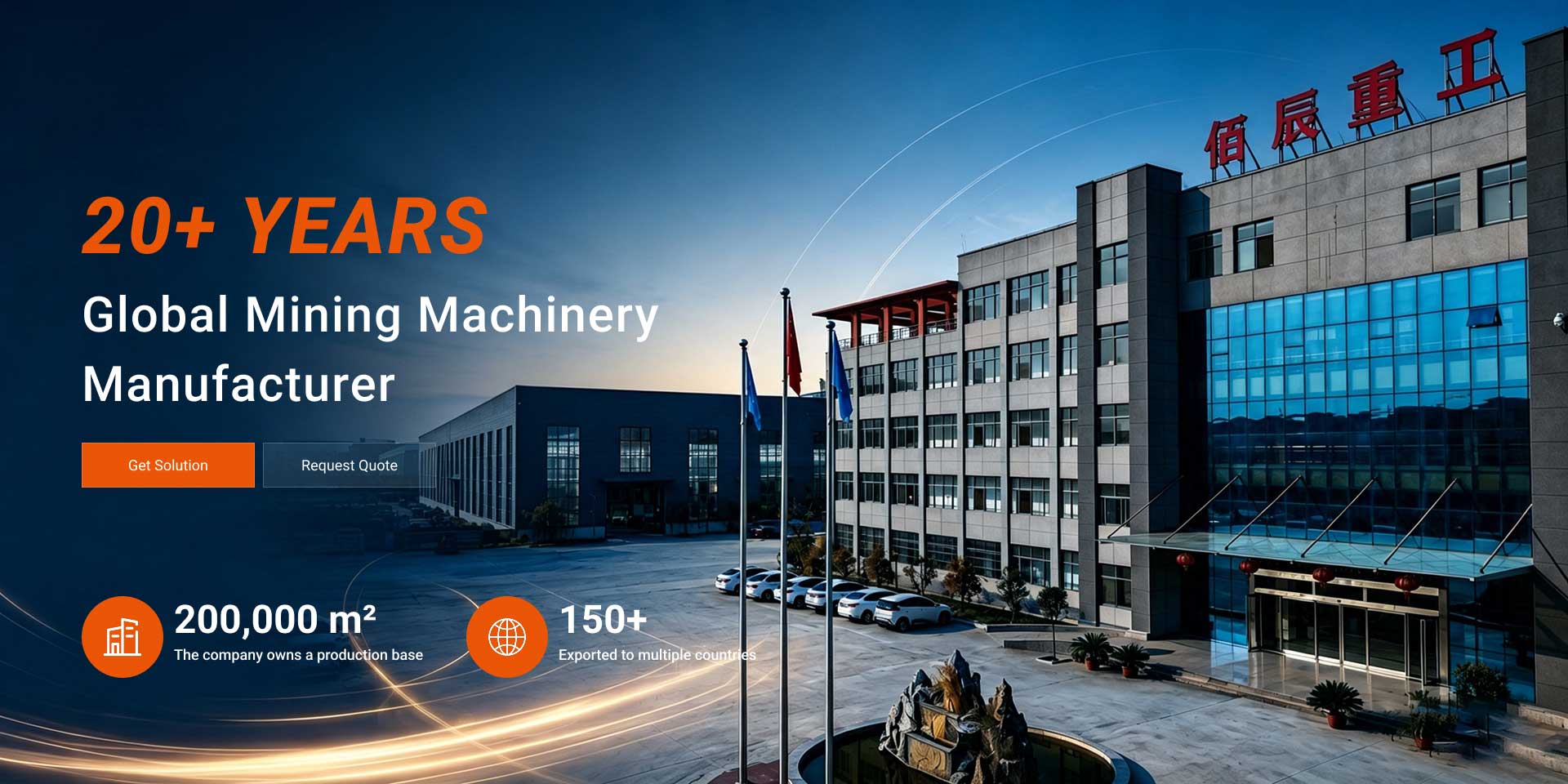
Baichy Heavy Industry, headquartered in Zhengzhou with a 200,000 m² manufacturing base in Jiaozuo, Henan, builds and exports both families to more than 80 countries. This guide breaks down the engineering differences, the real parameter data, and the total cost of ownership — so you can specify the right primary jaw crusher the first time.
What Is a PE Series Jaw Crusher?
Working principle and structural DNA
PE Series Jaw Crusher
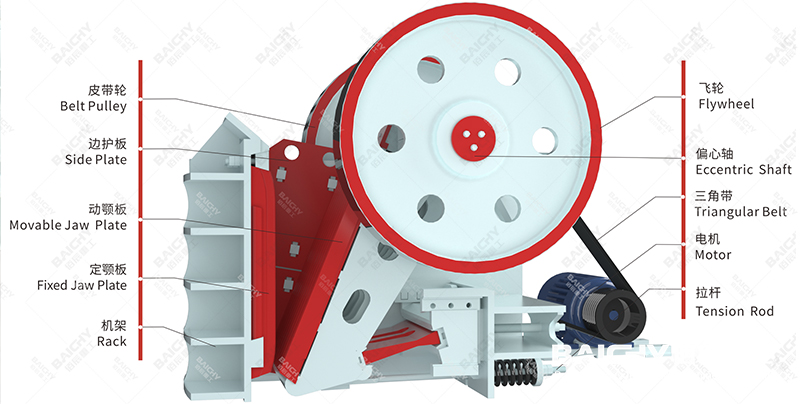
Structural diagram of the PE series jaw crusher
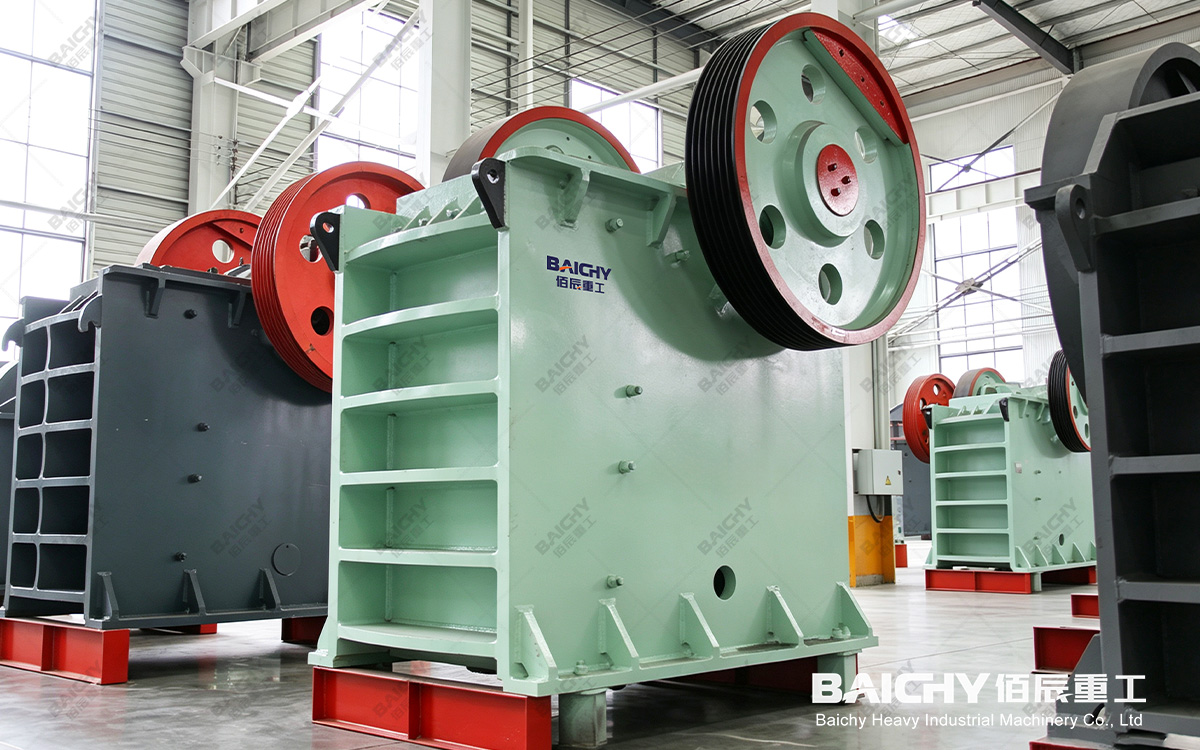
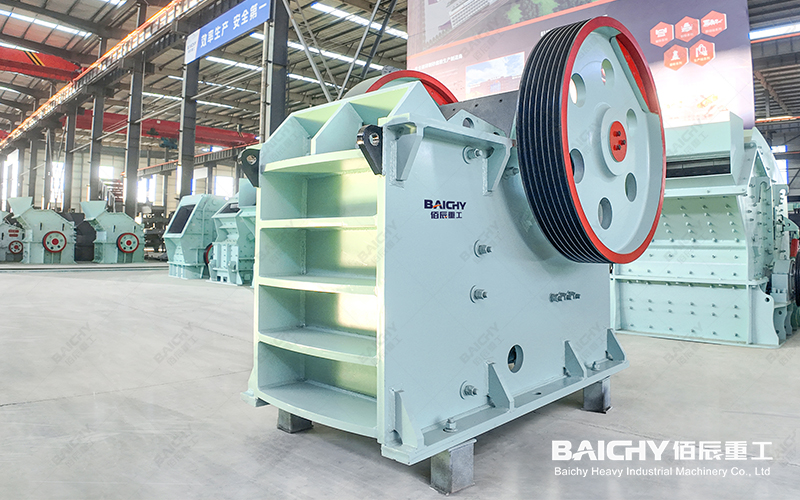
The PE series jaw crusher is a single-toggle, compound-pendulum machine. A motor drives the V-belt and eccentric shaft; the swing jaw rises, the toggle angle widens and material is compressed against the fixed jaw plate. When the swing jaw descends, the tension rod and spring pull it back and crushed rock discharges from the bottom of the cavity.
Structurally, the PE series jaw crusher uses a cast-steel welded frame, a forged 40Cr eccentric shaft, Mn18Cr2 / Mn13Cr2 high-manganese jaw plates, and a shim (gasket) discharge adjustment. It is deliberately simple — and that simplicity is its commercial advantage: any site mechanic with a grease gun and a shim pack can keep this jaw crusher running.
Where PE series wins
Lowest capital cost per ton of installed capacity.
• Simple maintenance — any site mechanic can change a shim pack or a jaw plate.
• Proven in medium-hard rock: limestone, river pebble, construction waste and weathered ores up to 320 MPa compressive strength.
• Fast delivery: standard models are usually in stock or built in 15–30 days.
Ideal for 50–500 t/h plants where budget dominates the decision and the jaw crusher may later be relocated or resold.
Baichy case reference: a 300 TPH limestone line in the Philippines runs a PE900×1200; a 200 TPH granite plant in Kenya runs a PE750×1060; a 150 TPH basalt plant in Mexico runs a PE600×900.
What Is a C Series Jaw Crusher?
Non-welded, pinned and bolted frame
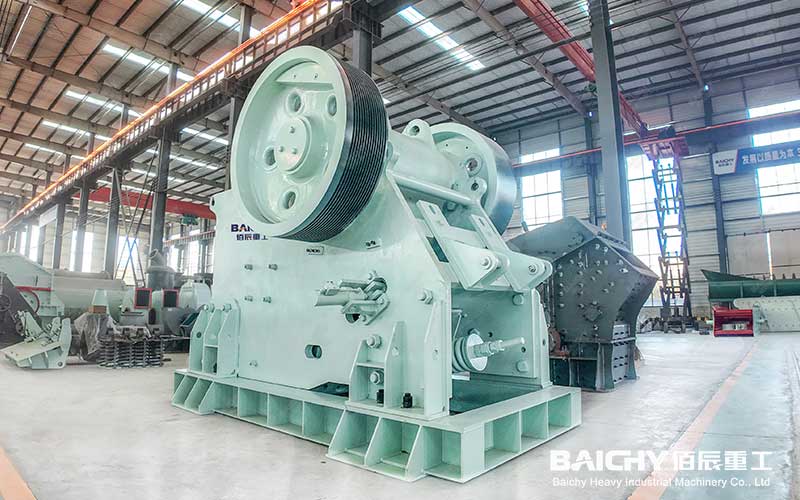
C Series Jaw Crusher
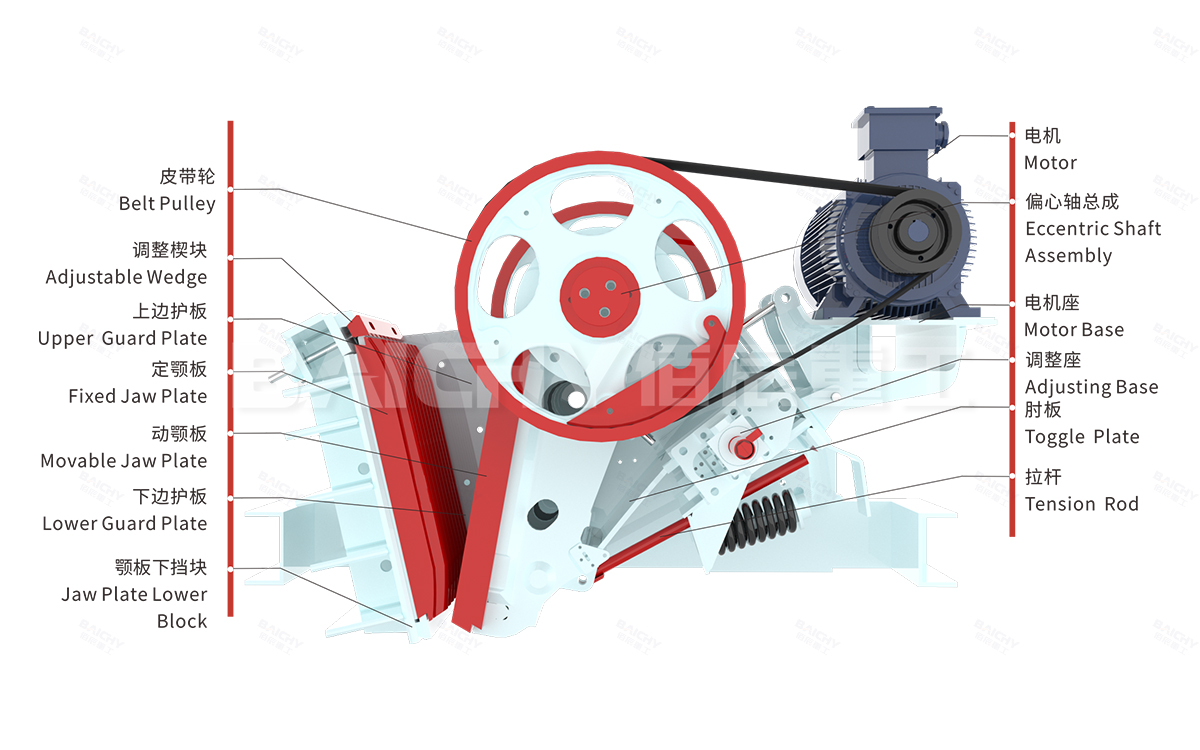
Structural diagram of the C-series jaw crusher
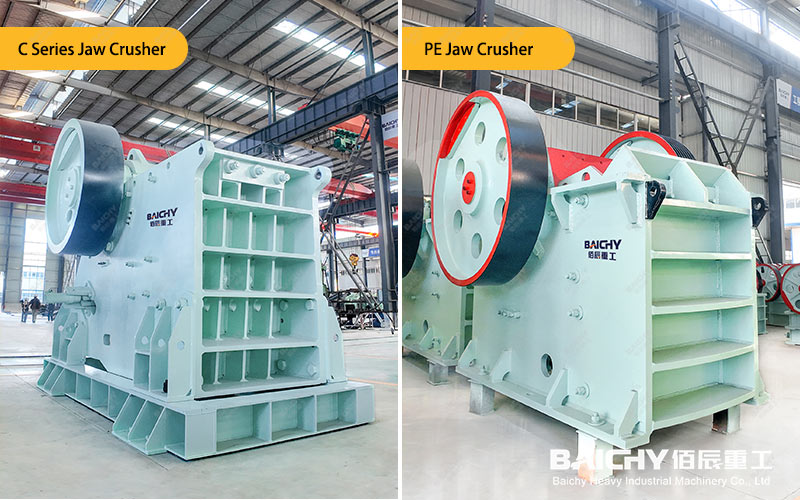
The C series jaw crusher is the European-type evolution of the same machine. Its defining feature is a pinned and bolted, non-welded frame: two hot-rolled steel side plates are bolted to a high-quality cast-steel frame with precision finishing pins. Removing weld seams removes the stress-concentration points where fatigue cracks normally start, which is why the C series is rated for continuous duty in the hardest ore bodies and for underground or mobile installation.
Steep cavity, aggressive kinematics, wedge setting
• Deep, steep V-shaped cavity with a high nip angle at the top and a long, well-aligned stroke at the bottom — the actual feed opening matches the nominal width, so material is not throttled at the mouth.
• Dual-wedge CSS adjustment (mechanical as standard, hydraulic optional) replaces shim plates; the setting can be changed while idling, in seconds.
• Oversized spherical roller bearings and a forged main shaft carry heavier loads; labyrinth seals extend bearing life.
• Centralized grease / hydraulic lubrication, optional Active Setting Control (ASC) and PLC-based automation for remote monitoring.
No anchor bolts required — support brackets and dampers absorb vibration, cutting civil works cost.
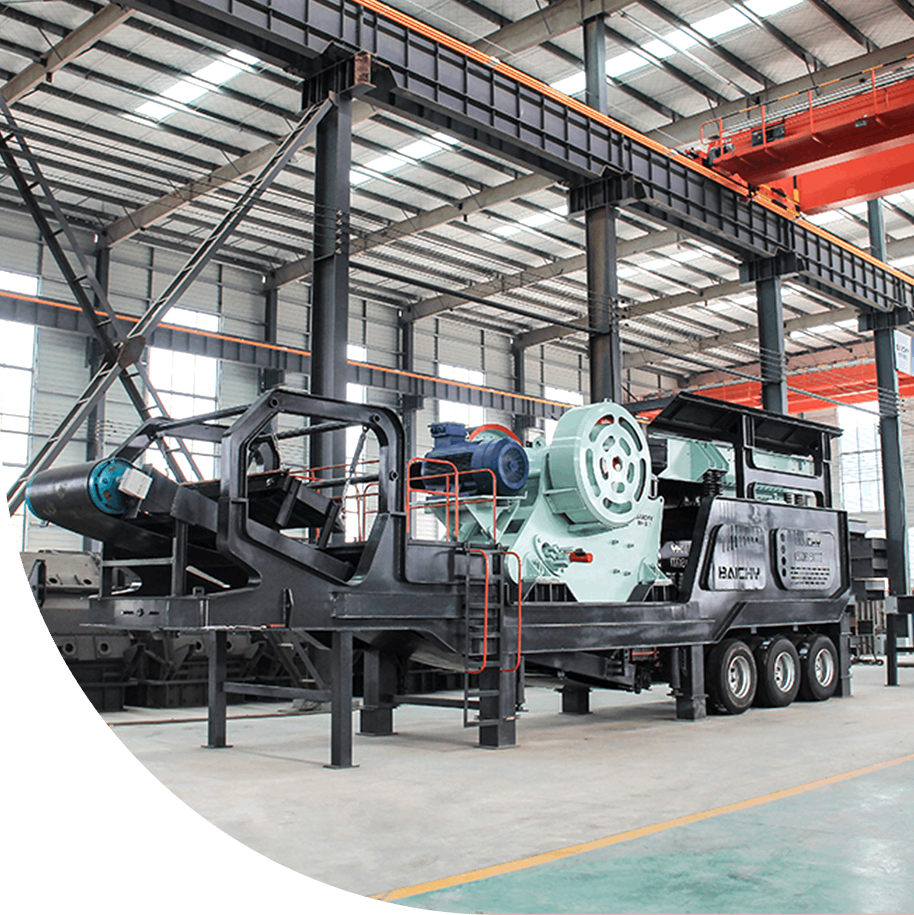
Baichy's C series jaw crusher range spans C80, C96, C106, C110, C116, C120, C125, C140, C145, C160 and C200, covering stationary plants, underground mines and compact mobile crushing stations. In short, this jaw crusher trades a higher purchase price for uptime, safety and lower cost per ton.
Six Engineering Differences That Actually Matter
1. Frame and fatigue life
| Item | PE series jaw crusher | C series jaw crusher |
|---|---|---|
| Frame | Cast-steel welded | Pinned & bolted, non-welded, modular |
| Bearing housing | Two-piece, welded to frame | One-piece cast steel, bolted fit |
| Fatigue behaviour | Stress concentration at welds | Excellent fatigue strength, FEM-verified |
| Transport | Shipped as one body | Dismantled into modules — underground & container friendly |
2. Crushing chamber
PE: a deep but semi-V cavity; good capacity, but the effective feed width of this jaw crusher is usually smaller than the nominal figure. C: a true V-shaped cavity with no dead zone, giving smoother flow, less bridging and roughly 20–30% more output at identical installed power — the main reason a C series jaw crusher out-produces a same-size PE machine.
3. Discharge setting adjustment
PE: shim adjustment — accurate, but the crusher must stop, and handling a shim pack is a two-person, dirty job. C: double-wedge, stepless, adjustable while idling, optionally hydraulic and remote.
4. Bearings, lubrication and protection
A C series jaw crusher runs larger eccentric-shaft bearings, centralized lubrication and optional hydraulic overload protection; the classic PE jaw crusher typically relies on manual greasing plus the toggle plate as its mechanical "safety fuse".
5. Automation and data
C series jaw crusher platforms accept ASC, cavity-level monitoring, power-draw trending and remote setting control. The PE series jaw crusher is mechanical, with basic overload protection — perfectly adequate if you do not run a central control room.
6. Reduction ratio and rock hardness
The PE series jaw crusher typically delivers a reduction ratio of 4–6; the C series jaw crusher reaches 6–8, making it the preferred primary jaw crusher for granite, basalt, iron ore and copper ore.
Parameter Comparison Table
C series jaw crusher — technical parameters (Baichy / industry-standard C geometry)
| Model | Feed opening (mm) | Max feed size (mm) | Capacity (t/h) | CSS range (mm) | Power (kW) | Weight (t) |
|---|---|---|---|---|---|---|
| C80 | 800 × 510 | 410 | 55–380 | 40–175 | 75 | 9.3 |
| C96 | 930 × 580 | 460 | 105–430 | 60–175 | 90 | 12.3 |
| C106 | 1,060 × 700 | 560 | 150–560 | 70–200 | 110 | 18.5 |
| C116 | 1,150 × 760 | 610 | 165–580 | 70–200 | 132 | 22.5 |
| C120 | 1,200 × 870 | 700 | 175–595 | 70–175 | 160 | 31.7 |
| C125 | 1,250 × 950 | 760 | 270–915 | 100–250 | 160 | 44.0 |
| C140 | 1,400 × 1,070 | 855 | 350–970 | 125–250 | 200 | 200 |
| C160 | 1,600 × 1,200 | 960 | 430–1,260 | 150–300 | 250 | 87.3 |
| C200 | 2,000 × 1,500 | 1,200 | 630–1,575 | 175–300 | 400 | 147.0 |
PE series jaw crusher — technical parameters (Baichy standard range)
| Model | Feed opening (mm) | Max feed size (mm) | Capacity (t/h) | Discharge range (mm) | Power (kW) | Weight (t) |
|---|---|---|---|---|---|---|
| PE400×600 | 400 × 600 | 340 | 16–65 | 40–100 | 30 | 6.5 |
| PE500×750 | 500 × 750 | 425 | 45–100 | 50–100 | 55 | 10.3 |
| PE600×900 | 600 × 900 | 500 | 60–140 | 65–160 | 75 | 16.5 |
| PE750×1060 | 750 × 1,060 | 630 | 110–250 | 80–180 | 110 | 28.0 |
| PE900×1200 | 900 × 1,200 | 750 | 200–400 | 100–220 | 132 | 48.5 |
| PE1000×1200 | 1,000 × 1,200 | 850 | 280–500 | 195–265 | 132–160 | 51.0 |
| PE1200×1500 | 1,200 × 1,500 | 1,020 | 400–800 | 150–300 | 220 | 100.9 |
| PE1500×1800 | 1,500 × 1,800 | 1,200 | 520–1,100 | 210–360 | 280–355 | — |
Capacities are based on material of ~2.7 t/m³ bulk density with prescreened feed; actual jaw crusher throughput varies with gradation, moisture, clay content and feed method.
Cost, Energy and Payback
| Factor | PE series jaw crusher | C series jaw crusher |
|---|---|---|
| Purchase price | Baseline | +20% to +40% |
| Foundation / civil work | Concrete foundation + anchor bolts | Minimal; often no anchor bolts |
| Energy per ton | Baseline | 10–15% lower |
| Wear-part life | Baseline | 25–50% longer on Mn18Cr2 liners |
| Setting change | 1–2 h shutdown | Minutes, often no shutdown |
| Best payback horizon | Under 2 years, or short-term projects | 3–10 years continuous operation |
Rule of thumb from Baichy project data: if your plant runs more than 3,000 hours per year on hard, abrasive rock, the C series jaw crusher normally recovers its price premium in 12–24 months through throughput, energy and liner savings. Below that duty, the PE series jaw crusher is the more rational buy. Whichever jaw crusher you shortlist, budget a further 15–25% of machine price for freight, foundation and electrical work.
How to Choose: A Practical Decision Checklist
Choose the PE series jaw crusher if:
• Budget is the binding constraint;
• Capacity requirement is 15–500 t/h;
• Material is limestone, river stone, construction waste or medium-hard ore;
• The site has limited instrumentation and prefers mechanical simplicity.
Choose the C series jaw crusher if:
• Feed is granite, basalt, iron ore or copper ore above 200 MPa;
• You need 500 t/h+ from a single machine, or a high reduction ratio to protect downstream cone crushers;
• The crusher is underground, on a mobile chassis, or must be relocated;
• You track OEE and want remote CSS control, power monitoring and predictive maintenance.
Whichever jaw crusher you select, size the vibrating feeder roughly 20% above crusher capacity and keep the feed opening loaded — a starved jaw crusher wears unevenly and loses up to 15% of rated throughput.
Why Buy from Baichy Heavy Industry
• Material science: Mn18Cr2 high-manganese jaw plates, 40Cr forged eccentric shafts (runout ≤ 0.03 mm), QT500-7 ductile-iron toggle plates as a calibrated safety fuse.
• Global power adaptation: 50 Hz / 60 Hz, 380–440 V, with optional diesel-generator drive for off-grid African and Southeast Asian sites.
• Configurability: jaw plate profile (corrugated, toothed, straight), manual shim or hydraulic CSS, motor brand, feed hopper, dust suppression.
• Turnkey scope: primary jaw crusher plus feeder, screen, cone crusher, ball mill, MTW Raymond mill and complete mineral processing lines.
• Response time: technical proposal and jaw crusher quotation within 24 hours of receiving material type, feed size and target t/h.
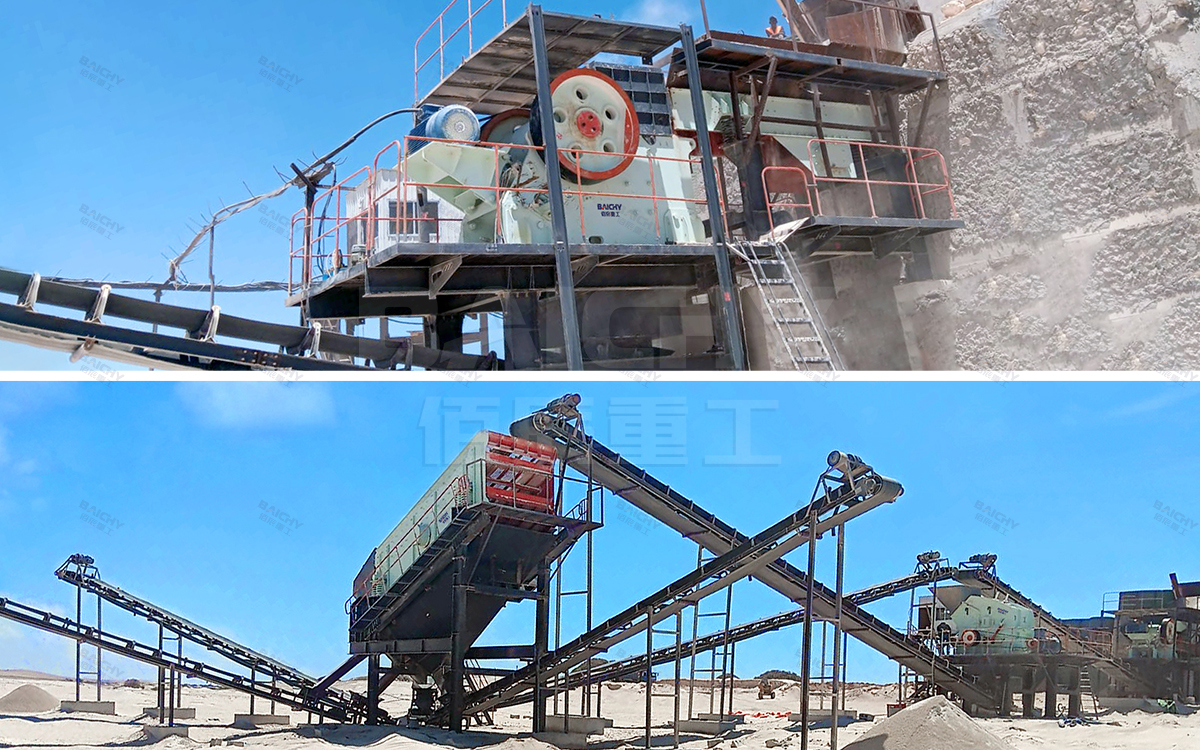
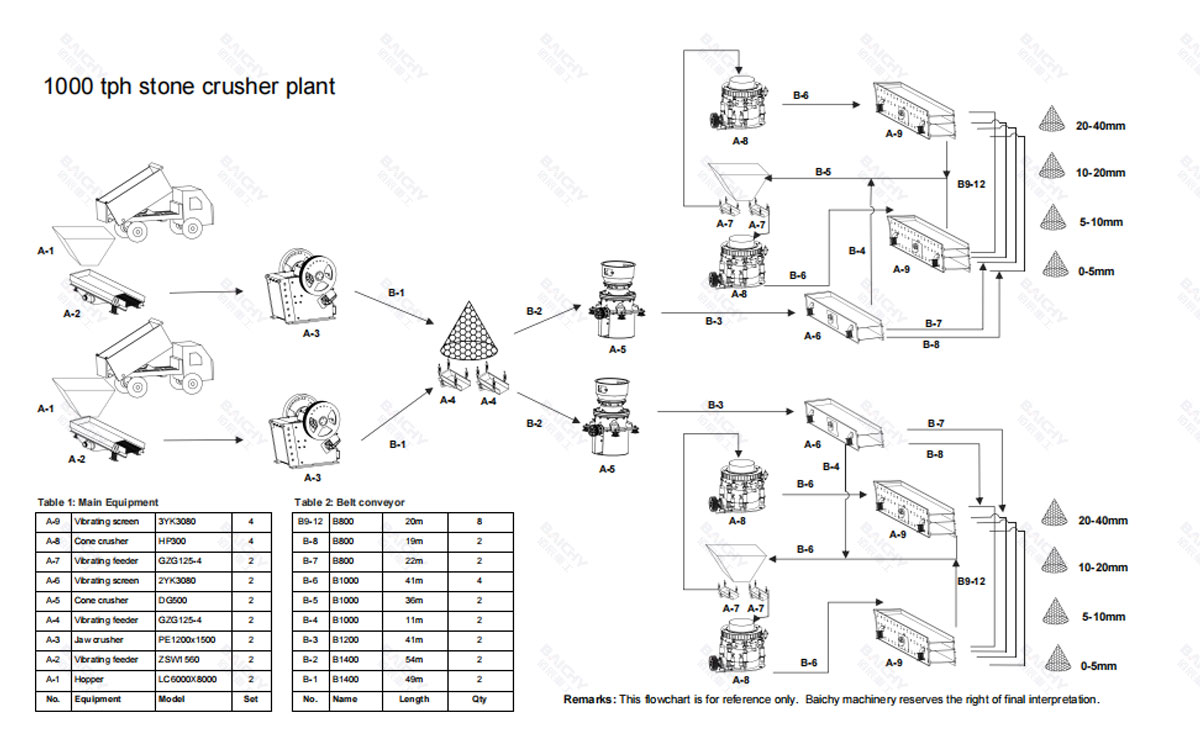
150 tph limestone crushing production line
Frequently Asked Questions (FAQ)
1. Is the C series jaw crusher worth the extra 20–40% investment?
Yes, if you run hard rock at high utilization. The premium buys a non-welded frame, wedge CSS adjustment, larger bearings and 10–15% lower kWh per ton. On granite or basalt above 3,000 operating hours per year, most Baichy customers recover the difference within 12–24 months.
2. Which jaw crusher suits limestone or construction waste recycling?
The PE series jaw crusher. Limestone is soft and non-abrasive, so the higher reduction ratio of the C series jaw crusher is rarely needed, and the lower capital cost improves project IRR. Hydraulic CSS and dust suppression can be added to a PE jaw crusher for recycling duty.
3. Can a C series jaw crusher be installed without anchor bolts?
Yes. Its pinned and bolted frame plus support brackets and vibration dampers allow the jaw crusher to sit on a simple steel skid or flat slab — a decisive advantage for underground mines, mobile plants and sites where concrete work is expensive.
4. How often should jaw plates be replaced?
It depends on abrasiveness. For basalt and other hard volcanic rock, expect 3–6 months; for limestone, 8–12 months. Baichy supplies Mn18Cr2 liners and recommends rotating plates end-for-end to use the full wear profile.
5. Do Baichy jaw crushers support overseas voltage and frequency standards?
Yes. Every Baichy jaw crusher is supplied for 50 Hz and 60 Hz grids at 380–440 V, with high-temperature cooling packages for African and Southeast Asian sites and optional diesel-generator drive where grid power is unavailable.
Baichy Heavy Industry
Baichy Heavy Industry is a high-tech mining equipment company integrating R&D, manufacturing, sales, and after-sales service. Focusing on crushing, grinding, and mineral processing equipment, we provide professional solutions to our customers. We are ISO9001:2015 、certified, and our products include mobile crushing palnts, crawler crushing plant, construction waste crushing plants, jaw crushers, sand making machines, cone crushers, fine crushers, grinding mills, ball mills, etc., all with reliable performance to meet diverse project needs.
Baichy Heavy Industry – Your Trusted Partner
To ensure optimal performance of your equipment, Baichy Heavy Industry offers:
- Professional on-site installation guidance
- Comprehensive operator training
- 24/7 technical support & maintenance services
Our complete after-sales service system guarantees long-term, stable operation of your machinery with minimal downtime.
Protect Your Rights – Only Use Official Channels
To avoid scams and ensure authentic support, contact us exclusively through:
• Official Website: www.baichychina.com
• WhatsApp: +8615093222637
• Email: [email protected]
Your satisfaction is our priority – expect prompt, professional service every time.
(Note: Beware of unauthorized third parties claiming to represent Baichy. Always verify through official contacts.)